Wake-up Call

Scripture Focus: Matthew 25.44-46
44 “They also will answer, ‘Lord, when did we see you hungry or thirsty or a stranger or needing clothes or sick or in prison, and did not help you?’
45 “He will reply, ‘Truly I tell you, whatever you did not do for one of the least of these, you did not do for me.’
46 “Then they will go away to eternal punishment, but the righteous to eternal life.”

Jeremiah 11.11-14
11 Therefore this is what the Lord says: ‘I will bring on them a disaster they cannot escape. Although they cry out to me, I will not listen to them. 12 The towns of Judah and the people of Jerusalem will go and cry out to the gods to whom they burn incense, but they will not help them at all when disaster strikes. 13 You, Judah, have as many gods as you have towns; and the altars you have set up to burn incense to that shameful god Baal are as many as the streets of Jerusalem.’
14 “Do not pray for this people or offer any plea or petition for them, because I will not listen when they call to me in the time of their distress.

Reflection: Wake-up Call
By John Tillman

The three stories of Matthew 25 are connected, presented in series with an intentional theme. Last January we wrote:

Matthew 25 is famous for the sheep and the goats parable. But really, the entire chapter is about people who shirked their responsibilities to themselves, to their master, and to others. The foolish virgins, the wicked servant, and the goats are a trinity of spiritual neglect.

The sin of neglect seems to be one that surprises each of the condemned groups and individuals in these stories. Pray that you may not be surprised.

During seminary days, while traveling on a ministry team on a long drive, someone suggested putting on a Keith Green album. The driver, a good friend, responded, “Oh good. I haven’t doubted my salvation in a while. Put it in.”

We all laughed but I will never forget it. Because, the truth was, and is, that we don’t often listen to music that challenges us. We tune in for encouragement.  We don’t often listen to sermons that challenge us. We tune out words of conviction.

This is bad news for us because when we tune out the voices correcting us for long enough, God lets us tune out. He allows us to develop spiritual cataracts and tunnel vision. He allows us to blow out our eardrums so that we can’t hear him anymore.

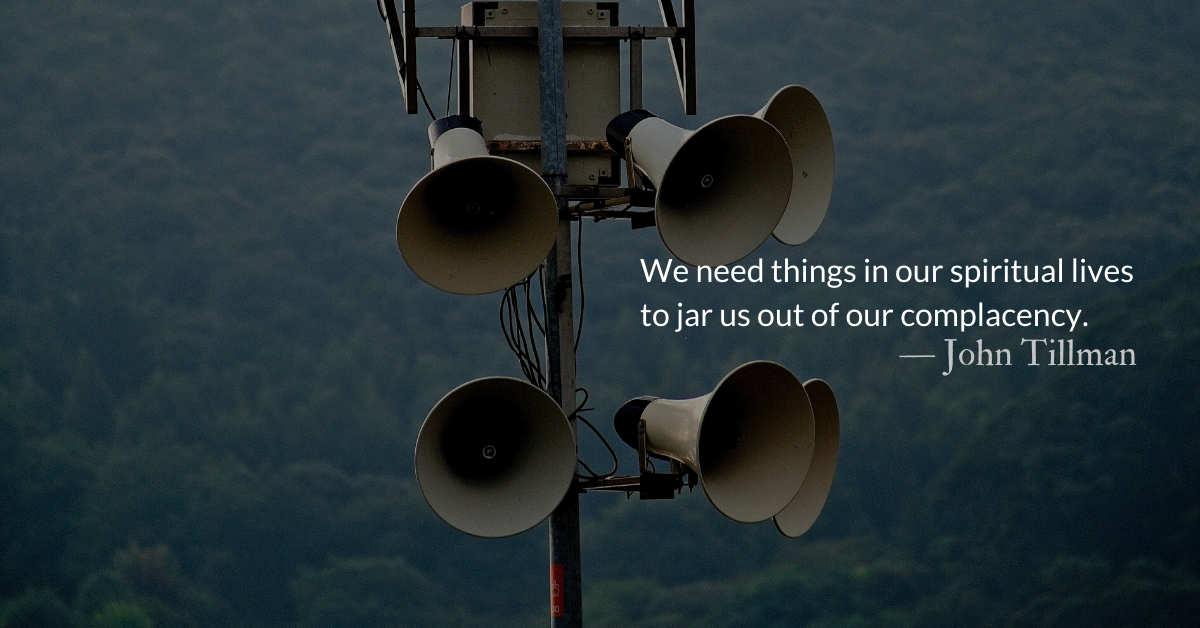
We need things in our spiritual lives to jar us out of our complacency and cause us to reevaluate our dedication to Christ. We need a wake-up call.

From the careless virgins buzzes an alarm: Take initiative! Don’t be passive about personal spiritual disciplines!
From the slothful servant rings a reveille trumpet: Be invested! Give your all to what providence invests in you!
From the goats, a clamorous claxon resounds: Serve Others! Serve the poor! Serve the hungry! Serve the outcast!
And from Jeremiah, we see the outcome of ignoring God’s calls—God will block our calls. “…I will not listen when they call to me in the time of their distress.”

Don’t push “snooze” on the alarms sounding in these passages. Their intention is not to terrify us, but to guide us to action. His desire is for no one to perish, so open your eyes, open your ears. Attend to your spiritual responsibilities to yourself, to Christ, our master, and to those around you.

Music: The Sheep and the Goats (Live Performance) — Keith Green

Divine Hours Prayer: A Reading
Jesus taught us, saying: “Take the fig tree as a parable: as soon as its twigs grow supple and its leaves come out, you know that summer is near. So with you when you see these things happening: know that he is near, right at the gates. In truth I tell you solemnly, before this generation has passed away all these things will have taken place. Sky and earth will pass away, but my words will not pass away. But as for that day or hour, nobody knows it, neither the angels of heaven, nor the Son; no one but the Father.”

– Divine Hours prayers from The Divine Hours: Prayers for Summertime by Phyllis Tickle

Today’s Readings
Jeremiah 11 (Listen – 4:09) 
Matthew 25 (Listen – 6:04)

Readers Choice is your time to share favorite Park Forum posts from the year. What post did you share with a friend?

https://forms.gle/DsYWbj45y9fCDLzi7

Read more about A Trinity of Neglect
The foolish virgins, the wicked servant, and the goats are a trinity of spiritual neglect.

Cherishing Chaff

Scripture Focus: Matthew 24.1-2
1 Jesus left the temple and was walking away when his disciples came up to him to call his attention to its buildings. 2 “Do you see all these things?” he asked. “Truly I tell you, not one stone here will be left on another; every one will be thrown down.”

Jeremiah 10.19-21
19 Woe to me because of my injury!
    My wound is incurable!
Yet I said to myself,
    “This is my sickness, and I must endure it.”
20 My tent is destroyed;
    all its ropes are snapped.
My children are gone from me and are no more;
    no one is left now to pitch my tent
    or to set up my shelter.
21 The shepherds are senseless
    and do not inquire of the Lord;
so they do not prosper
    and all their flock is scattered.

Reflection: Cherishing Chaff
By John Tillman

Some buildings are great by age and grandeur and some by the gleam and glisten of modern glass and steel. However, no matter how impressive a building is when you walk, ride, or drive by it regularly, it becomes just a part of the scenery. 

How impressive does a building have to be for you to still comment on it as you pass by, years later? Why would the disciples call Jesus’ attention to the impressive buildings of the Temple that both he and they had been worshiping in their entire lives?

The Temple had been standing for 500 years and had been extensively renovated and repaired by Herod during the disciple’s lifetimes. Perhaps the disciples were happy to see some scaffolding come down on an area that had been newly restored. 

But the Temple’s shiny new sheen couldn’t distract Jesus’ eyes from the self-righteous deceit within and the suffering he saw over the horizon. The disciples saw the Temple as grand, renewed, and a symbol of strength and status. Jesus saw its present and future, sinful, destroyed, and humiliated.

Herod was a ruler of nominal faith at best. (Even that is being extraordinarily generous.) Herod was corrupt, a womanizer, boastful, and lived in a sinful relationship. He “liked to listen” to John the Baptist, but that didn’t stop him from cutting off the prophet’s head. 

Herod’s work on the Temple wasn’t faith-driven. It was a political tactic to boost his status and generate support among the people—and it worked. Even the disciples of Jesus were impressed.

The Temple, and Herod, are just two examples of things unworthy of the esteem and attention the disciples gave them. Many things the disciples prized, Jesus recognized as poison. Many things they cherished Jesus called chaff in the wind. 

What catches our eyes? What chaff do we cherish or poison do we prize? A building? A politician? A charismatic leader? An institution? Point out to Jesus what catches your eye. Seek his opinion on whether you should hold it up for honor or whether it is destined to be thrown down.

Physical idols, whether statues, buildings, institutions, or living humans, are the product of inward sin. We worship them instead of God because inwardly we refuse to trust God or we have denounced God. Allow the revelation of outward idols to lead you to discover inward attitudes that must be torn down.

Divine Hours Prayer: The Small Verse
My soul has a desire and longing for the courts of the Lord; my heart and my flesh rejoice in the living God. — Psalm 84.1

– Divine Hours prayers from The Divine Hours: Prayers for Summertime by Phyllis Tickle

Today’s Readings
Jeremiah 10 (Listen – 3:51) 
Matthew 24 (Listen – 5:59)

Readers’ Choice is your time to share favorite Park Forum posts from the year.

What post helped you with loss?
https://forms.gle/DsYWbj45y9fCDLzi7

Read more about Treasuring Our Temples
Judah treasured the Temple’s importance but not its inhabitant. They treasured the regalia, not the relationship.

Praying Through Weeping—Guided Prayer

Scripture Focus: Jeremiah 9.17-18
This is what the Lord Almighty says:
“Consider now! Call for the wailing women to come;
send for the most skillful of them.
Let them come quickly
and wail over us
till our eyes overflow with tears
and water streams from our eyelids.

Reflection: Praying Through Weeping—Guided Prayer
By John Tillman

If prayer is relationship then when God weeps, we should join. What friend would weep, whom we would not join in weeping? Weeping for our own hurts and harms is one thing. Weeping for what grieves God is a prophetic task and a work of faith.

Weep in prayer with the weeping prophet. Jeremiah’s tears, just like his words, are not his own. They are as much a part of the revelation of God as the words he writes.

Oh, that my head were a spring of water
and my eyes a fountain of tears!
I would weep day and night
for the slain of my people. — Jeremiah 9.1

Jeremiah expresses our desire to escape evil—fleeing to the desert to be away from wrongdoers.

Oh, that I had in the desert
a lodging place for travelers,
so that I might leave my people
and go away from them;
for they are all adulterers,
a crowd of unfaithful people. — Jeremiah 9.2

We confess we are part of a culture that seeks out its own version of truth.
We confess that we live in echo-chambers of the lies we prefer rather than the truth. Any lie or obfuscation is acceptable as long as it can be weaponized to help us win.

“They make ready their tongue
like a bow, to shoot lies;
it is not by truth
that they triumph in the land.
They go from one sin to another;
they do not acknowledge me,”
declares the Lord. — Jeremiah 9.3

Weep with Christ prophetically. He weeps that our hypocrisy not only harms us, but blocks the path of redemption for others.

“Woe to you, teachers of the law and Pharisees, you hypocrites! You shut the door of the kingdom of heaven in people’s faces. You yourselves do not enter, nor will you let those enter who are trying to. — Matthew 23.13

“And so upon you will come all the righteous blood that has been shed on earth, from the blood of righteous Abel to the blood of Zechariah son of Berekiah, whom you murdered between the temple and the altar. Truly I tell you, all this will come on this generation.” — Matthew 23.35-36

More specifically, judgment would fall within the next week. And more personally, it would fall on Christ himself.

Christ can weep with us and wipe away our tears because he took the just payment for their cause.

Divine Hours Prayer:
Open my lips, O Lord, and my mouth shall proclaim your praise.
Had you desired it, I would have offered sacrifice, but you take not delight in burnt-offerings.
The sacrifice of God is a troubled spirit; and a broken and contrite heart, O God, you will not despise. — Psalm 51.16-18

– Divine Hours prayers from The Divine Hours: Prayers for Summertime by Phyllis Tickle

Today’s Readings
Jeremiah 9 (Listen – 4:38) 
Matthew 23 (Listen – 4:53)

Read more about Undignified Weeping and Dancing
Hannah carried the weight of her grief to God’s presence and broke open her heart with shameless weeping.

#ReadersChoice is time for you to share favorite Park Forum posts from the year.

What post helped you pray more passionately?https://forms.gle/DsYWbj45y9fCDLzi7

Blood Spilled

Scripture Focus: Jeremiah 2.34-35
34 On your clothes is found
    the lifeblood of the innocent poor,
    though you did not catch them breaking in.
Yet in spite of all this
35     you say, ‘I am innocent;
    he is not angry with me.’
But I will pass judgment on you
    because you say, ‘I have not sinned.’

Reflection: Blood Spilled
By John Tillman

God made us from the earth. This may be why it is so often noted that the spilled blood of humans “cries” to God from the ground. When the Maker senses his creation unmade, his wrath is justifiably stirred.

Abel’s blood, spilled in an act of jealousy, and revenge, was the first liquid cry in God’s ears but, unfortunately, humanity was not done spilling blood. We spill blood constantly and for many reasons. We spill blood in direct and indirect ways.

One specific way that we spill blood is exactly as Jeremiah describes. We spill blood when we allow the poor to be convicted of crimes without proper evidence and we take their “lifeblood” in execution or by imprisoning them for life. 

We spill blood when we participate in an economy that cheapens our goods by cheapening the lives of workers who put their health and lives in danger in the mines, factories, or sweatshops that produce our goods.

We spill blood when we do not hold those who administer justice accountable for deadly errors or abuses.

We are collectively guilty of spilling blood. As Jeremiah says, the blood of innocents is on our very clothing.

We need the Holy Spirit to confront us with the enormity of injustice around us and to stop saying, “I am innocent. I have not sinned.” Only when we drop our pointless excuses and confess that our clothes are stained with blood and our lips and hands are unclean before God, can we be forgiven and restored.

We can be forgiven of innocent blood we have shed because there is another whose innocent blood cries to God from the ground—Jesus. All the innocent blood we have spilled, from “the blood of righteous Abel” to the blood of the latest innocent to be spilled in today’s news headlines, is answered for by the blood of Jesus. We have spilled the blood of many innocents, but Jesus is The Innocent who spilled his own blood for us. 

His blood cries out not judgment but forgiveness. His blood cries out not curses but blessings. His blood cries out “it is finished.”

When we confess our need for clean hearts, hands, lips, and new garments, Christ clothes us with his righteousness that we may stand and walk in justice.

Divine Hours Prayer: The Refrain for the Morning Lessons
“Because the needy are oppressed, and the poor cry out in misery, I will rise up,” says the Lord, “And give them the help they long for.” — Psalm 12.5

– Divine Hours prayers from The Divine Hours: Prayers for Summertime by Phyllis Tickle

Today’s Readings
Jeremiah 2 (Listen – 5:54) 
Matthew 16 (Listen – 3:43)

Read more about Philemon’s Speck and Our Log
Our existence is supported by the labor of people who directly or indirectly serve us, just as Onesimus served Philemon.

Read more about Blind to Injustice, Deaf to Oppression
Our nations need your forgiveness. We bow deeply before you. We have betrayed you Lord and done evil before you.

The Losers Who Write History

Jeremiah 26.16-19 (quoting Micah 3.12)
Then the officials and all the people said to the priests and the prophets, “This man should not be sentenced to death! He has spoken to us in the name of the Lord our God.”

Some of the elders of the land stepped forward and said to the entire assembly of people, “Micah of Moresheth prophesied in the days of Hezekiah king of Judah. He told all the people of Judah, ‘This is what the Lord Almighty says:

“‘Zion will be plowed like a field,
Jerusalem will become a heap of rubble,
the temple hill a mound overgrown with thickets.’

“Did Hezekiah king of Judah or anyone else in Judah put him to death? Did not Hezekiah fear the Lord and seek his favor? And did not the Lord relent, so that he did not bring the disaster he pronounced against them? We are about to bring a terrible disaster on ourselves!”

Reflection: The Losers Who Write History
By John Tillman

In our passage today we read a prophecy from Micah that was quoted as precedent in defense of the prophet Jeremiah at least 80 years later.

Micah prophesied during the time of Hezekiah, one of the few kings of Judah who obeyed God and lived righteously. Yet even under a “good” king Micah spoke of the leaders of Judah when he said, “Therefore because of you, Zion will be plowed like a field, Jerusalem will become a heap of rubble, the temple hill a mound overgrown with thickets.”

Micah, it seems, lived in a time when dissent was not considered unpatriotic disloyalty. Hezekiah, listened, repented, and the prophesied disaster was, seemingly, averted. In reality it was only delayed, like Hezekiah’s prophesied death.

Jeremiah, by contrast, lived during the last gasps of a failing kingdom, amidst an evil generation and a corrupt government. There were still some who stood up to prevent the silencing of dissenting voices. But eventually, Jeremiah was killed in exile for his continued “unpatriotic” messages.

It has been said that winners write history books, but in the case of the Bible, that is decidedly not true. Scripture, especially when it comes to the prophets, passes the microphone to the losers of history.

There were prophets other than the ones in the canon of scripture. Micah mentions them in his writing. They sided with powerful kings, predicted good things to get a financial benefit, and spread the king’s vision of the country’s future instead of God’s.

From the standpoint of the time, these powerful, wealthy prophets were the winners. Yet, not one of those glowingly positive, king-praising prophets’ writings are in our Bible. Instead we have the writings of the losers. The cries of the oppressed. The letters from those imprisoned in the Concord jails, and Birmingham jails of Judah and Israel and often letters from those killed.

The same Jesus who wept over “Jerusalem, who kills the prophets” was also not afraid to utilize biting sarcasm on the topic, saying, “surely no prophet can die outside Jerusalem!”

Jesus also condemned the religious leaders who decorated the prophet’s tombs. He recognized that when we venerate prophets, we are often just venerating ourselves by proxy—envisioning ourselves in their role.

May we learn to listen to “losers” and learn what God may say through them.
May we learn to recognize ourselves as the audience of the prophets, not the prophets themselves.
May we learn from dissenting voices, testing every “prophecy” against scripture

Prayer: The Refrain for the Morning Lessons
I will bear witness that the Lord is righteous; I will praise the Name of the Lord Most High  — Psalm 7:18

– Prayer from The Divine Hours: Prayers for Autumn and Wintertime by Phyllis Tickle.

Prayers from The Divine Hours available online and in print.

Today’s Readings
Micah 3 (Listen – 1:51)
Luke 12 (Listen – 7:42)

Additional Reading
Read More about How to Read Prophetic Judgment :: Readers’ Choice
The best way to read prophecy is to imagine yourself not as the speaker, but as the spoken to.

Read More about Decorating the Tombs of the Prophets
The most difficult thing about following a risen and reigning prophet, priest, and king, is that he will not leave us alone. He will keep bugging us.

Support our Work
Each month over 22,000 Park Forum email devotionals are read around the world. Support our readers with a monthly or a one time donation. 

Show Buttons
Hide Buttons
Spur a spiritual rhythm of refreshment right in your inbox
By joining this email list you are giving us permission to send you devotional emails each weekday and to communicate occasionally regarding other aspects of the ministry.
100% Privacy. We don't spam.