Anticipating His Advent

From John:
As we move into the season of Advent (the first Sunday of Advent is this weekend) we prepare our hearts with this devotional from our latest guest writer, Dena Dyer. You can connect with Dena and find out more about her writing at her Facebook page. Dena also has a prayer journal available for Christmas, called The Colors of Christmas—a prayer journal.

Reflection: Anticipating His Advent
By Dena Dyer

The people of Israel had not heard from their prophets in over 400 years. In the midst of cruel taxation laws and heavy religious burdens, the long-awaited Messiah became a distant hope, a flicker of promise almost extinguished by doubt and fatigue.

Then a star appeared over a smelly manger in Bethlehem, and rumors began to surface about a child-king who’d been born to a poor man from Nazareth and his young bride. Angels sang to sweaty shepherds, who bowed in worship at a trough housing a promise kept. Some Jews—such as Anna, Simeon, and Elizabeth–worshipped; others stayed mired in confusion.

Thirty long years passed before Jesus began his public ministry. He healed the infirm, emptied graves, and forgave sins. And still, doubts persisted. After a very public trial, crucifixion, and resurrection, thousands of skeptics believed.

Even so, many people still await the Messiah.

Because we as humans are temporal beings in an ever-decaying world, we have a hard time waiting. We have an even more difficult time believing in promises.

My youngest son has prayed like this for years: “God, I hope that Dad has a good day at work. I hope I can go to Morgan’s this weekend. I hope Uncle Marty’s cancer gets better.”

I wondered whether I should correct him when he said “hope,” because I was only familiar with the Webster’s Dictionary definition: “to want something to happen or be true and think that it could happen or be true.”

Then I learned the biblical definition of hope. In the Old Testament, hope is often translated from the Hebrew word yachal meaning “trust.” In the New Testament, the word hope is used for elpis, which can be translated “to expect or anticipate with pleasure.”

Therefore, hope–in the biblical sense–equals trust and faith. Paul wrote in Romans 8:24-25, “In this hope we were saved. Now hope that is seen is not hope. For who hopes for what he sees? But if we hope for what we do not see, we wait for it with patience.”

As our world groans from injustice, terrorism, and catastrophe; as we slog through financial and familial stress, job changes, and health crises; as our children face temptations we could have never imagined—let’s not forget that we trust in what we do not see.

Let’s wait for Jesus with patience, encouraging one another to expect and anticipate with pleasure his second Advent, when he will set all things right.

Let’s wait in peace.

Do you find waiting difficult? Why or why not?
Have you ever lost hope in a certain situation?
Has God given you scripture or people to encourage you to expect and anticipate the fulfillment of God’s promises? Spend some time thanking him.

PRAYER:
My spirit grows weak at the thought of my children inheriting a world that we haven’t stewarded well…a faith that we haven’t lived out the way we should. Father, you’re our hope and peace. You can comfort us with your presence and your word. Let us not neglect it, or you, when we are afraid, but instead run to you with open minds and hearts. And Jesus? Thank you for your ridiculous love. Give me assurance that you are still at work in this world

*This devotional was originally posted as a part of The High Calling devotional series.

Prayer: The Call to Prayer
Search for the Lord and his strength; continually seek his face.— Psalm 105:4

– Prayer from The Divine Hours: Prayers for Autumn and Wintertime by Phyllis Tickle.

Prayers from The Divine Hours available online and in print.

Today’s Readings
Micah 5 (Listen – 2:21)
Luke 14 (Listen – 4:36)

This Weekend’s Readings
Micah 6 (Listen – 2:28) Luke 15 (Listen – 4:19)
Micah 7 (Listen – 3:36) Luke 16 (Listen – 4:27)

Additional Reading
Read More from Dena on Under His Covering
The wise men gave three presents to the baby Jesus, but God also gave three presents to Mary. He gave her the Messiah, but he also granted her joy and peace.

Read More from Origen on Prayer from the Belly of the Beast
Souls that have long been barren but have become conscious of their intellects’ sterility and the barrenness of their mind, through persevering prayer have conceived of the Holy Spirit and given birth to thoughts and words of salvation full of contemplated truth.  — Origen

Support our Work
Each month over 22,000 Park Forum email devotionals are read around the world. Support our readers with a monthly or a one time donation. 
Why We Celebrate Advent

Reflection: Why We Celebrate Advent
The Park Forum

As a commercial event, Christmas seems to come too soon each year. In the church calendar—observed by Christians around the world for centuries—Christmas morning marks the beginning of the season, and our hearts now rest in the season of Advent. To put that in the language of modern music, celebrating “Joy to the World” before we cry “O Come O Come Emmanuel” misses the hope of Advent.

“The ancient theologians of the Church, such as Origen and Clement of Alexandria, look upon the Christian life as one continual festival,” observed Ida von Hahn-Hahn in the 19th century. “Because the night of sin has been overcome by redemption, because reconciliation with God has brought peace and true joy to the soul, and because from this joy no one is excluded who does not voluntarily separate himself from God.”

Hahn-Hahn, a German countess who wrote a series of books on church history, highlighted the importance of Advent throughout history in preparing the souls of the faithful for Christmas:

Particular times were set apart as festivals, which, like faithful messengers of religion, returned every year, unceasingly announcing the work of redemption, and by their attractive festivity enkindling man, and preparing his soul for the everlasting feast of heaven.

The fast of the four weeks of Advent, to prepare the sinful world for the merciful coming of the Lord… is not to be fulfilled by a trifling and superficial joy, but by the supernatural rejoicing of a heart entirely resting in God, and a life wholly consecrated to Him. Zeal for sanctification should extend over all the aims and objects of life.

Our goal in this season isn’t to usurp materialism only to restore an idyllic image of Christmas-past. Advent is a season where we seek the renewal of our souls in Christ as we prepare for Christmas-present, and long for Christmas-future—the great second Advent where the broken are restored, the dead are revived, and the hope of the gospel brings forth the restoration of all things. So in this season we joyfully, and longingly, sing together, “Come, Thou Long Expected Jesus.”

Listen: Come, Thou Long Expected Jesus, by Kings Kaleidoscope (4:07)

Prayer: The Request for Presence
Teach me your way, O Lord, and I will walk in your truth; knit my heart to you that I may fear your name.— Psalm 86:11

– Prayer from The Divine Hours: Prayers for Autumn and Wintertime by Phyllis Tickle.

Prayers from The Divine Hours available online and in print.

Today’s Readings
Micah 4 (Listen – 233)
Luke 13 (Listen – 5:02)

Additional Reading
Read More about CS Lewis on Hope
Aim at Heaven and you will get earth “thrown in”: aim at earth and you will get neither.

Read More about The Object of Hope
The proper and principal object of hope is therefore eternal blessedness.

Support our Work
Each month over 22,000 Park Forum email devotionals are read around the world. Support our readers with a monthly or a one time donation. 
Restful Meditations :: Advent’s Hope

Focusing our hearts on Christ, the hope of Advent, expands the holiday experience beyond mere merriness. In the gospel our hearts find rest from pain and hope for renewal.

“Jesus, my feet are dirty,” prayed Origen in the third century. “Come even as a slave to me, pour water into your bowl, come and wash my feet. In asking such a thing I know I am overbold, but I dread what was threatened when you said to me, ‘If I do not wash your feet I have no fellowship with you.’ Wash my feet then, because I long for your companionship.”

Origen’s prayer captures the spirit of Advent: looking back at Christ’s work on our behalf, looking forward at the completion of his fellowship, and longing for his presence and power today.

Another third century prayer, an anonymous Syriac Christmas liturgy, gives words to this hope:

The radiance of the Father’s splendor, the Father’s visible image, Jesus Christ our God, peerless among counselors, Prince of Peace, Father of the world to come, the model after which Adam was formed, for our sakes became like a slave: in the womb of Mary the virgin, without assistance from any man, he took flesh.

Enable us, Lord, to reach the end of this luminous feast in peace, forsaking all idle words, acting virtuously, shunning our passions, and raising ourselves above the things of this world.

Bless your church, which you brought into being long ago and attached to yourself through your own life-giving blood…

Bless your servants, whose trust is all in you; bless all Christian souls, the sick, those tormented by evil spirits, and those who have asked us to pray for them.

Show yourself as merciful as you are rich in grace; save and preserve us; enable us to obtain those good things to come which will never know an end.

May we celebrate your glorious birth, and the Father who sent you to redeem us, and your Spirit, the Giver of life, now and forever, age after age. Amen.

Christ, may our hearts find their rest in you, the hope of Advent.

Listen: Greensleves by Vince Guaraldi Trio.

Today’s Reading
Micah 7 (Listen – 3:36)
Luke 16 (Listen – 4:27)


O Come, O Come, Emmanuel :: Advent’s Hope

“Caesar is Lord,” the people would shout as his chariot traversed the streets. Rome’s elite culture—from philosophy to viaducts, engineering to economics—was unsurpassed and almost universally recognized as the hope of the world. It was stunning when the empire fell into decline.

In the end, Caesar proved not only unable to save his kingdom, but even himself. The fall of Rome plunged civilization into what historians have long-called the Dark Ages. For hundreds of years battles raged endlessly, pestilence and plague spread freely, and chaos seemed to gain the upper hand all too regularly.

The period isn’t significantly brighter in church history. Scripture was largely inaccessible, starving the Church of sound doctrine and increasing the growth of folk religion, superstition, and far worse. (The devastating interpretations of Scripture that lead to the crusades fomented during this time.)

“O come, Thou Wisdom, from on high, and order all things far and nigh,” wrote an anonymous monk sometime before 800 C.E. The words to “O Come, O Come, Emmanuel” cry out from the depths of the Dark Ages—longing for God’s presence, Emmanuel, to rescue humankind.

In some ways the unknown author behind this song is an outlier to his or her world; the lyrics demonstrate intimate knowledge of Scripture in a time of illiteracy. In other ways the lyricist was shaped firmly by the Dark Ages—depravity writ large—and its revelations of humanity’s limits. Even had there been a vision for restoration present, no one on earth would have been sufficient to breathe it to life.

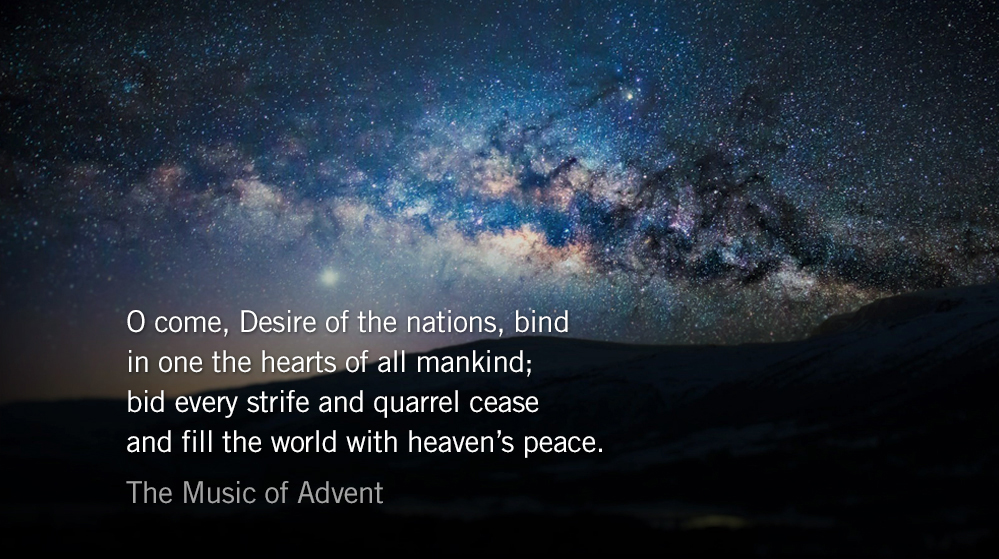
O come, Desire of the nations, bind
in one the hearts of all mankind;
bid every strife and quarrel cease
and fill the world with heaven’s peace.

“Jesus is Lord,” is a revolutionary claim. It not only upends global empires, but whatever we would enthrone on our hearts to save ourselves from the insufficiency of our world.

In Advent we await the coming of the all-sufficient King; he is the wisdom we yearn for and the power we need. He is God, and his presence brings healing to our world and restoration to our hearts.

Listen: O Come, O Come, Emmanuel by Francesca Battistelli (4:20)

Today’s Reading
Micah 6 (Listen – 2:28)
Luke 15 (Listen – 4:19)


Depression, Anger, Redemption :: Advent’s Hope

“Charles Jennens was a collaborator of Handel’s who struggled with depression following the suicide of his younger brother,” writes Mitch Davis who produced a documentary on Handel’s Messiah. Jennens’ brother was reportedly talked out of his faith at university and subsequently took his own life. “Jennens craved the spiritual solace he found in the exalted strains of Handel’s music and sought to combine that music with the scriptural words that comforted him during his depressive bouts.” Jennings composed the libretto of Messiah from translations of the Bible from the King James Version and The Book of Common Prayer.

Handel bounced from patron to patron throughout his career. Poor management of money and the resulting large shifts in his income, led him to become significantly indebted in London. Additionally, Handel’s first biographer John Mainwaring recorded that Handel, ”paid more attention to [food] than is becoming to any man.” Handel eventually became overweight, but was known far wider for English tabloid reports on his temper. In one argument he threatened to throw a soloist out a window, in another he escalated a verbal fight until a friend stabbed him with a sword (Handel was spared, as the sword was blunted by a metal button).

Mesmerized when he saw Jennens’ impassioned libretto, Handel worked feverishly on an oratorio, completing it in less than four weeks. Messiah was a turning point for Handel; its success freed him from his debts, and he became extraordinarily generous with the wealth his fame allowed. Something beyond material success seems to have happened as well. During the composition, Handel had what some call a spiritual epiphany. “I did think I did see all Heaven before me, and the great God himself.” Handel wrote as he composed the Hallelujah Chorus. “Whether I was in the body or out of my body when I wrote it, I know not.”

”Even when the subject of his work is religious, Handel is writing about the human response to the divine,” observes Harry Bicket, the director of The English Concert chamber orchestra. It’s clear both Jennens and Handel found personal grounding in Messiah and wanted to share that experience with others. Messiah seems to be both both men’s declaration that Christ is sufficient in the chaos of the world. They approached Messiah, as we can during this season as well, drawing solace and strength from the glory of Christ.

Listen: Hallelujah Chorus by The London Philharmonic.

Today’s Reading
Micah 5 (Listen – 2:21)
Luke 14 (Listen – 4:36)

Show Buttons
Hide Buttons
Spur a spiritual rhythm of refreshment right in your inbox
By joining this email list you are giving us permission to send you devotional emails each weekday and to communicate occasionally regarding other aspects of the ministry.
100% Privacy. We don't spam.