Born to Serve

Scripture Focus: Philippians 2:5-8
In your relationships with one another, have the same mindset as Christ Jesus:
Who, being in very nature God,
    did not consider equality with God something to be used to his own advantage;
rather, he made himself nothing
    by taking the very nature of a servant,
    being made in human likeness.
And being found in appearance as a man,
    he humbled himself
    by becoming obedient to death—
        even death on a cross!

Reflection: Born to Serve
By Jon Polk

In what is traditionally known as the “Christ Hymn” in Philippians 2, Paul describes who Christ is, and by extension, who God is, and furthermore by example, who we should be.
Who is Christ? Christ was in his very nature God. He was God himself, even though he was uniquely human, too. 

However, Christ didn’t behave the way people expected gods to behave. In the first century, they were more familiar with the volatile, angry gods of the Greek pantheon, who used power to advance themselves or to subdue others. 

Gods didn’t live their lives in humility. Gods didn’t come among their people as servants. And gods especially didn’t sacrifice their lives for the sake of their subjects. 

Paul writes that Christ took the very nature of a servant. He uses the Greek word doulos, which is more properly translated “slave.” A slave existed in servitude to others without advantages, rights or privileges.

Christ became nothing. He emptied himself by pouring out his grace to others. He humbled himself by entering into relationship with lowly humans. He obeyed death, freely giving his life.

Who is God? God’s strength is not in his ability to manipulate or subdue his subjects, but in his willingness to take on the form of his subjects. Not only does God condescend to human form, he chose not to come as a ruler or king but a servant.

Jürgen Moltmann writes in The Crucified God, “God is not greater than he is in this humiliation. God is not more glorious than he is in this self-surrender. God is not more powerful than he is in this helplessness. God is not more divine than he is in this humanity.”

Who should we be? Paul states we should “have the same mindset as Christ Jesus.” Not only does Christ present us with a radical picture of who God is, he presents us with a radical challenge about who we should be: humble servants giving ourselves on behalf of others.

Dietrich Bonhoeffer writes “The church is the church only when it exists for others… It must not underestimate the importance of human example which has its origin in the humanity of Jesus.” 

Jesus Christ is our ultimate example. For certain, none of us could ever be sinless and perfect, but that’s not the example that Paul wants us to see. Jesus is the full representation of God, but he also represents what it means to be fully human: to live life completely in service of others. 

Divine Hours Prayer: The Refrain for the Morning Lessons
From this day forward all generations will call me blessed, for the Almighty has done great things for me. — Luke 1.48

– From The Divine Hours: Prayers for Autumn and Wintertime by Phyllis Tickle.

1 Kings 11 (Listen – 7:05)
Phillipians 2 (Listen – 3:45)

Thank You!
Thank you to our donors who support our readers by making it possible to continue The Park Forum devotionals. This year, The Park Forum audiences opened 200,000 free, and ad-free, devotional content. Follow this link to join our donors with a one-time or a monthly gift.

Read more about He Stoops to Raise
Christ’s entire life could be understood as a process of descending and ascending. He goes from the highest place, to the lowest place. And then, he ascends.

Read more about Sacrifice of Self
Ultimately we have been called to imitate our self-sacrificing savior, Jesus, by giving of ourselves to do good for the benefit of others.

Paul’s Example of Thankfulness

Scripture Focus: Philippians 1:3-5, 9-10

I thank my God every time I remember you. In all my prayers for all of you, I always pray with joy because of your partnership in the gospel from the first day until now…And this is my prayer: that your love may abound more and more in knowledge and depth of insight, so that you may be able to discern what is best and may be pure and blameless for the day of Christ…

Reflection: Paul’s Example of Thankfulness

By Jon Polk

Who has been used by God to help you in your walk with Christ? Who has come alongside you during difficult times? Who has helped shape you into the follower of Christ that you are today?

In his letters, Paul frequently gives thanks for other Christians that have been important in his life and he has good reasons to have fond feelings for the church in Philippi.

There, Paul met Lydia and a group of “God-fearing” women praying down by a river. Lydia and her household responded immediately to the Gospel message and she invited Paul to stay in her home. The fledgling Philippian church started by meeting in her house.

There, Paul was imprisoned after incurring the wrath of a slave owner. While he was praying and singing hymns, an earthquake broke open the prison doors! Because Paul chose not to escape, the jailer and his household came to faith.

There, Paul would return to minister at least three times following his initial visit. The church in Philippi began to financially support his traveling ministry. Their support was so significant that Paul would brag about them in a letter to another church.

So it is no surprise that Paul writes about them, “I thank my God every time I remember you.” How many people in your life can you say that about, that you thank God for them every time you think of them? Not only does Paul thank God for them, he also prays for them on a regular and frequent basis.

What exactly does Paul pray for them? He prays that their love increases and grows to overflowing. He prays that as their love grows, so does their relationship with God. He prays that their actions and motives would be pure, driven by this profound love.

When you think about those who have been influential in your life, is this the way you pray for them? Do you pray that they might have so much love that they can’t expend it all? Do you pray that their relationship with God grows and deepens? Do you pray as frequently for your friends as Paul says he does for the Philippians?

Perhaps we should.

So why don’t you take a moment now to thank God for significant people in your life. But don’t stop there. Like Paul did, send them a note letting them know how much you appreciate them. Surprise someone with encouragement today. You’ll be glad you did. And so will they.

Divine Hours Prayer: The Greeting

The Lord lives! Blessed is my Rock! Exalted is the God of my salvation!
Therefore will I extol you among the nations, O Lord, and sing praises to your Name.

– From The Divine Hours: Prayers for Autumn and Wintertime by Phyllis Tickle.

1 Kings 10
 (Listen – 4:27)
Phillipians 1 (Listen – 4:03)

Thank You!
Thank you to our donors who support our readers by making it possible to continue The Park Forum devotionals. This year, The Park Forum audiences opened 200,000 free, and ad-free, devotional content. Follow this link to join our donors with a one-time or a monthly gift.

Read more about Paul’s Anti-Anti-Intellectualism
Paul’s intent was that developing faith should not be dependent on the eloquence of a speaker or the artfulness of argumentative tactics.

Read more about Paul’s First Sermon
Paul’s sermon is in response to a call for exhortation. The word Luke uses, paráklēsis, can imply an entreaty for help and is often translated as “comfort”

From Privilege to Prisoner to Priest

Scripture Focus: Ephesians 4:1-2

As a prisoner for the Lord, then, I urge you to live a life worthy of the calling you have received. Be completely humble and gentle; be patient, bearing with one another in love.

Many churches in the United States celebrate the Feast of St Francis of Assisi on October 4 each year. The feast commemorates the life of St Francis, who was born in the 12th century. Jon provides us an excellent reflection on today’s reading in Ephesians drawn from events of Francis’s life.

Reflection: From Privilege to Prisoner to Priest
By Jon Polk

St. Francis of Assisi is generally known for his peaceful disposition and love for animals and nature. The Prayer of St. Francis (authorship uncertain, but often attributed to Francis) begins…

Lord, make me an instrument of Thy peace;
Where there is hatred, let me sow love;
Where there is injury, pardon;
Where there is doubt, faith;
Where there is despair, hope;
Where there is darkness, light;
Where there is sadness, joy.

However, this devoted follower of Christ, widely regarded for his vow of poverty, did not begin life in a humble way. Francis was born in Italy around 1181 to a wealthy cloth merchant and his beautiful French wife. By age 14, Francis, spoiled by luxury, dropped out of school and gained a reputation as a rebellious teen, known for drinking, partying, and vanity.

His privileged upbringing afforded him training in archery and horsemanship and when war broke out in 1202, he joined the cavalry. Having no combat experience, Francis was easily captured by opposing forces and imprisoned for a year before ransom was negotiated.

But during his time as a prisoner of war, Francis began to receive visions from God and arrived home a changed man. He turned his heart towards God and spent time in prayer, seeking direction.

Eventually, he felt the call of Christ to serve the Church and to live a life of extreme poverty—fully devoted to Christianity. He is considered by many to be one of the purest examples of living the Christian life, other than Jesus himself.

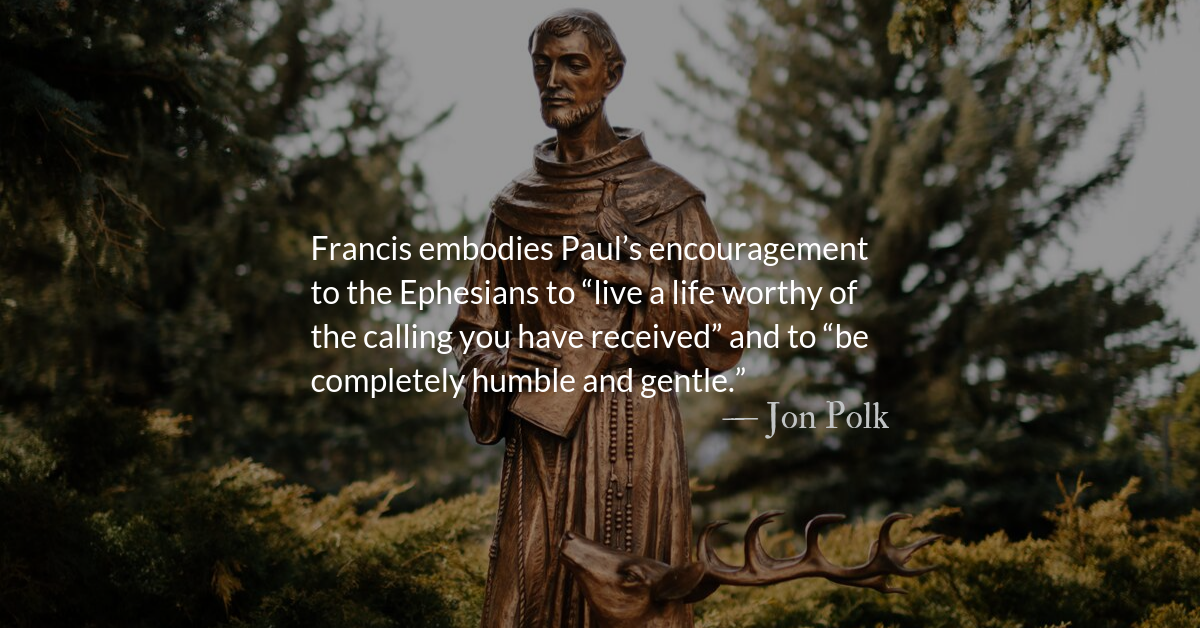
Certainly, Francis embodies Paul’s encouragement to the Ephesians to “live a life worthy of the calling you have received” and to “be completely humble and gentle.”

Francis’ deep dedication and gratitude to God is seen expressed in these excerpts from a song he composed, Canticle of the Sun. May these words guide our worship and service to Christ.

Most High, all powerful, good Lord,
Yours are the praises, the glory, the honor,
and all blessing.
To You alone, Most High, do they belong,
and no man is worthy to mention Your name.
Blessed are those who endure in peace
for by You, Most High, they shall be crowned.
Woe to those who die in mortal sin.
Blessed are those whom death will
find in Your most holy will,
for the second death shall do them no harm.
Praise and bless my Lord,
and give Him thanks
and serve Him with great humility.

Divine Hours Prayer: The Call to Prayer
Come now and see the works of God, how wonderful he is in his doing toward all people. — Psalm 66.5

– From The Divine Hours: Prayers for Summertime by Phyllis Tickle.

Today’s Readings
1 Kings 7 (Listen – 7:47)
Ephesians 4 (Listen – 3:58)

This Weekend’s Readings
1 Kings 8 (Listen – 10:23) Ephesians 5 (Listen – 3:42)
1 Kings 9 (Listen – 4:16) Ephesians 6 (Listen – 3:17)

Thank You!
Thank you to our donors who support our readers by making it possible to continue The Park Forum devotionals. This year, The Park Forum audiences opened 200,000 free, and ad-free, devotional content. Follow this link to join our donors with a one-time or a monthly gift.

Read more about Paul’s Prayer for the Power of Faith
Give us service to perform.
Give us needs to meet.
Give us debts to cancel.
Give us trouble for which you are the only answer.

https://theparkforum.org/843-acres/pauls-prayer-for-the-power-of-faith/

20191003

Read more about How to Know When to Give
As the Corinthians’ generosity caused Paul to celebrate, may our generosity bring joy and refreshment to those doing good in the world.

Paul’s Prayer for the Power of Faith

Scripture Focus: Ephesians 3.16
I pray that out of his glorious riches he may strengthen you with power through his Spirit in your inner being

Reflection: Paul’s Prayer for the Power of Faith
By John Tillman

Paul does not presume faith or spiritual power and neither can we. We also must kneel humbly, admitting our powerless state and our tendency towards unbelief. Let us pray this prayer on our own behalf and on behalf of our brothers and sisters in Christ around the world.

Prayer for the Power of Faith:

“For this reason I kneel before the Father…”

We are your children, adopted through Christ into your family.
We kneel, humbling ourselves, acknowledging our poverty, our nakedness, our need.

“I pray that out of his glorious riches he may strengthen you with power through his Spirit in your inner being”

We do not need your power only for great deeds of faith.
We need your power for every moment and miniscule act of goodness.

“I pray that out of his glorious riches he may strengthen you with power through his Spirit in your inner being, so that Christ may dwell in your hearts through faith.”

We need Christ to dwell in our hearts by faith. 
It is not that we do not have faith, Lord.
We do not lack belief. But we struggle with putting our faith in other things.
We are full of self-belief. We believe in our wealth. Our faith is in stockpiling resources. Our faith is in our human wisdom. 
Empty us of these beliefs.
Fill us with true faith in you alone.

“And I pray that you, being rooted and established in love, may have power, together with all the Lord’s holy people, to grasp how wide and long and high and deep is the love of Christ, and to know this love that surpasses knowledge—that you may be filled to the measure of all the fullness of God.”

Fill us with the Spirit as Jesus prayed.
May we fulfill the words of Christ when he said that we would do greater things than he did.

“Now to him who is able to do immeasurably more than all we ask or imagine…

Our imaginations are sinful, Lord. Do immeasurably more than we can imagine.
Do immeasurably more than give us wealth. 
Do immeasurably more than give us power. 
Do immeasurably more than give us honor.
Give us service to perform.
Give us needs to meet.
Give us debts to cancel.
Give us trouble for which you are the only answer.

“…according to his power that is at work within us, to him be glory in the church and in Christ Jesus throughout all generations, forever and ever! Amen.”

Divine Hours Prayer: The Refrain for the Morning Lessons
Blessed are they which do hunger and thirst after righteousness: for they shall be filled. — Matthew 5.6

– From The Divine Hours: Prayers for Summertime by Phyllis Tickle.

Today’s Readings
1 Kings 6 (Listen – 4:30)
Ephesians 3 (Listen – 2:41)

Thank You!
Thank you to our donors who support our readers by making it possible to continue The Park Forum devotionals. This year, The Park Forum audiences opened 200,000 free, and ad-free, devotional content. Follow this link to join our donors with a one-time or a monthly gift.

Read more about His Blessings, Our Curse :: A Guided Prayer
May we hear in God’s Word, always the tender love of our father who wants blessings for us.

Read more about The Miracle of Faith
Jesus’ greatest miracles were helping the faithless to believe again, helping the cynical to trust again, helping the hardened to love again.

Seeking after a Seeking God

Scripture Focus: 1 Kings 3.3-4
Solomon showed his love for the Lord by walking according to the instructions given him by his father David, except that he offered sacrifices and burned incense on the high places. The king went to Gibeon to offer sacrifices, for that was the most important high place, and Solomon offered a thousand burnt offerings on that altar.

Reflection: Seeking after a Seeking God
By John Tillman

People in scripture often worshiped God wherever they happened to be and God accepted them. But the “high places” in Israel were different. They were pagan sites of worship before the Israelites conquered the land. 

Israel drove out most idol worship but some still survived. Joshua warned the people of “traps and snares” saying that these practices, if continued, would be “whips for your backs and thorns for your eyes.” Worship at “high places” was expressly forbidden by God, because God knew that the old, cultic practices would return to pollute and subvert true worship. 

But people in Solomon’s day still worshiped at these places. The worship of God in Israel at this time was scattered. This was partly convenience so that they did not have to travel to Jerusalem, but it also had to do with tradition and an emotional and cultural connection to these locations. 

David had taken the Ark of the Covenant to Jerusalem and set up a tent for it there in anticipation of the Temple being built. But the tent of meeting constructed by Moses was still at Gibeon. Probably what made Gibeon the “most important” high place was the emotional, traditional, and historical connection to Moses. This empty tent, filled only with nostalgia, remained in use as a place of worship and is where God spoke to Solomon. 

James tells us that God grants wisdom to all, without finding fault, and that includes young king Solomon who asked for wisdom even while unwisely worshiping God at a questionable place. God will do the same for us. 

God, throughout the scriptures, is a God who seeks. God, of course, desires us to seek him “while he may be found” and to seek him in his Temple. We should care deeply about worshiping in ways that are proper and biblical. But because God is a seeking God, he is always ready to meet us where we are. 

He will meet us in hiding in the wilderness, as he met with David.
He will meet us wrapped in nostalgia, as he met with Solomon.
He will meet with us singing new songs, as he met with Asaph.
He will meet with us in a corrupted Temple, as he met with Isaiah.
He will meet with us in a corrupted land, as he met with the woman at the well in Sychar.

Wherever and however we draw near to God, he will draw near to us.

Divine Hours Prayer: The Greeting
Out of Zion, perfect in its beauty, God reveals himself in glory. — Psalm 50.2

– From The Divine Hours: Prayers for Summertime by Phyllis Tickle.

Today’s Readings
1 Kings 3 (Listen – 4:29)
Ephesians 1 (Listen – 3:10)

Thank You!
Thank you to our donors who support our readers by making it possible to continue The Park Forum devotionals. This year, The Park Forum audiences opened 200,000 free, and ad-free, devotional content. Follow this link to join our donors with a one-time or a monthly gift.

Read more about Prayer From the Cave :: Readers’ Choice
Prayer does not come easier in dark times, but we may feel it does since we more quickly and easily turn to it in distress.

Read more about Take Up Your Mat
Jesus sought us out when we were paralyzed and deformed by sin…When we take up our mat and walk, we are just beginning to follow him in faith.