TBT: Justice and the Kingdom of God

By Carl F.H. Henry

“The time has come,” Jesus said. “The kingdom of God has come near. Repent and believe the good news!” — Mark 1.15

Some evolutionists have argued that human beings came gradually to depict divinity in terms of ethical norms. But the Bible presents man as standing from his very beginnings in ethical relationships to God, and nowhere portrays law as a gradual conjectural equalization of human interests later declared to be divinely sanctioned. 

The conception of law as purely juridical, and the enforcement simply on grounds of custom or social legislation, reflect a later societal development in which man is considered the originator or revealer of law; such a development first obscures and then eclipses the truth that law in its absolute sense is the revealed will of God.

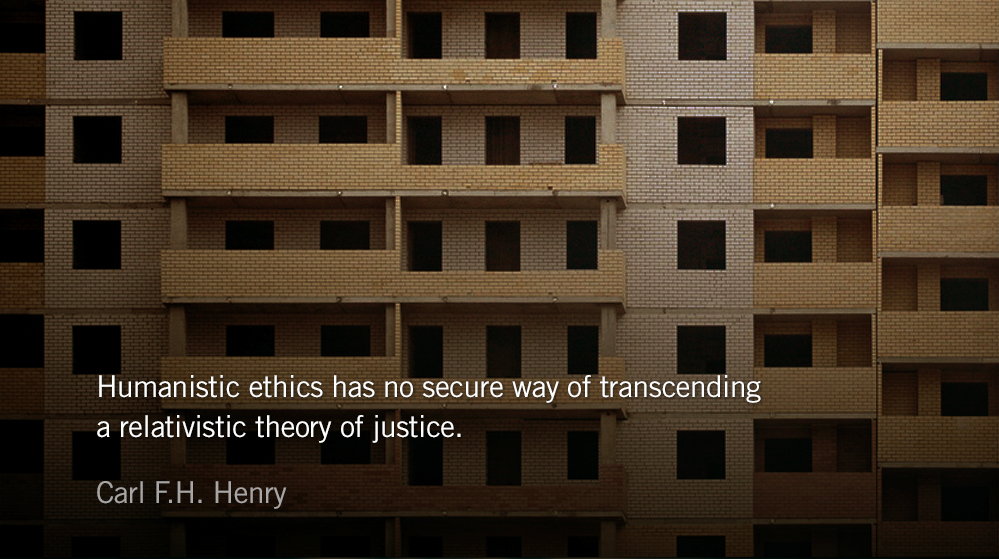
To be sure, many humanists engage vigorously in the struggles for justice and freedom; their effort, in fact, is sometimes more energetic than that of Christian believers, and should be commended whenever it coincides with the requirements of objective morality. But humanistic ethics has no secure way of transcending a relativistic theory of justice. Factual observations and utilitarian considerations on which humanists base their social concern imply no normative principle; they accommodate no logical transition from the is to the ought. 

The Christian vision of justice is comprehensive and spans all areas of good and evil; it not only vindicates the truly just man condemned to a criminal’s cross, but also summons to final judgment the self-righteous who vaunt themselves as paragons of virtue. 

Reminding his disciples of the approaching, inevitable judgment and justice of God, Jesus commends trustful prayer. His prayerful and faithful followers are to anticipate the Son of Man’s return in power and glory to vindicate the justice that God ordains. 

— Abridged from Carl F.H. Henry, God, Revelation, and Authority.

Prayer

O Christ, essential Day, O Light
that peels the darkness from the night,
we know you for the Heart of light,
who tell the blessedness of light.

O holy Master of the night
we beg defense against the night
and rest against your breast this night
and peaceful sleep throughout the night.

See what snares the foe prepares
see what villainy he dares—
in vain: your blood has bought your cares
for us, your guidance victory bears.

— From an anonymous hymn used in numerous medieval liturgies.

Today’s Readings
Genesis 30 (Listen – 6:10)
Mark 1 (Listen – 5:05)
The Real Scandal of the Resurrection

Matthew 28.5-6a
The angel said to the women, “Do not be afraid, for I know that you are looking for Jesus, who was crucified. He is not here; he has risen, just as he said.”

The resurrection is Christianity’s ever-present scandal. The first conspiracy theory arises less than a handful of verses after the women find the tomb. “The disciples stole the body.” Centuries of alternative explanations follow. The modern mind, however, is far less likely to cry scandal than it is to declare, nonsense.

“The Christian view of resurrection, absolutely unprecedented in history, sprang up full-blown immediately after the death of Jesus,” observes Timothy Keller. Cultural and material explanations for the resurrection have always lacked sufficient grounding. Perhaps our desire to materially explain the resurrection is less to satisfy the healthy pursuit of thoughtful faith and more to distract our heart from the reality of the gospel. [1]

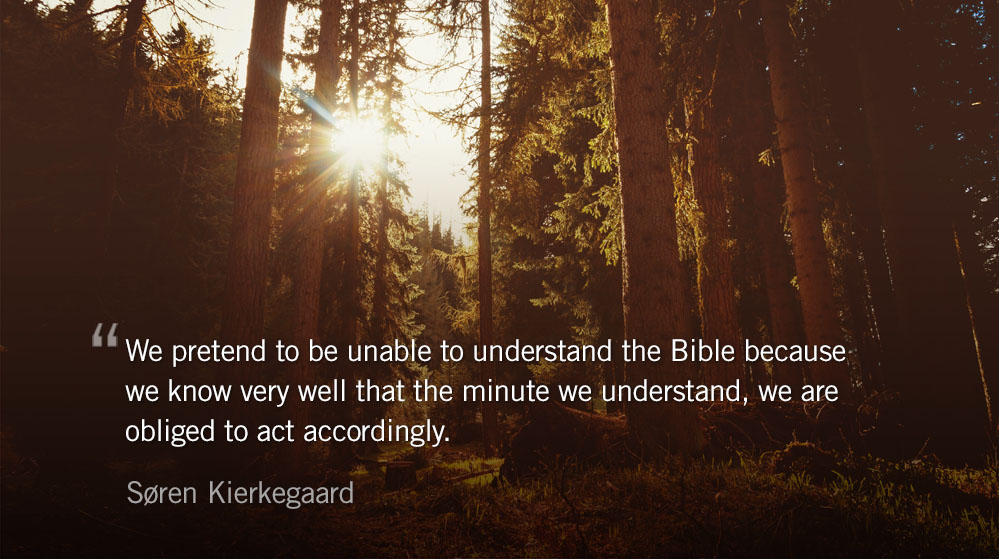
“We pretend to be unable to understand [the Bible] because we know very well that the minute we understand, we are obliged to act accordingly,” Kierkegaard proclaims. “Dreadful it is to fall into the hands of the living God. Yes it is even dreadful to be left alone with the New Testament.” [2]

The resurrection verifies what Christ held closest on the cross. According to the gospels his friends had abandoned him. His sole earthly possession, the very clothes on his back, had been taken. Union Presbyterian professor Jack Kingsbury observes, “On the cross Jesus held fast to God in trust, even as he relinquished his life. In raising Jesus from the dead, God certifies the truth of Jesus’ words and the efficacy of his trust.” [3]

Evil isn’t the only thing vanquished on the cross. The illusion that we can pull it together and do it ourselves was also destroyed on Golgotha. The idea that Christ would die on our behalf and offer freely what we are helpless to obtain ourselves is scandalous. To this the scriptures call us to abandon our selfish pursuits and look to the one who came to serve. He withheld nothing—even his own life—to show how wide, long, and deep is the love of the Father for us.

Prayer
Lord, we confess that we chase after so much to fulfill our lives. We confess our attempts to find fulfillment through self, career, possessions, and experiences. None are sufficient — for you knit us together with longings for things far greater. Only you can bring fulfillment. Only you can deliver us from the insufficiency of our world. Draw us near, our God.

Justice Through Christ
Part 3 of 5, read more on TheParkForum.org

Today’s Readings
Genesis 29 (Listen – 4:45)
Matthew 28 (Listen – 2:39)

___________________

FAQs

How can I make a tax-deductible donation? Click here.
How can I get these devotionals in my inbox? Click here.
What is the reading plan this blog is based on? Click here.

 ___________________________________

Footnotes

[1] Timothy Keller, Apologetics (City to City Incubator Session 4), p.26. | [2] Søren KierkegaardProvocations: Spiritual Writings of Kierkegaard. | [3] Jack Dean Kingsbury, Matthew as Story, pp. 90-91.


Justice and Injustice

Matthew 27.13-14
Then Pilate asked him, “Don’t you hear the testimony they are bringing against you?” But Jesus made no reply, not even to a single charge—to the great amazement of the governor. 

“Are you the king of the Jews?” Pilate asked. Caiaphas, the Jewish High Priest, had brought the accusation using Jesus’ own words from the Parable of the Tenants (Matthew 21.33-45). Jesus risked losing his freedom, possibly his life, if he affirmed the charge. The religious elite likely couldn’t imagine a scenario where a man would go to that length. If he denied the charge he might escape legal consequences but, most importantly, he would lose his influence with the people. 

“The universe held its breath as it waited for Jesus’ answer,” imagines Scottish theologian William Barclay. Surely Jesus wanted justice. The trial was anything but just. Jesus’ reply to Pilate revealed an expectant and quiet trust in the face of injustice. “You have said so.” With that, just two words in Greek, Jesus spoke his first and last of the trial. [1]

Even Pilate sensed the injustice of the moment and offered to spare a man’s life as a sign of mercy. First he presented Jesus, in whom he could find no fault. Then Pilate brought them Barabbas, a known violent criminal. Jesus had already prayed to his Father, “your will be done.” The people cried out for Barabbas. In no subtle way, the freeing of the criminal Barabbas was a sign of the people’s foolishness. But it was also more than that. 

In Christ’s condemnation for Barabbas’ freedom we see a foreshadowing of everything God was working on all along.

Jesus seemed expectant for God to bring justice, even in the injustice of this world. Barabbas, whose Greek name translates “son of the father,” walked free because Jesus laid down his life. Barabbas wasn’t the only one to go free that day. All the guilty were set free through the sacrifice of the One, Holy innocent. 

Prayer
Father, thank you for giving your only Son on our behalf. He endured the worst injustice and absorbed the blow of your justice. He laid down his life, defeating sin and evil, and offered his victory to anyone who would accept. We stand in awe of your sacrifice. We want to sit under your goodness and justice. We fall at the foot of your throne and offer our lives to you.

Justice Through Christ
Part 2 of 5, read more on TheParkForum.org

Today’s Readings
Genesis 28 (Listen – 3:17)
Matthew 27 (Listen – 8:45)

___________________

FAQs

How can I make a tax-deductible donation? Click here.
How can I get these devotionals in my inbox? Click here.
What is the reading plan this blog is based on? Click here.

 ___________________________________

Footnotes

[1] William Barclay, The Gospel of Matthew, 2:392.

Without a Cup of His Own

Matthew 26.27-28
Then he took a cup, and when he had given thanks, he gave it to them, saying, “Drink from it, all of you. This is my blood of the covenant, which is poured out for many for the forgiveness of sins.

Aside from consumption of wine, one of the roles that chalices play throughout history is “of demonstrating the status of the owner or drinker,” notes the British Museum Magazine. As an example the museum offers the Lacock Cup, currently on display. The cup dates from 15th century England, weighs over two pounds, and is fashioned of gold and silver. The museum adds that the cup would have been a, “costly and showy item to own.” [1]

It is likely Jesus drank from a cup that was not his own during the Last Supper. It was standard etiquette, as late as medieval times, for the host to provide their guests with chalices. We also know from Scripture that Jesus owned few personal items, denying himself what most would consider essential. “The Son of Man has no place to lay his head.” It’s likely owning his own chalice was a luxury Christ did not experience.

Later that night Jesus embraced a second cup that was not his own. “My soul is overwhelmed with sorrow to the point of death,” he told his disciples. “Going a little farther, he fell with his face to the ground and prayed, ‘My Father, if it is possible, may this cup be taken from me.’”

Neither the cup of riches nor the cup of suffering held sway over him. Jesus left the riches of heaven for the poverty of earth. He endured pain and destruction on our behalf. When faced with God’s refusal to answer his prayer and remove the cup of suffering, he conceded, “Yet not as I will, but as you will.” Then he stood and walked, “like a lamb to the slaughter.”

Although neither cup was his, he embraced what was inside. From the cup of justice he drank all that we could not. He paid a price we could not pay. From the cup of heavenly riches he offered what we could not afford. He gave a gift we could not earn. [2]

Prayer
Father, our hearts find their rest in you. That you would freely offer us life through the costliness of your son’s death shows a love we struggle to grasp. While the cup of your Kingdom is something we could not afford, we embrace what is in it with joy and gratitude. May your love overflow from it into our own lives and into the lives of everyone around us.

Justice Through Christ
Part 1 of 5, read more on TheParkForum.org

Today’s Readings
Genesis 27 (Listen – 6:25)
Matthew 26 (Listen – 10:01)

___________________

FAQs

How can I make a tax-deductible donation? Click here.
How can I get these devotionals in my inbox? Click here.
What is the reading plan this blog is based on? Click here.

 ___________________________________

Footnotes

[1] From a Table to the Alter. The British Museum Magazine. Spring/Summer 2014, Issue 78, pp. 44-45. | [2] Scripture references, in order of appearance: Matthew 8.20; Matthew 26.38-39; Isaiah 53.7


Weeping Over Jerusalem

Daily Reading
Genesis 24 (Listen – 9:42)
Matthew 23 (Listen – 4:53)

Matthew 23.37

“Jerusalem, Jerusalem, you who kill the prophets and stone those sent to you, how often I have longed to gather your children together, as a hen gathers her chicks under her wings, and you were not willing.”

This is usually the time of year when New Year’s resolutions begin to break down. It’s a lovely season for year-round gym attendees; classes get easier to book. It’s an unfortunate season in what it reveals about the condition of our souls. Yet again we are betrayed by the idea that intentional fortitude is all that we lack to change the affections of our hearts.

Jesus weeps over Jerusalem because he knows the people will be unfaithful to him. Although the religious elite have already rejected him, the people of the city will welcome him with an entry fit for a king. For I tell you, you will not see me again, until you say, ‘Blessed is he who comes in the name of the Lord.’” Days after their triumphalism the people would sentence Jesus to die.

God is under no illusions that we will keep our promises. Through the prophet Jeremiah, God reminds us, “The heart is deceitful above all things.” Christ doesn’t weep that the people will soon break their promises. Humanity’s disloyalty to God, despite intentions otherwise, is a repetitious theme in Scripture. Jesus went to the cross to take care of that reality, its root cause, and all its vicious implications. 

Christ weeps out of the depth of his love for humanity. He left the riches of heaven, to endure the poverty and brokenness of earth, so that we might inherit the righteousness of God. He is the sufficient answer to every one of our problems. He is the one good and true lover of our souls — even while we were yet sinners. He is faithful in our unfaithfulness — loving when we are unlovely. Christ’s teachings draw lines in the sand; no doubt. But we miss the foundation for everything Jesus says and does if we overlook the depth of his love and brokenness. “Greater love has no man than this, that he lay down his life for his friends.”

Prayer
Father, you are wonderful. To see your son weep over the lost is arresting. Truly you love us more than we know. Thank you for your vast, unfailing love. Thank you for pursuing us, even when we deny you. Help us to overflow with your love for us, that we would become vessels carrying your love to others.

This week: For These Things, I Weep
Part 5 of 5, read more on TheParkForum.org

 ___________________________________

Weekend Readings

Saturday: Genesis 25 (Listen – 4:18); Matthew 24 (Listen – 5:59)
Sunday: Genesis 26 (Listen – 4:31); Matthew 25 (Listen – 6:04)

___________________

FAQs

How can I make a tax-deductible donation? Click here.
How can I get these devotionals in my inbox? Click here.
What is the reading plan this blog is based on? Click here.

 ___________________________________

Footnotes

[1] Scriptures quoted today (in order of appearance): Matthew 23.38; Jeremiah 17.9; 1 Corinthians 8.9; John 15.13


Show Buttons
Hide Buttons
Spur a spiritual rhythm of refreshment right in your inbox
By joining this email list you are giving us permission to send you devotional emails each weekday and to communicate occasionally regarding other aspects of the ministry.
100% Privacy. We don't spam.