The Spirit of Adoption

Galatians 4.5
[Christ redeemed] those who were under the law, so that we might receive adoption as sons.

The borrowed use of the word adoption in the context of new technology and puppies has diffused our understanding of an ancient concept once associated with honor and legacy. Adoption for the purpose of redefining family and future was common in ancient Rome; records recovered from the ashes of Pompeii reveal nearly one in every ten city senators grew up in adoptive homes.
In Roman adoption the adoptee legally rescinds their past — canceling debts and expunging records — and receives a future defined by the rights, status, and inheritance of their adoptive family.

Adoption ceremonies in Roman Culture began with the adoptive father paying the price for the adoption. The name of this part of the ceremony, mancipatio, shares a root from which we derive the English word emancipation. Because of the price paid in mancipatio, the past no longer held sway over the adoptee’s future.

The adoption ceremony continued with a legal justification for the transference of fatherhood. This presentation placed the adoptee under the rights and record of the new father — including giving the new child full rights to participate in the inheritance. For most adoptees in Roman culture this was a significant step up — so much so the Romans called this part of the ceremony vindicatio — vindication.
The message of the New Testament announces to Christians the price God paid for our adoption. The Holy Spirit, through Paul’s words in the first part of Romans, lays out the legal argument both for our emancipation as well as our vindication and future.
Because of Christ’s work we can rest in the rights, status, and inheritance of our adoptive family. The Scriptures assure us:
If then you have been raised with Christ, seek the things that are above, where Christ is, seated at the right hand of God. Set your minds on things that are above, not on things that are on earth. For you have died, and your life is hidden with Christ in God. — Colossians 3.1-3

The modern cultural desire to imbue consumption (of devices, animals, or otherwise) with the deeper meaning of adoption should not only make us leery of ascribing unnecessary value to the temporal, but point us toward the richness of our lives as adopted sons and daughters of the King.

Today’s Reading
2 Samuel 24 (Listen – 4:48)
Galatians 4 (Listen – 4:13)

A Vision for the Future :: The Weekend Reading List

I came into the world. Free by nature, in the image of God, I was nevertheless the prisoner of my own violence and my own selfishness, in the image of the world into which I was born. That world was the picture of Hell, full of men like myself, loving God, and yet hating him; born to love him, living instead in fear of hopeless self-contradictory hungers. — Thomas Merton

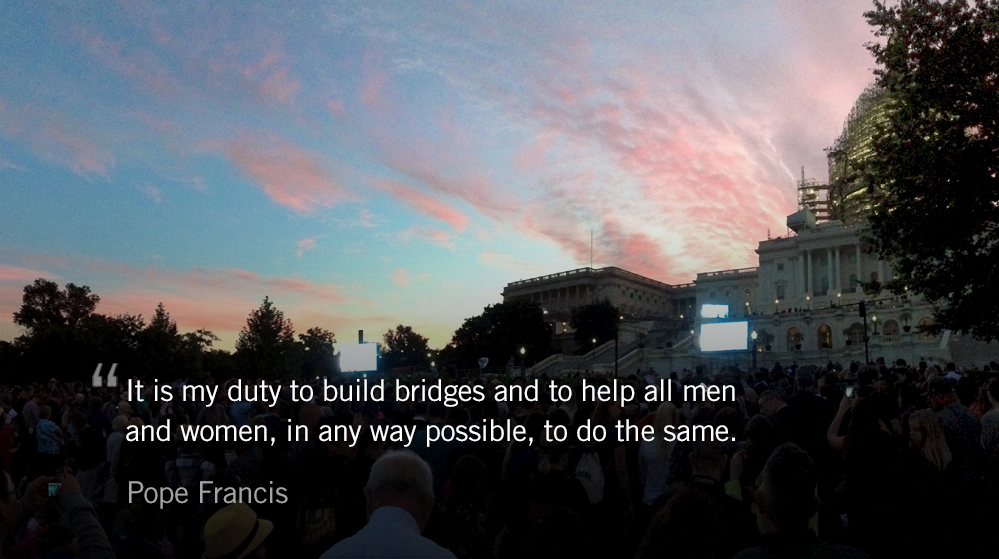
In his address to a Joint Session of Congress yesterday the Pontiff quoted from Thomas Merton’s autobiography (above), then shared his appreciation for the priest. “Merton was above all a man of prayer, a thinker who challenged the certitudes of his time and opened new horizons for souls and for the Church. He was also a man of dialogue, a promoter of peace between peoples and religions.”

Pope Francis presently enjoys a favorability that rivals that of John Paul II among catholics. He has even garnered the approval of 68% of those who have no religious affiliation, according to Pew Research Center. These numbers are directly linked to his ability to speak to modern issues with boldness and clarity, as he did in Bolivia this past July:

The earth, entire peoples and individual persons are being brutally punished. And behind all this pain, death and destruction there is the stench of what Basil of Caesarea called “the dung of the devil.” An unfettered pursuit of money rules. The service of the common good is left behind.

Once capital becomes an idol and guides people’s decisions, once greed for money presides over the entire socioeconomic system, it ruins society, it condemns and enslaves men and women, it destroys human fraternity, it sets people against one another and, as we clearly see, it even puts at risk our common home. — Pope Francis

Yesterday the Pope opened his speech to Congress by reminding them, “You are asked to protect, by means of the law, the image and likeness fashioned by God on every human face.” The full transcript reads less like an agenda, as his opponents feared, and more like a reminder: the most destructive forces in our world are directly limited, and promoted, by the action (and inaction) of the government of the world’s most powerful nation.

It isn’t exclusively this message that makes Francis unique in his role. In the Pope’s first exclusive interview he was asked, point-blank, “Who is Jorge Mario Bergoglio?” The Jesuit journalist who framed the question, Father Antonio Spadaro, records that “The pope stares at me in silence. I ask him if this is a question that I am allowed to ask…. He nods that it is, and he tells me:”

I do not know what might be the most fitting description…. I am a sinner. This is the most accurate definition. It is not a figure of speech, a literary genre. I am a sinner… I ​​am one who is looked upon by the Lord. I always felt my motto, Miserando atque Eligendo [By Having Mercy and by Choosing Him], was very true for me. — Pope Francis

In this we see a glimpse of a new kind of Pope. Perhaps someone who will not only represent Christian interests among world leaders, but someone standing with the poor, marginalized, and oppressed. (After exiting the Capitol yesterday the Pope went directly to a tent outside to eat with those who are homeless.) Could it be approval ratings change when people see a leader who chooses to leverage power rather than bask in it?

In the words selected from Thomas Merton’s biography: prayer, thinking, challenge, new horizons, and dialogue — we see both Pope Francis’ way of understanding the faithful of the past as well as the framework by which he crafts his own future.

Today’s Reading
2 Samuel 21 (Listen – 4:34)
Galatians 1 (Listen – 3:05)

This Weekend’s Readings
2 Samuel 22 (Listen – 5:22) and Galatians 2 (Listen – 3:44)
2 Samuel 23 (Listen – 5:38) and Galatians 3 (Listen – 4:39)

The Weekend Reading List

TBT: The Effects of a Loving God

2 Corinthians 13.5
Examine yourselves, to see whether you are in the faith. Test yourselves. Or do you not realize this about yourselves, that Jesus Christ is in you?


By Thomas Doolittle (1632-1707)

Besides, belief (how do we know we “are in the faith”)? We know by what we value, by what our will chooses, and by our affection loving Christ above all.

What We Value
A woman whose house is on fire loses all her pewter to the flames so that she may save her child. Is it not apparent which she values most? Likewise, you will keep Christ, if you prize him most.

What We Choose
Christ is an honor to the believer, and Christ is most prized and valued by the believer. Can a man not know what he prizes most?
What he values and esteems most?
What his mind dictates to him to be chosen above all?
Whether his will chooses according to the dictates of the mind?

The affections, love, and desire enjoy what the will choices; grief fills the heart when he cannot obtain it. There is as much power of God required, and strength of grace, to make a man part with his beloved sin as all the rest.

Loving Christ Above All

By the effects of love, we may certainly know that we love him.
  1. By your unfeigned desires to be like unto him. — We love to imitate those whom we dearly love. Love produces assimilation: if he is holy, so we will be; if he hates sin, so will we.
  2. By your passionate desire to be united to him, to have him with you. — You go from your prayer closet to the congregation — if you find him there, from the word to the sacrament, you rejoice.
  3. By your great care to please him, fear to offend him, and resigning yourself to him. — When it grieves your heart to grieve the Lord, and it breaks thy heart when your break his commands.
  4. By the love that we bear in his image — in whoever we love by denying ourselves of honor and profit, if necessary, God should call us to do them good.

The delight of the heart is revealed in the enjoyment a man values, even while lacking other things. You can delight in Christ, in poverty, affliction, in the midst of troubles in the world.

*Abridged and language updated from Rev. Doolittle’s Cambridge talk, If We Must Aim At Assurance, What Should They Do, That Are Not Able To Discern Their Own Spiritual Condition?

Today’s Reading
2 Samuel 20 (Listen – 4:51)
2 Corinthians 13 (Listen – 2:19)

Calamity Come

2 Corinthians 12.9
He said to me, “My grace is sufficient for you, for my power is made perfect in weakness.”By Ben Palpant

Editor’s Note: As we reflect on the verse above I want to return to an excerpt we published as part of our Summer Reading Series. This transparent look at his faith — during intense suffering — serves as both encouragement and great challenge. Ben Palpant’s transparency reveals both the profound pain of weakness and the remarkable sufficiency of God’s grace in it.

From the author’s website: “In his mid-thirties, Ben Palpant was suddenly reduced to an infant in a matter of a few short weeks–learning again to read and walk and feed himself. With no clear diagnosis, he was left alone with his questions: ‘Who am I?’ and ‘Why is this happening to me?’”

No child in the history of mankind, when asked what he would like to do when he grows up, has ever responded, “I want to suffer.” I, for one, did not. — Ben Palpant

C.S. Lewis called pain God’s megaphone. John Piper has called pain God’s pedagogy. “God, I am listening. Teach me. Speak into this bewilderment.”

After my meltdown in the office, everyone important to me encouraged me to stay home. My wife, father, mother, boss, and friends seemed to conspire against my ambitions. Soon my head began bobbing involuntarily and tremors gradually took over my torso. And then my arms and even my legs shook. My hands curled in on themselves and my tongue thickened in my mouth. I would sit like that for hours at a time.

My stability dissolved under the strain of suffering. In my suffering, I forgot that pain has a context. It is framed by the Master Storyteller. I am imagined: before I kicked against my mother’s womb, before the nurse pricked my heel and I cried out, before I threw a snowball and squealed with delight, God imagined all of it.

He imagined the death of grubs and the death of the chicks that ate them. Such pain is part of his story. Thomas Merton suggested that the mystery of God eclipses our suffering.

Pain is no case against God. No matter the cause. No matter the degree. Suffering does not call into question the existence of a good God; rather, it calls into question our lives. — Ben Palpant

He knows the falling of a sparrow and he knew the collapse of a mind. God does not look at our suffering from afar. It is an intimate event to him. He is the author of every detail, speaking the suffering as it occurs.

— Excerpt from A Small Cup of Light by Ben Palpant. benpalpant.com, 2014.

Today’s Reading
2 Samuel 19 (Listen – 7:31)
2 Corinthians 12 (Listen – 3:54)

The Strengths of Weakness

2 Corinthians 11.30
If I must boast, I will boast of the things that show my weakness.
Paul frequently asked his fellow believers to pray for him. Sometimes he would simply say, “Brothers, pray for us.” Other times he would passionately plead,“Strive together with me in your prayers to God on my behalf.” And we know why he so desperately needed their prayers.
2 Corinthians 11.24-27
Five times I received at the hands of the Jews the forty lashes less one. Three times I was beaten with rods. Once I was stoned. Three times I was shipwrecked; a night and a day I was adrift at sea; on frequent journeys, in danger from rivers, danger from robbers, danger from my own people, danger from Gentiles, danger in the city, danger in the wilderness, danger at sea, danger from false brothers; in toil and hardship, through many a sleepless night, in hunger and thirst, often without food, in cold and exposure.
Paul was brilliant and intense. He was a great man, a spiritual warrior, and a chosen instrument of God. Yet he needed others to pray for him. Why?
First, he knew that he could never accomplish his work apart from the grace of God: “By the grace of God I am what I am, and his grace toward me was not in vain. On the contrary, I worked harder than any of them, though it was not I, but the grace of God that is with me.”
Second, he knew that moral growth and ministry fruitfulness came only by prayer. As he told the Philippians, “It is my prayer that your love may abound more and more, with knowledge and all discernment”(moral growth), and wrote to the Thessalonians, “Pray for us, that the word of the Lord may speed ahead and be honored” (fruitfulness).
Prayer
Lord, we long for grace, moral growth and fruitfulness in our lives. Thus, we know that we must meet with you in prayer. We must boast in our weaknesses apart from you, knowing that we cannot accomplish the most lasting achievements on this earth apart from your might, power, glory and love.
Let us not be lazy in praying for one another – that your grace would abound in our lives, that our love may grow in knowledge and depth of insight, and that your word may speed ahead and be honored in our lives – even as we endure hardship for our obedience like Paul did. Amen.
Today’s Reading
2 Samuel 18 (Listen – 6:16)
2 Corinthians 11 (Listen – 4:46)