The Garden of Anguish :: Holy Week

Then Jesus said to them, “My soul is very sorrowful, even to death; remain here, and watch with me.” — Matthew 26.38

The Son of God, who rhythmically withdrew from all human contact to pray, now asks his disciples to journey with him into the garden. He did not want to be left alone.“Father, take this cup.” The prayer of Christ would go unanswered.

For the first time in all of eternity, “Jesus Christ turned toward the Father and there was nothing there but the abyss,” remarks Timothy Keller. “There was nothing there but the darkness that opens out into an infinite nothing. He turned, expecting heaven and the Father, and there was hell.” Blood vessels ruptured under stress—his body being forced toward death long before the cross—as the weight of sin fell upon our savior. Keller explains:

As he began to walk, he began to experience the wrath of God. He began to actually experience God turning away from him. How does God punish sin? The Bible tells us (it’s almost poetic justice) the sinful human heart wants to get away. It wants to be away from God. It wants to be able to be its own master. So the way God punishes sin is to give the heart what it wants.

Jesus received what we deserved—what we have earned. From his birth to his resurrection, Christ did for us what we are unable to do. He loved God fully and loved man perfectly. He gave his life that we may live. Though we see this, we have trouble reorienting our lives in response.

We do not want to accept such a sacrifice. We do not want to cost of our sin to be so high. We do not want to live indebted to grace so deep. Christ’s love shines through the night, even while our love flickers in the wind. Keller concludes:

We don’t trust him. We’re afraid he might not have our best interest in mind, that he might ask us to do something that won’t be really good for us. So on the one hand, we don’t really trust him, but on the other hand, we don’t really trust ourselves. One of the reasons why we don’t give ourselves wholly and utterly and completely is because we’re afraid of failure.

Here is a love that hell came down on. His love for you—hell came down on it—and it didn’t eat through it. His love for you, hell came down on it, and it didn’t break it.

Today’s Reading
Proverbs 11 (Listen – 3:41)
Ephesians 4 (Listen – 3:58)
Evil and the Cross :: Holy Week

“Theologies of the cross, of atonement, have not in my view grappled sufficiently with the larger problem of evil,” laments N.T. Wright in God, 9/11, the Tsunami, and the New Problem of Evil. Any Christian who can discuss the individual nature of salvation while struggling to articulate the impact of Christ’s death and resurrection on the greater evils of the world can relate.

Dr. Wright believes modern reading of the Scriptures have skewed toward individualism, causing us to read over the full work of Christ. He continues:

Once we learn to read the Gospels in a holistic fashion, we hear them telling us that the death of Jesus is the result both of the major political evil of the world, the power-games which the world was playing as it still does, and of the dark, accusing forces which stand behind those human and societal structures, forces which accuse creation itself of being evil, and so try to destroy it while its creator is longing to redeem it.

What the Gospels offer is not a philosophical explanation of evil, what it is or why it’s there, but the story of an event in which the living God deals with it. The call of the Gospel is for the church to implement the victory of God in the world. The cross is not just an example to be followed; it is an achievement to be worked out.

Once we begin working out the fullness of Christ’s passion, Wright believes, “The cross becomes the sign by which, and by which alone, we go to address the wickedness of the world.” In other words, evil writ large—terrorism, natural disasters, immorality in our field of work, and injustices in government, economics, and every other social system—is redeemed through our daily embrace of the suffering servant.

As Christians we can reject the sacred calling to join Christ in this work by trying to solve the problem of evil apart from God. Wright explains:

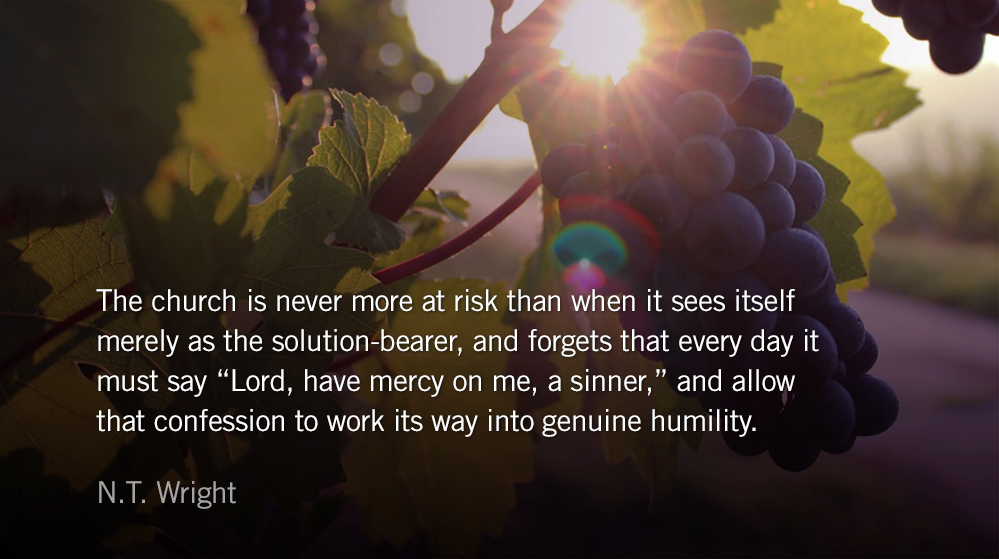
The church is never more at risk than when it sees itself merely as the solution-bearer, and forgets that every day it must say “Lord, have mercy on me, a sinner,” and allow that confession to work its way into genuine humility even as it stands boldly before the world and its crazy empires.

The Gospels thus tell the story, unique in the world’s great literature, religious theories, and philosophies: the story of the creator God taking responsibility for what’s happened to creation, bearing the weight of its problems on his own shoulders.


Today’s Reading
Proverbs 10 (Listen – 3:34)
Ephesians 3 (Listen – 2:41)

The Divine Mystery of the Cross :: Holy Week

“That wood of the cross is, then, as it were a kind of ship of our salvation, our passage, not a punishment, for there is no other salvation but the passage of eternal salvation,” wrote Ambrose of Milan. The saint must have held Isaiah’s prophecy in mind as he wrote:

Surely he has borne our griefs
and carried our sorrows;
yet we esteemed him stricken,
smitten by God, and afflicted.

But he was pierced for our transgressions;
he was crushed for our iniquities;
upon him was the chastisement that brought us peace,
and with his wounds we are healed.

All we like sheep have gone astray;
we have turned—every one—to his own way;
and the Lord has laid on him
the iniquity of us all.

The Son of God destroyed, his people set free—surely we have just as much trouble apprehending this as Christ’s own disciples. Early Christian writings focus not on the mechanics of the cross, but its implications for our lives. Ambrose, writing in the fourth century, continues:

That we may know that this mystery of the common redemption was most clearly revealed by the prophets, you have also in this place: “Behold, it has taken away your sins;” not that Christ put aside His sins Who did no sin, but that in the flesh of Christ the whole human race should be loosed from their sins.

O the divine mystery of that cross, on which weakness hangs, might is free, vices are nailed, and triumphal trophies raised. For Christ died for us, that we might live in His revived Body. Therefore not our life but our guilt died in Him, “Who,” it is said, “bore our sins in his body on the tree, that we might die to sin and live to righteousness. By his wounds you have been healed.”

We often join in Peter’s cry, “Far be it from you, Lord! This shall never happen to you.”—surely there must be another way. Unlike Peter, our desire is not as much to protect the Messiah we love, but to regain control by finding a logical way Christ could affect salvation.

The ship of our salvation is beyond our control. The gospel is this: though we created the storm, though we suffer as it surges, though we deserve to sink—we shall be guided home. Ambrose concludes, “While expecting death I do not feel it; while thinking little of punishment I do not suffer; while careless of fear I know it not.”


Evening Prayer: Daily Examen

1. Opening prayer of invitation: become aware of God’s presence (2 minutes).
2. Review your day with gratitude (3 minutes).
3. Renew the gospel in your heart and life (4 minutes).
4. Look forward with the Lord’s prayer (1 minute).

Download a guide for the Prayer of Examen (PDF).


Today’s Reading

Proverbs 9 (Listen – 1:50)
Ephesians 2 (Listen – 3:04)


Take Up Your Cross :: A Lenten Reflection

By Thomas à Kempis (c. 1379-1471)

Why, then, do you fear to take up the cross when through it you can win a kingdom? In the cross is salvation, in the cross is life, in the cross is protection from enemies, in the cross is infusion of heavenly sweetness, in the cross is strength of mind, in the cross is joy of spirit, in the cross is highest virtue, in the cross is perfect holiness. There is no salvation of soul nor hope of everlasting life but in the cross.

Take up your cross, therefore, and follow Jesus, and you shall enter eternal life. If you carry the cross willingly, it will carry and lead you to the desired goal where indeed there shall be no more suffering, but here there shall be. If you carry it unwillingly, you create a burden for yourself and increase the load, though still you have to bear it. If you cast away one cross, you will find another and perhaps a heavier one.

Do you expect to escape what no mortal man can ever avoid? Which of the saints was without a cross or trial on this earth? Not even Jesus Christ, our Lord, Whose every hour on earth knew the pain of His passion. The whole life of Christ was a cross and a martyrdom, and do you seek rest and enjoyment for yourself? Indeed, the more spiritual progress a person makes, so much heavier will he frequently find the cross, because as his love increases, the pain of his exile also increases.

Drink the chalice of the Lord with affection it you wish to be His friend and to have part with Him. Leave consolation to God; let Him do as most pleases Him. On your part, be ready to bear sufferings and consider them the greatest consolation, for even though you alone were to undergo them all, the sufferings of this life are not worthy to be compared with the glory to come.

If, indeed, there were anything better or more useful for man’s salvation than suffering, Christ would have shown it by word and example. But He clearly exhorts the disciples who follow Him and all who wish to follow Him to carry the cross, saying: “If any man will come after Me, let him deny himself, and take up his cross daily, and follow Me.”

*Abridged from The Imitation Of Christ.
Today’s Reading
Proverbs 6 (Listen – 3:22)
Galatians 5 (Listen – 3:22)


How to Find Freedom :: A Lenten Reflection

By Thomas à Kempis (c. 1379-1471)

Jesus has always many who love His heavenly kingdom, but few who bear His cross. He has many who desire consolation, but few who care for trial. He finds many to share His table, but few to take part in His fasting.

All desire to be happy with Him; few wish to suffer anything for Him. Many follow Him to the breaking of bread, but few to the drinking of the chalice of His passion. Many revere His miracles; few approach the shame of the Cross. Many love Him as long as they encounter no hardship; many praise and bless Him as long as they receive some comfort from Him. But if Jesus hides Himself and leaves them for a while, they fall either into complaints or into deep dejection.

Those, on the contrary, who love Him for His own sake and not for any comfort of their own, bless Him in all trial and anguish of heart as well as in the bliss of consolation. Even if He should never give them consolation, yet they would continue to praise Him and wish always to give Him thanks. What power there is in pure love for Jesus—love that is free from all self-interest and self-love!

Do not those who always think of their own profit and gain prove that they love themselves rather than Christ? Where can a man be found who desires to serve God for nothing? Rarely indeed is a man so spiritual as to strip himself of all things.

If a man has great virtue and much ardent devotion, he still lacks the one thing that is most necessary to him. What is this one thing? That leaving all, he forsake himself, completely renounce himself, and give up all private affections. For truth itself has said: “When you have done all that you were commanded, say, ‘We are unworthy servants; we have only done what was our duty.’”

Then he will be truly poor and stripped in spirit, and with the prophet may say: “I am alone and poor.” No one, however, is more wealthy than such a man; no one is more powerful, no one freer than he who knows how to leave all things and think of himself as the least of all.

*Abridged from The Imitation Of Christ.


Today’s Reading

Proverbs 5 (Listen – 2:08)
Galatians 4 (Listen – 4:13)