Risks of Faith :: Advent’s Love

Reflection: Risks of Faith :: Advent’s Love
The Park Forum

It is God’s love for us, not ours for him, that is the context for faith. Our ability to love God is imperfect—though spiritual disciplines and the rhythms of community can shape them greatly, as C.S. Lewis explains in Mere Christianity:

People are often worried. They are told they ought to love God. They cannot find any such feeling in themselves. What are they to do? The answer is the same as before. Act as if you did. Do not sit trying to manufacture feelings. Ask yourself, ‘If I were sure that I loved God, what would I do?’ When you have found the answer, go and do it.

Lewis isn’t deceived—“go and do it” only works until you can’t, or simply don’t—then what becomes of faith? He continues:

On the whole, God’s love for us is a much safer subject to think about than our love for Him. Nobody can always have devout feelings: and even if we could, feelings are not what God principally cares about.

Christian Love, either towards God or towards man, is an affair of the will. If we are trying to do His will we are obeying the commandment, ‘Thou shalt love the Lord thy God.’

He will give us feelings of love if He pleases. We cannot create them for ourselves, and we must not demand them as a right. But the great thing to remember is that, though our feelings come and go, His love for us does not. It is not wearied by our sins, or our indifference; and, therefore, it is quite relentless in its determination that we shall be cured of those sins, at whatever cost to us, at whatever cost to Him.

There is no faith without risk, and no reward in heaven for returning spiritual armor without dents. The armor of God is to protect believers as we apply our faith in a broken world—will not our hearts grow weary? The gospel is that Christ has succeeded where we have failed.

We do not shrink back because we are inconsistent in our love for God—we take risks of faith because God is relentless in his love for us.

Listen: It Came Upon A Midnight Clear by Ella Fitzgerald (3:20)

The Greeting
Into your hands I commend my spirit, for you have redeemed me, O Lord, O God of truth. — Psalm 31.5

– From 
Christmastide: Prayers for Advent Through Epiphany from The Divine Hours by Phyllis Tickle.

Full prayer available online and in print.

Today’s Readings
2 Chronicles 5-6.11 (Listen – 9:47)
1 John 4 (Listen – 2:58)
The Gift of Service :: Advent’s Love

Reflection: The Gift of Service :: Advent’s Love
The Park Forum

The story of Christ’s birth is the story of giving. Christ humbled himself. He was familiar with financial tension (his family lived at the sustenance level). He knew the pressures of vocation, and of working one job though he was designed for another—the Messiah was a carpenter for well over a decade. He gave himself to obedience, even to the point of death.

The words of Scripture instruct us to live as Christ lived, and draw models for Christian living from those that came before us. One such person to examine is Wenceslas I, the Duke of Bohemia, who later became a king and a saint. Ed Masters, writing for Regina Magazine, chronicles Wenceslas’ reputation:

He was generous to and provided support for the needs of the indigent, the widows and orphans. He bought freedom for slaves and even visited prisoners during the night, giving them alms and listening to their concerns as well as exhorting them to leave their former ways of life behind and to repent of their crimes. He was known to have carried wood on his back in the middle of the night to those that needed it for fuel and assisted at the funerals of the poor.

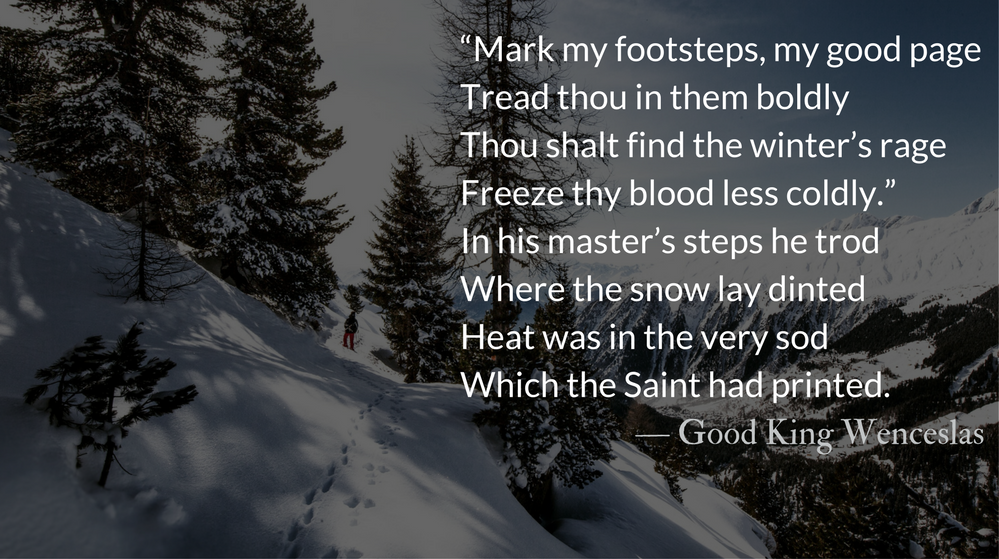
The saint was memorialized in the 1853 song, “Good King Wenceslas,” which celebrates the power of following the footsteps of a holy man. The fourth verse opens with the king’s page weakening as they press into the night to serve a poor man in the snow:

“Sire, the night is darker now
And the wind blows stronger
Fails my heart, I know not how,
I can go no longer.”
“Mark my footsteps, my good page
Tread thou in them boldly
Thou shalt find the winter’s rage
Freeze thy blood less coldly.”
In his master’s steps he trod
Where the snow lay dinted
Heat was in the very sod
Which the Saint had printed.

Wenceslas did not walk under his own strength; the king was often found at night praying in the church. His gifts of service were expressions of Christ’s ultimate gift—something our service to others can bring to life this holiday season.

Listen: Good King Wenceslas by Downhere (3:03)

The Morning Psalm
Great are the deeds of the Lord! They are studied by all who delight in them. — Psalm 111.2

– From 
Christmastide: Prayers for Advent Through Epiphany from The Divine Hours by Phyllis Tickle.

Full prayer available online and in print.

Today’s Readings
2 Chronicles 3-4 (Listen – 5:42)
1 John 3 (Listen – 4:41)

Restful Meditations :: Advent’s Hope

Reflection: Restful Meditations :: Advent’s Hope
The Park Forum

Focusing our hearts on Christ, the hope of Advent, expands the holiday experience beyond mere merriness. In the gospel our hearts find rest from pain and hope for renewal.

“Jesus, my feet are dirty,” prayed Origen in the third century. “Come even as a slave to me, pour water into your bowl, come and wash my feet. In asking such a thing I know I am overbold, but I dread what was threatened when you said to me, ‘If I do not wash your feet I have no fellowship with you.’ Wash my feet then, because I long for your companionship.”

Origen’s prayer captures the spirit of Advent: looking back at Christ’s work on our behalf, looking forward at the completion of his fellowship, and longing for his presence and power today.
Another third century prayer, an anonymous Syriac Christmas liturgy, gives words to this hope:

The radiance of the Father’s splendor, the Father’s visible image, Jesus Christ our God, peerless among counselors, Prince of Peace, Father of the world to come, the model after which Adam was formed, for our sakes became like a slave: in the womb of Mary the virgin, without assistance from any man, he took flesh.

Enable us, Lord, to reach the end of this luminous feast in peace, forsaking all idle words, acting virtuously, shunning our passions, and raising ourselves above the things of this world.
Bless your church, which you brought into being long ago and attached to yourself through your own life-giving blood…

Bless your servants, whose trust is all in you; bless all Christian souls, the sick, those tormented by evil spirits, and those who have asked us to pray for them.

Show yourself as merciful as you are rich in grace; save and preserve us; enable us to obtain those good things to come which will never know an end.

May we celebrate your glorious birth, and the Father who sent you to redeem us, and your Spirit, the Giver of life, now and forever, age after age. Amen.

Christ, may our hearts find their rest in you, the hope of Advent.

Listen: Greensleves by Vince Guaraldi Trio.

The Refrain for the Morning Lessons
For God, who commanded the light to shine out of darkness, hath shined in our hearts, to give the light of the knowledge of the glory of God in the face of Jesus Christ. — 2 Corinthians 4.6

– From 
Christmastide: Prayers for Advent Through Epiphany from The Divine Hours by Phyllis Tickle.

Full prayer available online and in print.

Today’s Readings
1 Chronicles 29 (Listen – 5:50)
2Peter 3 (Listen – 3:21)

Today’s Readings
2 Chronicles 1 (Listen – 2:47) 1 John 1 (Listen – 6:18)
2 Chronicles 2 (Listen – 3:41) 1 John 2 (Listen – 3:02)

O Come, O Come, Emmanuel :: Advent’s Hope

Reflection: O Come, O Come, Emmanuel :: Advent’s Hope
The Park Forum

“Caesar is Lord,” the people would shout as his chariot traversed the streets. Rome’s elite culture—from philosophy to viaducts, engineering to economics—was unsurpassed and almost universally recognized as the hope of the world. It was stunning when the empire fell into decline.

In the end, Caesar proved not only unable to save his kingdom, but even himself. The fall of Rome plunged civilization into what historians have long-called the Dark Ages. For hundreds of years battles raged endlessly, pestilence and plague spread freely, and chaos seemed to gain the upper hand all too regularly.

The period isn’t significantly brighter in church history. Scripture was largely inaccessible, starving the Church of sound doctrine and increasing the growth of folk religion, superstition, and far worse. (The devastating interpretations of Scripture that lead to the crusades fomented during this time.)

“O come, Thou Wisdom, from on high, and order all things far and nigh,” wrote an anonymous monk sometime before 800 C.E. The words to “O Come, O Come, Emmanuel” cry out from the depths of the Dark Ages—longing for God’s presence, Emmanuel, to rescue humankind.

In some ways the unknown author behind this song is an outlier to his or her world; the lyrics demonstrate intimate knowledge of Scripture in a time of illiteracy. In other ways the lyricist was shaped firmly by the Dark Ages—depravity writ large—and its revelations of humanity’s limits. Even had there been a vision for restoration present, no one on earth would have been sufficient to breathe it to life.

O come, Desire of the nations, bind
in one the hearts of all mankind;
bid every strife and quarrel cease
and fill the world with heaven’s peace.

“Jesus is Lord,” is a revolutionary claim. It not only upends global empires, but whatever we would enthrone on our hearts to save ourselves from the insufficiency of our world.

In Advent we await the coming of the all-sufficient King; he is the wisdom we yearn for and the power we need. He is God, and his presence brings healing to our world and restoration to our hearts.

Listen: O Come, O Come, Emmanuel by Francesca Battistelli (4:20)

The Request for Presence
For God alone my soul in silence waits; truly, my hope is in him — Psalm 62.6

– From 
Christmastide: Prayers for Advent Through Epiphany from The Divine Hours by Phyllis Tickle.

Full prayer available online and in print.

Today’s Readings
1 Chronicles 28 (Listen – 4:45)
2 Peter 2 (Listen – 3:52)

Depression, Anger, Redemption :: Advent’s Hope

Reflection: Depression, Anger, Redemption :: Advent’s Hope
The Park Forum

“Charles Jennens was a collaborator of Handel’s who struggled with depression following the suicide of his younger brother,” writes Mitch Davis who produced a documentary on Handel’s Messiah. Jennens’ brother was reportedly talked out of his faith at university and subsequently took his own life. “Jennens craved the spiritual solace he found in the exalted strains of Handel’s music and sought to combine that music with the scriptural words that comforted him during his depressive bouts.” Jennings composed the libretto of Messiah from translations of the Bible from the King James Version and The Book of Common Prayer.

Handel bounced from patron to patron throughout his career. Poor management of money and the resulting large shifts in his income, led him to become significantly indebted in London. Additionally, Handel’s first biographer John Mainwaring recorded that Handel, ”paid more attention to [food] than is becoming to any man.” Handel eventually became overweight, but was known far wider for English tabloid reports on his temper. In one argument he threatened to throw a soloist out a window, in another he escalated a verbal fight until a friend stabbed him with a sword (Handel was spared, as the sword was blunted by a metal button).

Mesmerized when he saw Jennens’ impassioned libretto, Handel worked feverishly on an oratorio, completing it in less than four weeks. Messiah was a turning point for Handel; its success freed him from his debts, and he became extraordinarily generous with the wealth his fame allowed. Something beyond material success seems to have happened as well. During the composition, Handel had what some call a spiritual epiphany. “I did think I did see all Heaven before me, and the great God himself.” Handel wrote as he composed the Hallelujah Chorus. “Whether I was in the body or out of my body when I wrote it, I know not.”

“Even when the subject of his work is religious, Handel is writing about the human response to the divine,” observes Harry Bicket, the director of The English Concert chamber orchestra. It’s clear both Jennens and Handel found personal grounding in Messiah and wanted to share that experience with others. Messiah seems to be both both men’s declaration that Christ is sufficient in the chaos of the world. They approached Messiah, as we can during this season as well, drawing solace and strength from the glory of Christ.

Listen: Hallelujah Chorus by The London Philharmonic.

The Request for Presence
Gladden the soul of your servant, for to you, O Lord, I lift up my soul. — Psalm 86.4

– From 
The Divine Hours: Prayers for Autumn and Wintertime by Phyllis Tickle.

Full prayer available online and in print.

Today’s Readings
1 Chronicles 26-27 (Listen – 9:39)
2Peter 1 (Listen – 3:06)

Show Buttons
Hide Buttons
Spur a spiritual rhythm of refreshment right in your inbox
By joining this email list you are giving us permission to send you devotional emails each weekday and to communicate occasionally regarding other aspects of the ministry.
100% Privacy. We don't spam.