Fully Human, Fully Saved

Scripture: Hebrews 2.14-15
Since the children have flesh and blood, he too shared in their humanity so that by his death he might break the power of him who holds the power of death—that is, the devil— and free those who all their lives were held in slavery by their fear of death.

This week and next, Jon Polk is taking us on a deep dive through the book of Hebrews. Check out the first one if you missed it. I’m looking forward to this journey. — John

Reflection: Fully Human, Fully Saved
By Jon Polk

For most believers of the Christian faith, accepting the divinity of Jesus is a given. This one who is called the Christ, the Son of God, is the fullest representation of the character and being of God. Jesus is fully divine.

But what are we to make of Jesus’ humanity? This is often where we struggle. How can Jesus be both fully divine and fully human?

When we read the gospels, we find that at times…

Jesus became hungry.

Jesus was thirsty.

Jesus became tired.

Jesus was sleepy.

The scriptures tell us that Jesus was born, he grew physically, he died, and he had a human body after the resurrection.

Was this all absolutely necessary?

Given the number of eye-witnesses to Jesus’ earthly life, it may seem odd that one of the earliest heresies to plague the early Christian church was Docetism, the belief that Jesus’ physical body was merely an illusion, that he was actually pure spirit and only appeared to have a human body. John addresses this issue in his letters, stating first that “those who acknowledge that Jesus Christ has come in the flesh” are from God and second, that “those who do not acknowledge Jesus Christ as coming in the flesh are deceivers.”

In the case of Jesus, neither fully divine nor fully human was sufficient on its own. This is one of the great mysteries of the incarnation. Why did God, through his Son, come to earth in human flesh?

He did so for our very salvation.

It was not the angels in the heavenly realms that Jesus set out to rescue, but flesh and blood human beings who were held in slavery by the great deceiver. Jesus became fully human so that he could serve as our high priest to not only administer the atoning sacrifice for our sins, but also to become that sacrifice himself.

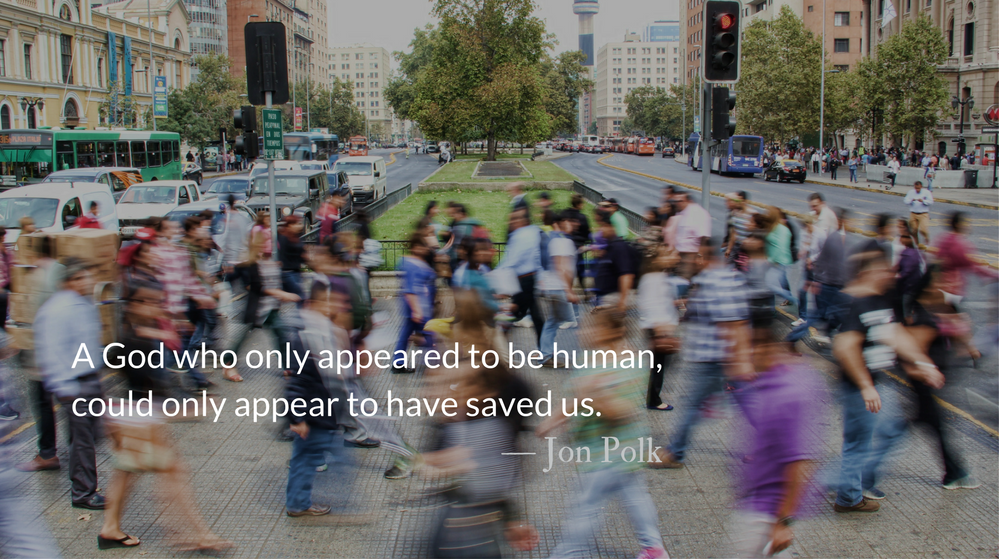
For a God who only appeared to be human, could only appear to have saved us. But our God, who became fully human, did so in order that he might fully save us. And therefore, we should not ignore so great a salvation, because we recognize that we are fully indebted to him.

The Request for Presence
Be glad, you righteous, and rejoice in the Lord; shout for joy, all who are true of heart. — Psalm 32.12

– From 
The Divine Hours: Prayers for Autumn and Wintertime by Phyllis Tickle.

Full prayer available online and in print.

Today’s Readings
2 Kings 20 (Listen – 3:39)
Hebrews 2 (Listen – 2:47)

Solus Christus

Scripture: Hebrews 1.1-2a
In the past God spoke to our ancestors through the prophets at many times and in various ways, but in these last days he has spoken to us by his Son….

I am excited for the next two weeks as Jon Polk takes us on a deep dive through the book of Hebrews starting with this expansion of its beautiful opening passage. Hebrews is rich ground and I’m looking forward to what Jon has for us. — John

Reflection: Solus Christus
By Jon Polk

Abraham, by faith, left his home and set off with his family on a journey to an unknown promised land, but he was not called the Son of God.

The deliverer, Moses, by the power of God, led the children of Israel out of captivity in Egypt and became their spiritual leader. He was used by God to reveal the law and the commandments, yet he was not called the Son of God.

The great king, David, indeed, the greatest of all the kings of Israel, was known as a man after God’s own heart, but he was not called the Son of God.

Isaiah, Micah, Jeremiah, Joel, Hosea and all the other prophets were the very mouthpiece of God, proclaiming truth to the people of Israel, yet not one of them was called the Son of God.

There is only one through whom God created the universe.

There is only one who is the radiance and majesty of God’s glory.

Only one who upholds all things by his mighty, powerful word.

Only one who, through his sacrifice, provided cleansing for sin.

And only one who sits at the right hand of God in heaven.

This is the one who is called the Son of God. The one through whom God has spoken to us in these final days. He is God’s Final Word.

God spoke through the Son in the same way God spoke through the prophets. The message was clear, significant and punctuated by illustrations of power. However, with Jesus, the difference was that his message was ultimate, final and complete.

Jesus, the Son of God, the Christ, the Messiah, the Liberating King, is the exact representation of God’s being. In Jesus, we see the fullness of God’s character. There has never been and will never be a clearer portrait of God than the person of Jesus himself.

If you want to know the nature of God, if you want to witness the work of God, if you want to understand the love and compassion of God, look no further than Jesus the Christ.

For nothing can ever replace Jesus, nothing can ever exceed Jesus, and nothing is ever needed in addition to Jesus.

Jesus alone is the Son of God.

The Request for Presence
You are the star of the morn

You are the day newly born

You are the light of our night

You are the Savior by your might

— by David Adam

– From 
The Divine Hours: Prayers for Autumn and Wintertime by Phyllis Tickle.

Full prayer available online and in print.

Today’s Readings
2 Kings 19 (Listen – 6:11)
Hebrews 1 (Listen – 2:15)

Persistence in Prayer

Scripture: 2 Thessalonians 1.3
We ought always to thank God for you, brothers and sisters, and rightly so, because your faith is growing more and more, and the love all of you have for one another is increasing.

Reflection: Persistence in Prayer
by Jon Polk

“I’ll pray for you.”

We’ve all done it. With complete sincerity, we’ve told a friend that we’d remember them in prayer, only to have the prayer request slip out of our memory not long after we’ve left their company.

We meant what we said; we intended to pray, but the request was forgotten once we got back to the office, or got home from our Bible study, or arrived at the restaurant for lunch after Sunday worship. There is a danger when we don’t follow through with our honest intentions to pray; eventually those words “I’ll pray for you” become a hollow and empty promise.

In the opening passage of 2 Thessalonians, we find Paul’s usual greetings and salutations. We may be tempted to rush past these opening verses in Paul’s epistles, thinking they are nothing more than, “Hi, how you doin’?”

However, in these opening remarks, Paul mentions two specific characteristics of the believers in Thessalonica that cause him to give thanks to God: their faith and love. He commends them for growth and maturation of both.

In Paul’s first correspondence with the Thessalonians, he tells them that “night and day we pray most earnestly that we may see you again and supply what is lacking in your faith.” (1 Thess. 3:10) He also prays for them, asking that “the Lord make your love increase and overflow for each other and for everyone else, just as ours does for you.” (1 Thess. 3:12)

Paul had announced his intention to pray for their faith, in areas where it was lacking, and for an increase in their love towards one another.

Presumably, a significant amount of time passed between Paul’s first and second letters to the Thessalonian believers, but nonetheless, as he pens the opening lines of his second letter, he thanks God for their growth in both faith and in love, the same issues upon which he had focused his prayers for them.

Later in this opening chapter of 2 Thessalonians, he reminds them, “we constantly pray for you.” Apparently when Paul says, “I’ll pray for you,” he actually follows through.

May we share that same sense of commitment the next time we utter those simple words, “I’ll pray for you.”

The Greeting
O Lord, I cry to you for help; in the morning my prayer comes before you. — Psalm 88:14

– From 
The Divine Hours: Prayers for Autumn and Wintertime by Phyllis Tickle.

Full prayer available online and in print.

Today’s Readings
2 Kings 1 (Listen – 3:13)
2 Thessalonians 1 (Listen – 1:52)

This Weekend’s Readings
2 Kings 2 (Listen – 4:26) 2 Thessalonians 2 (Listen – 2:32)
2 Kings 3 (Listen – 4:29) 2 Thessalonians 3 (Listen – 2:16)

Escaping Discontent

Scripture: Philippians 4:12
I know what it is to be in need, and I know what it is to have plenty. I have learned the secret of being content in any and every situation, whether well fed or hungry, whether living in plenty or in want.

Reflection: Escaping Discontent
By Jon Polk

A commercial pilot flying over the Tennessee mountains pointed out a lake to his co-pilot. “See that lake down there? When I was a boy, I used to sit in a rowboat and fish for hours. Whenever a plane flew overhead, I pretended I was piloting the jet.”

The co-pilot responded, “You must be proud that you have achieved your boyhood dreams.” The pilot replied, “Not exactly. Now when I fly over that lake, I wish I was down there fishing.”

Contentment is an elusive pursuit. We want to believe there is something out there that we can find or achieve or buy that will finally make us happy.

It is difficult to find contentment in a culture that works hard to foster discontent. Consumer economies are designed to ensure we are never satisfied, in essence, monetizing our discontent. Businesses do their best to keep us constantly longing for the latest and greatest “Shiny Objects.” Enough is never enough.

If we are never satisfied, we are not fully able to enjoy the life that God has given us.

Notice that Paul didn’t write, “I’m so glad that it is easy to be content in every situation.” No, he says, “I had to learn to be content whatever the circumstances.”

First, Paul learned we should rejoice in the Lord. Even in the midst of difficulty we can rejoice that God sustains and cares for us. Second, be known for gentleness, not insisting on our own rights, but instead striving for the welfare of others. Third, don’t be anxious about anything. Recall the words of Jesus, “Can any one of you by worrying add a single hour to your life?” Finally, pray with thanksgiving. When we give thanks to God, we acknowledge that everything we have is a gift, a result of His goodness and generosity.

If we are pursuing these things, what are we not doing?

We’re not congratulating ourselves for how great we are. We’re not being proud or selfish or stingy with our resources. We’re not complaining or comparing ourselves to others. We’re not consumed by the insatiable quest for more.

Instead, we are free to focus on the only one who can provide for us, God himself, and when we find joy in the Lord, we can let go of our discontent and find contentment in his love and grace.

The Call to Prayer
Sing praise to the Lord who dwells in Zion; proclaim to the peoples the things he has done. — Psalm 9:11

– From 
The Divine Hours: Prayers for Summertime by Phyllis Tickle.

Full prayer available online and in print.

Today’s Readings
1 Kings 13 (Listen – 5:14)
Philippians 4 (Listen – 3:20)

Gospel Faith or Garbage Faith

Scripture: Philippians 3:8-9
I consider them garbage, that I may gain Christ and be found in him, not having a righteousness of my own that comes from the law, but that which is through faith in Christ—the righteousness that comes from God on the basis of faith.

Reflection: Gospel Faith or Garbage Faith
By Jon Polk

Before the Damascus road, Paul had all that we expect would make a person successful: respect, reputation, power, influence. He had the pedigree of his nationality and family. He had the résumé of an impeccable Pharisee, a leader in the community.

And yet, even with all that he had achieved, once he met Christ, Paul realized everything prior was waste, rubbish, by comparison.

The word that Paul uses in Philippians 3:8, often translated “garbage,” is Greek for dung or excrement. Paul makes an extreme point by stating that all that he has built up in his life—all that we consider to be of value—is completely worthless when compared to faith in Christ. By using this particular word, he is saying that it is all, quite frankly, disgusting and repulsive.

So what does Paul consider worthwhile? What should we strive for? Knowing Christ through faith. We should pursue a righteousness that is not found in accomplishments, or in keeping the law or rules, or in being a “good person.” The only worthy thing is knowing Christ in the power of his resurrection and in participation in his suffering. This kind of faith is our foundation.

A story is told of a wealthy man on his deathbed visited by an angel. Upon hearing the angel remind him that “you can’t take it with you,” the man pleads, “Please, I have so much that I have worked hard all my life to acquire. May I bring just one suitcase?” The man begs until the angel grants his request.

Thinking he was clever, the wealthy man converted his riches and filled the suitcase with gold bars. When death came for the man and he arrived at the Pearly Gates, St. Peter insisted on inspecting his luggage.

Opening the heavy suitcase to examine its contents, Peter looked at the man, puzzled, and asked, “Why did you bring a suitcase full of pavement?”

The “streets of gold” metaphor in Revelation reminds us that the very things we find valuable in this life will be most ordinary in our eternal life. The stuff we value here will be under our feet in eternity.

Faith in Christ, the foundation of our righteousness, is the only thing that lasts. In the end, it won’t matter how much money we made, what country we were born in, what our family pedigree is, or how successful, powerful or prestigious we became. Only faith sustains and only faith remains.

A Reading
Jesus taught us, saying: “How blessed are the poor in spirit: the kingdom of heaven is theirs.” — Matthew 5:3

– From 
The Divine Hours: Prayers for Summertime by Phyllis Tickle.

Full prayer available online and in print.

Today’s Readings
1 Kings 12 (Listen – 7:05)
Philippians 3 (Listen – 3:21)