Diamonds In the Rough

Scripture Focus: 1 Samuel 30.22-25
22 But all the evil men and troublemakers among David’s followers said, “Because they did not go out with us, we will not share with them the plunder we recovered. However, each man may take his wife and children and go.” 

23 David replied, “No, my brothers, you must not do that with what the LORD has given us. He has protected us and delivered into our hands the raiding party that came against us. 24 Who will listen to what you say? The share of the man who stayed with the supplies is to be the same as that of him who went down to the battle. All will share alike.” 25 David made this a statute and ordinance for Israel from that day to this. 

Reflection: Diamonds In the Rough
By John Tillman

During this period of David’s life, he was God’s anointed, the rightful king of Israel, yet Saul was determined to maintain power. David not only had no throne, he was forced into exile.

An outcast, David attracted outcasts. (1 Samuel 22.2) He took in the distressed and the discontented, the poor and the rebellious. It’s easy to lead those of exemplary character and high moral standards. David was leading those so violent they were a danger to even him.

Many events in this section of scripture depict tests of David’s character. Will he murder Nabal? (1 Samuel 25.34) Or Saul? (1 Samuel 24.3-10) Will he take the throne by force? Will he be just? Will he be a ruffian in the wilderness or a diamond in the rough?

David doesn’t pass every test. To survive Saul, he serves the enemy of his enemy, marching under the banner of King Achish and his false god. David is no king yet. At best, during this time we might call David a warlord—a mercenary. At worst, a war criminal. Scripture doesn’t hide these failings but it does highlight moments when David’s roughness is cut away and facets of kingly destiny shine.

In a moment of victory, David’s rough gang of fighters wants to shame the weak, claiming dominance and a greedy share of wealth. The narrator calls them “evil men and troublemakers.” David calls them, “my brothers.”

David does not shy away from pointing out that their arguments are foolish. His rhetorical question, “Who will listen to what you say?” shames them but calling them “brothers” lifts them up. David not only stops the madness of the moment, he establishes a just rule from that moment on. David grows into his calling and at least some of his men follow along.

Like David, we may find ourselves in exile stuck between wicked kings. We feel the tension of being in this world but not of it and being surrounded by the desperate who default to violence and selfishness.

Like David, we’ll stumble, fail, and perhaps compromise when we should stand boldly. But amidst our rough and tumble world, we must remember that in God’s reality, we are children of God and regents of his Kingdom.

We, and those around us, need to be cut, shaped, ground, and polished by the Holy Spirit from diamonds in the rough to shining facets reflecting Christ’s light.

Divine Hours Prayer: The Call to Prayer
Open my lips, O Lord, and my mouth shall proclaim your praise. — Psalm 51.16

– From The Divine Hours: Prayers for Summertime by Phyllis Tickle.

Today’s Readings
1 Samuel 29-30 (Listen 6:33)
Revelation 9 (Listen 3:30)

Read more about Blocking the Way of Wickedness
We don’t always have a choice about working with or living among wicked people, but we can choose how we respond.

Read more about Supporting Our Work
Our donors support ad-free content that brings biblical devotionals to inboxes across the world. Consider becoming one today.


Beyond “Plain Reading” — Readers’ Choice

Scripture Focus: Ephesians 5.21-25
21 Submit to one another out of reverence for Christ. 
22 Wives, submit yourselves to your own husbands as you do to the Lord. 23 For the husband is the head of the wife as Christ is the head of the church, his body, of which he is the Savior. 24 Now as the church submits to Christ, so also wives should submit to their husbands in everything. 
25 Husbands, love your wives, just as Christ loved the church and gave himself up for her.

Originally published on July 11, 2023, based on readings from Ephesians 5.

Readers’ Choice posts are selected by our readers:
Erin, Texas — Despite addressing this topic before, each year we need reaffirmation of the value of women in ministry. The debates were heightened over the summer when some churches were disfellowshipped for women pastors. Thank you for this encouragement! 

Brian, Washington D.C
. — Thank you for the gift of this reflection. The Word is the Word. And so many pastors jump past these verses and rush to a verse and declare that verse ends the conversation. Drives me nuts. The Bible can be blunt and direct and can also cause us to study and pray and think about what is in this holy text.

Reflection: Beyond “Plain Reading” — Readers’ Choice
By John Tillman

We often describe the Bible as a park in the midst of the city — a place of restoration and peace amidst the concrete-coated, steel-and-glass struggles of life.

Some Bible passages, however, are less like peaceful parks and more like battlegrounds. When passages have been weaponized and abused, how can we stop hearing them as weapons but as God’s word?

Today’s passage and other Pauline passages about women are such cases. One chapter of Confronting Christianity is “Doesn’t Christianity Denigrate Women?” In it, Rebecca McLaughlin mentions that Ephesians 5.22 repulsed her at first. It seemed hierarchical and prime for abuse.

One reason many think such passages are abusive is how some Christian voices interpret them. Using a “plain reading” they say Paul tells women to sit down. To shut up. To go home. Are they right?

We need to go beyond “plain reading” because the Bible is not plainly written. Peter points out that the difficulty of interpreting Paul leads to destruction. (2 Peter 3.15-17) Treating the Bible as clear-cut instructions which need no interpretation is foolish. Treating our interpretations as infallible is arrogant.

“Plain reading” conveniently lets us carry our prejudices and culture into scripture rather than reading the text in the context and culture of the writer. We better understand Paul’s words in the context of his actions. Are men to be lifted up and women to be pushed down? Did Paul intend that? Did Paul believe it? Did Paul enact it?

Paul’s treatment of women interprets his words about women. What women did in Paul’s ministry tells us how “submissive” women behave and what they do. Phoebe the deacon, Junia the apostle, Lydia the business owner and church founder, Priscilla the theological teacher…these are not rebels or heretics. They are women following Paul’s words, obeying his intent.

We need to read scripture humbly, contextually, and repeatedly. Don’t give up on passages that have been abused or argued over. The Bible has pearls of great price, treasures hidden in fields, and riches of wisdom to be mined. You’ll rarely strike gold with the first turn of a shovel or solve thorny theological problems with the first turn of a page. (Or 400 words of a devotional.)

We’ll find what Paul means by walking in the steps of Paul and of Jesus. With humility and patience, battlefields can once again become peaceful parks.

From John: To go more in depth on this issue and other challenging topics, I recommend McLaughlin’s book, Confronting Christianity. I am, through my church, helping lead a book club of atheists, agnostics, and deconstructed people discussing the book and it is an excellent place to start for those exploring challenging questions about Christianity.

Divine Hours Prayer: The Morning Psalm: The Sparrow has Found a Nest
…My soul has a desire and longing for the courts of the Lord; my heart and my flesh rejoice in the living God.
The sparrow has found her a house and the swallow a nest where she may lay her young; by the side of your altars, O Lord of hosts, my King and my God. — Psalm 84.1-2


– From The Divine Hours: Prayers for Summertime by Phyllis Tickle.

Today’s Readings
1 Samuel 24 (Listen 3:36)
Revelation 4 (Listen 2:09)

Read more about None Excluded or Excused
For Paul, ministry was collaborative. Paul’s ministry team included all races, men and women, young people and elders, slaves and free, rich and poor.

Read more about No Asterisks
Deborah’s judgeship doesn’t deserve an asterisk…God did not “settle” for Deborah. He chose her.

Love One Another — Readers’ Choice

Scripture Focus: 1 Peter 3:8-9
8 Finally, all of you, be like-minded, be sympathetic, love one another, be compassionate and humble. 9 Do not repay evil with evil or insult with insult. On the contrary, repay evil with blessing, because to this you were called so that you may inherit a blessing. 

Originally published on November 9, 2022, based on readings from 1 Peter 3.

Readers’ Choice posts are selected by our readers:
Cheryl, South Dakota — Amen! And Amen!

Reflection: Love One Another — Readers’ Choice
By Erin Newton

If you took time to read all the verses that command God’s people to love one another and pursue peace, it would take quite a while. Love one another. (John 13.34-35) Show faithful love and compassion to one another. (Zechariah 7.9). Love one another deeply as brothers and sisters. (Romans 12.10). Let us consider one another in order to provoke love. (Hebrews 10.24) And on and on. Why the repetition? Wouldn’t one command have been enough?

People have always struggled in relationships. Families are broken. Friendships are strained. Neighbors are viewed as enemies. Since the breaking of peace in the Garden of Eden, humanity has been at odds with itself. This should not be so. This is the brokenness of our world.

After exhorting people in specific relationships, one last call to unity is given to the whole congregation. Peter reminds his church to seek what is good: Love. Sympathy. Compassion. Humility. Cautious words. Slowness to speak. Blessings to others.

We cannot blame our hatred, rudeness, malice, anger, or selfishness on ignorance. Too many commands have taught us to behave otherwise. Being a jerk is a conscious decision. We choose not to love someone. We choose not to speak kindly. We choose not to withhold insults.

For those who live in the United States, many will awaken to news of newly elected leaders. Some of the results will be for decisions or people we supported and others will not.

Over the last few years, culture has sunk into a climate of animosity. Our values and beliefs have turned us against one another. Sadly, it has seeped into our churches. Christians, united by the Holy Spirit, have turned against one another.

For our friends around the world, it will be another day with other concerns. No matter what the day brings, we still have the opportunity to choose our responses to one another.

Let us strive for something worthwhile. Let us strive for peace. If we are going to use up all our emotional energy targeting something, let it be with the energy of love and kindness. If we are going to be screaming, may it be words of life and encouragement. If we are going to focus our attention on someone for something they said, let us put our noses into our Bibles and read God’s words instead.

People will be watching us today and in the days to come. Be a worthy spectacle.

Divine Hours Prayer: A Reading
Jesus taught us, saying: Is a lamp brought in to be put under a tub or under the bed? Surely to be put on the lampstand? For there is nothing hidden, but it must be disclosed, nothing kept secret except to be brought to light. Anyone who has ears for listening should listen. — Mark 4.21-23

– From The Divine Hours: Prayers for Summertime by Phyllis Tickle.

Today’s Readings
1 Samuel 23 (Listen 4:18)
Revelation 3 (Listen 3:53)

Read more about Confessing Hostility—Guided Prayer
Like rebellious, prodigal children, our hostility breaks fellowship with you and with our brothers and sisters.

Read The Bible With Us
Our Bible reading plan’s sustainable, two-year pace helps you find meaning without being overwhelmed. Join us.
https://mailchi.mp/theparkforum/m-f-daily-email-devotional

Urban Legends and Good Shepherds — Readers’ Choice

Scripture Focus: John 10.11-15
11 “I am the good shepherd. The good shepherd lays down his life for the sheep. 12 The hired hand is not the shepherd and does not own the sheep. So when he sees the wolf coming, he abandons the sheep and runs away. Then the wolf attacks the flock and scatters it. 13 The man runs away because he is a hired hand and cares nothing for the sheep.

14 “I am the good shepherd; I know my sheep and my sheep know me—15 just as the Father knows me and I know the Father—and I lay down my life for the sheep.

Originally published on January 10, 2023, based on readings from John 10.

Readers’ Choice posts are selected by our readers:
Barbara, Tennessee — Wow, thank you, John! That is a terrible legend that I thought was legit animal husbandry! And it was taught to us by manipulative shepherds. Some of our adult children are still in need of the Lord for healing.

Brian, Washington D.C. — Thank you for this remarkable reflection. Such a good word for me today.

Jon, Hong Kong/TX — This is a nice piece. I think I may have been the one who told you it was Eddie Van Halen. At least, that was the story that I used to pass around as well.

Reflection: Urban Legends and Good Shepherds — Readers’ Choice
By John Tillman

In the 90s, listening to Phil Keaggy, I heard a story from a friend.

“Phil’s the world’s greatest guitarist. One night, on Johnny Carson, Jimi Hendrix was asked, ‘What’s it like to be the world’s greatest guitarist?’ He said, ‘I don’t know. Ask Phil Keaggy.’”

“So cool,” I thought at the time. I spread the tale often as I shared my love of Phil Keaggy.

Years later I heard another Keaggy fan begin the same story. I was shocked when, instead of Jimi Hendrix, it was Eddie Van Halen on the talk show. Every other detail was identical. My heart fell. I realized the stories weren’t true.

To put it kindly, they were urban legends. To be more direct, they were lies. Lies I had spread over and over. I felt sick and angry. My friends and I had been duped.

Worse than urban legends about guitarists are urban legends about God. Recently, I was reminded of an old “preacher story” about shepherds and lambs.

Supposedly, a shepherd would break a wandering lamb’s leg and carry it as the leg healed. By caring for the lamb and holding it close, it would bond with him and never wander again. This act of “tough love” allegedly explained how God wounds us to keep us close to him. Authoritative and abusive leaders have used this metaphor to justify “wounding” parishioners with “tough love” because they are “good shepherds.”

To put it kindly, this metaphor is a myth—a “rural legend” instead of an “urban” one. To be more direct, it is a lie. Nowhere in records of animal husbandry or the Bible is there a description of shepherds breaking the legs of sheep in this way. Worse than damaging our understanding of human shepherds, this story damages our understanding of Jesus, the true good shepherd.

Don’t be duped into thinking that Jesus treats his sheep in this way. Abusive “hired hands” may wound their sheep or leave them unprotected from the wolves. But Jesus, the good shepherd, rushes in to face the wolf.

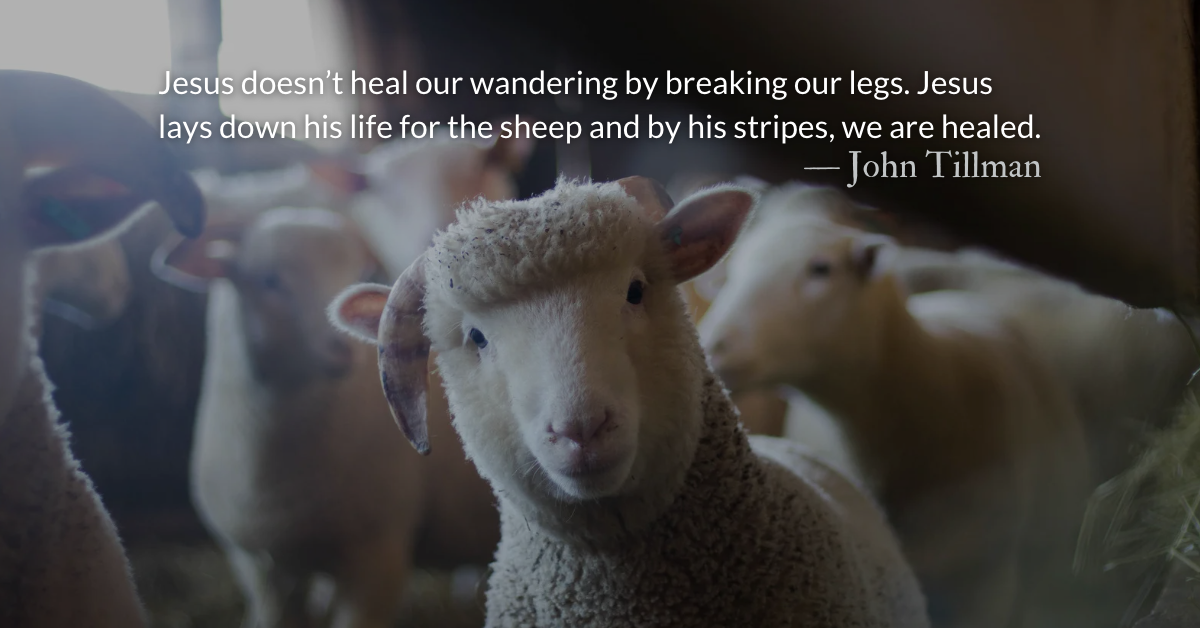
Jesus doesn’t heal our wandering by breaking our legs. Jesus lays down his life for the sheep and by his stripes, we are healed. Jesus’ body is broken for his sheep, and by him we are whole.

You may have been wounded by a foolish or wicked shepherd. But you can still be healed by Jesus, the good shepherd.

Music: “Jesus Is The Great Shepherd” from Live From Lawrence, Kansas (November 1974) by Phil Keaggy and Paul Clark

Divine Hours Prayer: The Greeting
O God, you have taught me since I was young, and to this day I tell of your wonderful works. — Psalm 71.17

– From The Divine Hours: Prayers for Summertime by Phyllis Tickle.

Today’s Readings
1 Samuel 20 (Listen 6:3)
Revelation 1 (Listen 1:51)

Read more about Tendencies of Unfaithful Shepherds
May we, and our shepherds be more like Jesus. May we seek and support earthly shepherds like him.

Read The Bible With Us
It’s never too late to join our Bible reading plan. Immerse in the Bible with us at a sustainable, two-year pace.

https://mailchi.mp/theparkforum/m-f-daily-email-devotional

Time Tested Devotion — Readers’ Choice

Scripture Focus: Colossians 4.2-6
2 Devote yourselves to prayer, being watchful and thankful. 3 And pray for us, too, that God may open a door for our message, so that we may proclaim the mystery of Christ, for which I am in chains. 4 Pray that I may proclaim it clearly, as I should. 5 Be wise in the way you act toward outsiders; make the most of every opportunity. 6 Let your conversation be always full of grace, seasoned with salt, so that you may know how to answer everyone.

Originally published on October 21, 2022, based on readings from Colossians 4.

Readers’ Choice posts are selected by our readers:
Cheryl, South Dakota — Thank you! This touched my soul! I look forward to applying it to my daily life again. I have used this process before, didn’t realize it had a name.

Barbara, Tennessee
— Reminder of this examen came at a perfect time for this. I’ve been awake for a couple of hours stewing unhealthily! This is helping me move on. Thank you, Lord!

Reflection: Time Tested Devotion — Readers’ Choice
By John Tillman

One time-tested way of devoting oneself to prayer is the prayer of Examen. First published in 1548 in the Spiritual Exercises, by Saint Ignatius, this prayer has been used throughout the Church, by both clergy and laypersons.

There are many versions of the Examen, including the version at this link. The Examen is adaptable and customizable. As you implement it and get it into your memory, you can use the prayer at any time.

Pray the Examen regularly and it will tutor you in practicing the presence of God. When you are more sensitive to his presence and leading, you can become a reliable source of God’s influence and action, no matter where you go.

For a simple, short version of the Examen, use the following five actions: Awareness, Analysis, Admission, Acceptance, Anticipation.

Awareness: Pause. Relax. Release any concerns your mind is holding. Become aware that you are in God’s presence and have been continually…when you are settled peacefully, thank God for his presence and ask for his grace to be more aware of him, especially in the next few minutes.

Analysis: Review moments from the past day or week in which you sensed God’s presence with you. When and how did you sense him? How did you interact with God or act on God’s prompting or on God’s behalf? … Celebrate moments in which Christ’s grace, love, and righteousness shone through you. Humbly acknowledge that these moments were empowered by the Holy Spirit and not yourself. 

Admission: As you review you will also recall shortcomings and failures. Confess sins with the knowledge that Jesus has forgiven you. Confess not just actions of sin, but motivations behind them. (Not just that you shouted in anger but that you have an unhealthy desire for dominance and control rooted in a failure to trust God…)

Acceptance: Celebrate that, through Jesus, you are forgiven, reinstated, and accepted. This is the good news, the gospel! In addition, celebrate that Christ is at work in and through us for our sanctification and perfection.

Anticipation: Look forward to tomorrow with faith and anticipation of the presence of Christ going before you and being with you. Ask for grace to be more aware of his presence with you going forward, and close with the Lord’s prayer or another prayer chosen from scripture.

The Lord’s Prayer:
Our Father in Heaven, holy is your name.
Your kingdom come and your will be done on earth as it is in heaven.
Give us today our daily bread.
Forgive us our debts as we forgive our debtors.
Lead us not into temptation but deliver us from evil. Amen.

*We will return to prayers from The Divine Hours: Prayers for Summertime, tomorrow.


Today’s Readings
1 Samuel 16 (Listen 3:45)
1 John 4 (Listen 2:58)

Read more about Mustard Seed Prayers
Allow your prayer to be shaped and rewritten by your relationship with God.

Read more about Breathing Prayers
Breath prayers are simply short prayers which can be said “in a breath.” These are often taken from scripture.

Show Buttons
Hide Buttons
Spur a spiritual rhythm of refreshment right in your inbox
By joining this email list you are giving us permission to send you devotional emails each weekday and to communicate occasionally regarding other aspects of the ministry.
100% Privacy. We don't spam.