

Links for today’s readings:
Jan 20 Read: Job 21 Listen: (3:05) Read: John 20 Listen: (4:17)
Is my complaint directed to a human being?
Why should I not be impatient?
Reflection: Needing Jesus to Pray
By John Tillman
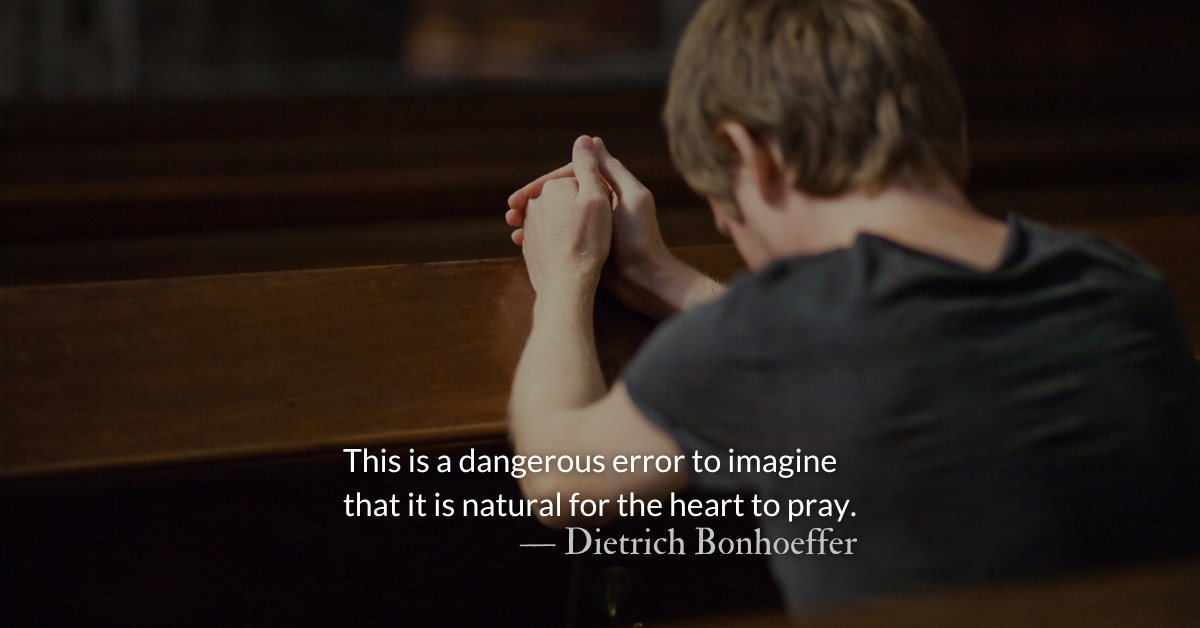
We tell our wants to God (and everyone else) easily enough. If this was all prayer was, it could be said to be natural, but Dietrich Bonhoeffer, the pastor and theologian, disagrees. He said, “This is a dangerous error to imagine that it is natural for the heart to pray.”
Dietrich Bonhoeffer lost his life in a Nazi concentration camp in 1945 just two weeks shy of the liberation of the camp by American forces. To say he understood the experience of intense prayer, and unanswered prayer, would be an understatement. He wrote:
“It can become a great torment to want to speak with God and not to be able to do it—having to be speechless before God, sensing that every cry remains enclosed within one’s own self, that heart and mouth speak a perverse language which God does not want to hear.”
Bonhoeffer taught ministry students and congregants that it was not possible to pray rightly without the power of God:
“We confuse wishing, hoping, sighing, lamenting, rejoicing—all of which the heart can certainly do on its own—with praying. But in doing so we confuse earth and heaven, human beings and God. Praying certainly does not mean simply pouring out one’s heart. It means, rather, finding the way to and speaking with God, whether the heart is full or empty. No one can do that on one’s own. For that one needs Jesus Christ.”
Bonhoeffer further explained how to pray Scripture, which is the Word of God, through the Holy Spirit, who fills words with the power of God:
“Jesus Christ has brought before God every need, every joy, every thanksgiving, and every hope of humankind. In Jesus’ mouth the human word becomes God’s Word. When we pray along with the prayer of Christ, God’s Word becomes again a human word.
If we want to read and to pray the prayers of the Bible, and especially the Psalms, we must not, therefore, first ask what they have to do with us, but what they have to do with Jesus Christ. We must ask how we can understand the Psalms as God’s Word, and only then can we pray them with Jesus Christ. Thus it does not matter whether the Psalms express exactly what we feel in our heart at the moment we pray.
Perhaps it is precisely the case that we must pray against our own heart in order to pray rightly. It is not just that for which we ourselves want to pray that is important, but that for which God wants us to pray. If we were dependent on ourselves alone, we would probably often pray only the fourth petition of the Lord’s Prayer. But God wants it otherwise. Not the poverty of our heart, but the richness of God’s word, ought to determine our prayer.”
Divine Hours Prayer: The Call to Prayer
Open my lips, O Lord, and my mouth shall proclaim your praise. — Psalm 51.16
Read more: Defining Moment
What adjectives do you carry with you? Doubting? Wounded? Worthless? Unreliable? Delete them and accept the new descriptors that are given to us in Jesus
Read more: Crushing Bruised Reeds
We do not need to abandon essentials to charitably embrace those in distress who struggle to define “essentials.” They need love, not contempt.

