

Links for today’s readings:
Jan 16 Read: Job 16-17 Listen: (3:40) Read: John 16 Listen: (4:14)
Links for this weekend’s readings:
Jan 17 Read: Job 18 Listen: (1:54) Read: John 17 Listen: (3:40)
Jan 18 Read: Job 19 Listen: (2:48) Read: John 18 Listen: (5:16)
Scripture Focus: Job 16.18-21
18 “Earth, do not cover my blood;
may my cry never be laid to rest!
19 Even now my witness is in heaven;
my advocate is on high.
20 My intercessor is my friend
as my eyes pour out tears to God;
21 on behalf of a man he pleads with God
as one pleads for a friend.
Job 17.13-16
13 If the only home I hope for is the grave,
if I spread out my bed in the realm of darkness,
14 if I say to corruption, ‘You are my father,’
and to the worm, ‘My mother’ or ‘My sister,’
15 where then is my hope—
who can see any hope for me?
16 Will it go down to the gates of death?
Will we descend together into the dust?”
Reflection: What Job Didn’t Know
By John Tillman
Job said upsetting things. It’s no wonder that his friends were offended and confused by his angry and despairing words. We understand Job better than his friends because we know things that he and his friends did not know.
We know God considered Job righteous. We know there was more at stake than Job’s well-being, comfort, or prosperity. We heard Satan’s accusations in God’s presence. The accuser claimed God’s faithful only love him when he blesses them. The accuser claimed God shows favoritism to those who love him. Both faith itself and God’s righteousness were under attack.
What Job endured had a purpose that he could not see and won a victory that he could not have imagined. But even knowing what we know doesn’t make Job’s suffering less painful. It doesn’t rebuild destroyed homes, restore destroyed crops, or return stolen livestock. It doesn’t raise to life those who died.
Job also said hopeful things. It is a wonder that anyone in his position still held any hope. Job claimed that a witness on his behalf and an advocate were defending him to God and that his intercessor and friend was in Heaven, pleading with God. To Job this friendly advocate was shadowy and undefined. Is it a human? An angel? A divine being?
We know more than Job did. We know Job’s shadowy, heavenly defender is Jesus. (1 John 2.1-2) We see him clearly in the gospels, and Jesus says, when we see him, we see the Father. (John 14.9)
Job is the oldest book (the first to be written) in the Bible. Job probably lived after the flood but before Abraham. So, before Abraham received God’s promise, Job described the hope we have in Jesus.
We know more than Job. We know the grave is not our home or our prison. We know Job’s advocate and our friend, Jesus, is the firstborn from among the dead (Romans 8.29; Colossians 1.15-18; Revelation 1.4-5) and we are his siblings, sharing his cross and resurrection. (Romans 6.4-5; Philippians 3.10) We know after returning to dust, he will descend, raising us to life everlasting. (1 Thessalonians 4.13-18)
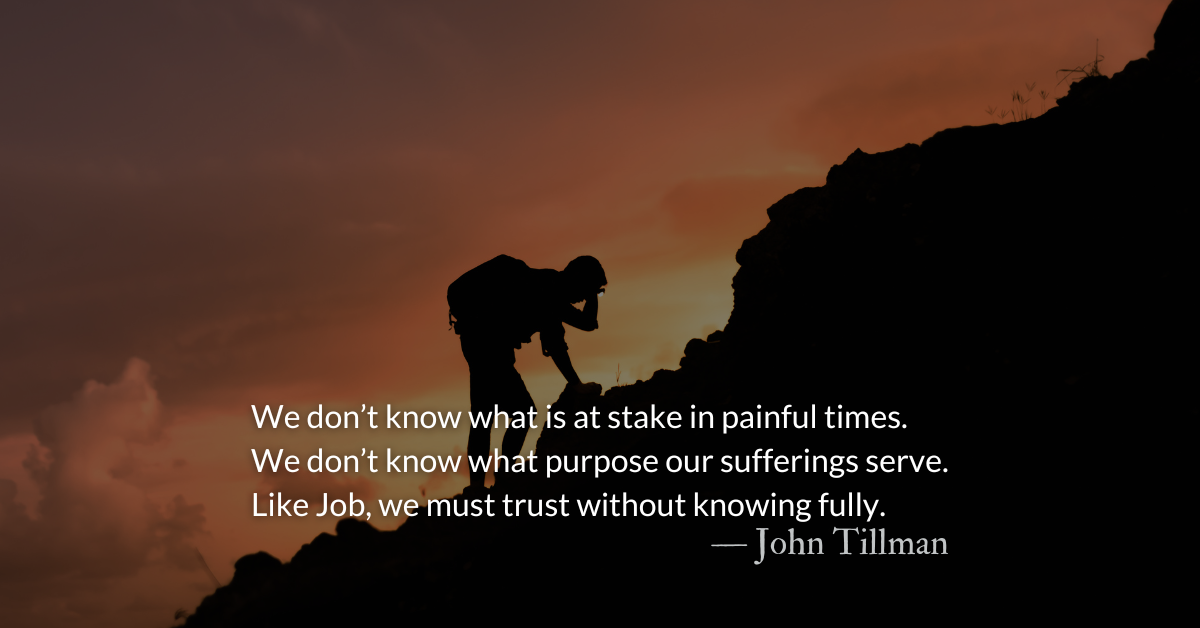
What Job didn’t know and couldn’t imagine is our reality. But we also live with unknowns in our present and future sufferings. We don’t know what is at stake in painful times. We don’t know what purpose our sufferings serve. Like Job, we must trust without knowing fully. Like him, we can rely on our friend and advocate.
Divine Hours Prayer: The Refrain for the Morning Lessons
Righteousness shall go before him, and peace shall be a pathway for his feet. — Psalm 85.13
– From The Divine Hours: Prayers for Autumn and Wintertime by Phyllis Tickle.
Read more: Hope In the Tree of the Cross
“He has done it,” Psalm 22’s last line proclaims. “It is finished,” Christ’s last breath from the cross echoes.
Read more: Resist Weaponizing Spiritual Things
God won’t be anyone’s mercenary and he looks unkindly on weaponizing the Bible for earthly purposes.