

Links for today’s readings:
Apr 10 Read: Hosea 11 Listen: (1:53) Read: Matthew 14 Listen: (4:14)
Apr 11 Read: Hosea 12 Listen: (1:51) Read: Matthew 15 Listen: (4:23)
Apr 12 Read: Hosea 13 Listen: (2:26) Read: Matthew 16 Listen: (3:43)
Scripture Focus: Matthew 14.25-33
25 Shortly before dawn Jesus went out to them, walking on the lake. 26 When the disciples saw him walking on the lake, they were terrified. “It’s a ghost,” they said, and cried out in fear. 27 But Jesus immediately said to them: “Take courage! It is I. Don’t be afraid.” 28 “Lord, if it’s you,” Peter replied, “tell me to come to you on the water.” 29 “Come,” he said. Then Peter got down out of the boat, walked on the water and came toward Jesus. 30 But when he saw the wind, he was afraid and, beginning to sink, cried out, “Lord, save me!” 31 Immediately Jesus reached out his hand and caught him. “You of little faith,” he said, “why did you doubt?” 32 And when they climbed into the boat, the wind died down. 33 Then those who were in the boat worshiped him, saying, “Truly you are the Son of God.”
Reflection: Into Winds, Onto Waves
By John Tillman
The disciples tried to do what Jesus said. They couldn’t. Then Jesus stepped in.
Matthew, Mark, and Luke describe Jesus calming a storm (Matt 8.23-27; Mark 4.35-41; Luke 8.22-25). Jesus walking on the water is a separate event recorded in Matthew, Mark, and John (Matt 14.22-33; Mark 6.45-52; John 6.16-21).
When Jesus walks on the water, there is no “storm,” but there is a strong wind. The wind, and the waves it kicks up, oppose the disciples’ progress. They are stuck.
From the mountain where he was praying, Jesus saw them struggling. He presumably prayed for them. He came to them. Then, he enabled them, especially Peter, to do things beyond their capacity. He stopped the wind. He helped Peter walk on the water. John’s account tells us that Jesus miraculously transported the boat from the middle of the lake to the shore.
Like the disciples, we have been sent to do what we can’t do. The prevailing winds of culture are against us. Our best efforts cannot gain any ground.
Also like the disciples, Jesus sees us, he prays for us, he comes to us, and he enables us to exceed our capacity.
It seems strange to tell someone to do something they can’t do. You wouldn’t tell a young child to fix a leak under the sink or change the timing belt under the hood of a car. However, you can tell a child, “Come help me fix the sink,” or “Come help me fix the car.” Doing something with someone, forms something in you.
When a child holds the flashlight for a parent working under the sink or under the hood, they are participating and (hopefully) learning. The child might come back to the living room and report to their other parent, “I fixed it!” In a way, they did. Even if they didn’t technically do any of the work themselves.
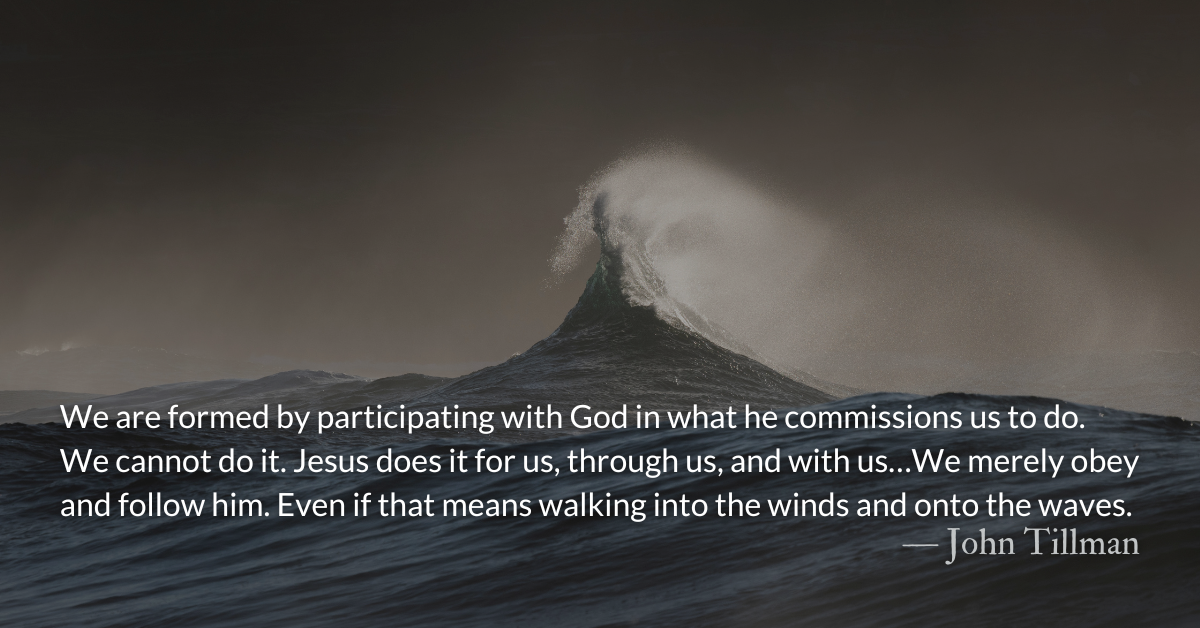
We are formed by participating with God in what he commissions us to do. We cannot do it. Jesus does it for us, through us, and with us. He turns the wrenches on nuts too tight for us to budge. We hold the flashlight. He stops the winds too strong for us to overcome. We step out of the boat. He helps us walk where we would normally sink. He catches us when we fall.
We merely obey and follow him. Even if that means walking into the winds and onto the waves.
Divine Hours Prayer: The Refrain for the Morning Lessons
Everyone will stand in awe and declare God’s deeds; they will recognize his works. — Psalm 64.9
– From The Divine Hours: Prayers for Springtime by Phyllis Tickle.
Read more: Cultivation Must Be Learned
Spiritual wisdom and knowledge, like agricultural knowledge, must be passed on, with its seeds, from one generation to the next.
Read more: Clumsy Doves
Pain tends to heighten our spiritual sensitivities. Some of us stumble into the presence of God after the long dark night of the soul.