

Links for today’s readings:
Feb 2 Read: Job 35 Listen: (1:33) Read: Psalm 19 Listen: (1:52)
Scripture Focus: Job 35.2-8
2 “Do you think this is just?
You say, ‘I am in the right, not God.’
3 Yet you ask him, ‘What profit is it to me,
and what do I gain by not sinning?’
4 “I would like to reply to you
and to your friends with you.
5 Look up at the heavens and see;
gaze at the clouds so high above you.
6 If you sin, how does that affect him?
If your sins are many, what does that do to him?
7 If you are righteous, what do you give to him,
or what does he receive from your hand?
8 Your wickedness only affects humans like yourself,
and your righteousness only other people.
Reflection: Don’t Troll the Troubled
By John Tillman
Productive conversations with ideological or theological opponents on social media are possible, but rare.
Sometimes, while having a social media conversation, another voice chimes in. Will they help or hurt the conversation? Will they turn into a troll?
The online term “troll” might primarily seem to describe a monster, like the Three Billy Goats Gruff troll. Online trolls are considered monstrous; however, the definition has more to do with fishing-related meanings of “troll.”
“Trolling” is a type of fishing in which a boat drags a fishing line through places where the fisherman hopes fish won’t be able to resist taking the bait. Online trolls scroll through comments and conversation boards, dropping “lures” of offensive content they hope their targets will react to in anger or fear.
When Elihu jumps into Job’s conversation with his friends, we do not know what to expect. Job’s conversation was already not going well. At first, it seems Elihu might add positive things to the conversation, but he quickly starts trolling Job with guilt and blame.
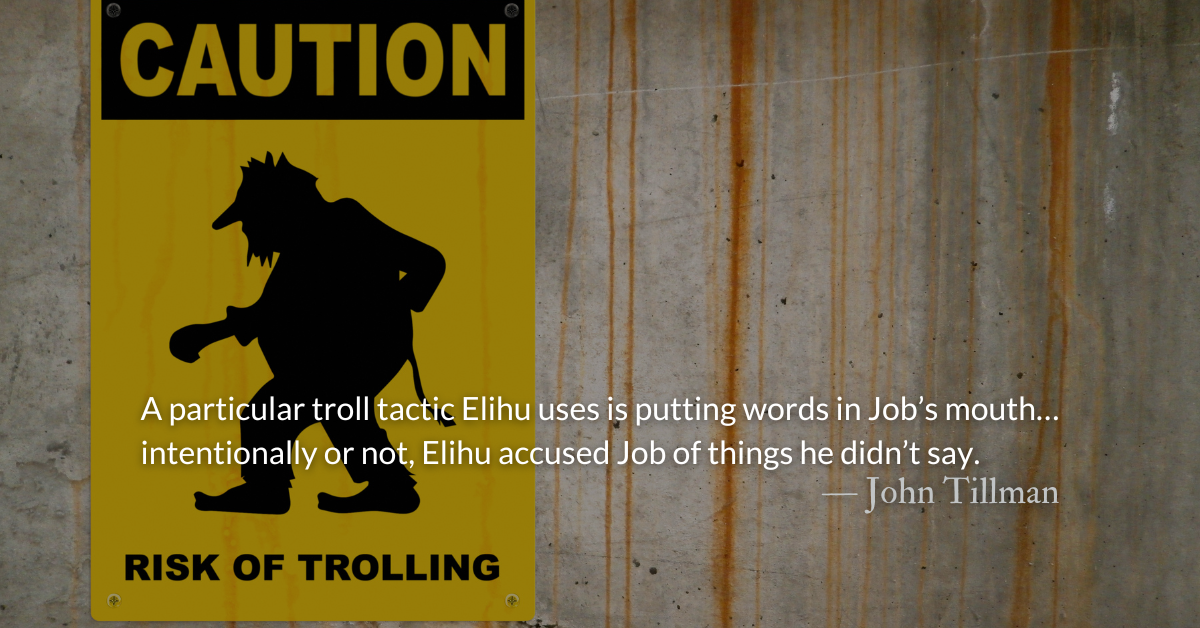
A particular troll tactic Elihu uses is putting words in Job’s mouth. Job never said God was in the wrong or that not sinning was worthless (v. 2-3). Whether intentionally or not, Elihu accused Job of things he didn’t say. He made a “strawman” argument that he could easily attack for verse after verse after verse.
When troubled people truthfully describe their experiences, it is easy for us to hear things they aren’t saying. Don’t hear, “God is unfaithful,” when they say, “Life is hopeless.” Don’t hear, “Grace is not sufficient for me,” when they say, “Pain is unbearable.” Don’t put words in their mouths. If you do, don’t be surprised if they snap like an angry fish. Hurting people don’t need verse after verse attacking arguments they aren’t making.
We can be better counselors than Elihu. Hurting people don’t need to be trolled with truisms that feel like an attack. All people need to know the truth that God’s love is real, even in the hardships. Acknowledge feelings without trying to fix things. Tell them God loves them without demanding they deny their reality.
The time will come when God shows up as he did for Job. They will remember, and God will honor how we represent God’s faithful love that doesn’t abandon his beloved children when we are in despair.
Divine Hours Prayer: The Greeting
Let the words of my mouth and the meditation of my heart be acceptable in your sight, O Lord, my strength and my redeemer. — Psalm 19.14
– From The Divine Hours: Prayers for Springtime by Phyllis Tickle.
Read more: God’s Not Deaf
The fear that…your pleas are being offered to a deaf God are not founded in truth. Do not let your heart nourish such lies.
Read more: On What Are You Meditating?
The ways of God affect our thinking, reasoning, and action. From our inner emotions and thinking, to our outward actions and perceptions, God’s law shapes us.