Links for today’s readings:
Apr 2 Read: Hosea 1 Listen: (2:08) Read: Matthew 6 Listen: (4:35)
Scripture Focus: Matthew 6.24-34
24 “No one can serve two masters. Either you will hate the one and love the other, or you will be devoted to the one and despise the other. You cannot serve both God and money. 25 “Therefore I tell you, do not worry about your life, what you will eat or drink; or about your body, what you will wear. Is not life more than food, and the body more than clothes? 26 Look at the birds of the air; they do not sow or reap or store away in barns, and yet your heavenly Father feeds them. Are you not much more valuable than they? 27 Can any one of you by worrying add a single hour to your life?
28 “And why do you worry about clothes? See how the flowers of the field grow. They do not labor or spin. 29 Yet I tell you that not even Solomon in all his splendor was dressed like one of these. 30 If that is how God clothes the grass of the field, which is here today and tomorrow is thrown into the fire, will he not much more clothe you—you of little faith? 31 So do not worry, saying, ‘What shall we eat?’ or ‘What shall we drink?’ or ‘What shall we wear?’ 32 For the pagans run after all these things, and your heavenly Father knows that you need them. 33 But seek first his kingdom and his righteousness, and all these things will be given to you as well. 34 Therefore do not worry about tomorrow, for tomorrow will worry about itself. Each day has enough trouble of its own.
Reflection: Heavy Loads Lifted
By John Tillman
Christ’s moral teachings are the most popular thing about him.
The Sermon on the Mount is recognized worldwide as an aspirational description of a beautiful way to live. Even non-Christians recognize the Sermon on the Mount as the most astute moral teachings ever produced in the history of the world.
It may be a beautiful way to live, but isn’t it impossible? Rich Mullins confronts this humorously in the bridge of his song, “Hard.”
“Well His eye’s on the sparrow
And the lilies of the field I’ve heard
And He will watch over you and He will watch over me
So we can dress like flowers and eat like birds.”
It is hard to be like Jesus describes in these teachings.
Jesus generally commended the Pharisees’ moral teaching. “Do what they say…Don’t do what they do.” He critiqued the Pharisees for tying up “heavy loads” of moral requirements but not lifting them themselves or helping people live them out. (Matthew 23.4)
Aren’t Jesus’ hard moral teachings “heavy loads”?
Who can dress like a flower?
Eat like a bird?
Continually turn the other cheek?
Go the extra mile?
Give unrestrainedly to the needy?
Surrender our security for another’s shelter and safety?
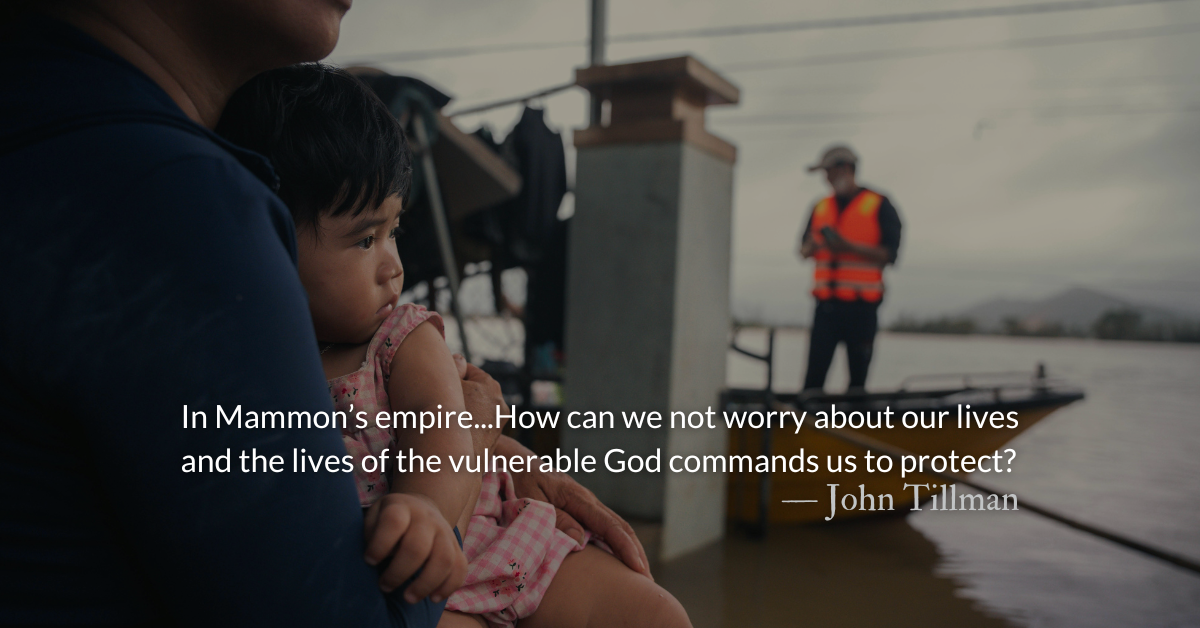
In Mammon’s empire, how can we survive without accumulating wealth? In a world that denigrates the poor, how can we be unconcerned with clothing, food, and shelter? In a world where governments fight for the right to end the lives of the defenseless in the womb, the defenseless in war zones, and the defenseless in borderland river crossings, how can we not worry about our lives and the lives of the vulnerable God commands us to protect?
Who can carry this load? Who can “be perfect” as our Heavenly Father is perfect? (Matthew 5.48; 19.21) Not us. Only Jesus.
Jesus tied this load for his own back. He carried it perfectly. He carries it for us. The teaching of the Sermon on the Mount glimpses the Kingdom of Heaven. One day, we will arrive.
It is too simplistic to say, “We don’t have to do it. Jesus did it.” However, we can say, “Jesus did it for me, and he is doing it within me now.” Together with the same power that raised Christ from the dead, strain toward heavenly living today. (Ephesians 1.19-21; Philippians 3:12-14) Don’t walk away discouraged or sad. “With God, all things are possible.” (Matthew 19.21-26) Heavy loads can be lifted.
Divine Hours Prayer: The Request for Presence
Make me understand the way of your commandments, that I may meditate on your marvelous works. — Psalm 119.27
– From The Divine Hours: Prayers for Springtime by Phyllis Tickle.
Read more: The Shema and the Lord’s Prayer
In the Shema and The Lord’s Prayer, we are expected to engage in concrete actions once we stop praying.
Read more: The Naked Emotion of God
Hosea shows us a God unashamed of shame, nakedly confessing his love for the unlovable.