Our Merciless Culture

Scripture Focus: 1 Timothy 1.13-14
13 Even though I was once a blasphemer and a persecutor and a violent man, I was shown mercy because I acted in ignorance and unbelief. 14 The grace of our Lord was poured out on me abundantly, along with the faith and love that are in Christ Jesus.

Reflection: Our Merciless Culture
By John Tillman

The mercy and forgiveness offered to Paul is staggering, scandalous, and in our own time, practically impossible.

One of the least Christian things about American culture today is how we feel about forgiveness and mercy. We frown at forgiveness in general, but to forgive someone who harmed you or to forgive someone outside one’s tribe or group, is anathema. If you want to be an outcast, forgive someone outside your political party, your race, or your gender.

Every culture is a bit cynical about mercy and repentance. Reasonable skepticism is justifiable. Even the apostles didn’t accept Paul until Barnabas spoke up for him. The type of mercy extended to Paul and many others in scripture would never be tolerated or allowed today. 

Our culture has become anti-mercy, going past skepticism and walking into the wilderness of hatred and retributive violence. In recent years, when people have offered public forgiveness to individuals that everyone agreed did not deserve it, our world wouldn’t tolerate it. We are opposed to forgiveness. We go beyond refusing to forgive—we label forgiveness and mercy, not just foolish, but evil.

A culture that is invested in and glorifies hatred, retribution, payback, and vengeance cannot allow an act of mercy to stand as a simple act of mercy. It must be critiqued and spun. Media and pundits immediately will attempt to twist it, politicize it, and discount it.

Our world is desperate to explain away Christian forgiveness as something else. It must be enabling evil. It must be the result of racism. It must be a naive and foolish gesture. It must be anything other than Christian, gospel forgiveness. Never that.

Otherwise, we might be forced to set down our weapons of vengeance. Otherwise, we might be forced to question our treasured value of total war against our ideological enemies. Otherwise, we might have to abandon our “ends justify the means” political machinations. Otherwise, we might be forced to admit we need mercy ourselves.

Our world would like to pretend that it hates mercy because it cares for victims. But it requires it’s victims to stay victims, suffering eternally. Healing or restoration doesn’t fuel hatred, only pain does. Our culture’s interest in victims is mostly as fuel for hatred. Our world hates mercy because it loves hate.

As Christians, we must defeat hate by truly caring for victims and by forgiving in shocking and scandalous ways.

*Forgiveness and mercy do not mean abandoning the pursuit of justice through the law. It also does not mean asking victims to be quiet or to stop sharing their pain and their stories. For a short brush-up on the tension between forgiveness and justice, see this Veritas Forum video with Rachael Denhollander.


Divine Hours Prayer: The Refrain for the Morning Lessons
It is not the healthy who need the doctor, but the sick…and indeed I did not come to call the the virtuous, but the sinners. — Matthew 9.12-13

– From The Divine Hours: Prayers for Summertime by Phyllis Tickle.

Today’s Readings
Joshua 24 (Listen 5:49)
1 Timothy 1 (Listen  2:59)

Read more about When God Has Mercy…Will We?
Jonah held his bitterness so deeply that the depths of the sea couldn’t wash it away and the sun couldn’t burn it away. How deeply will we hold on to ours?

Share a Readers’ Choice post!

#ReadersChoice is the time for you to share your favorite Park Forum posts from the year.
What post helped you better understand scripture?
https://forms.gle/dfa88nayaEEqiy9X7


Born to Serve

Scripture Focus: Philippians 2.5-8
5 In your relationships with one another, have the same mindset as Christ Jesus:

6 Who, being in very nature God,
    did not consider equality with God something to be used to his own advantage;
7 rather, he made himself nothing
    by taking the very nature of a servant,
    being made in human likeness.
8 And being found in appearance as a man,
    he humbled himself
    by becoming obedient to death—
        even death on a cross!

Reflection: Born to Serve
By Jon Polk

In what is traditionally known as the “Christ Hymn” in Philippians 2, Paul describes who Christ is, and by extension, who God is, and furthermore by example, who we should be.

Who is Christ? Christ was in his very nature God. He was God himself, even though he was uniquely human, too. 

However, Christ didn’t behave the way people expected gods to behave. In the first century, they were more familiar with the volatile, angry gods of the Greek pantheon, who used power to advance themselves or to subdue others. 

Gods didn’t live their lives in humility. Gods didn’t come among their people as servants. And gods especially didn’t sacrifice their lives for the sake of their subjects. 

Paul writes that Christ took the very nature of a servant. He uses the Greek word doulos, which is more properly translated “slave.” A slave existed in servitude to others without advantages, rights or privileges.

Christ became nothing. He emptied himself by pouring out his grace to others. He humbled himself by entering into relationship with lowly humans. He obeyed death, freely giving his life.

Who is God? God’s strength is not in his ability to manipulate or subdue his subjects, but in his willingness to take on the form of his subjects. Not only does God condescend to human form, he chose not to come as a ruler or king but a servant.

Jürgen Moltmann writes in The Crucified God, “God is not greater than he is in this humiliation. God is not more glorious than he is in this self-surrender. God is not more powerful than he is in this helplessness. God is not more divine than he is in this humanity.”

Who should we be? Paul states we should “have the same mindset as Christ Jesus.” Not only does Christ present us with a radical picture of who God is, he presents us with a radical challenge about who we should be: humble servants giving ourselves on behalf of others.

Dietrich Bonhoeffer writes “The church is the church only when it exists for others… It must not underestimate the importance of human example which has its origin in the humanity of Jesus.” 

Jesus Christ is our ultimate example. For certain, none of us could ever be sinless and perfect, but that’s not the example that Paul wants us to see. Jesus is the full representation of God, but he also represents what it means to be fully human: to live life completely in service of others. 

Divine Hours Prayer: A Reading
Jesus taught us, saying: “Enter by the narrow gate, since the road that leads to destruction is wide and spacious, and many take it; but it is a narrow gate and a hard road that leads to life, and only a few find it.” — Matthew 7.13-14

– From The Divine Hours: Prayers for Summertime by Phyllis Tickle.

Today’s Readings
Joshua 20-21 (Listen 7:02)
Philippians 2 (Listen  3:45)

Today’s Readings
Joshua 22 (Listen 6:16), Philippians 3 (Listen  3:21)
Joshua 23 (Listen 2:31), Philippians 4 (Listen  3:20)

Read more about He Stoops to Raise
In every aspect of his life, and death, he intentionally moves from the highest place, to the lowest place.

Read more about Greater Footstool, Greater God, Greater Redeemer
Christ, who is higher and greater than anyone has imagined, would become less and lower than anyone would imagine, to do for us what no one could imagine.

Transformed by Koinonia

Scripture Focus: Philippians 1.4-6
4 In all my prayers for all of you, I always pray with joy 5 because of your partnership in the gospel from the first day until now, 6 being confident of this, that he who began a good work in you will carry it on to completion until the day of Christ Jesus.

Reflection: Transformed by Koinonia
By John Tillman

The word Paul uses to describe the partnership that he feels with the Philippian church is koinonia. Like many Greek words, it has multiple shades of meaning. The word in English primarily refers to the “fellowship” of the church as a community. This meaning is not incorrect, but another interpretation is of being a business partner or having a “share” or investment together in a business. 

Paul knows what it is to have partners in business, having supported himself at times through the skilled trade of tentmaking which he had in common with Priscilla and Aquila. However, the business to which Paul is referring, that we all have a share in, is the gospel.

The business of the gospel is the “putting right” of everything in the cosmos. And the means by which we do so is by “fellowship” or “partnership” with Christ Jesus, whose work continues until “the day of Christ Jesus.” There is no koinonia with Christ without change.

In this phrase, Paul is redefining the ancient Jewish concept of the “Day of the Lord.” This is the “last day” to which Martha refers when discussing her brother Lazarus’s future resurrection and is sometimes called the “eighth day” to symbolize that God is both ending and renewing creation.

This is a day when all will be put right. The day of Lord will be a day of leveling. It will mean tearing down those who have built themselves up and lifting up those who have been crushed.  Earth will be transformed into another place—a place in keeping with all that God desires for us, but we are too foolish to ask for or seek.

Christ’s correction of the cosmos is not limited to all that is without us but includes all that is within us. It is not just Earth that will be transformed but Earthlings. We, each of us, have an inner cosmos that must succumb to a “Day of the Lord” transformation. Within us are exalted idols and habits that must be torn down. Within us are fruits of the spirit that we have trampled under selfish feet.

As we submit to him, Jesus will, with axe and fire, tear down in us what must burn, and with tender nourishing care will tend and cultivate the fruit that he always designed to grow in us. Christ is our partner and our koinonia with him means every trial, suffering, isolation, loss, and sadness, shall work together for our betterment, strengthening, and righteousness.


Divine Hours Prayer: A Reading
Jesus taught us, saying: “I am the true vine, and my Father is the vinedresser. Every branch in me that bears no fruit he cuts away, and every branch that does bear fruit he prunes to make it bear even more. You are pruned already, by means of the word that I have spoken to you.” — John 15.1-3

– From The Divine Hours: Prayers for Summertime by Phyllis Tickle.

Today’s Readings
Joshua 18-19 (Listen 9:59)
Philippians 1 (Listen  4:03)

Read more about Jesus with Axe and Fire
May we ask him regularly to cut down our idols. May he burn out of our souls impurity and selfish desires.

Read more about A Rebellion of Repentance
The repentance John describes is a rebellion more radical than violent insurrection.

Bold Women, Bold Men

Scripture Focus: Joshua 17:3-4
3 Now Zelophehad son of Hepher, the son of Gilead, the son of Makir, the son of Manasseh, had no sons but only daughters, whose names were Mahlah, Noah, Hoglah, Milkah and Tirzah. 4 They went to Eleazar the priest, Joshua son of Nun, and the leaders and said, “The Lord commanded Moses to give us an inheritance among our relatives.” So Joshua gave them an inheritance along with the brothers of their father, according to the Lord’s command. 

Reflection: Bold Women, Bold Men
By Erin Newton

Women were uncommon recipients of land inheritance in ancient Israel. The daughters of Zelophehad, however, are rewarded for their boldness. 

Without a brother, the customary practice would deny them receiving a portion of the land. They took a bold step in an unconventional direction. Their request could have easily been denied due to the practices of patriarchy. They asked and Joshua granted them inheritance just as it was given to their uncles.

Carolyn Pressler states, “Inheritance by women is an exception rather than the rule…Nonetheless, female passivity is not idealized.” They are not chastised for this request nor rebuked for having something to which typically only men have rights.

This confrontation contrasts with another group requesting a change in inheritance. The men of Joseph received land as was their custom. But they were numerous and needed more space. 

They asked and Joshua denied their request.

The men were not left without an answer; for Joshua offered other solutions with the resolve that God would help them succeed.  

These two stories describe people who were unsatisfied with their situation. Neither group expressed dissatisfaction in ways that were wrong or sinful. They simply had other expectations that benefited their family and community in greater ways. Both made requests outside of the traditional custom.

The common thread in both scenarios is the glorification of the will of God. The women received inheritance “according to the Lord’s command.” The men were encouraged that their efforts would be just like the battles before—empowered by God. 

Men and women sought a portion of God’s blessing. Men and women were granted a place within the Promised Land. 

For women, this story reveals the importance of being bold. Women are not commanded to settle for the customary practices that place them at a disadvantage simply for being born female. If passivity is not the ideal, boldness can take its place. 

For men, this story reveals the importance of being bold as well. It is a story of boldly asking for more when it would benefit their family and community. The answer demands more faith in the sovereignty of God. 

One group received a quick and simple “yes” and the other, a complicated “maybe but have faith” answer. This text does not overturn the patriarchal tendencies of the Old Testament. It does, however, reveal the unexpected and uncustomary ways in which God indiscriminately blesses his people. 

Divine Hours Prayer: The Call to Prayer
I will call upon God, and the Lord will deliver me.
In the evening, in the morning, and at the noonday, I will complain and lament, and he will hear my voice.
He will bring me safely back… God, who is enthroned of old, will hear me. — Psalm 55.17

– From The Divine Hours: Prayers for Summertime by Phyllis Tickle.

Today’s Readings
Joshua 16-17 (Listen 5:13)
Ephesians 6 (Listen  3:17)

Read more about Inheritance of Rachel’s Daughters
Leah and Rachel show us the spectrum of marriage at that time. Rachel represents a fairytale…Leah reveals an ugly reality.

Read more about Trust and Pursue God’s Promises
Fully trusting in God’s promises gives us the hope, strength, and courage to pursue those promises.

Beyond “Plain Reading”

Scripture Focus: Ephesians 5.21-25
21 Submit to one another out of reverence for Christ. 
22 Wives, submit yourselves to your own husbands as you do to the Lord. 23 For the husband is the head of the wife as Christ is the head of the church, his body, of which he is the Savior. 24 Now as the church submits to Christ, so also wives should submit to their husbands in everything. 
25 Husbands, love your wives, just as Christ loved the church and gave himself up for her.

Reflection: Beyond “Plain Reading”
By John Tillman

We often describe the Bible as a park in the midst of the city — a place of restoration and peace amidst the concrete-coated, steel-and-glass struggles of life.

Some Bible passages, however, are less like peaceful parks and more like battlegrounds. When passages have been weaponized and abused, how can we stop hearing them as weapons but as God’s word?

Today’s passage and other Pauline passages about women are such cases. One chapter of Confronting Christianity is “Doesn’t Christianity Denigrate Women?” In it, Rebecca McLaughlin mentions that Ephesians 5.22 repulsed her at first. It seemed hierarchical and prime for abuse.

One reason many think such passages are abusive is how some Christian voices interpret them. Using a “plain reading” they say Paul tells women to sit down. To shut up. To go home. Are they right?

We need to go beyond “plain reading” because the Bible is not plainly written. Peter points out that the difficulty of interpreting Paul leads to destruction. (2 Peter 3.15-17) Treating the Bible as clear-cut instructions which need no interpretation is foolish. Treating our interpretations as infallible is arrogant.

“Plain reading” conveniently lets us carry our prejudices and culture into scripture rather than reading the text in the context and culture of the writer. We better understand Paul’s words in the context of his actions. Are men to be lifted up and women to be pushed down? Did Paul intend that? Did Paul believe it? Did Paul enact it?

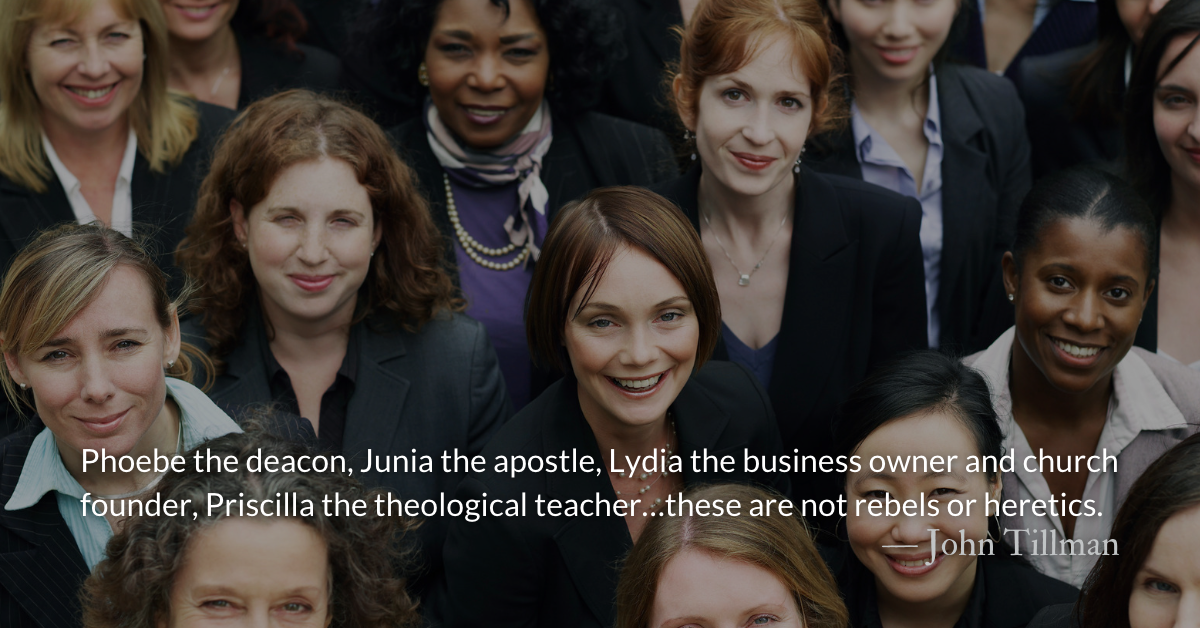
Paul’s treatment of women interprets his words about women. What women did in Paul’s ministry tells us how “submissive” women behave and what they do. Phoebe the deacon, Junia the apostle, Lydia the business owner and church founder, Priscilla the theological teacher…these are not rebels or heretics. They are women following Paul’s words, obeying his intent.

We need to read scripture humbly, contextually, and repeatedly. Don’t give up on passages that have been abused or argued over. The Bible has pearls of great price, treasures hidden in fields, and riches of wisdom to be mined. You’ll rarely strike gold with the first turn of a shovel or solve thorny theological problems with the first turn of a page. (Or 400 words of a devotional.)

We’ll find what Paul means by walking in the steps of Paul and of Jesus. With humility and patience, battlefields can once again become peaceful parks.

From John: To go more in depth on this issue and other challenging topics, I recommend McLaughlin’s book, Confronting Christianity. I am, through my church, helping lead a book club of atheists, agnostics, and deconstructed people discussing the book and it is an excellent place to start for those exploring challenging questions about Christianity.


Divine Hours Prayer: A Reading
Jesus taught us, saying: “The kingdom of heaven is like treasure hidden in a field which someone has found; he hides it again, goes off in his joy, sells everything he owns and buys the field. Again, the kingdom of heaven is like a merchant looking for fine pearls; when he finds one of great value he goes and sells everything he owns and buys it.”  — Matthew 13.44-45

– From The Divine Hours: Prayers for Summertime by Phyllis Tickle.

Today’s Readings
Joshua 14-15 (Listen 9:20)
Ephesians 5 (Listen  3:42)

Read more about None Excluded or Excused
For Paul, ministry was collaborative. Paul’s ministry team included all races, men and women, young people and elders, slaves and free, rich and poor.

Read more about No Asterisks
Deborah’s judgeship doesn’t deserve an asterisk…God did not “settle” for Deborah. He chose her.