
The Cost of Discipleship :: Summer Reading Series

By Dietrich Bonhoeffer

The Summer Reading Series is designed to equip our growing community with curated book recommendations that shape faith and sharpen cultural insight.

Cheap grace is the deadly enemy of our Church. We are fighting today for costly grace.

Cheap grace means grace sold on the market like cheapjacks’ wares. Grace is represented as the Church’s inexhaustible treasury, from which she showers blessings with generous hands, without asking questions or fixing limits.

Cheap grace means grace as a doctrine, a principle, a system. It means forgiveness of sins proclaimed as a general truth, the love of God taught as the Christian “conception” of God. An intellectual assent to that idea is held to be of itself sufficient to secure remission of sins.

The Church which holds the correct doctrine of grace has, it is supposed, ipso facto a part in that grace. In such a Church the world finds a cheap covering for its sins; no contrition is required, still less any real desire to be delivered from sin. Cheap grace therefore amounts to a denial of the living Word of God, in fact, a denial of the Incarnation of the Word of God.

Cheap grace means the justification of sin without the justification of the sinner. Grace alone does everything, they say, and so everything can remain as it was before.

Costly grace is the treasure hidden in the field; for the sake of it a man will gladly go and sell all that he has. It is the pearl of great price to buy which the merchant will sell all his goods. Such grace is costly because it calls us to follow, and it is grace because it calls us to follow Jesus Christ.

It is costly because it costs a man his life, and it is grace because it gives a man the only true life. It is costly because it condemns sin, and grace because it justifies the sinner. Above all, it is costly because it cost God the life of his Son: “ye were bought at a price,” and what has cost God much cannot be cheap for us. Above all, it is grace because God did not reckon his Son too dear a price to pay for our life, but delivered him up for us. Costly grace is the Incarnation of God.

Costly grace is the sanctuary of God. Costly grace confronts us as a gracious call to follow Jesus, it comes as a word of forgiveness to the broken spirit and the contrite heart. Grace is costly because it compels a man to submit to the yoke of Christ and follow him; it is grace because Jesus says: “My yoke is easy and my burden is light.”

*Excerpt from Dietrich Bonhoeffer, The Cost of Discipleship. Touchstone, 1995. Background and brief biography at The Gospel Coalition.

Today’s Reading
Isaiah 34 (Listen – 2:59)
Revelation 4 (Listen – 2:09)
Inklings: Tolkien, Lewis, Barfield, and Williams :: Summer Reading Series

The Summer Reading Series is designed to equip our growing community with curated book recommendations that shape faith and sharpen cultural insight.

By Philip and Carol Zaleski

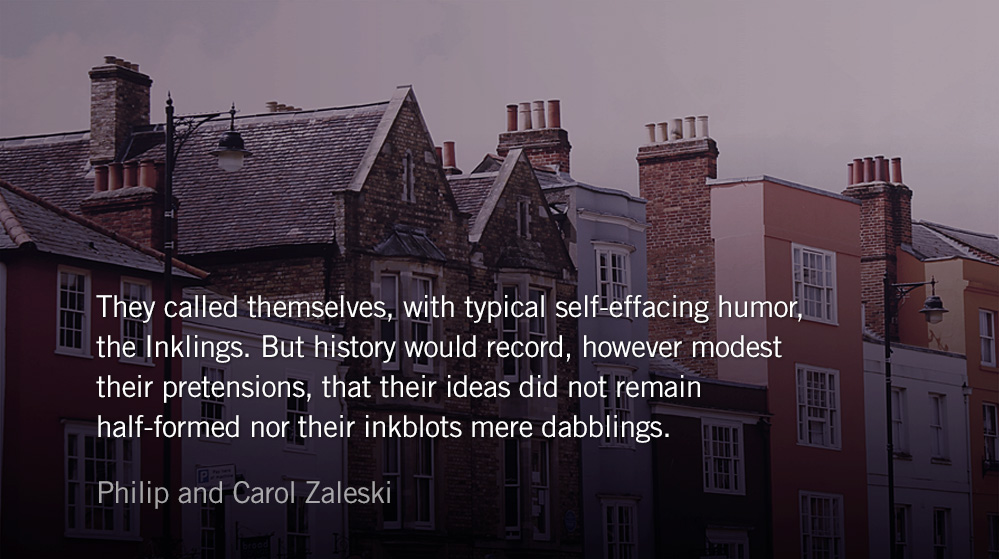
During the hectic middle decades of the twentieth century, from the end of the Great Depression through World War II and into the 1950s, a small circle of intellectuals gathered on a weekly basis in and around Oxford University to drink, smoke, quip, cavil, read aloud their works in progress. They called themselves, with typical self-effacing humor, the Inklings.

But history would record, however modest their pretensions, that their ideas did not remain half-formed nor their inkblots mere dabblings. By the time the last Inkling passed away on the eve of the twenty-first century, the group had altered, in large or small measure, the course of imaginative literature (fantasy, allegory, mythopoeic tales), Christian theology and philosophy, comparative mythology, and the scholarly study of the Beowulf author, of Dante, Spenser, Milton, courtly love, fairy tale, and epic; and drawing as much from their scholarship as from their experience of a catastrophic century, they had fashioned a new narrative of hope amid the ruins of war, industrialization, cultural disintegration, skepticism, and anomie.

Interest in the Inklings often first dawns in the minds of readers who have fallen in love with Tolkien and Lewis, and wish to enter more deeply into their spiritual and imaginative cosmos.

Lewis resembled, many said, the neighborhood butcher. Add the ubiquitous tweed jacket and flannel slacks, and he comes up in the world, but only as far as a midlevel accountant. He dressed like an ordinary man. He cultivated an image, that of the ordinary chap, endowed perhaps—one can do nothing about these things—with extraordinary brains, who lived an ordinary life of plain talk, plain food, and plain faith [“Mere Christianity”].

As a scholar, he made sure never to be mistaken for an aesthete. ‘What is life’s greatest pleasure?’ he asked his doctoral student, the future Renaissance scholar Alastair Fowler. Lewis ticked off the possibilities—Fowler remembers them as great art, mystical ecstasy, simultaneous orgasm—rejecting them one by one. “I’ll tell you,” Lewis said. “It’s the pleasure, after walking for hours, of coming to a pub and relieving yourself.”

But this sensuous side of Lewis’s nature was a late development. Lewis as a youth was extraordinarily uncomfortable in his body. His face betrayed him, broadcasting arrogance or anger in just those moments when he was feeling particularly meek or contrite. Each thumb had only one joint, a defect that led, when shaving, tying laces, or attempting other normal manipulations, to fury and tears.

He inhabited his young body as if it were a suit of armor; and if his face was doomed to miscommunicate his true feelings, he would have to learn to play the parts assigned to him, until, as an adult, he could assume his chosen part as Everyman.

*Excerpt from Philip Zaleski and Carol Zaleski, The Fellowship: The Literary Lives of the Inklings: J.R.R. Tolkien, C. S. Lewis, Owen Barfield, Charles Williams. Farrar, Straus and Giroux, 2015. Book review at The Atlantic.

Today’s Reading
Isaiah 33 (Listen – 3:45)
Revelation 3 (Listen – 3:53)