Our Immovable Rock

Scripture Focus: Zechariah 12.3
3 On that day, when all the nations of the earth are gathered against her, I will make Jerusalem an immovable rock for all the nations. All who try to move it will injure themselves.

Luke 21.5-11
5 Some of his disciples were remarking about how the temple was adorned with beautiful stones and with gifts dedicated to God. But Jesus said, 6 “As for what you see here, the time will come when not one stone will be left on another; every one of them will be thrown down.” 
7 “Teacher,” they asked, “when will these things happen? And what will be the sign that they are about to take place?” 
8 He replied: “Watch out that you are not deceived. For many will come in my name, claiming, ‘I am he,’ and, ‘The time is near.’ Do not follow them. 9 When you hear of wars and uprisings, do not be frightened. These things must happen first, but the end will not come right away.” 
10 Then he said to them: “Nation will rise against nation, and kingdom against kingdom. 11 There will be great earthquakes, famines and pestilences in various places, and fearful events and great signs from heaven. 

Reflection: Our Immovable Rock
By John Tillman

Zechariah spoke to those who had gone through exile and captivity. They knew what it meant for armies to gather, the city to fall, and the walls to be destroyed and burned. They heard their parents’ tales and tasted the fear and uncertainty. God’s words reassured these people that, in the future, no gathering of armies will be able to overcome Jerusalem, the shelter of his people.

Jesus spoke to his disciples, suffering under Roman occupation and puppet kings like Herod. Herod was “king”, but all were forced to say “Caesar is Lord.” They longed for liberation.

The Temple Zechariah knew was renovated and expanded by Herod. The disciples were impressed with the stonework in Herod’s expansion. If they had read Zechariah’s words at that moment, they would probably have thought that they were living in the time of their fulfillment. We know they expected Jesus to become king. We can easily imagine that they hoped to see Jerusalem become the immovable rock that Rome and every other enemy would break themselves against.

But instead of speaking of armies breaking against Jerusalem, Jesus spoke of Jerusalem being broken. Even the Temple’s impressive stones would be cast down, not one of them left on another.

Eschatological anxiety has waxed and waned in my lifetime. It’s easy for us to go to extremes on this issue. Some panic that the end is near and then, when it seems delayed, lose faith. Some throw their hands up in cynical doubt that the day will ever come. Some seek to bring the day to pass by taking the reins of power into their own hands. They long to build whatever kingdom they can using hastily baptized political power.

Christ told his followers to not be easily taken in by messianic movements. He warned them against fear and reactionary haste and encouraged patience.

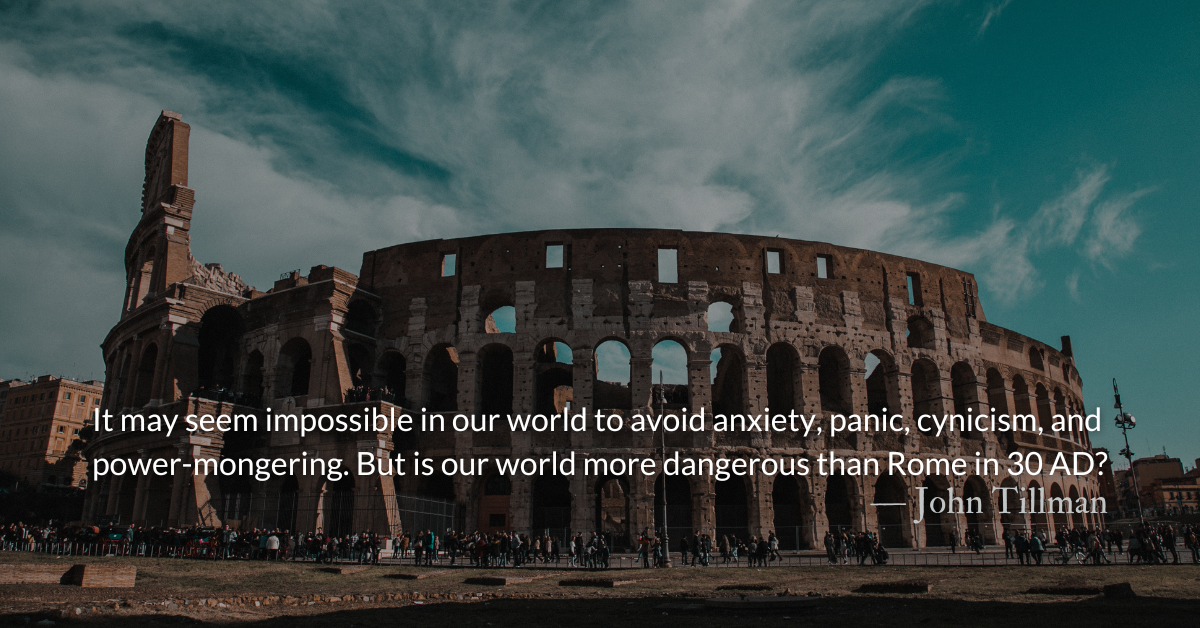
It may seem impossible in our world to avoid anxiety, panic, cynicism, and power-mongering. But is our world more dangerous than Rome in 30 AD?

“Do” is easier than “Don’t.” Instead of thinking, “Don’t be anxious,” concentrate on resting in Jesus. Resist panic by resting in hope. Wrestle in prayer rather than for power. What Christ will establish will not depend on our power or wisdom but on his.

Remember that our immovable rock is not an institution, movement, country, or leader. Jesus is our immovable rock.

Divine Hours Prayer: The Greeting
The Lord lives! Blessed is my Rock! Exalted is the God of my salvation! — Psalm 18.46


– From The Divine Hours: Prayers for Summertime by Phyllis Tickle.

​Today’s Readings
Zechariah 12-13.1 (Listen 2:30)
Luke 21 (Listen 4:18)

Read more about Fasting Uncovers Our Hearts
If all we get from fasting is a measurable, earthly ROI, we will be unlikely to reap a spiritual benefit.

Read The Bible With Us
Our two-year Bible reading plan encourages moments of reflection at a sustainable pace. It’s never too late to join.

https://mailchi.mp/theparkforum/m-f-daily-email-devotional

God’s Performance Artists

Scripture Focus: Zechariah 11.4-5, 7-8
4 This is what the Lord my God says: “Shepherd the flock marked for slaughter. 5 Their buyers slaughter them and go unpunished. Those who sell them say, ‘Praise the Lord, I am rich!’ Their own shepherds do not spare them

7 So I shepherded the flock marked for slaughter, particularly the oppressed of the flock. Then I took two staffs and called one Favor and the other Union, and I shepherded the flock. 8 In one month I got rid of the three shepherds. The flock detested me, and I grew weary of them.

Reflection: God’s Performance Artists
By John Tillman

When Christians think of God as an artist, we often think of pretty sunsets. But God’s artistic portfolio reveals edgier, darker, and grittier work beyond sunsets or rainbows. God often directed his prophets in shocking forms of performance art.

Few people understand performance art, which, like any art form, can be shocking, disgusting, or absurd. In 2014, Shia LaBeouf participated in performance art called “I Am Sorry.” LaBeouf attended events wearing a paper bag over his head that read, “I am not famous anymore.” Then, he wore the bag in the gallery while visitors sat across from him. Most verbally abused him.

“I Am Sorry” was mild compared to God’s performance art exhibits.
Isaiah prophesied naked.
Jeremiah wore an oxen’s yoke.
Ezekiel ate food cooked over feces.
Hosea married a prostitute.

Zechariah’s performance art was taking over a herd of sheep marked for slaughter. These sheep were neglected and ill-treated by former shepherds. Zechariah paid special attention to the oppressed of the flock, yet even with his tender treatment, they detested him. Zechariah turned them over to a far worse shepherd than the ones before.

God explains this as a condemnation of the shepherds and the flock. God sent a good shepherd to replace the bad, but the flock rejected him. They paid Zechariah thirty pieces of silver as an insult. It was the same price paid for the death of a servant gored by a bull.

Zechariah’s performance art previewed Jesus’ ministry. Jesus was the good shepherd sent to the abused flock. He directed his attention to the outcasts, abused, and oppressed. Israel rejected him and sold his life for thirty pieces of silver. (Matthew 27.9-10) We can trust this good shepherd.

Not all art we encounter is holy in meaning or execution. But art expresses part of the image of God in us. Understanding anyone’s art helps us better understand God’s art, which reveals God’s heart.

God is an artistically expressive creator, a verbally gifted communicator, and a passionate storyteller. Like most great artists, God puts his blood, sweat, and tears into his work. We communicate with God through art inspired by and interpreted by his Holy Spirit.

God’s art, including the Bible, is complex and multifaceted but not inscrutable or absurd. Even at its darkest, there is hope. Even at its most confusing, we can trust the heart of Jesus, the ultimate artist and good shepherd.

Divine Hours Prayer: A Reading
On the last day, the great day of the festival, Jesus stood and cried out: “Let anyone who is thirsty come to me! Let anyone who believes in me come and drink! As scripture says, ‘From his heart shall flow streams of living water.’” He was speaking of the Spirit which those who believed in him were to receive; for there was no Spirit as yet because Jesus had not yet been glorified. — John 7.37-39

– From The Divine Hours: Prayers for Summertime by Phyllis Tickle.

​Today’s Readings
Zechariah 11 (Listen 2:40)
Luke 20 (Listen 5:07)

Read more about Supporting Our Work
Please consider becoming a donor. Support ad-free content that brings biblical devotionals to inboxes across the world.

Read The Bible With Us
It’s never too late to join our Bible reading plan. Immerse in the Bible with us at a sustainable, two-year pace.
https://mailchi.mp/theparkforum/m-f-daily-email-devotional

Defilement, Deconstruction, and Reconstruction

Scripture Focus: Zechariah 5.3-4
3 And he said to me, “This is the curse that is going out over the whole land; for according to what it says on one side, every thief will be banished, and according to what it says on the other, everyone who swears falsely will be banished. 4 The Lord Almighty declares, ‘I will send it out, and it will enter the house of the thief and the house of anyone who swears falsely by my name. It will remain in that house and destroy it completely, both its timbers and its stones.’”

From John: This past Monday evening, I wrapped up volunteering in my eighth Alpha course with our church. In it we speak with and listen to those with no faith, lost faith, and injured faith and try to help them pick up the pieces. It seems appropriate to return to this post about deconstruction and reconstruction from 2022. When injury or damage happens, we often must take things apart before we can put them back together.

Reflection: Defilement, Deconstruction, and Reconstruction
By John Tillman

Many of Zechariah’s visions are about cleansing and rebuilding afresh. Those returning from exile face a destroyed and defiled landscape.

It isn’t so hard for us to imagine something similar today. Millions of people have fled the Russian invasion of Ukraine and the cities and towns left behind have been bombed to rubble in ways not seen since World War II. Not only bombed buildings but mass graves await those who hope to one day return. Destruction and defilement.

Like post-war Europe, much of Jerusalem in Zechariah’s day would have to be reconstructed from the ground up. However, God isn’t only concerned with physical reconstruction. He wants to reconstruct the people’s faith, starting with their hearts.

God is and always has sought to deal with the corruption and defilement of human hearts. The mental, social, and physical damage we cause one another flows from inner corruption. When our cities are wicked, our hearts are the source. When our countryside is corrupt, our hearts are the cause. When Jerusalem and its walls and Temple were destroyed and burned with fire, it was because of their hearts.

As the new community of Jerusalem rebuilt the Temple, their homes, and eventually the wall, God was concerned that no spiritual defilement would be present. Zechariah sees a vision of a flying scroll that represents a curse. This curse will target those whose hearts seek wicked ways of prospering and will destroy their homes.

Zechariah’s “timbers and stones” language echoes some passages about physical molds in Leviticus. (Leviticus 14.35-45) Priests inspected homes with mold. If the mold spread, the first step was to remove only the affected stones. But if the mold returned, the entire house had to be deconstructed, “stones, timbers, and all the plaster,” and removed from the community. 

May we never allow ourselves to think we, or our culture, are immune to the rot of sin. In our individual lives, our churches, and the structures of our denominations and nations, we all face defiling influences from our cultures.

Defiling influences have to be fully removed to save existing structures. If small steps do not stop the seeping spread of defilement, more extreme measures are required. Defiled structures must be completely deconstructed and rebuilt.

Cutting out corruption is salvific. Destruction is not God’s goal. Reconstruction is. Take care to deconstruct and destroy only when corruption persists.


Divine Hours Prayer: The Refrain for the Morning Lessons
He looks at the earth and it trembles; he touches the mountains and they smoke. — Psalm 104.33

– From The Divine Hours: Prayers for Summertime by Phyllis Tickle.


​Today’s Readings
Zechariah 5 (Listen 1:35)
Luke 14 (Listen 4:36)

Apply or tell a student!
Our last openings are filling up. #StudentWritersMonth orientation is coming soon! #FreeCoaching, seminars by special guests, published work, and a scholarship/stipend.

Read more about Invitation to Re-creation
Zephaniah is predicting God will dominate and destroy every evil thing in creation…He will wipe the floor with them.

Confused Along with the Prophets

Scripture Focus: Zechariah 4.5
5 He answered, “Do you not know what these are?”
“No, my lord,” I replied.

Reflection: Confused Along with the Prophets
By Erin Newton

Zechariah is one of the more difficult texts of the Old Testament. Like the prophet, I read these passages and think, “I have no idea what he’s talking about.” Thankfully, Zechariah was equally confused.

The setting for Zechariah is after the destruction of Jerusalem by the Babylonians. Solomon’s Temple was a pile of rubble (perhaps even the mountain mentioned in verse 7). Zechariah’s visions were of hope and restoration in the midst of suffering and doubt.

The imagery is somewhat mysterious—golden lampstands with branches and channels. The lampstand is representative of God, whose eyes are on the work of the people.

A message was also given to Zerubbabel. These additional statements interrupt Zechariah’s vision and the conversation he was having with the angel. Despite the erratic conversation bouncing from one topic to the next, the interruptions add to the overall message. There are answers within the chaos. Zerubbabel will finish the temple. The work of restoration that seems insurmountable will indeed find completion.

I tried to look through various commentaries, hoping to find scholars far more skilled and familiar with Zechariah to help explain exactly what these images mean. You know what? Everyone is a little bit perplexed. Part of me gets frustrated when I read passages that make me scratch my head. Looking for clarity here, I find whole crowds of biblically trained headscratchers.

Nevertheless, this head-scratching scene is one of hope—and the hope part of the vision is clear. The temple will be completed. God is present. God is watching over them. The presence of God with his people in this restored temple is prophesied as a certain future.  

Isn’t this the beauty of Scripture sometimes? The vision that is vague in some places and clear in others coincides with the complexity and confusion of our lives.

Zechariah looks out on the piles of stones that once formed the magnificent temple. Zerubbabel was stirred by the Holy Spirit to work on rebuilding the temple (Haggai 1.14), but the work is fraught with difficulties. Zechariah declares, however, it is by God’s power that the work gets done.

In a strange way, I am thankful for these complicated and confusing passages. The vision of our future is always filled with questions. What we see as a mess, God sees as a future of hope. What we fear is up to us, God knows he can empower.


Divine Hours Prayer: The Greeting
The Lord is in his holy temple; let all the earth keep silence before him. Amen. 

– From The Divine Hours: Prayers for Summertime by Phyllis Tickle.


​Today’s Readings
Zechariah 4 (Listen 1:53)
Luke 13 (Listen 5:02)

Apply or tell a student!
#StudentWritersMonth orientation is coming soon! #Write with us for #FreeCoaching, seminars by special guests, published work, and a scholarship/stipend.

Read more about Supporting Our Work
Our work needs your support. Please consider becoming a donor. Support ad-free content that brings biblical devotionals to inboxes across the world.

The King We Want

Scripture Focus: John 19.15
15 But they shouted, “Take him away! Take him away! Crucify him!” “Shall I crucify your king?” Pilate asked. “We have no king but Caesar,” the chief priests answered.

Zechariah 9.9
9 Rejoice greatly, Daughter Zion! 
Shout, Daughter Jerusalem! 
See, your king comes to you, 
righteous and victorious, 
lowly and riding on a donkey, 
on a colt, the foal of a donkey. 

1 Samuel 8.6-7
6 But when they said, “Give us a king to lead us,” this displeased Samuel; so he prayed to the Lord. 7 And the Lord told him: “Listen to all that the people are saying to you; it is not you they have rejected, but they have rejected me as their king.


Reflection: The King We Want
By John Tillman

All the gospel writers include the detail from Zechariah’s vision of a coming king riding on a donkey. John and Matthew quote Zechariah 9.9 to point out Jesus’ fulfillment of this prophecy. However, this humble king wasn’t what many wanted. Many rejected Jesus then. And many still reject him now.

The King We Want
We want a king, we say
A king like other nations
With Solomon’s glitz and glamor
With Goliath’s sword and armor

I’ve sent a king, God says
Unlike any you’ve seen
Son of the Giant Killer
Yet, rejected as your ruler

We want a king, we say
Exalted and victorious
We’ll hear his saber rattle
We’ll follow him to battle

I’ve sent a king, God says
A king not of this realm
Your lust for worldly power
Shows you mistake the hour

We want a king, we say
To make our city great
To make for ourselves a name
To not be scattered from this plain

I’ve sent a king, God says
You had no eyes to see him
He wept over your city
That the outcasts gained no pity

We want a king, we say
We’ll even take a bad one
Let him speak like a serpent coiled
Long as we can share the spoils

I’ve sent a king, God says
You had no ears to hear him
Of sin’s sting you must repent
Then my King will crush the serpent

We want a king, we say
A conqueror, triumphant
Crush our enemies who slight us
Crush the governments above us

I’ve sent a king, God says
He rode in on a donkey
My servants prophesied him
You rebels crucified him

We want a king, we say
To cast out the unworthy
Keep away those we despise and fear
Isolate us with those we hold dear

I’ve sent a king, God says.
Accepting any and all subjects
No repentant sinner he’ll exclude
And that, my child, includes you


Divine Hours Prayer: The Refrain for the Morning Lessons
Righteousness shall go before him, and peace shall be a pathway for his feet. — Psalm 85.13

– From The Divine Hours: Prayers for Summertime by Phyllis Tickle.


Today’s Readings
Job 20 (Listen 2:52
John 19 (Listen 6:23)

This Weekend’s Readings
Job 21 (Listen 3:05), John 20 (Listen 4:17)
Job 22 (Listen 2:54), John 21 (Listen 3:58)

Read more about Ecce Homo
Pilate presents Jesus as king and he is rejected. Not just by the Jews. By the world. This moment is the essence of all sin.

Read more about Pause To Read
Check out today’s new podcast episode: Defining Moment. How many have you listened to? Let us know what you think. Share and rate the episodes to spread the word.

Show Buttons
Hide Buttons
Spur a spiritual rhythm of refreshment right in your inbox
By joining this email list you are giving us permission to send you devotional emails each weekday and to communicate occasionally regarding other aspects of the ministry.
100% Privacy. We don't spam.