Let’s Talk about Sex

Links for today’s readings:

Apr 1  Read: Song of Songs 8 Listen: (2:23) Read: Matthew 5 Listen: (6:03)

Scripture Focus: Song of Solomon 8:4

4 Daughters of Jerusalem, I charge you:
    Do not arouse or awaken love
    until it so desires.

Reflection: Let’s Talk about Sex

By Erin Newton

Song of Solomon repeats the plea to “refrain from arousing or awakening love until it so desires” in 2:7, 3:5, and 8:4. But what does this phrase mean? 

Admittedly, this phrase had left scholars with more questions than answers. Early church fathers saw the intimate relationship as an allegory for God and the Church. Others and later interpreters read the poetry as a typical human love poem.

Still more troublesome is our culture’s relationship with sex. Everything is over-sexualized from clothing to cologne ads to music to Halloween costumes. Our imago Dei is good and lovely, yet the exploitation of our bodies crosses many moral lines.

Setting aside an allegorical reading of the book, let’s talk about sex.

Some have read the phrase to refer to abstinence from sex altogether. Since the phrase is repeated twice before chapter 8, the two have already been intimate so that cannot be the meaning here.

Sheila Gregoire, author and founder of Bare Marriage, speaks regularly about Christians’ (mis)understanding about sex. In her blog post about this phrase, she notes that for many Christian women who grew up in the 90s-00s, “we’re taught that we are responsible both for our own purity and for his.” It was this verse that was used to support not arousing him until it was time

The problem with this concept was that the onus fell on women. “Boys can’t stop” was the mantra. Failure to refrain meant the female in the relationship was the cause of both of their failures to follow this scriptural admonition. This is untrue.

Shame that often followed has added to many Christian couples’ struggles in bed. 

What can we learn from this phrase? Sexual desire is good and inevitable, but don’t underestimate its power (for both men and women). There is wisdom in timing. The better “purity teaching” would highlight how waiting is meant to benefit couples, protecting from heartache, unplanned pregnancies, or abandonment.

For many Christians, the admonition might be far too late to heed. There is so much more to this topic, more than we can fit in our short reflections here at The Park Forum. But I think Sheila concludes it well:

“Please know, even if love was awakened too early, you can still re-awaken it. I think that’s what God loves to do—restore that which was broken. All of creation is broken, but Jesus is always working towards wholeness.”

Divine Hours Prayer: The Request for Presence

Send out your light and your truth, that they may lead me, and bring me to your holy hill and to your dwelling;

That I may go to the altar of God, to the God of my joy and gladness; and on the harp I will give thanks to you, O God my God. — Psalm 43.3-4

– From The Divine Hours: Prayers for Springtime by Phyllis Tickle.

Read more: Jesus Is as Serious as Leviticus

A victim may grant forgiveness as part of their act of worship. Those who do harm must make restitution as part of theirs.

Read more: Love Stronger Than Death

Human love can be twisted, becoming sinful jealousy that destroys what it can no longer possess…leads to rape, domestic violence, abuse, and often murder.


Seeking the Lover of Our Souls

Links for today’s readings:

Mar 27  Read: Song of Songs 3 Listen: (1:48) Read: Psalm 72 Listen: (2:21)

Links for this weekend’s readings:

Mar 28  Read: Song of Songs 4 Listen: (2:46) Read: Matthew 1 Listen: (3:29)
Mar 29  Read: Song of Songs 5 Listen: (2:43) Read: Matthew 2 Listen: (3:18)

Scripture Focus: Song of Songs 3.1-2

1 All night long on my bed 

I looked for the one my heart loves; 

I looked for him but did not find him.

2 I will get up now and go about the city, 

through its streets and squares; 

I will search for the one my heart loves. 

So I looked for him but did not find him. 

John 20.15-16

15 He asked her, “Woman, why are you crying? Who is it you are looking for?”
Thinking he was the gardener, she said, “Sir, if you have carried him away, tell me where you have put him, and I will get him.”
16 Jesus said to her, “Mary.”
She turned toward him and cried out in Aramaic, “Rabboni!” (which means “Teacher”).

Reflection: Seeking the Lover of Our Souls

By John Tillman

Charles Wesley’s hymn, “Jesus, Lover of My Soul,” might not sound scandalous now, but early listeners were uncomfortable with its portrayal of an intimate, loving relationship to Jesus. Some Christians today are similarly bothered by modern songs that sing passionately about loving God and being loved by him.

Every once in a while, I have wondered if a new worship song would be better sung to a prom date than God, but scripture teems with more direct romantic metaphors than any modern hymn. Any metaphor can go too far, but in general, expressing love for God using the metaphor of human relationships is nothing to be squeamish about.

Based on this passage from Song of Songs, many have drawn parallels between the Bride’s search for her lover and Mary Magdalene’s search for Jesus’ body.

The bride dreams of her groom. She races through the city, asking watchmen to find him but they cannot answer. Suddenly, she finds her love and takes him home with her to an intimate place. But the “dream lover” is not the true lover. An unknown stranger approaches from the wilderness. Then, she recognizes him! Solomon has come to find her, in a glorious carriage constructed for the occasion. The public ceremony and spectacle involve the whole city. The reality was greater than her fantasy.

Mary seeks Jesus at the garden tomb, but cannot find him. The guards are still, mute, or absent and cannot answer. Mary expects to find and care for Jesus’ dead body, but an unknown stranger approaches her in the garden. Then, she recognizes him! Jesus, resurrected and glorified, finds and cares for her. The reality was greater than what she imagined.

The bride in Song of Songs was probably a real person. She represents individuals longing for marriage and love as well as God’s beloved people, Israel and (to Christians) the Church. Mary is not a “lover” of Jesus in the romantic sense but she represents all who love him and seek him. 

Regardless of gender, we can all find ourselves in both these biblical women. These women are portraits of those for whom Jesus is the lover of our souls. To paraphrase St. Augustine, we are made for Jesus, and our hearts are restless until they rest in him.

Love him because he loved you. Seek him and he will find you. Reality will be greater than your imaginings.

Divine Hours Prayer: A Reading

They then said to him, “John’s disciples are always fasting and saying prayers, and the disciples of the Pharisees, too, but yours go on eating and drinking.” Jesus replied, “Surely you cannot make the bridegroom’s attendants fast while the bridegroom is still with them? But the time will come when the bridegroom is taken away from them; then, in those days, they will fast.” — Luke 5:33–35

– From The Divine Hours: Prayers for Springtime by Phyllis Tickle.

Read more: A “Righteous” Government?

What principles do you see in this picture of a righteous government? A righteous government creates stability and safety without resorting to brutality or oppression.

Consider Supporting Our Work

It’s challenging, even in Christian spaces to find content that isn’t monetized by advertising. We need support to keep our work ad-free. Please consider becoming a donor.

Touches of Eden

Links for today’s readings:

Mar 26  Read: Song of Songs 2 Listen: (2:15) Read: Psalms 70-71 Listen: (3:29)

Scripture Focus: Song of Songs 2.2-4

He

2 Like a lily among thorns 
is my darling among the young women.

She

3 Like an apple tree among the trees of the forest 

is my beloved among the young men. 

I delight to sit in his shade, 

and his fruit is sweet to my taste.

4 Let him lead me to the banquet hall, 

and let his banner over me be love.

Reflection: Touches of Eden

By John Tillman

Scriptures often mean more than one thing.

Isaiah’s prophecy about a “virgin” (literally “young woman”) who would give birth to a child as a sign of blessing was both about a normal child, born during the siege of Jerusalem in Isaiah’s lifetime, and about Jesus who would be born centuries later. (Is 7.10-17; Matt 1.20-25)

Jesus’ teaching about the “end of the age” was both about the fall of Jerusalem that would occur in a few decades, and about the time of his second coming which we still await. (Matt 24.15; Mark 13.14; Luke 21.20)

Similarly, Song of Songs is both about physical and emotional love between a royal groom and bride and about God’s love for his people that is best pictured in Jesus.

The lovers in Song of Songs find each other remarkable.

There are other women. But not like her. There are other men. But not like him. Other women are thorns instead of lilies. Other men are fruitless trees like the one Jesus cursed (Mark 11.12-22), instead of fruitful trees that provide both shelter and sustenance.

This comparison is not primarily a romantic exaggeration like saying, “All women are ugly compared to you,” or “All men are monsters, except for you.” They see in one another a spark of Eden.

Outside of Eden, the ground naturally produces thorns, but she, among the thorns, is a beautiful, soft, and pleasing flower. Outside of Eden, food comes by toil and sweat, but he produces fruit in keeping with righteousness and shelter from heat and labor. They find in one another a touch of Eden’s blessings.

Reading this into our human relationships doesn’t mean insulting other people to “compliment” our loved ones. It means seeking and building relationships that bear the fruit of Eden and the blessings of God. This should be true in both our romantic and platonic relationships. We should be soft and beautiful in a world of harshness. We should create space that is safe and nourishing in a world of selfishness.

Reading this into our spiritual lives, we realize that we can only share the fruit of Eden by sitting under the shade of Jesus’ tree, the cross. He transforms the thorns of his crown into lilies. He transforms the toil, sweat, and blood of the cross, a tool of oppression, war, and death, into the true tree of life, blessing, beauty, love, rest, and peace.

His banner over us is love.

Divine Hours Prayer: The Request for Presence

Teach me your way, O Lord, and I will walk in your truth; knit my heart to you that I may fear your Name. — Psalm 86.11

– From The Divine Hours: Prayers for Springtime by Phyllis Tickle.

Read more: Hip-Hop Psalmists?

Musical familiarity enhances understanding of music…familiarity with scripture enhances understanding of biblical author’s “samples.”

Read more: Always the Rock of Refuge

I went to that rock of refuge again and again. And from that continual, enduring, and reliable source of refuge, I found hope.

Love Stronger Than Death

Scripture Focus: Song of Songs 8.6-7
6 Place me like a seal over your heart, 
like a seal on your arm; 
for love is as strong as death, 
its jealousy unyielding as the grave. 
It burns like blazing fire, 
like a mighty flame. 
7 Many waters cannot quench love; 
rivers cannot sweep it away. 
If one were to give 
all the wealth of one’s house for love, 
it would be utterly scorned. 

Hosea 1.2
2 When the Lord began to speak through Hosea, the Lord said to him, “Go, marry a promiscuous woman and have children with her, for like an adulterous wife this land is guilty of unfaithfulness to the Lord.”

Reflection: Love Stronger Than Death
By John Tillman

Today, we conclude Song of Songs and move, over the weekend, into Hosea. What a contrast!

From the idyllic, passionate love poetry in Song of Songs, we turn to the tear-stained legal documents and pleadings of a marriage in crisis. It’s like turning from a Hallmark love story to a gritty, true-crime documentary. 

The beloved’s poem about the strength of love is one of the most well-known passages of the Bible. It is often quoted as a positive. “Many waters cannot quench love” is on the mausoleum dedicated to Ida And Isidor Straus, who chose to die together on the Titanic as it sank, rather than be separated. Ida is reported to have quoted Ruth, “Where you go, I will go,” as she refused to get on a lifeboat without her husband. (Ruth 1.16)

However, there is also a warning within this passage. Love strong as death, like a blazing fire, unable to be quenched, unable to be bought off, or denied…this is a confession. Human love can be twisted, becoming sinful jealousy that destroys what it can no longer possess or takes with force what will not yield to it. This leads to rape, domestic violence, abuse, and often murder. This unyielding love can lead to wickedness in humans, but in God it is the motivation for the gospel. The holy jealousy of God leads not to destruction but to redemption and salvation.

Hosea is God’s stand-in depicting this. His anger and hurt are real and justifiable. His love burns. His jealousy rises. Hosea’s human love is as strong as death and by Jewish law, he could have demanded death for Gomer.

God chose, rather than let us sink in the titanic disaster of our sin, to sink himself. His love is so great, that he did not die with us, sinking into oblivion. Rather, he died instead of us and when he sank into the grave, it was only to lift us up after him.

God’s love is stronger than death. His love breaks the unyielding hold of the grave. His love burns through any barrier that would come between us. His love quenches the fires of sin that would burn us. His love gave all the wealth of his house, becoming poor that we can become rich. (2 Corinthians 8.9

Who could scorn this kind of love?

Music: “Love As Strong As Death” – Canticle of Plains by Kevin Max / Rich Mullins

Video: Overview of Hosea by The Bible Project

Divine Hours Prayer: The Request for Presence
Be pleased, O God, to deliver me; O Lord, make haste to help me. — Psalm 70.1

– From The Divine Hours: Prayers for Springtime by Phyllis Tickle.

Today’s Readings
Song of Songs 8Listen – 2:23)
Psalm 123-125(Listen -1:52)

This Weekend’s Readings
Hosea 1Listen – 2:08)Psalm 126-128(Listen -1:158)
Hosea 2Listen – 3:48)Psalm 129-131(Listen -2:03)

Read more about The Naked Emotion of God
Hosea. This shows us a God unashamed of shame, nakedly confessing his love for the unlovable.

Read more about He Stoops to Raise
He strips himself.
He lays aside
His Heaven
His throne
His clothes
His life

Proper Desire

Scripture Focus: Song of Songs 7.10-12
10 I belong to my beloved,
    and his desire is for me.
11 Come, my beloved, let us go to the countryside,
    let us spend the night in the villages.
12 Let us go early to the vineyards
    to see if the vines have budded,
if their blossoms have opened,
    and if the pomegranates are in bloom—
    there I will give you my love.

Reflection: Proper Desire
By Erin Newton

If we overheard this kind of mushy, lovey-dovey, colorful language, many of us would turn red. In this chapter, we are privy to the most intimate description of the woman. It is incredibly flattering; he loves everything about her.

In response, she suggests that they run off to a romantic getaway. Interjected into this proposal, she reaffirms their mutual commitment. 

Just like the previous chapter, she is for her lover. In this case, the second half of the line declares that her lover’s desire is for her. Is this sexual impulse, authoritarian rule, or something more?

Debate has occurred over the term “desire.” It is used only three times in the Old Testament. After the fall in Genesis 3, the woman is said to desire her husband. Sin desires to consume Cain due to jealousy. And finally, the lover desires the woman. The rarity of the word draws attention to its use.

In Genesis 3, the mutual relationship between the man and woman in Eden was suddenly disrupted. This fall from paradise produces “one of the most grievous ills of our world: the unequal power relation between woman and man that has been a feature of nearly every society from biblical times to the present” (Ellen Davis). Her desire after the Fall still entailed her longing for the man as it was in Eden but the new order was a distortion of their relationship.

When viewed in light of creation and the fall, it is desire which seeks to return people to proper communion. Aimee Byrd, in The Sexual Reformation, sees desire as the longing to restore the pre-Fall relationship between men and women.

In the Song of Songs, restoration between the man and woman is exemplified in the lovers’ relationship. She is fully committed to him. He longs for her in a way that echoes the woman’s desire in Genesis 3. Let us redirect our desire to restore unity that was lost in Genesis. 

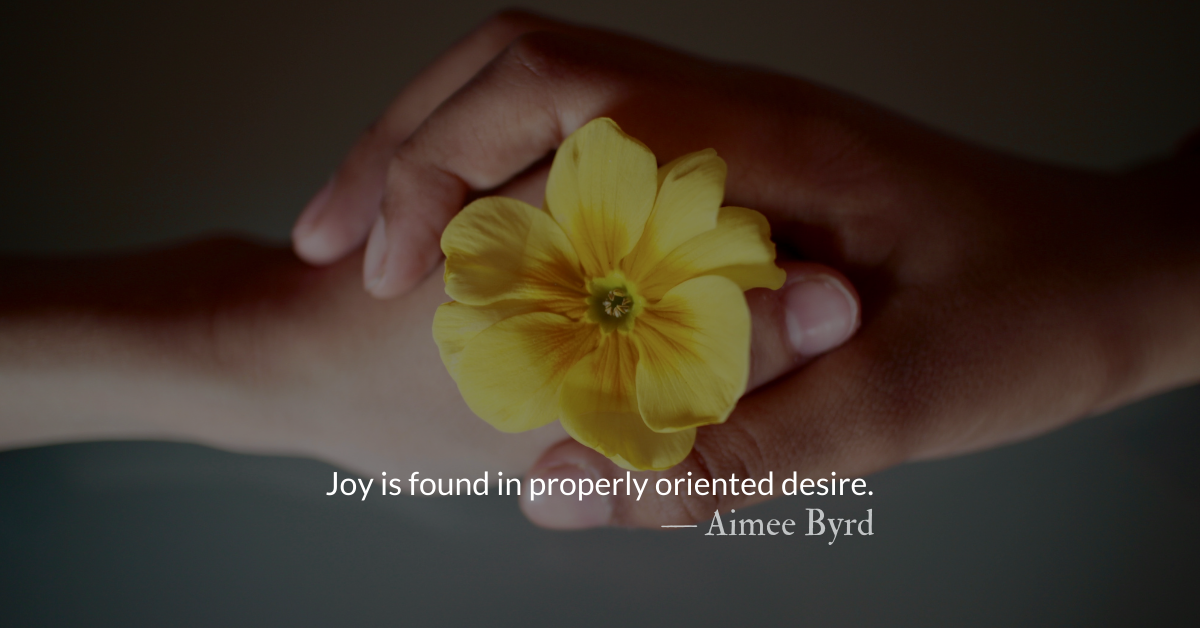
In this picturesque view of intimacy, it is important to realize that despite the ideal nature of their relationship, the lovers can never satisfy their deepest longings. Aimee Byrd aptly warns, “Unlike the many resources marketed to Christians today, it isn’t found in so-called biblical manhood or womanhood. Unlike the many who oppose them, it isn’t found in egalitarianism…Joy is found in properly oriented desire.” And that desire is found in Christ, our Bridegroom. 

Divine Hours Prayer: The Refrain for the Morning Lessons
My eyes are upon the faithful in the land, that they may dwell with me. — Psalm 101.6

– From The Divine Hours: Prayers for Springtime by Phyllis Tickle.

Today’s Readings
Song of Songs 7Listen – 1:55)
Psalm 120-122(Listen -2:12)

Read more about Love is Not a Panacea
Why would we interpret sin on her part for being slow to rise and not sin on the man’s part for being absent in the first place?

Read more about Love Without Red Flags
“I am for my lover, and my lover is for me.” This literal translation reveals the self-giving attitude of the husband and of the wife. They are for one another.

https://theparkforum.org/843-acres/love-without-red-flags