

Links for today’s readings:
Mar 19 Read: Ecclesiastes 7 Listen: (3:37) Read: Psalms 58-59 Listen: (3:32)
Scripture Focus: Psalm 58.1-2; 10-11
1 Do you rulers indeed speak justly?
Do you judge people with equity?
2 No, in your heart you devise injustice,
and your hands mete out violence on the earth.
10 The righteous will be glad when they are avenged,
when they dip their feet in the blood of the wicked.
11 Then people will say,
“Surely the righteous still are rewarded;
surely there is a God who judges the earth.”
Psalm 59.11-13
11 But do not kill them, Lord our shield,
or my people will forget.
In your might uproot them
and bring them down.
12 For the sins of their mouths,
for the words of their lips,
let them be caught in their pride.
For the curses and lies they utter,
13 consume them in your wrath,
consume them till they are no more.
Then it will be known to the ends of the earth
that God rules over Jacob.
Reflection: Do Not Destroy?
By John Tillman
In The Sun Also Rises, Ernest Hemingway described how bankruptcy happens: “Gradually, then suddenly.” Other writers have adapted this idea to falling in love or falling asleep. Both happen “Slowly, then all at once.”
In David’s trilogy of Psalms 57, 58, and 59, which use the tune “Do Not Destroy,” he mixes lament for his sufferings with imprecatory passages against morally bankrupt enemies.
The middle psalm, Psalm 58, is harshest. It asks God to break and rip out his enemies’ fangs. It pictures enemies swept away like Pharoah’s army in a flood and the righteous walking through the wicked’s blood. This is typical language for imprecatory psalms, which do not endorse or command vengeful violence, but instead leave vengeance to God. But a surprise awaits in the final psalm.
In Psalm 59 David asks God not to kill his enemies. Or at least, not too quickly. He asks that they be uprooted and consumed slowly. This gradual punishment is not mercy. David is not concerned for the lives of the wicked but for the lives of those who will witness their long, slow, painful fall.
David wants God’s people to see these enemies fall and fail publicly, on an epic scale, and in slow motion. The tune, “Do Not Destroy” might be more accurately called “Do Not Destroy Too Quickly.”
Leaders go morally bankrupt in the same way Hemingway described financial bankruptcy—gradually, then suddenly. Justice comes against the corrupt in the same way David prayed for—slowly, then all at once.
Our world is not short of leaders like those David prayed about. Do you see those who devise injustice and spread lies? (Ps 58.2-3) Do you see those whose words are harmful swords promoting and promising violence scoffing that no one can hold them accountable? (Ps 59.7) (I hesitate to mention examples like the Epstein files…this is not about just one scandal.)
We can and should pray imprecatory psalms but imprecatory psalms are not angry social media posts. Those “prayers” on the “public street corner” have earthly rewards. (Matthew 6.5-6) Imprecatory psalms turn our justifiable rage, anger, and pain over to God for his vengeance and justice.
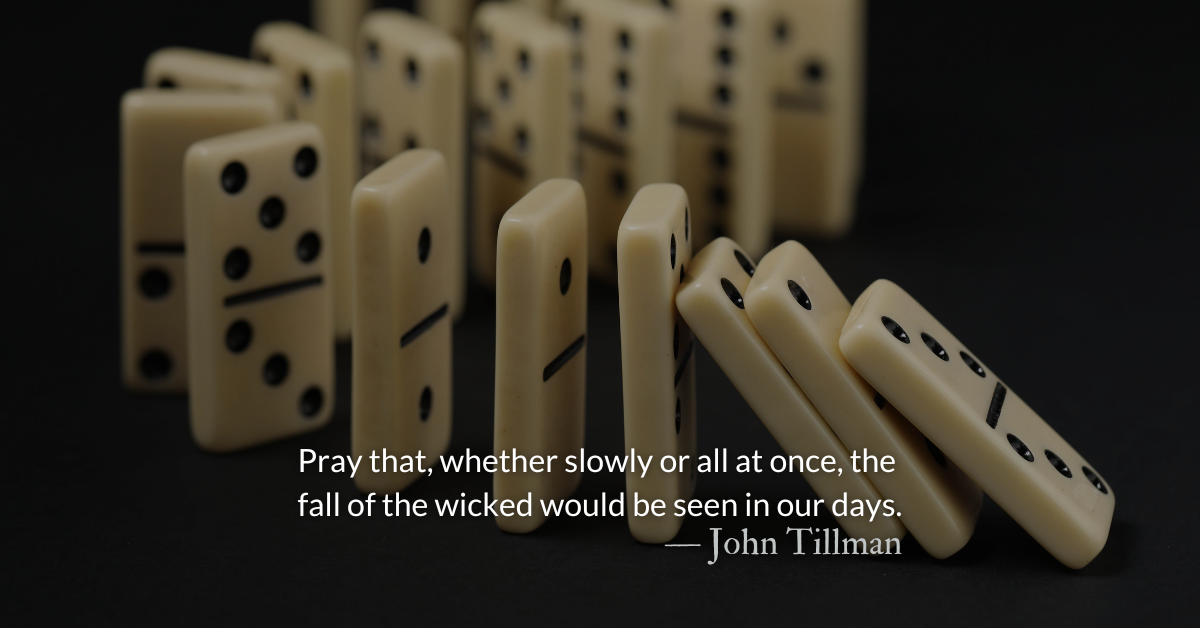
Pray that, whether slowly or all at once, the fall of the wicked would be seen in our days. Bring them down, Lord, that the suffering may be encouraged, the wicked may be warned, and the world may remember you are watching.
Divine Hours Prayer: The Morning Psalm
Do not fret yourself because of evildoers; do not be jealous of those who do wrong.
For they shall soon wither like the grass, and like the green grass fade away.
Put your trust in the LORD and do good; dwell in the land and feed on its riches.
Take delight in the LORD, and he shall give you your heart’s desire.
Commit your way to the LORD and put your trust in him, and he will bring it to pass.
He will make your righteousness as clear as the light and your just dealing as the noonday.
Be still before the LORD and wait patiently for him. — Psalm 37.1–7
– From The Divine Hours: Prayers for Springtime by Phyllis Tickle.
Read more: Extremes of Moralism and Permissiveness
There is a level of religious fervor and moral strictness that destroys our souls rather than saves them.
Read more: Wisdom in Houses of Mourning
Many may confess we tossed aside Jesus, and the entanglement we escaped was the cords of loving-kindness God sought to guide us by.