
Where Admission is Free

Links for today’s readings:

Feb 6 Read: Job 39 Listen: (2:47) Read: Psalm 25 Listen: (2:18)

Links for this weekend’s readings:

Feb 7 Read: Job 40 Listen: (2:09) Read: Psalms 26-27 Listen: (3:13)
Feb 8 Read: Job 41 Listen: (3:03) Read: Psalms 28-29 Listen: (2:41)

Scripture Focus: Psalm 25.4-5, 8-9

4 Show me your ways, Lord, 

teach me your paths. 

5 Guide me in your truth and teach me, 

for you are God my Savior, 

and my hope is in you all day long. 

8 Good and upright is the Lord; 

therefore he instructs sinners in his ways. 

9 He guides the humble in what is right 

and teaches them his way.

Reflection: Where Admission is Free

By John Tillman

Some teachers and schools are selective about admissions.

To enroll in a renowned school or study under a renowned teacher, you typically must prove you are already an excellent student in that topic. So-called “great” teachers have the distinct advantage of only teaching students who are already great before they ever show up in class. There are good and reasonable explanations for this. Students must be prepared for rigorous study under a master teacher.

Many private schools deny admission to students requiring greater educational resources. Students with disabilities, poor grades, poor behavior, or other deficiencies are turned away. Explanations for this are significantly less good and reasonable. These institutions shirk responsibility to conserve resources and (in some cases) maximize profit.

Seven times in Psalm 25, the psalmist describes learning from, or being taught by, God. The psalmist connects God’s goodness to his willingness to teach anyone. God is the ultimate master teacher. No teacher is wiser. Yet, God is a teacher from whom we all may learn. God teaches the humble, the weak, the foolish, the failures, and especially, the sinners.

God shows, teaches, guides, and instructs us in God’s ways. God’s ways require humility, but deliver from shame. God’s ways require confession, but forgive wrongdoing. God’s ways require submission, yet lead to freedom. God’s ways pass through suffering, yet emerge in victory.

The psalmist learns despite being in crisis. His feet are ensnared. Treachery surrounds him. He is lonely, troubled, afflicted, anguished, and distressed. Enemies who fiercely hate him seek his shame and destruction.

Doesn’t it seem like we face crisis after crisis? Do you feel trapped? Betrayed? Do you mourn the hatred you see and feel?

If so, you are perfectly positioned, as the psalmist was, to learn from God. God is good and upright. Loving and faithful. He is demanding, yet forgiving. He is fearful to behold, yet gracious and beautiful in his mercy displayed toward us and revealed in Jesus.

Take Jesus’ yoke upon you. Learn from him. (Matthew 11.29-30) He’s the world’s greatest teacher, and admission is free. Go beyond informational education to experiential learning. Go beyond lectures to the laboratory of living.

Don’t just study the map of Jesus’ life from a comfortable chair. Put your feet on the road and travel his path. He is gentle and humble. May we become so. He is loving and courageous. May we become so.

Divine Hours Prayer:

Jesus taught his disciples, saying: “And indeed, which of you here, intending to build a tower, would not first sit down and work out the cost to see if he had enough to complete it? Otherwise, if he laid the foundation and then found himself unable to finish the work, everyone who saw it would start making fun of him and saying, ‘Here is someone who started to build and was unable to finish.” — Luke 14.28-30


– From The Divine Hours: Prayers for Springtime by Phyllis Tickle.

Read more: Following Through Jerusalem

The path leading to glory with Christ is the path leading through suffering to death.

Read more: A God Who Celebrates

Though we are unwieldy and unwise as the ostrich, give us grace to run in the path of your commands.
Stop Following Old Laws

Scripture Focus: Leviticus 20.22-14
22 “ ‘Keep all my decrees and laws and follow them, so that the land where I am bringing you to live may not vomit you out. 23 You must not live according to the customs of the nations I am going to drive out before you. Because they did all these things, I abhorred them. 24 But I said to you, “You will possess their land; I will give it to you as an inheritance, a land flowing with milk and honey.” I am the Lord your God, who has set you apart from the nations. 

Psalm 25.12-15
12 Who, then, are those who fear the Lord? 
He will instruct them in the ways they should choose. 
13 They will spend their days in prosperity, 
and their descendants will inherit the land. 
14 The Lord confides in those who fear him; 
he makes his covenant known to them. 
15 My eyes are ever on the Lord, 
for only he will release my feet from the snare. 

Reflection: Stop Following Old Laws
By John Tillman

God does not desire for people to perish but to flourish. His prohibitions are not designed to cause denial or suffering but to bring out fulfillment and pleasure. 

Godly wrath, punishment, and judgment come from love for victims. There is no such thing as victimless crime. Yet, even the harshest earthly penalties, cannot truly compensate victims for their sufferings. They are still only tokens, looking forward to the true justice that would be wrought by the sacrifice of Jesus. 

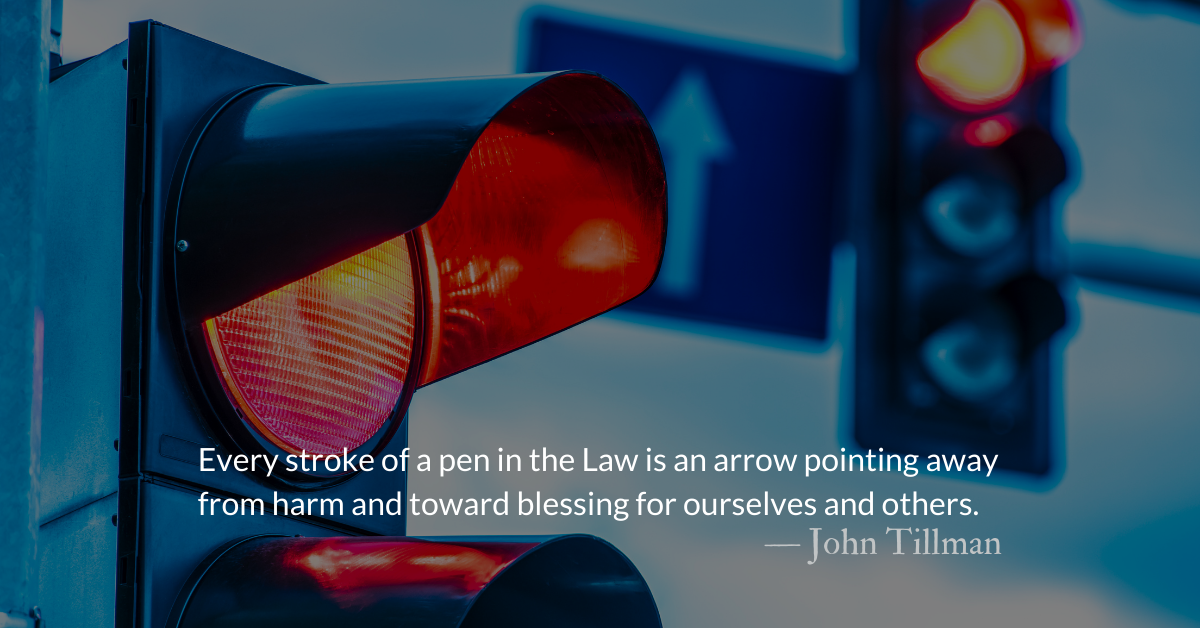
God desires the best for all people, even perpetrators. Victims are not the only ones harmed by sin. Perpetrators of violence, promiscuity, and greed harm themselves, in addition to their victims. God’s prohibitions are flashing red warning lights that say, “I love you. Don’t do this.” Every stroke of a pen in the Law is an arrow pointing away from harm and toward blessing for ourselves and others.

However, when we are convinced of our own righteousness, we argue against the righteousness of God. The surest way Satan tempts us to sin, perhaps the only way he ever has tempted us to sin, is to convince us that God is unjust.

These laws also were intended to shape God’s people into something new. All nations and empires were (and are) sinful and unjust. Israel was to be different. All humans victimized others. They were to be different. All humans considered sexuality as just another tool of manipulation and control. They were to be different. All peoples considered themselves better than all others. They were to be different.

We think of laws from the Bible as “old” and irrelevant. But the cultural laws we follow today were old before God’s law came:

“The strong will survive.”
“Eat, drink, and be merry.”
“Get it while you can.”
“Do what is best for you.”

Our culture is still following these “old laws” of dominance, indulgence, impermanence, and selfishness. These old laws are irrelevant in God’s kingdom. God’s laws given to Israel are the new laws:

“Take care of the weak.”
“Leave extra for others.”
“Live for eternity, not the moment.”
“Do what is best for others.”

These are the new laws of justice, equity, eternality, and sacrifice that Jesus came to fulfill. May we live out this law today. When we do, we will find our feet freed from the snare of sin and we will make visible a glimpse of the coming kingdom of God.

Divine Hours Prayer: The Morning Psalm
Why should I be afraid in evil days, when the wickedness of those at my heels surrounds me,
The wickedness of those who put their trust in their goods, and boast of their great riches?
We can never ransom ourselves, or deliver to God the price of our life;
For the ransom of our life is so great, that we should never have enough to pay it, — Psalm 49.6-10

– Divine Hours prayers from The Divine Hours: Prayers for Springtime by Phyllis Tickle


Today’s Readings
Leviticus 20 (Listen – 4:18)
Psalms 25– (Listen – 2:18)

This Weekend’s Readings
Leviticus 21 (Listen – 3:08), Psalms 26-27 (Listen – 3:13)
Leviticus 22 (Listen – 4:41), Psalms 28-29– (Listen – 3:41)

Read more about Two Lamechs, One Jesus
Lamech multiplies all of Cain’s sins….violence and oppression…“marrying” two wives…

Read more about Uprooting and Replanting
In the flood, we see uprooting and replanting. The thorny brambles of Cain and Lamech filled the world with violence and bloodshed.

Following Through Jerusalem

Psalm 25.15-18
My eyes are ever on the Lord,
   for only he will release my feet from the snare.
Turn to me and be gracious to me,
   for I am lonely and afflicted.
Relieve the troubles of my heart
   and free me from my anguish.
Look on my affliction and my distress
   and take away all my sins.

Reflection: Following Through Jerusalem
By John Tillman

During his dramatic entrance to Jerusalem, Jesus allowed himself to be worshiped (Even by those he knew would turn against him in a few days). When Jesus entered the Temple, he violently disrupted an economic center of oppression and made room for more foreigners to enter the outer court of the Temple. Matthew’s account adds that afterward, the blind and the lame, who would not have been permitted to enter the Temple, came to Jesus there and he healed them. These actions undermined the religious leaders’ superiority, threatened their wealth, and countermanded their teachings on the nature of sin.

Jesus represented a direct threat to their power structure and their methods of retaining power and control. So the religious leaders, instead of being ready to listen, ready to rejoice, and ready to accept the freedom and healing Jesus was bringing, were ready to challenge him.

The challenges of the religious leaders were meticulously designed logical traps. They were loaded, hot-button political questions, intended to turn the crowds against Jesus. Jesus answered every one of them masterfully.

To say his answers were skillful implies some level of craft or deceit. That’s what we expect from those answering tricky questions. But it was Christ’s undeniable truthfulness and solid basis in scripture that forced even those opposing him to publicly admit he answered well. Scripture says he “silenced” his opponents.

In our social media, drama-driven world, we often long for someone to silence our critics and win our battles. We equate winning arguments with advancing the kingdom.

But we need to remember that Jesus didn’t ride into Jerusalem to shame his enemies, but to be shamed on the cross. He didn’t come to slaughter his enemies, but to be slaughtered.

The crowds and outward successes of Christ’s entry to Jerusalem may have given his disciples a wrong impression of Christ’s true mission.

When Jesus calls us to follow him, it isn’t just to follow him to sit on some Heavenly throne. James and John longed to sit there, but Jesus knew they didn’t understand what they asked for. The path leading to glory with Christ is the path leading through suffering to death.

If we desire to rise with him, we must expect to suffer with him, and be prepared to die with him.

Prayer: The Morning Psalm
…For with you is the well of life, and in your light we see light.
Continue your loving-kindness to those who know you, and your favor to those who are true of heart. — Psalm 36.9-10

– From The Divine Hours: Prayers for Springtime by Phyllis Tickle.

Today’s Readings
Leviticus 20 (Listen – 4:18) 
Psalm 25 (Listen – 2:18)

Thank You!
Thank you for reading and a huge thank you to those who donate to our ministry, keeping The Park Forum ad-free and enabling us to continue to produce fresh content. Every year our donors help us produce over 100,000 words of free devotionals. Follow this link to support our readers.

Read more about The Context of The Widow’s Mite
Can we learn to live like the widow? Are we able to live in faith, despite our systematic victimization, despite our poverty, and despite the existence of corruption?

Read more about Where is the Love?
John’s account of the cleansing of the Temple is the most violent, showing Jesus making a weapon and wielding it. It’s probably why we don’t read it as often. It’s unsettling to see Jesus this way.