Honeycombs

Links for today’s readings:

Feb 25  Read: Proverbs 16 Listen: (3:15) Read: Mark 6 Listen: (7:23)

Scripture Focus: Proverbs 16:24

Gracious words are a honeycomb,
    sweet to the soul and healing to the bones.

Reflection: Honeycombs

By Erin Newton

“You can catch more bees with honey.”

Just the other night I was walking my dogs when another dog-owner started yelling for me to “Move on!” Apparently, I was walking too close for this person’s liking, and they were already angry. I wish my response had been gracious words. I think I muttered an exasperated, “I’m trying!”

I love the metaphor used in Proverbs 16: Gracious words are a honeycomb. Graciousness, in the Bible, is often paired with words about compassion and mercy. In this text, the Hebrew word means “kind.” Kind words are a honeycomb.

My sister has an apiary—she keeps bees. From her experience (and a fascination with all things in nature), I have learned about the intricate part of bee life. First, honeycombs do not occur spontaneously. They are carefully made. In fact, it requires the whole hive of worker bees to make honeycomb. Second, honeycombs are made from ingredients inside bees that are then deposited (and chewed and re-deposited) by other bees. Lastly, honeycombs hold not only honey but pollen and the brood of future bees. In short, honeycombs are more than a dessert tray.

Words can be honeycomb. How should we think about this metaphor?

Gracious words are not simply something to sweeten things. We have heard about “toxic positivity” where people attempt to ward off bad feelings or ignore bad situations by infusing positive statements. Think about someone who has lost a family member. It might be simple to say, “They’re in a better place now!” It might be true but it’s not always soul-sweetening or bone-healing (as our proverb says). Gracious (kind) words should be nourishing. They are not just words for a moment but words that can give life.

Gracious words are the result of what is inside us. Like the wax created from the parts of the bees themselves, gracious words are not just phrases we memorize. Bees search for pollen and convert that to create honeycomb. We too must be looking for life-giving words from Scripture. The Gospels remind us, “For the mouth speaks what the heart is full of” (Matt 12.34; Luke 6.45).

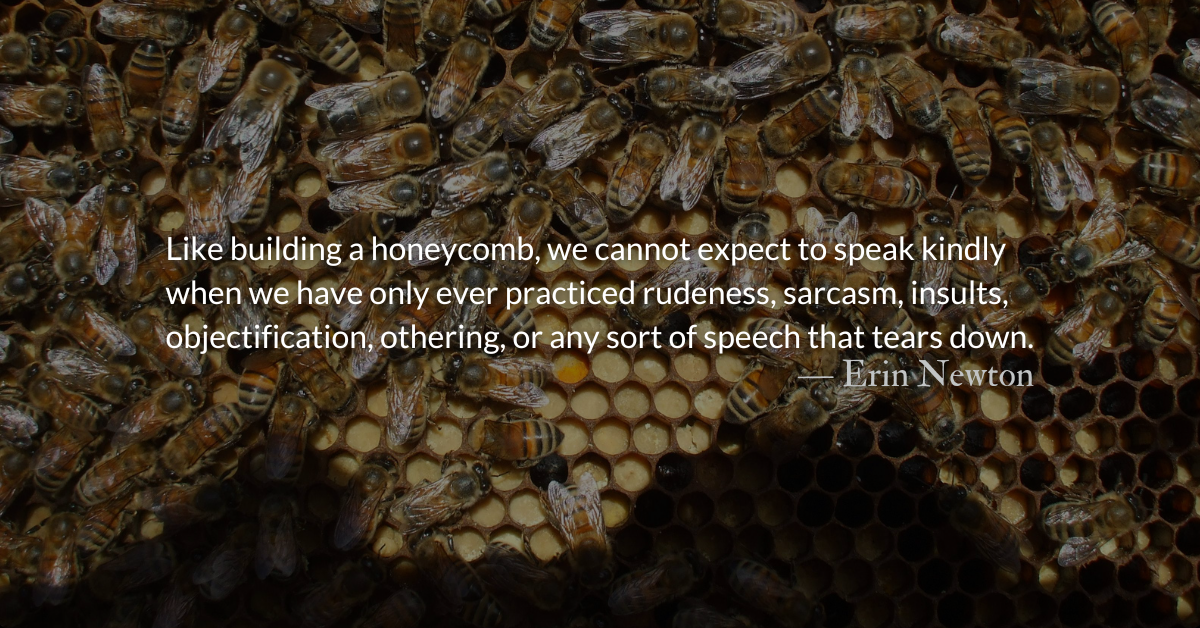
Producing gracious words requires practice and work. Like building a honeycomb, we cannot expect to speak kindly when we have only ever practiced rudeness, sarcasm, insults, objectification, othering, or any sort of speech that tears down.

Kind words are carefully crafted. Kind words heal souls.

Divine Hours Prayer: The Call to Prayer

Love the Lord, all you who worship him; the Lord protects the faithful, but repays to the full those who act haughtily. — Psalm 31.23


– From The Divine Hours: Prayers for Springtime by Phyllis Tickle.

Read more: When Skepticism meets Kindness

Sometimes we look at kindness and assume there is a scheme of self-promotion…We treat the servants of mercy as spies.

Consider Supporting Our Work

We want to do more to spread God’s word. For that we need donors like you. Please consider becoming a donor.
Are We Proud of the Prideful?

Scripture Focus: Proverbs 16.18-19
18 Pride goes before destruction, 
a haughty spirit before a fall. 
19 Better to be lowly in spirit along with the oppressed 
than to share plunder with the proud. 

Reflection: Are We Proud of the Prideful?
By John Tillman

Some saw the podcast, The Rise and Fall of Mars Hill, as unnecessarily dragging out dirty laundry. Most praised it for doing the laundry, dragging past sins out of darkness and into the light. An important question it poses is “What is it about us that prefers narcissists in leadership?”

A section of Proverbs 16 describes ideal qualities and actions of righteous kings. Surrounding the “kingly” proverbs are warnings against pride, including one of Proverbs’ most famous verses (Proverbs 16.18) People who know nothing about the Bible know, “Pride goes before a fall.”

Biblically, the primary thing a king or a leader needs to be is humble. This qualification is stated or implied strongly throughout the Bible. However, when we look around we rarely see this. Leaders tend to overflow with ego, bravado, spite, vitriol, and violent language (or even actual violence). Speaking callously about potential violence against one’s opponents has been normalized. (In this, Mark Driscoll was a thought leader.) Other leaders in American churches have also perpetuated this anti-biblical leadership model. We say, “May the best man win” rather than, “May the first among you become your slave.” (Matthew 20.25-28)

In most situations (whether through democracy, the economy, or church membership) people have at least some influence in choosing leaders. Why do we so often choose poorly?

This question is for our entire culture. Business and politics are deeply affected by this. The idea that hard-nosed, abusive, prideful, narcissist leaders are the best chance for success came into the church from culture. Not the other way around.

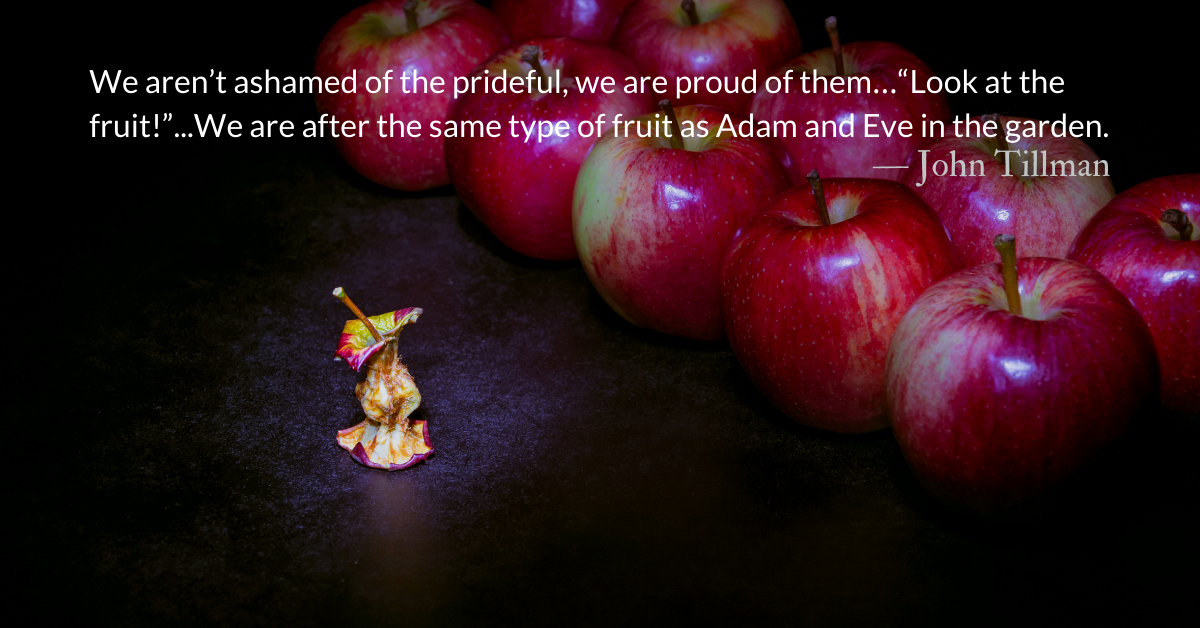
Too often, we aren’t ashamed of the prideful, we are proud of them. “Look at all they’ve done!” “Look at the growth!” “Look at the fruit!” However, the “fruit” we are typically pointing to is worldly results: attendance, book sales, etc. We are after the same type of fruit as Adam and Eve in the garden. “Look at it! It’s good for knowledge and gaining power! Take and eat.”

To select and become better leaders, we have to learn to love righteousness over results. We must learn to prefer sitting with the oppressed over divvying plunder with the proud. We need to recognize tenderness as strength and empathy as Christlike. We need to surrender our determination to win at all costs and instead count “all things loss.” (Philippians 3.8)

May we be and see better leaders in the mold of Christ rather than the world.

Divine Hours Prayer: A Reading
Then Jesus said to his disciples, “If anyone wants to be a follower of mine, let him renounce himself and take up his cross and follow me. Anyone who wants to save his life will lose it; but anyone who loses his life for my sake will find it.” — Matthew 16.24-25

– From The Divine Hours: Prayers for Springtime by Phyllis Tickle.


Today’s Readings

Proverbs 16 (Listen – 3:15)
Psalm 79 (Listen – 1:50)

This Weekend’s Readings
Proverbs 17 (Listen – 2:58), Psalm 80 (Listen – 1:58)
Proverbs 18 (Listen – 2:23), Psalm 81-82 (Listen – 2:36)’

Read more about Pride and Cowardice
The proud person, ironically, begins looking around for people of like mind who want to be sufficient unto themselves in their pride.

Read more about After the Whirlwind
Many fear that careless, vitriolic words from leaders may inspire physical violence that could erupt from either side of our fractured political spectrum.