Elisabeth Elliot’s Faith in God’s Justice

Righteousness and justice are the foundation of your throne; steadfast love and faithfulness go before you. — Psalm 89.14

“Time and again in the history of the Christian church, the blood of martyrs has been its seed,” reflected Elisabeth Elliot. Her husband Jim was killed with four other missionaries in January of 1956. After she was widowed, Elliot—and her daughter—returned to live among the very indigenous people who savagely killed her husband and friends. Her motivating factor was faith in God’s justice. Decades later she wrote:

There is always the urge to oversimplify, to weigh in at once with interpretations that cannot possibly cover all the data or stand up to close inspection. Cause and effect are in Gods hands. Is it not the part of faith to simply let them rest there?

God is God. I dethrone him in my heart if I demand that He act in ways that satisfy my idea of justice. For us widows the question as to why the men who had trusted God to be both shield and defender should be allowed to be speared to death was not one that could be smoothly or finally answered in 1956, nor yet silenced in 1996.

God did not answer Job’s questions either. Job was living in a mystery—the mystery of the sovereign purpose of God—and the questions that rose out of the depths of that mystery were answered only by a deeper mystery, that of God Himself.

I believe with all my heart that God’s Story has a happy ending. But not yet, not necessarily yet. It takes faith to hold on to that in the face of the great burden of experience, which seems to prove otherwise. What God means by happiness and goodness is a far higher thing that we can conceive.

A healthier faith seeks a reference point outside all human experience, the Polestar which marks the course of all human events, not forgetting that impenetrable mystery of the interplay of God’s will and man’s (“He did not many miracles there because of their unbelief”; “Jesus was handed over to the power of men”).

It is not the level of our spirituality that we can depend on. It is God and nothing less than God, for the work is God’s and the call is God’s and everything is summoned by Him and to His purposes, the whole scene, the whole mess, the whole package—our bravery and our cowardice, our love and our selfishness, our strengths and our weaknesses.

Today’s Reading
Ezekiel 38 (Listen – 4:23)
Psalms 89 (Listen – 5:29)
 

Resting in Hopelessness

For my soul is full of troubles, and my life draws near to Sheol. — Psalm 88.3

If Christianity has lost anything in the transition from its eastern roots to modern western culture it is surely its emphasis on contentment. It takes enormous energy to find contentment in the day-to-day of material-oriented life—let alone to find it in the depths of pain and discomfort.

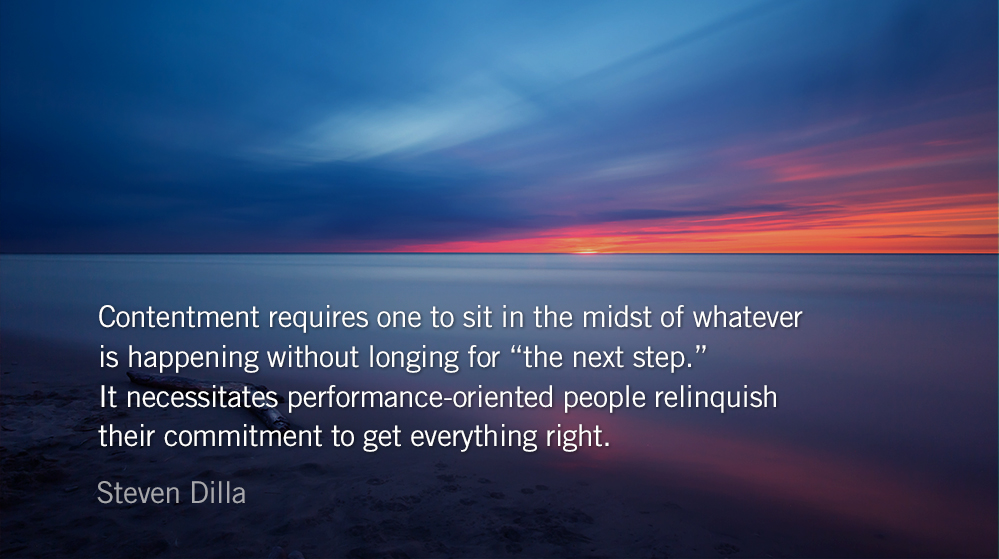
The journey of contentment is often short-circuited by our appetite for conclusion. Contentment requires one to sit in the midst of whatever is happening without longing for “the next step.” It necessitates performance-oriented people relinquish their commitment to get everything right. Sitting in contentment isn’t about getting answers, but gaining understanding.

In The Resurrection of the Son of God, bishop N.T. Wright contrasts what the authors of scripture ought to have felt with the reality they confess in their deepest struggles:

When this strong faith in YHWH as the creator, the life-giver, the God of ultimate justice met the apparent contradiction of the injustices and sufferings of life, at that point there was, as we have seen, a chance of fresh belief springing up. Not that the sufferings of Israel always evoked this response. Psalm 88, and the book of Job, are evidence to the contrary.

Psalm 88 is disturbing not only because, as Spurgeon says, it is, “the darkest of all the Psalms; it has hardly a spot of light in it,” but because it doesn’t even try to move forward out of the abyss.

The psalmist pours out pain, frustration, and disappointment before God. The lament is unapologetic and lacks a move toward restoration: it weeps, aches, complains, and accuses. Then it ends.

Contentment, in this way, is not satisfaction in the moment but the ability to be fully present. It creates margin for the exploration of the soul and space for transparency in what was found. Contentment’s fruit is born not in resolution, but in presence.

We fear contentment because it has become convoluted with complacency. How can we rest at peace when there are great things to accomplish, proper beliefs to be held, and greener pastures in which we could find ourselves? And so we press on—unaware, performing, and restless.

The invitation of Psalm 88 is to stop. Discover where you are—don’t judge it against where you ought be, or what you ought believe—just find yourself. It’s only here that the journey of authentic community and renewal in the gospel can take root.

Today’s Reading
Ezekiel 37 (Listen – 5:07)
Psalms 87-88 (Listen – 2:45)


Glory Eclipsed

Show me a sign of your favor… — Psalm 86.17

What’s too much to ask from God? Surely if there were a limit this prayer would fall outside of it: show me a sign. Prove yourself. It’s as if everything God had done prior in David’s life—anointing him as king, preserving his life, extending radical grace—weren’t enough and now something more was needed. Yet God was not offended by such a request.

“We may feel quite safe in seeking tokens of the kind which are mentioned in this psalm,” Charles Haddon Spurgeon assures in his sermon, Tokens for Good:

And first, we may beg for answers to prayer… There is no fanaticism in expecting God to answer prayer, and there is no misuse of logic in drawing the inference that, if he does hear my prayer in the time of trouble, this is a token for good to my soul.

David’s life had the blessings of God woven throughout it—yet unanswered prayer eclipsed all of this glory, even if momentarily. The doubting king wasn’t meant to feel ashamed of his request for proof. David presented his request because his relationship with God was vibrant and sure. The depth of trust was found in the presence of the request.

God’s past faithfulness spurs greater commitment in the face of unanswered prayer, according to Spurgeon. The great pastor acknowledges God’s grace in his own life—despite its trials—and challenges the faithful to press on, even more, when answers to prayer delay:

I am not too bold when I assert that the Lord has granted me according to the desire of my heart times without number. With overwhelming delight he fills me, for he has had respect unto my cry. His tenderness to me in this respect has made my life singularly happy, though I have had a large share of pain and depression.

At this present be of good cheer. Even if for a while the heavens should seem as brass, and prayer should not be heard, recollect that he did hear you in times gone by, and he is the same God, and changes not, and therefore is hearing still, and will answer by-and-by. Therefore cry mightily to him.

Go on in prayer if you have no immediate answer, and let the answers you have had in years gone by be tokens for good to your soul at this time.

Today’s Reading
Ezekiel 36 (Listen – 6:40)
Psalms 86 (Listen – 1:39)


Finding Rest :: Weekend Reading List

We have turned to Abraham Joshua Heschel this week to recover some of the tension lost when we, as western Christians, read the Hebrew Scriptures. Instead of publishing his thoughts with commentary we chose to present them in full force—allowing the rabbi’s words to confront, challenge, and inspire our faith.

I first entered the flourishing world of Heschel’s writings through his works on the Sabbath. The kind of rest he presents as normative for God’s people had been long-missing from my personal faith. I remember becoming captivated by his vision of rest and relationship—and quickly found myself longing for true sabbath.

So today, may we find the rest Rabbi Heschel says is the invitation of God for everyone of faith:

He who wants to enter the holiness of the day must first lay down the profanity of clattering commerce, of being yoked to toil. He must go away from the screech of dissonant days, from the nervousness and fury of acquisitiveness and the betrayal in embezzling his own life. He must say farewell to manual work and learn to understand that the world has already been created and will survive without the help of man.

Six days a week we wrestle with the world, wringing profit from the earth; on the Sabbath we especially care for the seed of eternity planted in the soul. The world has our hands, but our soul belongs to Someone Else. Six days a week we seek to dominate the world, on the seventh day we try to dominate the self.

[The Hebrew word] menuha, which we usually render with “rest”, means here much more than withdrawal from labor and exertion, more than freedom from toil, strain or activity of any kind. Menuha is not a negative concept but something real and intrinsically positive.

The essence of good life is menuha. “The Lord is my shepherd; I shall not want. He makes me lie down in green pastures. He leads me beside still waters” (the waters of menuhot). In later times menuha became a synonym for the life in the world to come, for eternal life.

The Sabbath is a reminder of two worlds—this world and the world to come; it is an example of both worlds. For the Sabbath is joy, holiness, and rest; joy is part of this world; holiness and rest are something of the world to come.

Unlike the Day of Atonement, the Sabbath is not dedicated exclusively to spiritual goals. It is a day of the soul as well as of the body; comfort and pleasure are an integral part of the Sabbath observance. Man in his entirety, all his faculties must share its blessing.

Time is like a wasteland. It has grandeur but no beauty. Its strange, frightful power is always feared but rarely cheered. Then we arrive at the seventh day, and the Sabbath is endowed with a felicity which enraptures the soul, which glides into our thoughts with a healing sympathy. It is a day on which hours do not oust one another. It is a day that can soothe all sadness away.

A song of the Sabbath day: “It is good to give thanks unto the Lord!” Therefore, all the creatures of God bless Him.

*Abridged and adapted from The Sabbath.

Weekend Reading List

Today’s Reading
Ezekiel 33 (Listen – 6:03)
Psalms 81-82 (Listen – 2:36)

Today’s Reading
Ezekiel 34 (Listen – 5:11) Psalms 83-84 (Listen – 3:20)
Ezekiel 35 (Listen – 2:21) Psalms 85 (Listen – 1:25)


Spiritual Audacity :: Throwback Thursday

By Abraham Joshua Heschel (1907-1972)

Restore us, O Lord God of hosts! Let your face shine, that we may be saved! — Psalm 80.19

The renewal of man involves a renewal of the sense of wonder and mystery of being alive—taking notice of the moment as a surprise. The renewal of man must begin with rebellion against reducing existence to mere fact or function.

Contemporary consciousness has not come to terms with its own experience. Overwhelmed by the rapid advancement in technology, it has failed to develop an adequate anthropology, a way of ensuring the independence of the human being in the face of forces hostile to it.

Why do I speak about the renewal of man? Because the Hebrew Bible is not a book about God. It is a book about man. Paradoxical as the Bible is, we must accept its essential premise: that God is concerned about man.

It is useless to speak of the holy to those who have failed to cultivate the ingredient of being human. Prior to faith are premises or prerequisites of faith, such as a sense of wonder, radical amazement, reverence, a sense of mystery of all being. Man must learn, for example, to question his false sense of sovereignty.

Men of faith frequently succumb to a spectacular temptation: to personalize faith, to localize the holy, to isolate commitment. Detached from and irrelevant to all emergencies of being, the holy may segregate the divine.

To recover sensitivity to the divine we must develop in “uncommon sense,” rebel against the seemingly relevant, against conventional validity; to think many thoughts, to abandon many habits, to sacrifice many pretensions.

Those who pray tremble when they realize how staggering are the debts of the religions of the West. We have mortgaged our souls and borrowed so much grace, patience, and forgiveness. We have promised charity, love, guidance, and a way of redemption, and now we are challenged to keep the promise, to honor the pledge. How shall we prevent bankruptcy in the presence of God and man?

We must learn how to labor in the affairs of the world with fear and trembling. While involved in public affairs, we must not cease to cultivate the secrets of religious privacy. What is required is a continuous effort to overcome hardness of heart, callousness, and above all to inspire the world with the biblical image of man.

*Abridged and adapted from Moral Grandeur and Spiritual Audacity.

Today’s Reading
Ezekiel 32 (Listen – 5:30)
Psalms 80  (Listen – 1:58)