When Suffering Lingers :: Readers’ Choice

We have been shown that God will get us through times of struggle. “Though we burn, we are not consumed” is a good reminder. — Lucy

Readers’ Choice (Originally published February 20, 2017)

Because the schooling of suffering is so dangerous, it is right to say that this school educates for eternity.
― Søren Kierkegaard

Scripture: Exodus 3.5

The angel of the Lord appeared to Moses in a flame of fire out of the midst of a bush. He looked, and behold, the bush was burning, yet it was not consumed.

Reflection: When Suffering Lingers
The Park Forum

The burning bush appeared at the height of Israel’s suffering. Early rabbinic writings understood the bush to be a symbol of ancient Israel—persevering under the flame of Egypt’s brutality.

The Greek philosopher Philo expanded the rabbi’s imagery to include all of humanity. “For the burning bramble was a symbol of those who suffered wrong, as the flaming fire of those who did it,“ he explained in his work On the Life of Moses.

Philo was a contemporary of Christ, although the two never would have met (Philo was an aristocrat in Alexandria). The philosopher spent his life exploring the synergy and tension of Jewish scriptural study and Stoicism. His writings reveal through scripture what he could not find in philosophy—meaning in suffering.

“Christianity teaches that, contra fatalism, suffering is overwhelming; contra Buddhism, suffering is real; contra karma, suffering is often unfair; but contra secularism, suffering is meaningful,” writes Timothy Keller In Walking with God through Pain and Suffering. “There is a purpose to it, and if faced rightly, it can drive us like a nail deep into the love of God and into more stability and spiritual power than you can imagine.”

Though we burn, we are not consumed. This is the mere beginning of God’s grace. Endurance is the deposit guaranteeing great reward. God’s promise to those who suffer is not only that the flame will be extinguished, but that all it has burnt will be restored.

The prophets joyfully proclaim God as the one who will return the wasted years. The New Testament crescendos with no more tears, no more death, no more pain—all of it replaced by  new life.

It is the cross that is the enduring symbol of the Christian faith, not the burning bush. The bush reminds us that God always hears the cry of his people. The cross shows us that God stops at nothing—moving heaven and earth, even sacrificing his beloved—to bring them restoration.

The Greeting
Awesome things will you show us in your righteousness, O God of our salvation, O Hope of all the ends of the earth.

– From 
The Divine Hours: Prayers for Summertime by Phyllis Tickle.

Full prayer available online and in print.

Today’s Readings
Judges 1 (Listen – 5:08)
Acts 5 (Listen – 6:49)
God’s Power in Rejection :: Readers’ Choice

It is so often easy to fix our eyes on what we would like our lives to look like, who we would like to be, the kind of success we would like to achieve…and yet, Jesus, who achieved the most important thing in the history of the world, who was “the cure all creation longed for,” appeared to fail, was rejected by His Father. God’s power is made perfect in our weakness; His thoughts and plans are so far beyond our capability to think and plan! May we look to Him instead of ourselves for the victory. — Elisabeth

Readers’ Choice (Originally published October 24, 2016)
The Park Forum

The stone that the builders rejected has become the cornerstone. This is the Lord’s doing; it is marvelous in our eyes. — Psalm 118.22-23

Picture Joseph: his dreams rejected by his father; cast out by his brothers; thrown out by the Egyptian elite—and yet, cornerstone of Israel. Then David: neglected by his father when the prophet arrived to anoint a king; hated by Saul; hiding in caves—and yet, cornerstone of Israel. The great preacher Charles Haddon Spurgeon remarks:

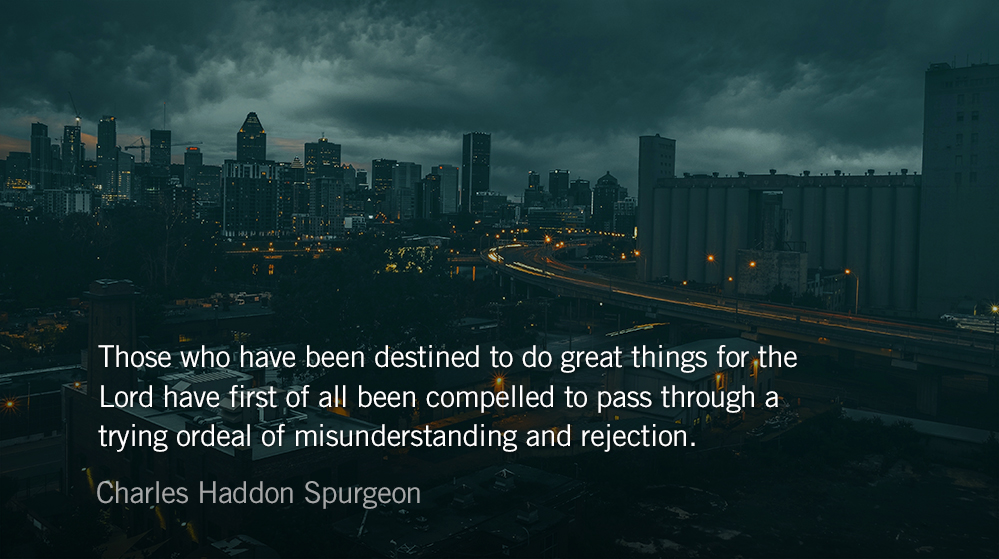
Be not afraid, O ye persecuted ones, for you shall fulfill your destiny. It has happened again and again in history that those who have been destined to do great things for the Lord have first of all been compelled to pass through a trying ordeal of misunderstanding and rejection….

At this time, however, we shall confine our application of these verses to our blessed Lord himself, to whom they most evidently refer. Their meaning is focussed upon him, and in reference to him each word is emphatic.

Christ rejected: though he clamored for no earthly power; though he served the poor; though he was the cure all creation longed for. Spurgeon recalls that his was no ordinary rejection—it was unreasonably violent and indignant:

They were not content to say, “He is not the Messiah,” but they turned their hottest malice against him; they were furious at the sight of him. This precious stone was kicked against and rolled about with violence, and all manner of ridicule was poured upon it. Nothing would content them but the blood of the man who had disturbed their consciences and questioned their pretensions.

And yet, he is the cornerstone of Israel. He is exalted—and it is the Lord’s doing. The path of rejection reveals this. Spurgeon concludes:

If the Scribes and Pharisees had endorsed the claims of our Lord it might have been said that Christianity was grafted upon the old stock of Judaism. If Pilate, or Herod, or any of the great ones, especially if the Caesar of the day had accepted it, then the following ages would have said, “Oh yes, he derived his power, and was lifted to his place through the prestige of empire and the prowess of arms.” But it was not so. All the establishments on earth were against him: rank and station despised the carpenter’s son; superstition abhorred his simplicity and spirituality.

“My strength,” God says, “is made perfect in weakness,” and, as the Psalmist says, “it is marvelous in our eyes.”

The Concluding Prayer of the Church
…Preserve me with your mighty power, that I might not fall into sin, nor be overpowered by adversity…

– From 
The Divine Hours: Prayers for Summertime by Phyllis Tickle.

Full prayer available online and in print.

Today’s Readings
Joshua 24 (Listen – 5:49)
Acts 4 (Listen – 5:15)

CS Lewis on Hope :: Readers’ Choice

I daily need reminding that this world isn’t what I’m working for and won’t make me happy. This blend of Lewis and Scripture was a timely reminder particularly as I began 2017 when it’s easy to focus on worldly goals, ambitions, and blessings. Thank you, Park Forum, for reminding me that I must aim for Heaven first!  — Catherine

Readers’ Choice (Originally published December 27, 2016)
The Park Forum

Tolkien’s words yesterday seemed timely, yet nearly discouraging—though he would have wanted his letter to be quite the opposite. Today we turn to his contemporary and, often, sounding board, C.S. Lewis, to highlight the hope he and Tolkien shared.

In Mere Christianity, Lewis writes:

Hope is one of the Theological virtues. This means that a continual looking forward to the eternal world is not (as some modern people think) a form of escapism or wishful thinking, but one of the things a Christian is meant to do.

It does not mean that we are to leave the present world as it is. If you read history you will find that the Christians who did most for the present world were just those who thought most of the next. The Apostles themselves, who set on foot the conversion of the Roman Empire, the great men who built up the Middle Ages, the English Evangelicals who abolished the Slave Trade, all left their mark on Earth, precisely because their minds were occupied with Heaven.

It is since Christians have largely ceased to think of the other world that they have become so ineffective in this. Aim at Heaven and you will get earth “thrown in”: aim at earth and you will get neither. It seems a strange rule, but something like it can be seen at work in other matters.

Health is a great blessing, but the moment you make health one of your main, direct objects you start becoming a crank and imagining there is something wrong with you. You are only likely to get health provided you want other things more—food, games, work, fun, open air. In the same way, we shall never save civilization as long as civilization is our main object. We must learn to want something else even more.

Most of us find it very difficult to want “Heaven” at all—except in so far as “Heaven” means meeting again our friends who have died. One reason for this difficulty is that we have not been trained: our whole education tends to fix our minds on this world. Another reason is that when the real want for Heaven is present in us, we do not recognize it.

Most people, if they had really learned to look into their own hearts, would know that they do want, and want acutely, something that cannot be had in this world. There are all sorts of things in this world that offer to give it to you, but they never quite keep their promise.

The Refrain
Help me, O Lord my God; save me for your mercy’s sake.

– From 
The Divine Hours: Prayers for Summertime by Phyllis Tickle.

Full prayer available online and in print.

Today’s Readings
Joshua 20-21 (Listen – 9:58)
Acts 1 (Listen – 3:58)

This Weekend’s Readings
Joshua 22 (Listen – 6:16) Acts 2 (Listen – 6:35)
Joshua 23 (Listen – 2:31) Acts 3 (Listen – 3:33)

The Honor of Faith :: Throwback Thursday

By George Whitefield
Haman recounted to them the splendor of his riches, the number of his sons, all the promotions with which the king had honored him, and how he had advanced him above the officials and the servants of the king. — Esther 5.11

I suppose you would all think it a very high honor to be admitted into an earthly prince’s private council—to be trusted with his secrets, and to have his ear at all times and at all seasons. It seems Haman thought it so when he boasted.

Alas, what is this honor in comparison of that which the meekest of those enjoy: to walk with God! Do you think it a small thing to have the secret of the Lord of lords with you and to be called the friends of God? All God’s saints have this honor!

The secret of the Lord is with them that fear him: “No longer do I call you servants, for the servant does not know what his master is doing; but I have called you friends, for all that I have heard from my Father I have made known to you.” David was so sensitive to the honor of walking with God that he declares, “I would rather be a doorkeeper in the house of my God than dwell in the tents of wickedness.”

As it is an honorable, so it is a pleasing thing, to walk with God. The wisest of men has told us that wisdom’s “ways are ways of pleasantness, and all her paths are peace.”

Has not one day in the Lord’s courts been better to you than a thousand? In keeping God’s commandments, have you not found a present, and very great reward? Has not his word been sweeter to you than the honey or the honeycomb?

What have you felt when, like Jacob, you have been wrestling with your God? Has not Jesus often met you when meditating in the fields, and been made known to you over and over again in breaking of bread? Has not the Holy Ghost frequently shed the divine love abroad in your hearts abundantly and filled you with joy unspeakable, even joy that is full of glory?

I know you will answer all these questions in the affirmative and realize the yoke of Christ is easy and his burden light—His service is perfect freedom. And what need we then any further motive to excite us to walk with God?

*Abridged and language updated from George Whitefield’s sermon, Walking With God.

Today’s Reading
Esther 5 (Listen – 2:42)
Acts 28 (Listen – 4:56)

One Reason to Stop Praying

[Esther replied,] “I will go to the king, though it is against the law, and if I perish, I perish.” — Esther 4.16
We hold prayer to be one of the most sacred and powerful acts of faith. “It is the insight into the mystery of reality, the sense of the ineffable, that enables us to pray,” remarks Abraham Joshua Heschel. Remarkable things blossom when the prayers of the saints join in the work of the Spirit.

It is almost shocking not to see prayer in this part of Esther’s story. She is told she must risk her life and approach the king—that her people will be murdered if she isn’t successful. Her reply is bold and decisive; she responds without pause for prayer, “I will go to the king… if I perish, I perish.” It’s at this point that Charles Swindoll, in his book Esther: A Woman of Strength and Dignity, remarks:
Is that a great answer or what? Is this a great woman? She’s had only a few moments to consider what Mordecai had told her, a brief slice of time to weigh his counsel. It was all she needed. She is determined to make a difference, no matter what the consequences to her personally:

‘If I perish, I perish. If a guard drives a sword through my body, I die doing the right thing.’ She has changed from fear to abandonment and faith, from hesitation to confidence and determination, from concern for her own safety to concern for her people’s survival. She has reached her own personal hour of decision and has not been found wanting.
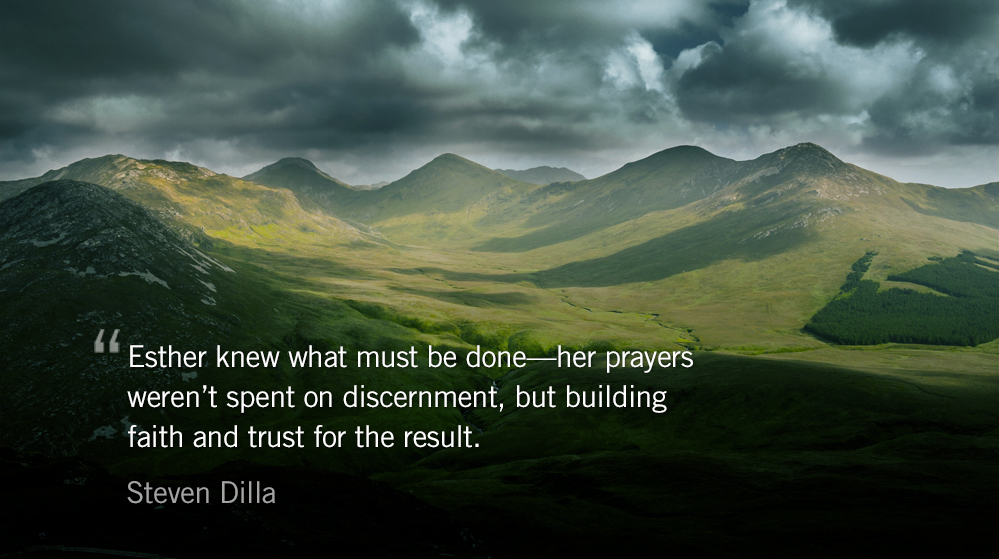
Esther calls her people to fast—not so she can discern what is proper to do, but so God would sway the heart of the king. She knew what must be done—her prayers weren’t spent on discernment, but upon building faith and trust for the result.

It was in the middle of another miraculous rescue, as the Egyptians were closing in on Israel after their exodus, that God asked Moses, “Why do you cry to me? Tell the people of Israel to go forward.” Moses needed
confidence like Esther. Prayer for what action to take wasn’t needed—the time had come for courageous faith.

Esther didn’t pray to discern what action to take. We find her seeking God, calling her people to fast, as she realizes her actions alone will be insufficient in meeting the deepest needs of her people.

Today’s Reading
Esther 4 (Listen – 2:53)
Acts 27 (Listen – 6:09)

Show Buttons
Hide Buttons
Spur a spiritual rhythm of refreshment right in your inbox
By joining this email list you are giving us permission to send you devotional emails each weekday and to communicate occasionally regarding other aspects of the ministry.
100% Privacy. We don't spam.