The Efficacy of Prayer :: Throwback Thursday

Ephesians 1.16
I do not cease to give thanks for you, remembering you in my prayers.

By C.S. Lewis (1956)

The thing we pray for may happen, but how can you ever know it was not going to happen anyway? Even if the thing were indisputably miraculous it would not follow that the miracle had occurred because of your prayers.

If an infinitely wise Being listens to the requests of finite and foolish creatures, of course He will sometimes grant and sometimes refuse them. Invariable “success” in prayer would not prove the Christian doctrine of prayer at all. It would prove something much more like magic—a power in certain human beings to control, or compel, the course of nature.

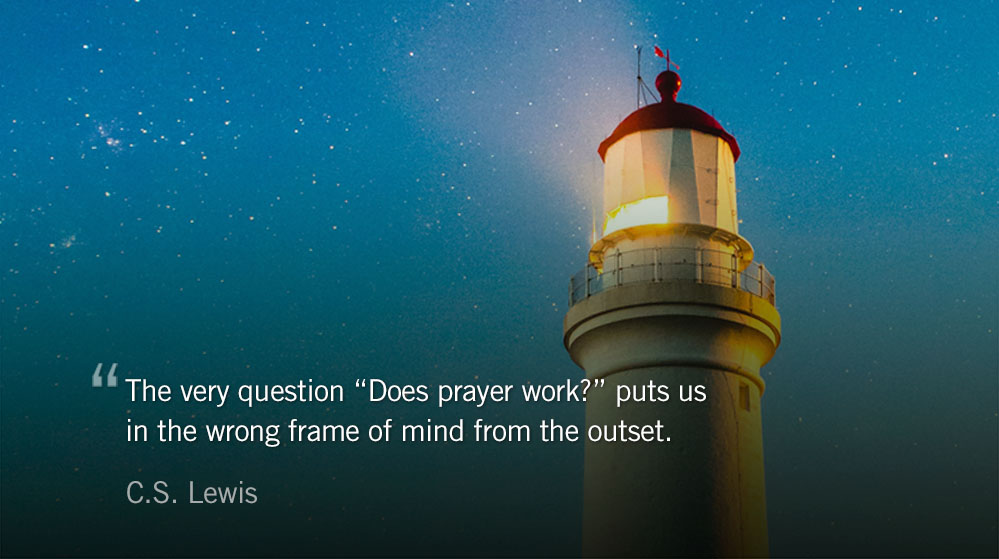
The very question “Does prayer work?” puts us in the wrong frame of mind from the outset.

“Work”: as if it were magic, or a machine—something that functions automatically. Prayer is either a sheer illusion or a personal contact between embryonic, incomplete persons (ourselves) and the utterly concrete Person.

Prayer in the sense of petition, asking for things, is a small part of it; confession and penitence are its threshold, adoration its sanctuary, the presence and vision and enjoyment of God its bread and wine. In it God shows Himself to us. That He answers prayers is a corollary— not necessarily the most important one— from that revelation. What He does is learned from what He is.

Petitionary prayer is, nonetheless, both allowed and commanded to us: “Give us our daily bread.” And no doubt it raises a theoretical problem. Can we believe that God ever really modifies His action in response to the suggestions of men?

For infinite wisdom does not need telling what is best, and infinite goodness needs no urging to do it.

It is not really strange, that my prayers should affect the course of events than that my other actions should do so. They have not advised or changed God’s mind—that is, His over-all purpose. But that purpose will be realized in different ways according to the actions, including the prayers, of His creatures.

Prayer is not a machine. It is not magic. It is not advice offered to God. If our prayers are sometimes granted, beyond all hope and probability, we had better not draw hasty conclusions to our own advantage. If we were stronger, we might be less tenderly treated. If we were braver, we might be sent, with far less help, to defend far more desperate posts in the great battle.

— Excerpt from C.S. Lewis’ (wonderful essay) The Efficacy of Prayer.

Today’s Reading
1 Kings 3 (Listen – 4:29)
Ephesians 1 (Listen – 3:10)
Where we Focus our Attention

Galatians 6.2
Bear one another’s burdens, and so fulfill the law of Christ.

One year ago today the first of 11 cases of Ebola was confirmed in the United States. Though nine of the patients would fully recover, media coverage of stateside cases spread at pandemic levels. MediaMatters.org reports that at its peak the six major networks ran over 400 segments on ebola during just one week’s worth of evening news.
Well over 11,000 people lost their lives to ebola last year; deaths in the U.S. represented 0.0002% of the global total.

At some level we comprehend these numbers — and their disproportionate impact on Africans. On another level it’s easy to get discouraged into inaction by their immensity.

At the end of Galatians Paul spurs the church to care for one another and the world. He is not disillusioned to the size of need, but focused on the size of God’s grace expressed through the Body of Christ. “So then, as we have opportunity, let us do good to everyone, and especially to those who are of the household of faith.”

The absurd prioritization of stories which directly impact Americans is a lesson in distraction to anyone trying to live out this type of faith. The gospel’s ability to reorient our attention is critical in a culture where the possibility of water on other planets and a billionaire reality tv show star consume headlines. Especially today.
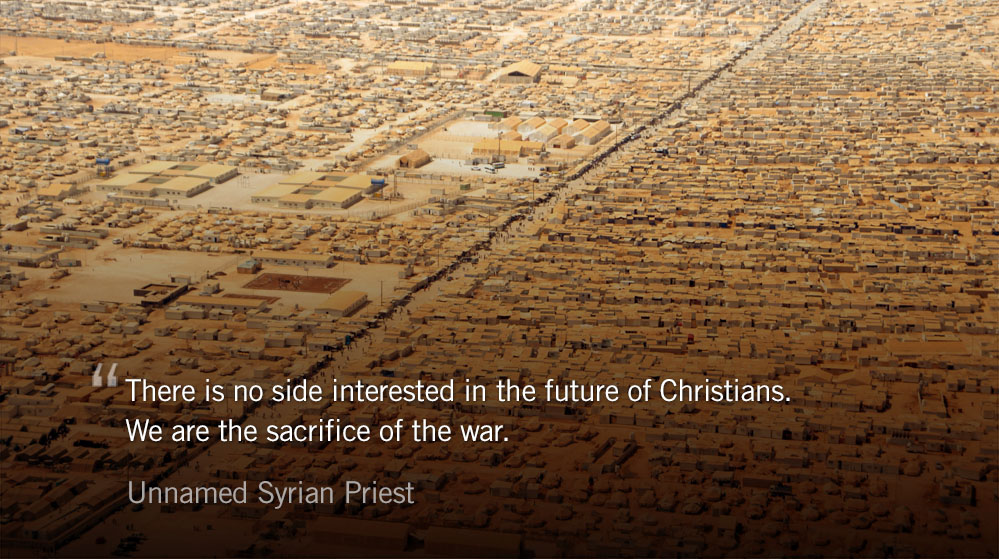
“There is no side interested in the future of Christians. We are the sacrifice of the war.” — Unnamed Syrian priest in response to the unfolding crisis

Around 220,000 Syrians have already lost their lives. The war has left another 12.8 million people in desperate need of humanitarian aid (which is not-yet coming in any meaningful way). Over 4 million refugees have fled the country, at tremendous risk, to seek any form of protection or aid.

Christianity’s care for the refugee and selfless service to the marginalized can fundamentally reorient the national conversation away from partisan blather and into action. This crisis is massive — but where we focus our attention, as a state and an individual, matters.
On Monday the President tweeted a link to ways Americans can get involved in helping refugees around the world. We can add these to UNICEF, the UN Refugee Agency, and other international options for action.

The pain of our world is deep — and we await Christ for full relief and the restoration of all that is lost. In the meantime we give ourselves to joining God in the restoration of all things, remembering Paul’s encouragement, “let us not grow weary of doing good, for in due season we will reap, if we do not give up.”

Today’s Reading
1 Kings 2 (Listen – 7:45)
Galatians 6 (Listen – 2:18)

Bringing Good News to Life

Galatians 5.13
For you were called to freedom, brothers. Only do not use your freedom as an opportunity for the flesh, but through love serve one another.

Nothing is more wonderful than the art of being free, but nothing is harder to learn how to use than freedom. — Alexis de Tocqueville

True freedom is one of the richest fruits of Christianity. By it those who follow Christ are able to invest their faith into a broken world in profoundly diverse ways — participating in redemption through acts of service and vocation.

But freedom can be misused to allow a life of pride or apathy that disconnects the Christian from the world. In the worst cases the phrase “Christian freedom” is used as a defense against calling these acts what they really are — sin.

Paul explores freedom deeply in his writings. He defines its true acts as the Fruit of the Spirit and gives warning to those living in true freedom; “Let us not become conceited, provoking one another, envying one another.”

The Greek word for “conceited” can be literally translated, “vain-gloried” and occurs only here in Scripture. The United Bible Society clarifies its meaning:

In its use in secular literature, it is often associated with boastfulness and has the sense of “glorying in vain things” or “seeing value in things not really valuable.”
“Our natural condition is to be ‘glory-empty’, starved for significance, honor, and a sense of worth,” observes Timothy Keller. “This condition is rooted in sin.”

Sin makes us feel both superior (because we are trying to prove to ourselves and others that we are significant) and inferior (because at a deep level we feel guilty and insecure).

In different people these deep currents express themselves in different ways. Some people’s ‘glory-emptiness’ takes the form of bravado and pride; some people’s ‘glory- emptiness’ takes the form of self-deprecation and self-loathing. Most of us are in the middle, wracked by both impulses. — Timothy Keller

Through Christ we inherit freedom from this pomposity and crushing discouragement. This is the good news for us individually. When our freedom bears fruit — love, joy, peace, patience, kindness, goodness, faithfulness, gentleness, self-control — we become agents of human flourishing.

True freedom reorients our lives around acts of renewal — bringing the gospel to life in ways this world is desperate to experience.

Today’s Reading
1 Kings 1 (Listen – 7:52)
Galatians 5 (Listen – 3:22)