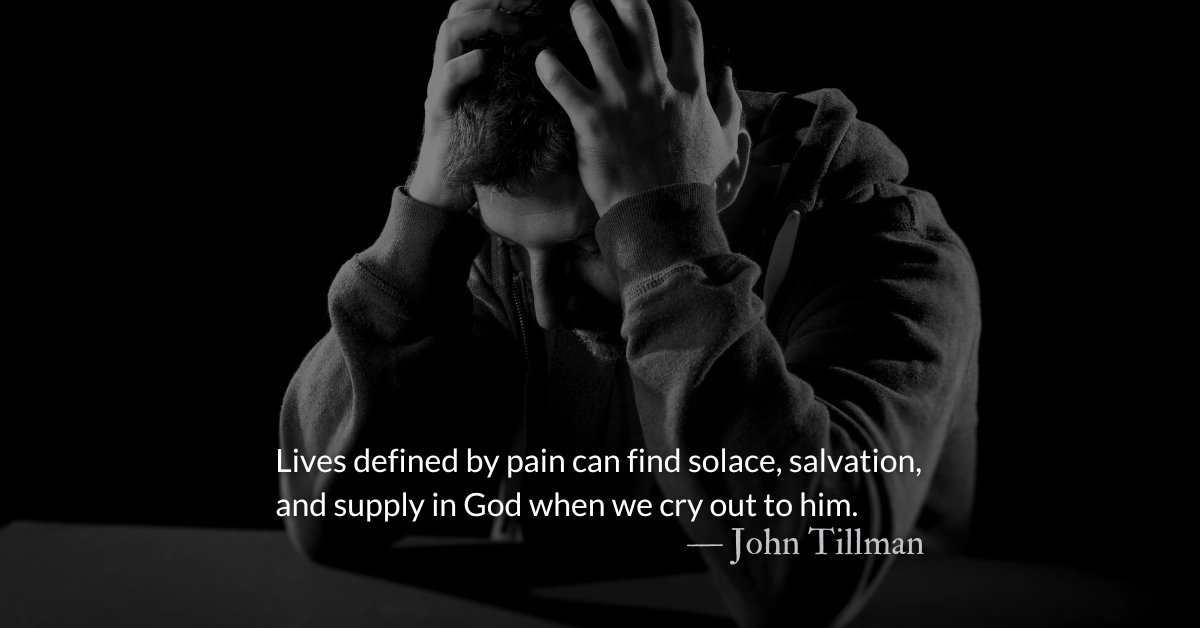
The Prayer of a Man Named “Pain”

Scripture Focus: 1 Chronicles 4.9-10
9 Jabez was more honorable than his brothers. His mother had named him Jabez, saying, “I gave birth to him in pain.” 10 Jabez cried out to the God of Israel, “Oh, that you would bless me and enlarge my territory! Let your hand be with me, and keep me from harm so that I will be free from pain.” And God granted his request. 

Reflection: The Prayer of a Man Named “Pain”
By John Tillman

Jabez was born from pain and named for pain. This man called “Pain” cried out to God to avoid experiencing or causing pain. We should never sneer or be surprised when people in pain pray for relief.

Jabez prayed for God’s provision, presence, power, and protection.

Praying for God’s provision includes praying for “things” but goes beyond that to pray for God’s providential will. Praying for provision means requesting what we need in order to do what God would have us do.

Praying for God’s hand means longing to walk in God’s presence. God is omnipresent and with us at all times and places, but when we pray for his hand on us, we mean a greater experience of his presence.

Praying for God’s powerful hand means trusting God’s arm is not too short to save nor too weak to work in and through us according to his will. God’s power is for his purposes. His power will not go with us if we stray from his purpose.

Prayer for God’s protection confesses humility. We acknowledge our lack of control and that we cannot protect ourselves from spiritual or physical dangers. Sin and death hunger to devour us, and we, like Cain, fail to master them. Therefore, we need God’s protection.

The chronicler inserts Jabez’s story in the genealogical record of Judah but does not list Jabez as anyone’s father or son. It is a little bubble of narrative bursting out of a chart of records. Why is this story here?

The Bible only mentions Jabez one other time. 1 Chronicles 2.55 notes a town of scribes presumably named for Jabez. Many of the texts we hold dear today were copied and cared for by scribes such as the ones who lived at Jabez.

Perhaps the chronicler knew of Jabez before the exile or even lived there? Whether or not this is true, Jabez’s prayer must be one the chronicler longed to see come true in his life and the lives of other exiles.

When hurting, cry for healing. When exiled or outcast, cry for rescue and inclusion. When called a cursed name, cry for blessing and fruitfulness. When suffering pain in this world and homesick for our true home, cry for relief. Lives defined by pain can find solace, salvation, and supply in God when we cry out to him.

Pray for relief and blessing from pain.


Divine Hours Prayer: The Greeting
Your statutes have been like songs to me wherever I have lived as a stranger. — Psalm 119.54

– From The Divine Hours: Prayers for Summertime by Phyllis Tickle.


Today’s Readings

1 Chronicles 3-4  (Listen 8:52)
Psalms 80 (Listen 1:58)

Read more about Ask and Keep Asking
Lord, help us to ask and keep asking…grant us greater wisdom, enlightenment, hope, and power.

Read more about Beyond Second Chances
God goes beyond giving second chances. Scripture is full of second chances, third, fourth, fifth, sixth, seventh chances, and beyond.


Beginning Again

Scripture Focus: 1 Chronicles 1.1-4
1 Adam, Seth, Enosh, 2 Kenan, Mahalalel, Jared, 3 Enoch, Methuselah, Lamech, Noah. 
4 The sons of Noah: 
Shem, Ham and Japheth… 

Psalm 79.1
1 O God, the nations have invaded your inheritance; 
they have defiled your holy temple, 
they have reduced Jerusalem to rubble.
2 They have left the dead bodies of your servants 
as food for the birds of the sky, 
the flesh of your own people for the animals of the wild. 
3 They have poured out blood like water 
all around Jerusalem, 
and there is no one to bury the dead.

Reflection: Beginning Again
By John Tillman

No act of judgment is the end of the story. God is always ready to begin again.

The banishment from Eden, the flood of Noah, and the destruction of Jerusalem are all referenced in our readings today. Each event is a horrific loss followed by God starting over with the faithful.

Chronicles comes from the pain of the Babylonian exile and looks to the past to see the future. The chronicler recognizes the need to return to the beginning to remember who God is and who humans are. Beginning with creation, the chronicler writes the longest genealogical record in the Bible. The chronicler tells the story of a God willing to start over, no matter how often we fail.

Adam lost Eden. Then he lost two sons. He lost Cain to the beast of sin that made him a murderer. He lost Abel to Cain’s rage. In Seth, God started over.

Noah lost his entire world. Then, he lost a son to an act of rebellion and shame. In Shem, God started over.

Psalm 79 cries out in pain and anger. The psalmist has lost home, the Temple, and many who died. Most likely written from Babylon immediately following the destruction of Jerusalem and the Temple, the writer mourns the loss of both places and people, both destroyed buildings and bodies.

The psalmist’s hot tears and stinging loss are not without hope. The writer foresees a time when mercy will come for the oppressed, freedom for prisoners, salvation for the dying, and judgment for the wicked. God, in the exile, is starting over. 

Most of us will never be physically exiled from our homeland or see our families slaughtered or enslaved. We endure other forms of exile and suffering. Losses of friendships, communities, and broken institutions feel like a death. On top of these losses, we have seen abuse and death within our communities of faith, our cities, and our nation. We can all join the psalmist’s lament, “How long, Lord?”

The psalmist assures us that God hears our groans, complaints, cries, and distress. The chronicler assures us that, no matter what has been lost, God is already at work to restore, repair, rebuild, and rescue.

There is nothing humans can ruin that God cannot restore. Are we ready to begin again?

Divine Hours Prayer: The Refrain for the Morning Lessons
Blessed be the Lord! For he has shown me the wonders of his love in a besieged city. — Psalm 31.21


– From The Divine Hours: Prayers for Summertime by Phyllis Tickle.

Today’s Readings
1 Chronicles 1-2  (Listen 11:18)
Psalms 79 (Listen 1:50)

Read more about From Your Nothing…Something Beautiful
Give your scarcity, your vacuum, your past to Jesus. Sense him hovering over it with you. From your nothing Jesus can make something beautiful.

Read more about Lasting Revivals and Normal Idols
Josiah cleansed Israel and Judah from top to bottom, but the next generation went bottom up. The changes didn’t stick. Why?

Daughters of Saul and Sons of Moses—Readers’ Choice

Readers’ Choice Month:
This September, The Park Forum is looking back on readers’ selections of our most meaningful and helpful devotionals from the past 12 months. Thank you for your readership. This month is all about hearing from you. Submit a Readers’ Choice post today.

Today’s post was originally published, on April 11, 2022, based on Psalm 145.1-4, 1 Chronicles 15.29, and Luke 19.39-40
It was selected by reader, MT.


Scripture Focus: Psalm 145.1-4
1 I will exalt you, my God the King; 
I will praise your name for ever and ever. 
2 Every day I will praise you 
and extol your name for ever and ever. 
3 Great is the Lord and most worthy of praise; 
his greatness no one can fathom. 
4 One generation commends your works to another; 
they tell of your mighty acts.

1 Chronicles 15.29
29 As the ark of the covenant of the Lord was entering the City of David, Michal daughter of Saul watched from a window. And when she saw King David dancing and celebrating, she despised him in her heart.

Luke 19.39-40
39 Some of the Pharisees in the crowd said to Jesus, “Teacher, rebuke your disciples!”
40 “I tell you,” he replied, “if they keep quiet, the stones will cry out.”

Reflection: Daughters of Saul and Sons of Moses—Readers’ Choice
By John Tillman

Yesterday, Palm Sunday, we celebrated Jesus’ arrival into Jerusalem and the week leading to the crucifixion and resurrection. (Matthew 21.1–11; Mark 11.1–11; Luke 19.28–44; John 12.12–19)

Like David’s procession of the Ark of the Covenant entering Jerusalem, Jesus’ processional was met by a joyous crowd. In both cases, there were those who wanted to steal the joy of the moment.

Michal, daughter of Saul and wife of David, critiqued the celebration. (1 Chronicles 15.29) She claimed to be concerned about propriety and modesty, but David’s response implied that her moralizing concealed a concern about power. (2 Samuel 6.20-23) The daughter of Saul despised this lowly king.

Likewise, religious leaders objected to crowds singing about Jesus “Hosanna to the Son of David! Blessed is he who comes in the name of the Lord!” (Psalm 118:25,26) They publicly voiced concerns about blasphemy but privately they were concerned about power. They didn’t want to upset Rome. (John 11.48) The sons of Moses despised this lowly teacher.

Psalm 105
is the Psalm listed in Chronicles as one David (or Asaph at David’s direction) sang on the occasion of the Ark’s entry. (1 Chronicles 16.7-11) However, despite Psalm 145 not having a date or event attached, one could certainly imagine its celebratory tone going well with the procession David led or the procession of Jesus the Son of David.

Those traveling up to Jerusalem would sing psalms on their ascent, preparing for and celebrating being in the presence of God. We can pray and sing these psalms with the same sense of anticipation. Jesus comes to us as he came to Jerusalem, humble and lowly. We can welcome him with shouts, cries, and joyous abandon that some will not understand.

Welcome him this week and every week as the only rightful king of our hearts. We must depose our affection for other Saul-like kings. We must abandon vestiges of religion which grasp at power rather than righteousness.

Do not let daughters of Saul or sons of Moses steal your joy in the lowly king, the humble teacher. Let us exalt him with pure praise and abandon. Let us ensure the next generation joins in with us.

“I will exalt you, my God the King; 
I will praise your name for ever and ever. 
Every day I will praise you 
and extol your name for ever and ever. 
Great is the Lord and most worthy of praise; 
his greatness no one can fathom. 
One generation commends your works to another; 
they tell of your mighty acts.”


Divine Hours Prayer: The Call to Prayer
Search for the Lord and his strength; continually seek his face. — Psalm 105.4

– From The Divine Hours: Prayers for Summertime by Phyllis Tickle.

Today’s Readings
Jeremiah 42(Listen 3:44)
2 Corinthians 2 (Listen 2:13)

Today’s Readings
Jeremiah 43(Listen 2:34)2 Corinthians 3 (Listen 1- 2:25)
Jeremiah 44(Listen 6:10)2 Corinthians 4 (Listen 1- 3:02)

Read more

Read more about A Way Back for Strivers
If we wrestle with you God, you will bless…If we will return to you, God, you will heal

Readers’ Choice is Here!
We want to know about your favorite post from the last 12 months! Tell us about it and we will repost it in September.

Daughters of Saul and Sons of Moses

Scripture Focus: Psalm 145.1-4
1 I will exalt you, my God the King; 
I will praise your name for ever and ever. 
2 Every day I will praise you 
and extol your name for ever and ever. 
3 Great is the Lord and most worthy of praise; 
his greatness no one can fathom. 
4 One generation commends your works to another; 
they tell of your mighty acts.

1 Chronicles 15.29
29 As the ark of the covenant of the Lord was entering the City of David, Michal daughter of Saul watched from a window. And when she saw King David dancing and celebrating, she despised him in her heart.

Luke 19.39-40
39 Some of the Pharisees in the crowd said to Jesus, “Teacher, rebuke your disciples!”
40 “I tell you,” he replied, “if they keep quiet, the stones will cry out.”

Reflection: Daughters of Saul and Sons of Moses
By John Tillman

Yesterday, Palm Sunday, we celebrated Jesus’ arrival into Jerusalem and the week leading to the crucifixion and resurrection. (Matthew 21.1–11; Mark 11.1–11; Luke 19.28–44; John 12.12–19)

Like David’s procession of the Ark of the Covenant entering Jerusalem, Jesus’ processional was met by a joyous crowd. In both cases, there were those who wanted to steal the joy of the moment.

Michal, daughter of Saul and wife of David, critiqued the celebration. (1 Chronicles 15.29) She claimed to be concerned about propriety and modesty, but David’s response implied that her moralizing concealed a concern about power. (2 Samuel 6.20-23) The daughter of Saul despised this lowly king.

Likewise, religious leaders objected to crowds singing about Jesus “Hosanna to the Son of David! Blessed is he who comes in the name of the Lord!” (Psalm 118:25,26) They publicly voiced concerns about blasphemy but privately they were concerned about power. They didn’t want to upset Rome. (John 11.48) The sons of Moses despised this lowly teacher.

Psalm 105
is the Psalm listed in Chronicles as one David (or Asaph at David’s direction) sang on the occasion of the Ark’s entry. (1 Chronicles 16.7-11) However, despite Psalm 145 not having a date or event attached, one could certainly imagine its celebratory tone going well with the procession David led or the procession of Jesus the Son of David.

Those traveling up to Jerusalem would sing psalms on their ascent, preparing for and celebrating being in the presence of God. We can pray and sing these psalms with the same sense of anticipation. Jesus comes to us as he came to Jerusalem, humble and lowly. We can welcome him with shouts, cries, and joyous abandon that some will not understand.

Welcome him this week and every week as the only rightful king of our hearts. We must depose our affection for other Saul-like kings. We must abandon vestiges of religion which grasp at power rather than righteousness.

Do not let daughters of Saul or sons of Moses steal your joy in the lowly king, the humble teacher. Let us exalt him with pure praise and abandon. Let us ensure the next generation joins in with us.

“I will exalt you, my God the King; 
I will praise your name for ever and ever. 
Every day I will praise you 
and extol your name for ever and ever. 
Great is the Lord and most worthy of praise; 
his greatness no one can fathom. 
One generation commends your works to another; 
they tell of your mighty acts.”

Divine Hours Prayer: A Reading
…They cried out: “Blessed is he who is coming as King in the name of the Lord! Peace in heaven and glory in the highest heavens!” Some Pharisees in the crowd said to him, “Master, reprove your disciples,” but he answered, “I tell you, if these keep silence, the stones will cry out.” — Luke 19.37-40


Today’s Readings
Hosea 12  Listen – 1:51)
Psalm 145  (Listen -2:19)

Read more about A Way Back for Strivers
If we wrestle with you God, you will bless…If we will return to you, God, you will heal

Read more On Psalm 145: Praying as Music
If music is a universal language, prayer can be similarly described.

Hope in Mercy, Not Wrath — Hope of Advent

Scripture Focus: 1 Chronicles 29.15
15 We are foreigners and strangers in your sight, as were all our ancestors. Our days on earth are like a shadow, without hope.

2 Peter 3.9-10, 13-15
9 The Lord is not slow in keeping his promise, as some understand slowness. Instead he is patient with you, not wanting anyone to perish, but everyone to come to repentance. 
10 But the day of the Lord will come like a thief. The heavens will disappear with a roar; the elements will be destroyed by fire, and the earth and everything done in it will be laid bare.

13 But in keeping with his promise we are looking forward to a new heaven and a new earth, where righteousness dwells. 14 So then, dear friends, since you are looking forward to this, make every effort to be found spotless, blameless and at peace with him. 15 Bear in mind that our Lord’s patience means salvation…

Reflection: Hope in Mercy, Not Wrath — Hope of Advent

By John Tillman

As David neared death, he acknowledged that life seemed to be “a shadow, without hope.”

We are not wrong, like David, to admit that the world is a dark place. The world is undeniably filled with wickedness, injustice, oppression, poverty, and violence. It is a lie to deny this darkness. What is more, we are the reason the earth is filled with darkness.

We are responsible for the shadows of hopelessness upon the world. We are responsible collectively and individually, historically and personally. For this reason, much of what we know and see of this world is destined for destruction and wrath. 

It can be tempting, especially when we are suffering, to put our hope in God’s wrath. David did this from time to time. (Psalm 69.22-28) When we hope in wrath, we wait impatiently. Every second that God’s fiery wrath is delayed, we doubt his love and justice.

It is just for God to destroy evil. It is also just that those who refuse to abandon evil and repent will perish along with it. Yet, it is hypocritical for those of us delivered from destruction only by the mercy of God to desire only destruction for our enemies.

For David and for us, setting our hope on God’s wrath is unfulfilling. In his life and art, David also clung to the hope of resurrection. In Psalm 16, David pointed to life beyond death and a hope that he would be in God’s presence and experience eternal pleasures.

Peter relied on David’s psalm in his Pentecost sermon, explaining that the hope David held was fulfilled in the resurrection of Jesus. Later in Acts, Paul also argued that David’s psalm expressed hope in the resurrection of the messiah to come. (Acts 2.20-32; 13.32-41) In Peter’s second letter, he repeated and reinforced this theme.

The destruction of our enemies is a tempting image. Peter, however, counsels his readers in a different direction. These believers suffered under persecutions that most western Christians have never in history endured. Yet, Peter counseled the church not to despise God’s delay or despair during it.

As we wait during this advent and always, let us rend our hearts hoping for God’s mercy for sinners rather than wringing our hands savoring the thought that evildoers will suffer. 

As we wait, let our hope be in God’s mercy and patience. Every second he delays is salvation for sinners.

Divine Hours Prayer: The Call to Prayer
Let us make a vow to the Lord our God and keep it; let all around him bring gifts to him who is worthy to be feared. — Psalm 76.11
– From The Divine Hours: Prayers for Autumn and Wintertime by Phyllis Tickle.

Today’s Readings
1 Chronicles 29 (Listen – 5:50)
2 Peter 3 (Listen – 3:21)

Read more about Supporting our Work
We are thankful for our donors’ gifts because they contribute to improving the spiritual discipleship of readers around the globe.

Read more about When God Has Mercy…Will We?
Do we mistakenly think we deserve God’s mercy while others don’t?