Elisabeth Eliot on the Future :: Reflections for a New Year

By Elisabeth Eliot

While a new year offers us a fresh start, it can also bring anxiety. Questions crowd into our minds. Will my job become redundant? Is God going to keep me single for another whole year? Where is that mate he’s supposed to be bringing me? Where will the money come from for college, rent, clothes, food? Must I continue to suffer this person, this church, this handicap, this pain, this loneliness?

We have a calming word in Psalm 138.8; “The Lord will fulfill his purpose for me; your love, O Lord, endures forever—do not abandon the works of your hands.” That word stands. He will fulfill. His love endures. He will not abandon.

We are meddling with God’s business when we let all the manner of imaginings loose, predicting disaster, contemplating possibilities instead of following one day at a time, God’s plain and simple pathway. When we try to meet difficulties prematurely we have neither a light nor the strength for them yet.

“As thy days, so shall thy strength be” was Moses’ blessing for Asher—in other words, your strength shall equal your days. God knows how to apportion each one’s strength according to that day’s need, however great or small. The psalmist understood this when he wrote, “Lord, you have assigned me my portion and my cup; you have made my lot secure.”

Whatever may be tomorrow’s cross I never seek to find. My father says, ‘Leave me to that, and keep a quiet mind.” — Anonymous

To lug into this new year all the baggage of the last year would greatly impair our ability to concentrate on what our heavenly father wants us to do…. Oswald Chambers wrote:

Our yesterdays present irreparable things to us; it is true that we have lost opportunities which will never return, but God can transform this destructive anxiety into a constructive thoughtfulness for the future. Let the past sleep, but let it sleep on the bosom of Christ. Leave the irreparable past in his hands, and step out into the irresistible future with him.

Can we wholeheartedly surrender to God, leaving quietly with him all the “what ifs” and “but what abouts”? Will we truthfully say to him, “Anything you choose for me Lord—to have, to be, to do, or to suffer. I am at your orders. I have no agenda of my own”?

*Abridged from the Elisabeth Elliot Newsletter.

Today’s Reading
Malachi 2 (Listen – 3:12)
John 19 (Listen – 6:23)
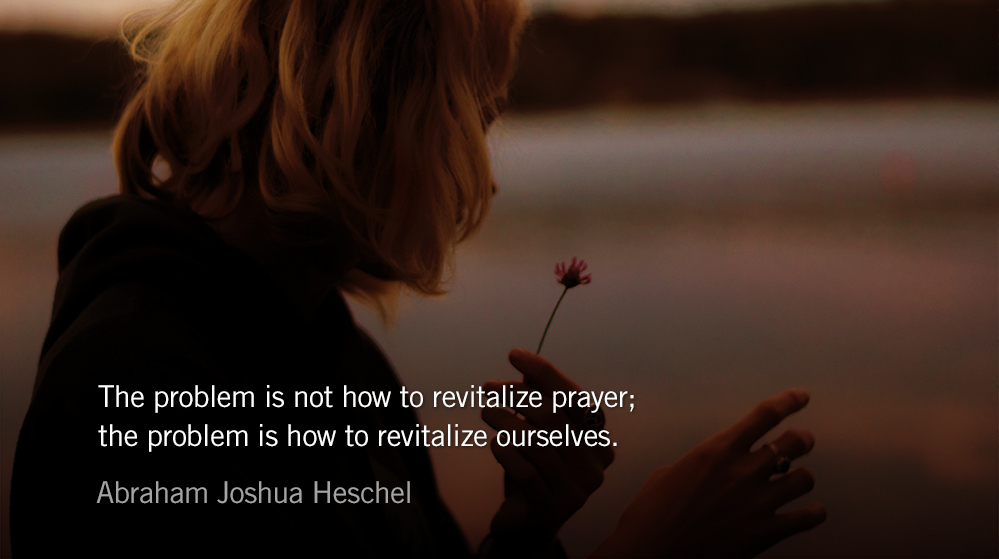
 

Heschel on Discovering our Humanity :: Reflections for a New Year

How much the faith community has to offer our divided and increasingly hostile world. Silence and solitude have been devoured by technology—the Church can be a place of stillness. Partisanship and hatred of the other have eroded our humanity—the Church can be a place of embrace through Christ’s transcendent work.

Perhaps no one lived this message more vividly in modern history than Abraham Joshua Heschel. At the 1953 gathering of the Rabbinical Assembly of America, Rabbi Heschel reflected:

If “prayer is the expression of the sense of being at home in the universe,” then the Psalmist who exclaimed, “I am a stranger on the earth hide not your commandments from me,” was a person who grievously misunderstood the nature of prayer. Throughout many centuries of Jewish history, the true motivation for prayer was not, “The sense of being at home at the universe,” but the sense of not being at home in the universe.

We could not but experience anxiety and spiritual homelessness in the sight of much suffering and evil, in the countless examples of failure to live up to the will of God. That experience gained in intensity by the soul-stirring awareness that God himself was not at home in a universe where his will is defied, where his kingship is denied.

To pray, then, means to bring God back into the world, to establish his kingship, to let his glory prevail. This is why in the greatest moments of our lives, on the Days of Awe, we cry out of the depth of our disconcerted souls, a prayer for redemption.

Great is the power of prayer…. The problem is not how to revitalize prayer; the problem is how to revitalize ourselves. Let us begin to cultivate those thoughts and virtues without which our worship becomes, of necessity, a prayer for the dead—for ideas which are dead to our hearts.

We must not surrender to the power of platitudes. If our rational methods are deficient and too weak to plumb the depth of faith, let us go into stillness and wait for the age in which reason will learn to appreciate the spirit rather than accept standardized notions that stifle the mind and stultify the soul….

To Judaism, the purpose of prayer is not to satisfy an emotional need. Prayer is not a need, but an ontological necessity, an act that expresses the very essence of man. He who has never prayed is not fully human.

Today’s Reading
Malachi 1 (Listen – 2:47)
John 18 (Listen – 5:16)


CS Lewis on Hope :: Reflections for a New Year

Tolkien’s words yesterday seemed timely, yet nearly discouraging—though he would have wanted his letter to be quite the opposite. Today we turn to his contemporary and, often, sounding board, C.S. Lewis, to highlight the hope he and Tolkien shared.

In Mere Christianity, Lewis writes:

Hope is one of the Theological virtues. This means that a continual looking forward to the eternal world is not (as some modern people think) a form of escapism or wishful thinking, but one of the things a Christian is meant to do.

It does not mean that we are to leave the present world as it is. If you read history you will find that the Christians who did most for the present world were just those who thought most of the next. The Apostles themselves, who set on foot the conversion of the Roman Empire, the great men who built up the Middle Ages, the English Evangelicals who abolished the Slave Trade, all left their mark on Earth, precisely because their minds were occupied with Heaven.

It is since Christians have largely ceased to think of the other world that they have become so ineffective in this. Aim at Heaven and you will get earth “thrown in”: aim at earth and you will get neither. It seems a strange rule, but something like it can be seen at work in other matters.

Health is a great blessing, but the moment you make health one of your main, direct objects you start becoming a crank and imagining there is something wrong with you. You are only likely to get health provided you want other things more—food, games, work, fun, open air. In the same way, we shall never save civilization as long as civilization is our main object. We must learn to want something else even more.

Most of us find it very difficult to want “Heaven” at all—except in so far as “Heaven” means meeting again our friends who have died. One reason for this difficulty is that we have not been trained: our whole education tends to fix our minds on this world. Another reason is that when the real want for Heaven is present in us, we do not recognize it.

Most people, if they had really learned to look into their own hearts, would know that they do want, and want acutely, something that cannot be had in this world. There are all sorts of things in this world that offer to give it to you, but they never quite keep their promise.

Today’s Reading
Zechariah 14 (Listen – 3:52)
John 17 (Listen – 3:40)

Tolkien on Global Turmoil :: Reflections for a New Year

The light shines in the darkness, and the darkness has not overcome it. — John 1.5

It has been difficult to process how our world changed in 2016. Terrorism has become the new norm in almost every part of the world, nationalism and xenophobia have won the moment, and we now use the term “post-truth” to assuage the harsh reality that a large part of our culture  is ambivalent—even partial—to the lies that form their worldview.

Yet, for people of faith, we do not lose hope. I am reminded of one of J.R.R. Tolkien’s letters, sent to his son Christopher toward what would be the end of World War II. The elder Tolkien navigates the present darkness and, as he does in his books, finds hope that penetrates the heart.

30 April 1944

My dearest:

I have decided to send you another air letter, not an airgraph, in the hope that I may so cheer you up a little more… I do miss you so, and I do find all this mighty hard to bear on my own account and on yours. The utter stupid waste of war, not only material but moral and spiritual, is so staggering to those who have to endure it. And always was (despite the poets), and always will be (despite the propagandists)—not of course that it has not is and will be necessary to face it in an evil world.

But so short is human memory and so evanescent are its generations that in only about 30 years there will be few or no people with that direct experience which alone goes really to the heart. The burnt hand teaches most about fire.

I sometimes feel appalled at the thought of the sum total of human misery all over the world at the present moment: the millions parted, fretting, wasting in unprofitable days—quite apart from torture, pain, death, bereavement, injustice. If anguish were visible, almost the whole of this benighted planet would be enveloped in a dense dark vapor, shrouded from the amazed vision of the heavens! And the products of it all will be mainly evil—historically considered. But the historical version is, of course, not the only one.

All things and deeds have a value in themselves, apart from their ’causes’ and ‘effects’. No man can estimate what is really happening at the present sub specie aeternitaris [(in light of the eternal)]. All we do know, and that to a large extent by direct experience, is that evil labors with vast power and perpetual success—in vain: preparing always only the soil for unexpected good to sprout in. So it is in general, and so it is in our own lives.

Today’s Reading
Zechariah 13:2-9 (Listen – 1:40)
John 16 (Listen – 4:14)


O Holy Night :: Advent’s Peace

On Christmas Eve of 1906 Reginald Fessenden, who had been one of Thomas Edison’s chief chemists, was testing a new generator for radio transmissions. In what became the first broadcast of voice and music over radio, Fessenden read the Christmas story from the gospel of Luke and played the carol “O Holy Night” on his violin. This remarkable entrance into history was not the first, nor the only for this song.

The lyrics to “O Holy Night” came from a French socialist, who penned them for a Catholic service in 1847. The music was written by a Jewish composer. Legend holds that the song brought a 24-hour respite to fighting between French and German troops after being sung from the battlefield on Christmas Eve of 1871. The carol hopped the pond, thanks to the Unitarian minister and abolitionist John Sullivan Dwight, and caught on in the North far more quickly than in the South:

Truly He taught us to love one another;
His law is love and His gospel is peace.
Chains shall He break for the slave is our brother;
And in His name all oppression shall cease.

The only thing more astonishing than the journey of one the most beloved Christmas songs is the event which it celebrates:

Long lay the world in sin and error pining,
‘Til He appear’d and the soul felt its worth.
A thrill of hope the weary world rejoices,
For yonder breaks a new and glorious morn.

How remarkable that in the light of God our soul feels its worth? “God is in the manger, wealth in poverty, light in darkness, succor in abandonment.” remarks Dietrich Bonhoeffer in his book, God is in the Manger. He continues:

And that is the wonder of all wonders, that God loves the lowly. God marches right in. He chooses people as his instruments and performs his wonders where one would least expect them. God is near to lowliness; he loves the lost, the neglected, the unseemly, the excluded, the weak and broken.

The hope, love, joy, and peace of Advent broke into our world on the holiest of nights. Songs about Christ have endured, and changed, history—more importantly the good news of Christ changes our present and future.

ListenO Holy Night by Chris Tomlin (1:29).

Today’s Reading
Zechariah 10 (Listen – 2:11)
John 13 (Listen – 5:06)

This Weekend’s Readings
Zechariah 11 (Listen – 2:40) John 14 (Listen – 4:13)
Zechariah 12:1-13:1 (Listen – 2:30) John 15 (Listen – 3:20)