Tamar’s Story — Love of Advent

Scripture Focus: Matthew 1.1, 3
1 This is the genealogy of Jesus the Messiah the son of David, the son of Abraham:

3 Judah the father of Perez and Zerah, whose mother was Tamar…

Genesis 38.26
26 Judah recognized them and said, “She is more righteous than I, since I wouldn’t give her to my son Shelah.” And he did not sleep with her again.

Reflection: Tamar’s Story — Love of Advent
By Erin Newton

These are the matriarchs of Jesus: Tamar, Rahab, Ruth, Bathsheba, and Mary. This is Tamar’s story.

Born among the Canaanites, Tamar was not one of Abraham’s kin. She married Er, the son of Judah and Shua, his Canaanite wife, and so became (for a short time) part of Abraham’s lineage.

Marital bliss was not to be found, for Er was evil. I imagine a loveless marriage filled with emotional or physical abuse. Perhaps a husband prone to angry outbursts and critical remarks. Perhaps a husband who sought other women or beat his workers. We are left only to wonder. The wickedness of Er, however, exceeded the tolerance of even God, and God ended his days.

Marital bliss certainly vanished. Tamar was a young widow. Among a people heralded for their covenantal righteousness—bound to be blessings among the nations—Tamar would find another form of abuse.

Judah’s second son, Onan, purposely thwarted his cultural duty to provide an heir for Tamar, though not hesitating to take pleasure in sleeping with her. She is used for her body but denied a child. Such selfishness of Onan exceeded the patience of God, and so God ended his days as well.

The final son, Shelah, is given to Tamar as a vague promise. A long time passes. I imagine Tamar living in her father’s house without a husband or child. Two men had abused her and now she must wait for the third. I imagine she worried he would be as terrible as his brothers.

Judah—a man of the covenant of Abraham, the namesake for the nation of God’s people, the patriarch in charge of Tamar’s honor—seeks out a shrine prostitute without hesitation just as the promises to Tamar have been delayed without hesitation. She takes matters into her own hands, maneuvering the situation so that Judah confuses her with a prostitute. She bears twin boys by Judah and reveals his failure of duty.  

The men tasked to care for Tamar placed their pleasures and priorities over her dignity and honor.

This was no story of godly love. 

But she is not defined by the abuse she suffered at the hands of men or by her assertive (and albeit, morally questionable) actions. Once abused and neglected, Tamar is chosen and honored as one of five women named in Jesus’s family. She is a matriarch of Jesus.

In the love of Jesus belong the abused. 


Divine Hours Prayer: The Greeting
I will thank you, O Lord my God, with all my heart, and glorify your Name forevermore. — Psalm 86.12

– From The Divine Hours: Prayers for Summertime by Phyllis Tickle.


Today’s Readings
2 Chronicles 11-12  (Listen 6:00)
Psalms 119-25-48 (Listen 15:14)

Read more about The Wrong People
Many of us have felt like we’re the wrong people to build up God’s kingdom…God uses the Tamars…Rahabs…And the Pauls. 

Read more about Supporting Our Work
Donate today to support ad-free content that brings biblical devotionals to inboxes across the world.
Hymn of Hope — Hope of Advent

Scripture Focus: Psalm 116.1-2
1 I love the Lord, for he heard my voice;
he heard my cry for mercy.
2 Because he turned his ear to me,
I will call on him as long as I live.

Reflection: Hymn of Hope — Hope of Advent
By John Tillman

Advent isn’t shy about acknowledging pain and darkness. Advent happens as the world gets darker specifically to remind us that it is into the darkest dark that Jesus came and from the darkest dark that Jesus ignites the light of salvation. Psalm 116 is a lament that never loses sight of salvation’s light and cycles continually back to thankfulness and praise.

Hymn writer Isaac Watts wrote a hymn based on Psalm 116 in 1719. The hymn was later adopted and adapted by African-American churches and the gospel tradition. In 1990, gospel music artist Richard Smallwood wrote new music to the adapted text based on versions he experienced. The work was featured on the soundtrack of the Whitney Houston Christmas film The Preacher’s Wife. The opening phrase closely follows the psalm and Watts’s interpretation.

“I love the the Lord
He heard my cry
And pitied every groan
Long as I live
And troubles rise
I hasten to his throne”
 — I Love the Lord, sung by Whitney Houston on The Preacher’s Wife soundtrack

The psalmist agrees with Watts that troubles rise. The psalmist was “greatly afflicted” and alarmed, saying, “Everyone is a liar,” still, they trusted in the Lord. (Psalm 116.10-11). Death features repeatedly in Psalm 116. The psalmist has been delivered from death to the land of the living. In the end, despite darkness and trouble, the psalmist hastened to the temple courts to give an offering of thanks, praise, and obedience.

Thanksgiving and love are connected to lament. One often leads to another. When we love the Lord, rising troubles lead us to raise laments to God. When we lament, we reflect not only on the suffering of the moment but the salvation of the past. When we remember how good God has been to us and his promises for the future, we respond in hope with thanksgiving.

In this season and every season, no matter what your troubles are, the Lord pities every groan. His Holy Spirit groans with ours when we have no words. (Romans 8.26) Our hope is not only that we can hasten to his temple and throne of mercy but that Jesus hastens to us in response. His Advent brings his presence, compassion, and care.

Reminding ourselves of what Jesus has done and that he hastens to us, we can say, as the psalmist does, “Return to your rest, my soul, for the Lord has been good to you.” (Psalm 116.7)

Divine Hours Prayer: The Refrain for the Morning Lessons
For god, who commanded the light to shine out of darkness, hath shined in our hearts, to give the light of the knowledge of the glory of God in the face of Jesus Christ. — 2 Corinthians 4.6

– From The Divine Hours: Prayers for Summertime by Phyllis Tickle.

Today’s Readings
2 Chronicles 8 (Listen 3:02)
Psalms 116 (Listen 1:34)

Today’s Readings
2 Chronicles 9 (Listen 5:07Psalms 117-118 (Listen 2:52)
2 Chronicles 10 (Listen 3:01Psalms 119.1-24 (Listen 1:34)

Read more about What to Expect when Suffering
Don’t be surprised or ashamed of the emotions that come in times of struggle and pain.

Read more about Supporting Our Work
We are thankful for our donors who support ad-free content that brings biblical devotionals to inboxes across the world. Please consider joining them.
Zealous Correction and Healing — Hope of Advent

Scripture Focus: 2 Chronicles 7.11-16
11 When Solomon had finished the temple of the Lord and the royal palace, and had succeeded in carrying out all he had in mind to do in the temple of the Lord and in his own palace, 12 the Lord appeared to him at night and said: 
“I have heard your prayer and have chosen this place for myself as a temple for sacrifices. 
13 “When I shut up the heavens so that there is no rain, or command locusts to devour the land or send a plague among my people, 14 if my people, who are called by my name, will humble themselves and pray and seek my face and turn from their wicked ways, then I will hear from heaven, and I will forgive their sin and will heal their land. 15 Now my eyes will be open and my ears attentive to the prayers offered in this place. 16 I have chosen and consecrated this temple so that my Name may be there forever. My eyes and my heart will always be there. 

Luke 2.45-49
45 When they did not find him, they went back to Jerusalem to look for him. 46 After three days they found him in the temple courts, sitting among the teachers, listening to them and asking them questions. 47 Everyone who heard him was amazed at his understanding and his answers. 48 When his parents saw him, they were astonished. His mother said to him, “Son, why have you treated us like this? Your father and I have been anxiously searching for you.” 
49 “Why were you searching for me?” he asked. “Didn’t you know I had to be in my Father’s house?”

Reflection: Zealous Correction and Healing — Hope of Advent
By John Tillman

God promised Solomon that his eyes, ears, and heart would always be in the Temple and attentive to those who sought him there. But, God warned that if they turned away and abandoned him, he would reject Solomon’s Temple, destroy it, and exile his people away from the Temple and his presence. The slide into idolatry began quickly. Soon, Solomon built other temples for false gods and joined in worshiping there.

By the time Jesus visited Jerusalem, Solomon’s Temple had been destroyed and burnt with fire. Jesus entered a rebuilt version. However, Jesus’ eyes, ears, and heart still longed to be there, engaging in his father’s business.

One of the humorous mysteries of the incarnation is imagining adults teaching young Jesus about the world he created and the scriptures he inspired. Imagine him, who filled the hearts of psalmists until they burst with poetry, learning to sing words he shaped. Imagine him, who spoke through Isaiah and other prophets about the minute details of his life, ministry, and death, sitting in Nazareth’s Hebrew school listening to a teacher interpret Isaiah’s words without realizing they are about him. Imagine Jesus, who “knew what was in each person” (John 2.24-25), learning ethics from a pharisee who will “devour widows’ houses and for a show make lengthy prayers.” (Mark 12.40)

For Jesus, God’s house was the Temple, flawed as it was. Like today, corruption in religious circles was rampant, and religious leaders were more concerned about political power than truth or justice. Jesus showed us an example of maintaining zeal for God’s house in his life, but that zeal didn’t mean warm, fuzzy nostalgia or not rocking the boat. Every time Jesus came to the Temple, there was something to confront. In the Temple, Jesus deconstructed hypocrisy, repaired the foundations of faith, healed broken bodies, mended broken hearts, and corrected crooked teaching. Don’t we hope for that today?

For us, God’s house is the church, flawed as it is. Advent tells us Jesus is coming. To our churches. To our cities. To us. His eyes, ears, and heart are in his church today. What might Jesus see, hear, and feel in our churches? Will he long to stay? Will he find us doing his father’s business?

Thank God, Jesus is zealous for imperfect people and places! May his Advent bring zealous correction for our errors and healing for our weaknesses.


Divine Hours Prayer: The Refrain for the Morning Lessons
Blessed is he who comes in the name of the lord; we bless you from the house of the Lord. — Psalm 118.26 

– From The Divine Hours: Prayers for Summertime by Phyllis Tickle.


Today’s Readings
2 Chronicles 7  (Listen 4:07)
Psalms 114-115 (Listen 2:18)

Read more about Better Temples
Jesus’ life stands, like the Temple, as a miraculous work of God. He is the promised one who fulfills all of God’s promises.

Read more about Supporting Our Work
Please consider becoming a donor. Your support is needed for us to continue our work.

Exclusive Claims, Inclusive Hope — Hope of Advent

Scripture Focus: 2 Chronicles 6.18-21
​​18 “But will God really dwell on earth with humans? The heavens, even the highest heavens, cannot contain you. How much less this temple I have built! 19 Yet, Lord my God, give attention to your servant’s prayer and his plea for mercy. Hear the cry and the prayer that your servant is praying in your presence. 20 May your eyes be open toward this temple day and night, this place of which you said you would put your Name there. May you hear the prayer your servant prays toward this place. 21 Hear the supplications of your servant and of your people Israel when they pray toward this place. Hear from heaven, your dwelling place; and when you hear, forgive.

Luke 2.28-38
28 Simeon took him in his arms and praised God, saying: 
29 “Sovereign Lord, as you have promised, 
you may now dismiss your servant in peace. 
30 For my eyes have seen your salvation, 
31 which you have prepared in the sight of all nations: 
32 a light for revelation to the Gentiles, 
and the glory of your people Israel.” 

36 There was also a prophet, Anna, the daughter of Penuel, of the tribe of Asher. She was very old; she had lived with her husband seven years after her marriage, 37 and then was a widow until she was eighty-four. She never left the temple but worshiped night and day, fasting and praying. 38 Coming up to them at that very moment, she gave thanks to God and spoke about the child to all who were looking forward to the redemption of Jerusalem.

Reflection: Exclusive Claims, Inclusive Hope — Hope of Advent
By John Tillman

It was a common belief in the ancient world that gods were territorial.

When Assyria conquered the northern kingdom of Israel they exiled much of the population and imported captured peoples from other regions to take their place. When animal attacks became a problem, the Assyrians reasoned that the imported non-Israelites were not properly worshiping “the god of that country,” so they sent back an Israelite priest to train the foreigners in worshiping Yahweh. (2 Kings 17.26-28)

Jews did not worship Yahweh as a regional god. Yahweh was God in Israel, Judah, Egypt, Assyria, Babylon, and everywhere else. Yet, they still struggled to comprehend God’s presence. Solomon marveled that God’s presence would enter the Temple when even the highest heavens failed to contain him. Solomon pondered how this everywhere-god could “dwell on earth with humans.”

God’s enormity does not limit his intimacy, and Solomon’s Temple is not the smallest or humblest place God will enter.

Centuries later, standing in a reconstructed Temple, Simeon held in his arms the same presence that filled Solomon’s Temple. The prophetess Anna, who never left God’s presence in the Temple, recognized it in Jesus and proclaimed about him to Jerusalem.

How astounded Solomon would be at Simeon standing in the Temple holding Jesus in his arms! How astounded we should still be!

Yahweh is God, and Jesus is Lord everywhere, at all times, all at once. This exclusive claim was odd to some and offensive to others. “Who is the Lord that I should obey him?” (Exodus 5.2) “Bow down before this statue I have made!” (Daniel 3.15) “Great is Artemis of the Ephesians!” (Acts 19.34)

Exclusive claims are no less odd or insulting today. Christians face versions of these same objections now. “Why should I obey God?” “You must assent to and support my belief!” “My belief is greater than yours!”

God’s exclusivity is not a bragging point or an insult. Our hope is exclusively in God yet inclusively welcomes all people. Jesus is the light of the world, not the light of our region, race, or nation. His existence is exclusive—He is the only God. His invitation is inclusive—He will be anyone’s God.

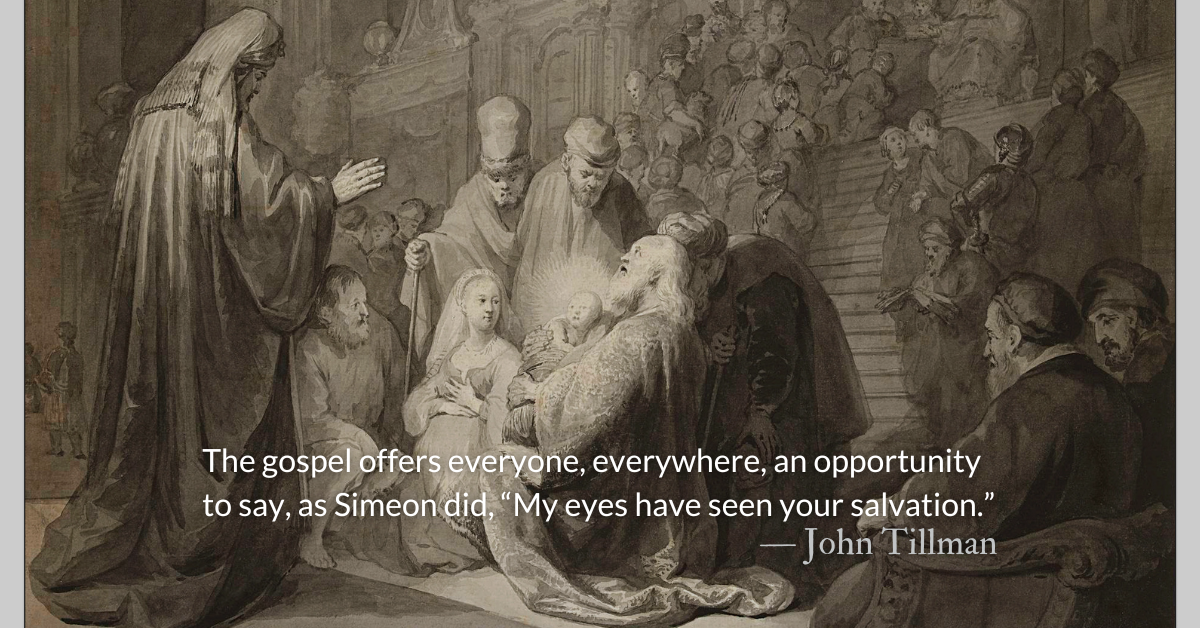
The gospel offers everyone, everywhere, an opportunity to say, as Simeon did, “My eyes have seen your salvation.” God is their God, too. Jesus loves them, too. He longs for them and desires to come closer to them than Solomon, Simeon, or Anna could imagine.


Divine Hours Prayer: The Refrain for the Morning Lessons
With my whole heart I seek you; let me not stray from your commandments. — Psalm 119.10

– From The Divine Hours: Prayers for Summertime by Phyllis Tickle.


Today’s Readings
2 Chronicles 6.11-42  (Listen 7:17)
Psalms 112-113 (Listen 1:49)

Read more about He Stoops to Raise
The equally interesting, intimate glory of God is how infinitely small he is willing to shrink in order to meet us, save us, and lift us up.

Read more about Supporting Our Work
Will you help support ad-free content that brings biblical devotionals to inboxes across the world? Join our donors with a one-time or recurring donation.

Unexpectedly Tangible Presence — Hope of Advent

Scripture Focus: 2 Chronicles 5.13
13 The trumpeters and musicians joined in unison to give praise and thanks to the Lord. Accompanied by trumpets, cymbals and other instruments, the singers raised their voices in praise to the Lord and sang: 

“He is good; 
his love endures forever.” 

Then the temple of the Lord was filled with the cloud, 14 and the priests could not perform their service because of the cloud, for the glory of the Lord filled the temple of God.

Luke 2.6-11
6 While they were there, the time came for the baby to be born, 7 and she gave birth to her firstborn, a son. She wrapped him in cloths and placed him in a manger, because there was no guest room available for them. 
8 And there were shepherds living out in the fields nearby, keeping watch over their flocks at night. 9 An angel of the Lord appeared to them, and the glory of the Lord shone around them, and they were terrified. 10 But the angel said to them, “Do not be afraid. I bring you good news that will cause great joy for all the people. 11 Today in the town of David a Savior has been born to you; he is the Messiah, the Lord.

Reflection: Unexpectedly Tangible Presence — Hope of Advent
By John Tillman

David remembered God’s faithfulness. God had inspired him as he slept under the stars as a shepherd, protected him from wicked leaders as a fugitive in his own country, and gone with him into foreign lands as an exile. Now David’s throne was in a palace, and God’s throne, the mercy seat of the Ark of the Covenant, was in a centuries-old tent. David thought God’s presence should be housed more grandly. Solomon made sure of it, following David’s preparations. 

When the days were completed for the Ark to be delivered, Solomon brought forth the presence of the Lord to take up residence in the Temple.

Every priest, no matter their job description, was consecrated. Countless sacrifices were made in worship. The entire nation gathered. Under the spreading wings of cherubim, the Ark was set in place. Choirs of singers and bands of musicians made music of praise and thanks. 

Then, the unexpectedly tangible presence of God, a cloud that filled the Temple, prevented the performance of the priests’ duties. God took over the space as his own. Then, Solomon prayed a priestly prayer over the Temple and kingdom.

When the days were completed for Jesus to be delivered, different preparations had been made. No consecrated priests were there to minister, but Mary, full of the Holy Spirit, prophesied and gave him life. No choir of Levites in fine linen celebrated him, but shepherds, sleeping on the ground, were inspired to seek him by music from the heavens. No dignitaries from his nation visited or brought sacrifices, but foreigners came from afar to worship, bringing sacrificial gifts. No king prayed to or worshiped him, but Herod’s killers pursued him, and Jesus became a fugitive and an exile, leaving behind comfort and familiarity.

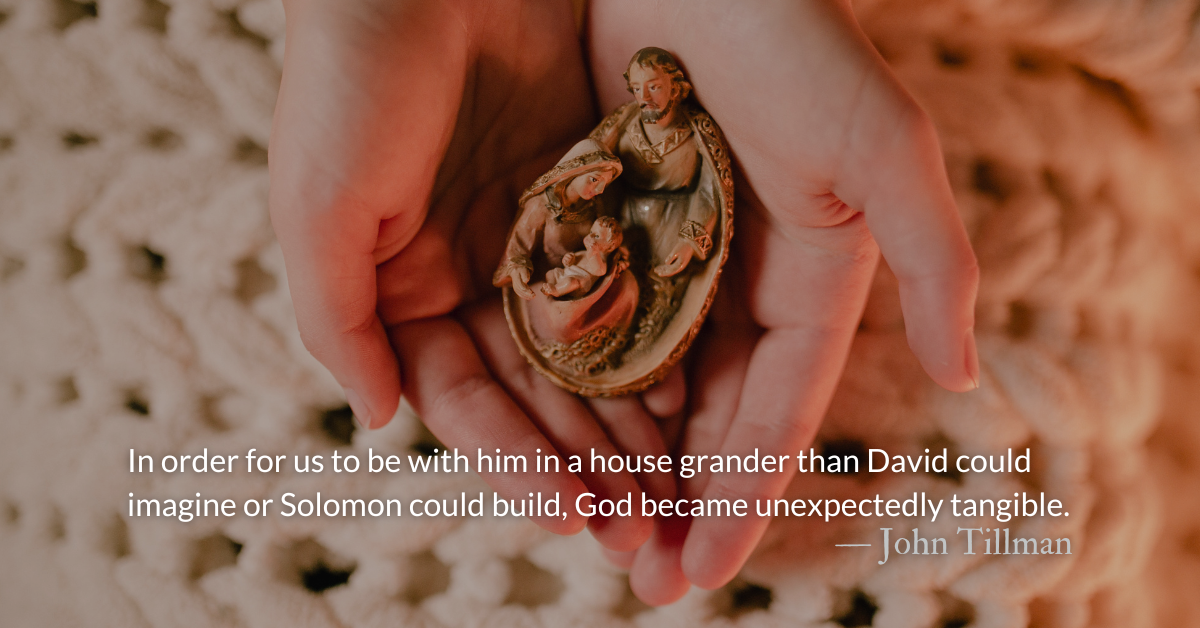
In order for us to be with him in a house grander than David could imagine or Solomon could build, God became unexpectedly tangible. Rather than a non-corporeal cloud, he became a poor, unhoused, itinerant carpenter and died as a slandered, tortured rebel.

Jesus, with no place to lay his head, is the same God who inspired David’s songs in the night. Jesus, whose parents could not afford to sacrifice a lamb, is the Lamb of God. Jesus, hung on a cross with a crown of thorns, is the same God enthroned on the mercy seat of the Ark of the Covenant.

Come, thou unexpectedly tangible Jesus.


Divine Hours Prayer: The Request for Presence
Show us the light of your countenance, O God, and come to us. — Psalm 67.1

– From The Divine Hours: Prayers for Summertime by Phyllis Tickle.


Today’s Readings
2 Chronicles 5-6.11 (Listen 9:47)
Psalms 110-111 (Listen 1:57)

Read more about O Come, O Come, Emmanuel — Carols of Advent Hope
Our true hope…Messiah King soothes doubts, heals afflictions, wipes sorrowful tears, and rescues us from captivity to sin.

Read more about Supporting Our Work
Approximately half of our funding comes from monthly and half from once-a-year donors. Please consider joining one of these groups and supporting our work.

Show Buttons
Hide Buttons
Spur a spiritual rhythm of refreshment right in your inbox
By joining this email list you are giving us permission to send you devotional emails each weekday and to communicate occasionally regarding other aspects of the ministry.
100% Privacy. We don't spam.