Don’t Hope in Humans—Reader’s Choice

Readers’ Choice Month:
This September, The Park Forum is looking back on readers’ selections of our most meaningful and helpful devotionals from the past 12 months. Thank you for your readership. This month is all about hearing from you. Submit a Readers’ Choice post today.

Today’s post was originally published, on August 23, 2022, based on Jeremiah 17:5-6
It was selected by reader, Karen Kallberg, Saint Louis: 
“‘We can find help in another person, but hope remains in Christ alone.’ I had to learn this lesson in a dark hour of my life. Now as a counselor, I am learning to help others discover the freedom in trusting a Savior who may not do as we wish but will never fail us. To this post, I heartily say, ‘Amen.’”


Scripture Focus: Jeremiah 17:5-6
5 This is what the Lord says:
“Cursed is the one who trusts in man,
    who draws strength from mere flesh
    and whose heart turns away from the Lord.
6 That person will be like a bush in the wastelands;
    they will not see prosperity when it comes.
They will dwell in the parched places of the desert,
    in a salt land where no one lives.

Reflection: Don’t Hope in Humans—Reader’s Choice
By Erin Newton

As we read the Old Testament, we often scoff at idolatry. Hmph, how primitive, we think. Most of our world sees God as one of many religious, divine beings but considers all such powers as ultimately nonexistent. By default, trust shifts from the divine to the created order. We are a culture that not only trusts in humanity but takes pride in doing so.

Jeremiah lives among a culture that rarely sees any dichotomy between the natural and supernatural yet speaks of this erroneous way of living that we encounter all the time. The prophet chides the people for trusting in humanity as if nothing could be more foolish. As fools today, our world chides at those who trust in God as if it were all a figment of our imaginations.

Trusting in another human being includes not only trusting another person for security, power, value, identity, and love but also drawing strength from ourselves. The prophet rebukes the mantra to pull oneself up by the bootstraps. He rebukes the idea that a mere mortal could be called upon to fix all of one’s problems. The future of those who trust in humanity will be like those who wander the desert always looking to settle but never finding rest.

We hear politicians speak about promises of a brighter and better future if only we will pick them to lead us. We are confronted with the failures of our religious organizations and are told that if we follow “so-and-so” then everything will be made right. Sometimes we hope that if we can be loved by this one person, then our souls will be filled and our identities complete.

It is a lonely, confusing, and hurting world that we live in. We want something to cling to in times like this. Unsurprisingly, people will present themselves as our knights in shining armor. As we look for hope and answers, let us be careful. We can find help in another person, but hope remains in Christ alone. We cannot call another person our savior or speak about someone as a cure-all for our world.

The only person worthy of our trust is Christ. We can draw strength from our Lord who put on flesh but was fully divine. He is our anchor. God may choose to use men and women to bring peace or prosperity, but wholehearted trust can only be in God.

Divine Hours Prayer: The Cry of the Church
Be, Lord, my helper and forsake me not. Do not despise me, O God, my savior.

– From The Divine Hours: Prayers for Summertime by Phyllis Tickle.

Today’s Readings
Jeremiah 34 (Listen -4:15)
1 Corinthians 10 (Listen – 4:04)

Readers’ Choice is Here!
What post from the last 12 months encouraged or uplifted you? Tell us about it and we’ll reshare it this month.

Read more about No Princes
How many believers veil their trust in men as trust in God? This can cause problems in two ways.
Temptation Has No Gender—Readers’ Choice

Readers’ Choice Month:
This September, The Park Forum is looking back on readers’ selections of our most meaningful and helpful devotionals from the past 12 months. Thank you for your readership. This month is all about hearing from you. Submit a Readers’ Choice post today.

Today’s post was originally published, on February 11, 2022, based on Proverbs 2.12-19
It was selected by reader, EN: 
“This was really encouraging as a woman. In some circles, being a woman automatically makes you guilty of temptation but this was a good dose of truth to correct those erroneous assumptions.”


Scripture Focus: Proverbs 2.12-19
12 Wisdom will save you from the ways of wicked men, 
from men whose words are perverse, 
13 who have left the straight paths 
to walk in dark ways, 
14 who delight in doing wrong 
and rejoice in the perverseness of evil, 
15 whose paths are crooked 
and who are devious in their ways.
16 Wisdom will save you also from the adulterous woman, 
from the wayward woman with her seductive words, 
17 who has left the partner of her youth 
and ignored the covenant she made before God.
18 Surely her house leads down to death 
and her paths to the spirits of the dead. 
19 None who go to her return 
or attain the paths of life.

Reflection: Temptation Has No Gender
By John Tillman

Much ink has been spent in Christendom warning men to avoid female temptresses. Today’s reading, a warning to “my son” about an “adulterous woman,” is one that is often cited. The lessons are valid and needed.

The proliferation of pornography is exploding and prostitution and pornography are seeking normalization, even for minors. The pornography industry, like the tobacco industry before it, taps addiction as an income stream. Physical and psychological damage to customers and performers is callously counted as the cost of doing business.

However, porn isn’t just for men, and men also commonly initiate adulterous (or abusive) sexual relationships. All people need to be warned about infidelity and the predatory industry of porn. 
In addition, these passages have been often misused to paint all women as temptresses and all men as victims. The twisted extremes of “purity culture” taught women to treat their bodies like unexploded lust bombs on a hair-trigger. If a dress strap fell off of a shoulder, or a skirt hem rose up too high when sitting down, the lust explosion that could destroy a young (or old) man’s morality would be their fault. Men, instead of being protectors, demanded protection. Women were taught to bear the burden of dressing to protect men’s eyes and souls.

One way to prevent abuse of this passage is to recognize that it sits in balance with the four lines before it. A father is telling his son of the dangers that wisdom will save him from—but female seduction is not the first thing on his mind. The first dangers mentioned are the temptations of evil men. 

Sections of scripture that mirror each other like this are intended to cast light on each other. We must widen our gaze in the scriptures, especially in Proverbs, where matched pairs in tension with each other draw us deeper than the surface reading of either one alone.

The picture of the female temptress informs the image of the men of wickedness. The temptations of leaving straight paths for ones that are dark and wicked tell us more about how one is seduced sexually.

Seduction and temptation are not feminine (or masculine), nor are they limited to sexual pleasures. Carnality includes the lust of the eyes and of pride, not just the lust of the flesh. (1 John 2.16) Power, wealth, indulgence, sexuality…nothing escapes the corruption of sin and no gender is exempt from responsibility.

Divine Hours Prayer: The Request for Presence
Send out your light and your truth, that they may lead me, and bring me to your holy hill and to your dwelling;
That I may go to the altar of God, to the God of my joy and gladness; and on the harp, I will give thanks to you, O God my God. — Psalm 43.3-4


– From The Divine Hours: Prayers for Summertime by Phyllis Tickle.

Today’s Readings
Jeremiah 33(Listen -4:46)
1 Corinthians 9 (Listen – 4:04)

Readers’ Choice is Here!
We look forward to more of your recommended posts from the last 12 months. Which one helped you understand scripture?

Read more about The Sins Behind Sexual Sins
Many times sexual sins are a symptom of other sins such as greed, selfishness, inequality, and oppression.

When God Shakes Our Foundation—Readers’ Choice

Readers’ Choice Month:
This September, The Park Forum is looking back on readers’ selections of our most meaningful and helpful devotionals from the past 12 months. Thank you for your readership. This month is all about hearing from you. Submit a Readers’ Choice post today.

Today’s post was originally published, on April 25, 2022, based on Amos 9.1a, 11-13
It was selected by reader, Michelle Perez: 

“This devotional is timely and profound. I hear all too often people who remain part of failed churches led by questionable pastors place the blame entirely on enemy influence… God gave us his Holy Spirit for guidance and his word for wisdom. When a pastor’s words and actions are sinful, one needs to leverage those incredible tools to keep from becoming an idol worshiper, enabler, and ultimately, a victim.”

Scripture Focus: Amos 9.1a, 11-13
1 I saw the Lord standing by the altar, and he said:
“Strike the tops of the pillars
so that the thresholds shake.
Bring them down on the heads of all the people; 

11 “In that day 
“I will restore David’s fallen shelter— 
I will repair its broken walls 
and restore its ruins— 
and will rebuild it as it used to be, 
12 so that they may possess the remnant of Edom 
and all the nations that bear my name,” 
declares the Lord, who will do these things. 
13 “The days are coming,” declares the Lord, 
“when the reaper will be overtaken by the plowman 
and the planter by the one treading grapes. 
New wine will drip from the mountains 
and flow from all the hills, 

Reflection: When God Shakes Our Foundation—Readers’ Choice
By John Tillman

Amos describes God standing by the altar and striking the pillars to bring the structure down on the people. This image is reminiscent of Samson’s destruction of the temple of Dagon. (Judges 16.23-30) Why would God treat his own Temple like Samson treated the temple of Dagon?

The people worshiped other idols alongside God, even placing images of these idols in God’s Temple. In doing so, they made him equal to those idols. To God, the elaborate temples, in Samaria and Jerusalem, had become little more than tents of wickedness.

The people reduced God to an idol so, in Amos’s vision, God reduces the Temple to rubble which falls and crushes the people. In fulfillment of this vision the Assyrians and Babylonians would crush both nations and both temples would be burned, torn down, and reduced to rubble.

God brings judgment beyond his people as well. Amos describes God going to the ends of the earth (and below it and above it and to the depths of the sea) to bring vengeance to the wicked. (Amos 9.2-4)

God is determined to renovate this world, starting with his church and his people. And renovation always starts with demolition. When leaders, churches, and organizations fall after revelations of misconduct and sin some have a tendency to blame “enemies of the church.” This is unbiblical. It is God, not Satan, who works to destroy corruption in the church. When sin is revealed and an organization crumbles, it was God who struck the blow, not an enemy.

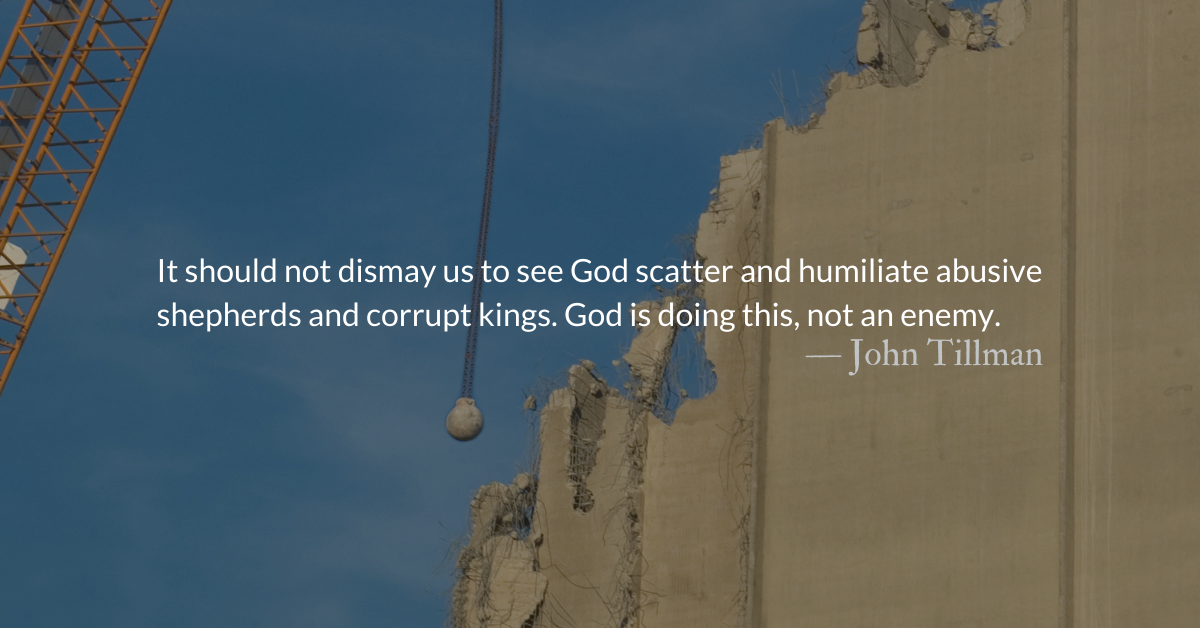
It should not surprise us to see the foundations of our churches shaken when wickedness has been covered up. It should not dismay us to see God scatter and humiliate abusive shepherds and corrupt kings. God is doing this, not an enemy. God is striking our pillars. God’s church is renewed by the removal of corrupt leaders.

What idols have we set beside God in the temples of our hearts and in our houses of worship? 

There is no hiding from God’s judgment. (Revelation 6.16) There is also no hiding from God’s mercy. Amos ends with a picture of restoration. God repairs “David’s tent” which refers to the destroyed Temple. He can and will repair us.

God seeks us as individuals and as his church, longing to heal us if we will let him. The razed can be rebuilt. The ruined can be restored. The uprooted can be replanted.

Divine Hours Prayer: A Reading
Jesus taught us, saying: “If I were to seek my own glory my glory would be worth nothing; in fact, my glory is conferred by the Father, by the one of whom you say, “He is our God” although you do not know him. But I know him, and if I were to say: I do not know him, I should be a liar…But I do know him, and I keep his word.” — John 8:54-56

– From The Divine Hours: Prayers for Summertime by Phyllis Tickle.

Today’s Readings
Jeremiah 32(Listen – 7:34)
1 Corinthians 8(Listen – 1:54)

Readers’ Choice is Here!
There’s still room for your recommended posts from the last 12 months. Which one helped you heal?

Read more about Misleading the Least
Woe to leaders who mislead…Have we caused others to stumble? If so, how?…By being an example of greed or any other sin?

From Esau to Jacob—Readers’ Choice

Readers’ Choice Month:
This September, The Park Forum is looking back on readers’ selections of our most meaningful and helpful devotionals from the past 12 months. Thank you for your readership. This month is all about hearing from you. Submit a Readers’ Choice post today.

Today’s post was originally published, on June 2, 2022, based on Malachi 1.2-3, Matthew 12.48-50, and Romans 5.8
It was selected by reader, Barbara: 

“This was one of my favorites.”

Scripture Focus: Malachi 1.2-3
2 “I have loved you,” says the Lord. 
“But you ask, ‘How have you loved us?’ 
“Was not Esau Jacob’s brother?” declares the Lord. “Yet I have loved Jacob, 3 but Esau I have hated, and I have turned his hill country into a wasteland and left his inheritance to the desert jackals.”

Matthew 12.48-50
48 He replied to him, “Who is my mother, and who are my brothers?” 49 Pointing to his disciples, he said, “Here are my mother and my brothers. 50 For whoever does the will of my Father in heaven is my brother and sister and mother.” 

Romans 5.8
…God demonstrates his own love for us in this: While we were still sinners, Christ died for us.

Reflection: From Esau to Jacob—Readers’ Choice
By John Tillman

“Esau I have hated.”

We may wonder: Does God randomly hate people? Am I one of those arbitrarily hated by God?


It is normal to struggle with difficult passages, especially those that have been misused. For example, some passages in Malachi 1, including this one, have been twisted to support slavery. Those who did this surrendered to culture and profit and selfishness, all the while proclaiming themselves wise, biblical, and superior. May we not make similar mistakes.

It’s impossible in a 400-word devotional to unpack a difficult passage like this. I won’t attempt it. Let us simply meditate on a few details from scripture.

  1. “Esau” doesn’t mean the individual. God is using these names as collective nouns to speak to the descendants of these brothers, not the brothers themselves. We don’t do this much in our culture. The closest thing we might understand is using the name of a country’s leader to refer to actions of that nation. For example, “Volodymyr Zelensky” meaning Ukraine, or “Xi Jinping” meaning China.
  2. God’s “hatred” isn’t arbitrary. It refers to justice for Edom’s actions—what they collectively did and continued to do. Esau, the individual, while reconciled to his brother, enjoyed God’s blessing. His descendants continually opposed Israel throughout their history and came to represent, poetically, all people opposed to God and God’s people.
  3. God’s “hatred” is not absolute. Edomites are not arbitrarily cursed or hated throughout history or in totality. In many places, God implies hope for Edom. He shows he cares for them, gives them their own land, and commands that no Israelite should despise an Edomite. (Deuteronomy 2.1-8, 12; 23.7)
  4. This statement’s purpose is to show love, not hatred. God speaks poetically to reassure his people. He points to justice done on their behalf, which proves his love. To Micah’s readers, this justice was the downfall of “The Wicked Land” (Malachi 1.4) that harmed them.

We can be assured of God’s love and justice. We are not innocent. Yet, we are not hated. We are loved. This is demonstrated in Christ as God turns “Esaus” into “Jacobs.”

God loved us when we were like Esau—sinners, rebels, and persecutors. (Romans 5.8) All of us have been children of Esau, but by God’s grace, we can become children of Jacob and brothers and sisters of Christ (Matthew 12.50). Through Jesus, we cry “Abba, father,” (Romans 8.15; Galatians 4.6; Mark 14.36) for “Jacob, have I loved.” (Malachi 1.2)

Divine Hours Prayer: The Refrain for the Morning Lessons
It is not the healthy who need a doctor but the sick…And indeed I did not come to call the virtuous, but sinners. — Matthew 9.12-13

– From The Divine Hours: Prayers for Summertime by Phyllis Tickle.

Today’s Readings
Jeremiah 27(Listen -3:52)
1 Corinthians 4(Listen – 3:15)

This Weekend’s Readings
Jeremiah 28(Listen -3:05)1 Corinthians 5(Listen – 1:58)
Jeremiah 29(Listen -5:44)1 Corinthians 6(Listen – 3:03)
Jeremiah 30-31(Listen 11:21)1 Corinthians 7(Listen – 6:09)

Read more about Running to Forgive
In this moment, in a limited way, Esau demonstrates the welcome of the gospel. The wronged party shows undeserved mercy.

Readers’ Choice is Here!
There’s still room for your recommended posts from the last 12 months. Which ones did you share with a friend?

Prayer When None are Faithful—Readers’ Choice

Readers’ Choice Month:
This September, The Park Forum is looking back on readers’ selections of our most meaningful and helpful devotionals from the past 12 months. Thank you for your readership. This month is all about hearing from you. Submit a Readers’ Choice post today.

Today’s post was originally published, on January 7th, 2022, based on Psalm 12.
It was selected by reader, cjs: 

“This devotional is how I feel almost daily. Where has truth gone in our world? I especially liked the prayer, which I have saved to use in the future. I shared this post with friends that are struggling with the same issue. All of them said they saved the prayer for their personal use in the future as they too, struggle to find truth in our broken world. Come quickly, Lord Jesus. Fill us with the living water that heals us from the inside out. Fill us, so we may serve You in truth and faith.”

Scripture Focus: Psalm 12
1 Help, Lord, for no one is faithful anymore; 
those who are loyal have vanished from the human race. 
2 Everyone lies to their neighbor; 
they flatter with their lips 
but harbor deception in their hearts. 
3 May the Lord silence all flattering lips 
and every boastful tongue— 
4 those who say, 
“By our tongues we will prevail; 
our own lips will defend us—who is lord over us?” 
5 “Because the poor are plundered and the needy groan, 
I will now arise,” says the Lord. 
“I will protect them from those who malign them.” 
6 And the words of the Lord are flawless, 
like silver purified in a crucible, 
like gold refined seven times. 
7 You, Lord, will keep the needy safe 
and will protect us forever from the wicked, 
8 who freely strut about 
when what is vile is honored by the human race. 

Reflection: Prayer When None are Faithful—Readers’ Choice
By John Tillman

In Psalm 12 we see a cry and a response. The psalmist cries out about lies, deception, and boastful leaders. God responds, saying, “I will now arise…” God’s response also gives us a clue about who the lies targeted and who suffered under the deceptive and false leaders: the poor.

God says the “poor are plundered” and the “needy groan.” He says they have been “maligned” but that he will keep them safe and protect them from the wicked.

When we look around at our society, we can easily relate to the psalmist’s cries from Psalm 12. The costs of lies are all around us. Violence. Confusion. Desperation. Loss of life. They fill our news programs, newsfeeds, and memories. Over this weekend, reflect on Psalm 12 and pray this prayer based on its themes.

Prayer When None Are Faithful
Help, Lord, for no one is faithful!
Kings promise help but only help themselves.
Leaders demand loyalty while planning betrayals
Braggarts call themselves “saviors” to boost their influence.

Boasting and flattering people rise up
They weaponize their words and destroy
They threaten and pretend to be joking
They cause death and deny responsibility

We are dismayed, Lord…
We are sheep among wicked shepherds…

Will only braggarts lead?
Will only the boastful hold sway?
Will deception take root and blossom?
Will disdain and derision take bows to applause?
Will people believe anything so long as it insults their enemy?
Will people deny any authority other than their own desires and their own words? 
Is there any loyalty left to the truth?
Is there anyone faithful?

Rise up, Lord, and protect the poor from the powerful
Sweep down, Lord, and shield those being crushed, defending truth
Speak up, Lord, and drown out boastful lies designed to deceive the elect
Step down, Lord, and make those that strut pridefully stumble into their own traps.

Come, Lord Jesus, the Way. Lead us away from wicked shepherds.
Come, Lord Jesus, the Truth. Cut down idolatrous liars with the sword of your mouth.
Come, Lord Jesus, the Life. Fill us with living water that heals us from the inside out.

Come quickly, Lord Jesus.

Divine Hours Prayer: The Request for Presence
Teach me your way, O Lord, and I will walk in your truth; knit my heart to you that I may fear your Name. — Psalm 86.11


– From The Divine Hours: Prayers for Summertime by Phyllis Tickle.

Today’s Readings
Jeremiah 26(Listen -4:04)
1 Corinthians 3(Listen – 3:05)

Read more about The Floodlight of Epiphany
Today, we will pray that the light of Christ would dawn, exposing darkness.

Readers’ Choice is Here!
There’s still room for your favorite post from the last 12 months. Tell us about it and we will repost it in September.