Hear Us from Heaven — Readers’ Choice

Scripture Focus: 1 Kings 8:49-50
49 …then from heaven, your dwelling place, hear their prayer and their plea, and uphold their cause. 50 And forgive your people, who have sinned against you; forgive all the offenses they have committed against you, and cause their captors to show them mercy…

Originally published on October 05, 2022, based on readings from 1 Kings.

Readers’ Choice posts are selected by our readers:
Kolade, Nigeria — Thank you for sharing God’s word.

Reflection: Hear Us from Heaven — Readers’ Choice
By Erin Newton

Upon the dedication of the Temple, the presence of God fills the Holy Place like a cloud. The cloud is so magnificent that the priests move away and can no longer do their jobs. With the manifestation of God in the Temple, Solomon begins to pray for God’s grace upon the people.

The prayer of Solomon begins with the adoration of God. He praises his superiority and supremacy. Solomon marvels at the magnitude of God. But overall, the recurring message in the prayer is the plea for mercy. He stands between God and the people and falls to his knees, knowing that only by mercy can they live.

Within this 30-verse prayer, the phrase “hear from heaven” (or phrases similar) occurs 13 times. Even seeing the cloud, a visible manifestation of God’s presence, Solomon wanted to plead with God to hear him. 

The design of the Temple that Solomon built had many features common to temples in the ancient Near East. There were distinct differences but nothing more distinct than the absence of images of the deity. God had already declared to Moses that they were to never make images of him. They worshiped the invisible God. 

The command to follow and rely on God, forever unseen, was a huge act of faith. The people struggled with knowing that God was working when there were no outward signs. Psalm 77 echoes this sentiment, “Your path led through the sea, your way through the mighty waters, though your footprints were not seen.” Even the miraculous parting of the Red Sea is couched in the idea of hidden footprints. 

Solomon prays over and over that in all sorts of situations God would be merciful and hear the pleas from heaven. Each scenario begins with a crisis, followed by a call to repentance, a plea for a listening ear, and a resolution to live righteously.

This prayer is as apt today as it was 3000 years ago. We have the Holy Spirit who brings the presence of God, not just into our midst, but within our being. But even with this constant presence, we plead with God to hear us. We need him to hear or we will be left in our crises.

One day our faith will be made sight. One day we will see our Lord face to face. For now, we pray to the invisible God and know that he is listening.

Divine Hours Prayer: The Greeting
Happy are they whom you choose and draw to your courts to dwell there! They will be satisfied by the beauty of your house, by the holiness of your temple. — Psalm 65.4

– From The Divine Hours: Prayers for Summertime by Phyllis Tickle.

Today’s Readings
1 Samuel 25 (Listen 7:12)
Revelation 5 (Listen 2:39)

This Weekend’s Readings
1 Samuel 26 (Listen 4:30Revelation 6 (Listen 3:12)
1 Samuel 27 (Listen 1:59Revelation 7 (Listen 2:56)

Monday’s Reading
1 Samuel 28 (Listen 4:04Revelation 8 (Listen 2:15)

Read more about The House God Desires
When we make room for God in our hearts and lives, he will enter.
And when our lives are over, we will awake in the house of God.

Read more about Supporting Our Work
Ad-free content that brings biblical devotionals to inboxes across the world isn’t free. Please consider joining our donors and supporting our work.


Beyond “Plain Reading” — Readers’ Choice

Scripture Focus: Ephesians 5.21-25
21 Submit to one another out of reverence for Christ. 
22 Wives, submit yourselves to your own husbands as you do to the Lord. 23 For the husband is the head of the wife as Christ is the head of the church, his body, of which he is the Savior. 24 Now as the church submits to Christ, so also wives should submit to their husbands in everything. 
25 Husbands, love your wives, just as Christ loved the church and gave himself up for her.

Originally published on July 11, 2023, based on readings from Ephesians 5.

Readers’ Choice posts are selected by our readers:
Erin, Texas — Despite addressing this topic before, each year we need reaffirmation of the value of women in ministry. The debates were heightened over the summer when some churches were disfellowshipped for women pastors. Thank you for this encouragement! 

Brian, Washington D.C
. — Thank you for the gift of this reflection. The Word is the Word. And so many pastors jump past these verses and rush to a verse and declare that verse ends the conversation. Drives me nuts. The Bible can be blunt and direct and can also cause us to study and pray and think about what is in this holy text.

Reflection: Beyond “Plain Reading” — Readers’ Choice
By John Tillman

We often describe the Bible as a park in the midst of the city — a place of restoration and peace amidst the concrete-coated, steel-and-glass struggles of life.

Some Bible passages, however, are less like peaceful parks and more like battlegrounds. When passages have been weaponized and abused, how can we stop hearing them as weapons but as God’s word?

Today’s passage and other Pauline passages about women are such cases. One chapter of Confronting Christianity is “Doesn’t Christianity Denigrate Women?” In it, Rebecca McLaughlin mentions that Ephesians 5.22 repulsed her at first. It seemed hierarchical and prime for abuse.

One reason many think such passages are abusive is how some Christian voices interpret them. Using a “plain reading” they say Paul tells women to sit down. To shut up. To go home. Are they right?

We need to go beyond “plain reading” because the Bible is not plainly written. Peter points out that the difficulty of interpreting Paul leads to destruction. (2 Peter 3.15-17) Treating the Bible as clear-cut instructions which need no interpretation is foolish. Treating our interpretations as infallible is arrogant.

“Plain reading” conveniently lets us carry our prejudices and culture into scripture rather than reading the text in the context and culture of the writer. We better understand Paul’s words in the context of his actions. Are men to be lifted up and women to be pushed down? Did Paul intend that? Did Paul believe it? Did Paul enact it?

Paul’s treatment of women interprets his words about women. What women did in Paul’s ministry tells us how “submissive” women behave and what they do. Phoebe the deacon, Junia the apostle, Lydia the business owner and church founder, Priscilla the theological teacher…these are not rebels or heretics. They are women following Paul’s words, obeying his intent.

We need to read scripture humbly, contextually, and repeatedly. Don’t give up on passages that have been abused or argued over. The Bible has pearls of great price, treasures hidden in fields, and riches of wisdom to be mined. You’ll rarely strike gold with the first turn of a shovel or solve thorny theological problems with the first turn of a page. (Or 400 words of a devotional.)

We’ll find what Paul means by walking in the steps of Paul and of Jesus. With humility and patience, battlefields can once again become peaceful parks.

From John: To go more in depth on this issue and other challenging topics, I recommend McLaughlin’s book, Confronting Christianity. I am, through my church, helping lead a book club of atheists, agnostics, and deconstructed people discussing the book and it is an excellent place to start for those exploring challenging questions about Christianity.

Divine Hours Prayer: The Morning Psalm: The Sparrow has Found a Nest
…My soul has a desire and longing for the courts of the Lord; my heart and my flesh rejoice in the living God.
The sparrow has found her a house and the swallow a nest where she may lay her young; by the side of your altars, O Lord of hosts, my King and my God. — Psalm 84.1-2


– From The Divine Hours: Prayers for Summertime by Phyllis Tickle.

Today’s Readings
1 Samuel 24 (Listen 3:36)
Revelation 4 (Listen 2:09)

Read more about None Excluded or Excused
For Paul, ministry was collaborative. Paul’s ministry team included all races, men and women, young people and elders, slaves and free, rich and poor.

Read more about No Asterisks
Deborah’s judgeship doesn’t deserve an asterisk…God did not “settle” for Deborah. He chose her.

Love One Another — Readers’ Choice

Scripture Focus: 1 Peter 3:8-9
8 Finally, all of you, be like-minded, be sympathetic, love one another, be compassionate and humble. 9 Do not repay evil with evil or insult with insult. On the contrary, repay evil with blessing, because to this you were called so that you may inherit a blessing. 

Originally published on November 9, 2022, based on readings from 1 Peter 3.

Readers’ Choice posts are selected by our readers:
Cheryl, South Dakota — Amen! And Amen!

Reflection: Love One Another — Readers’ Choice
By Erin Newton

If you took time to read all the verses that command God’s people to love one another and pursue peace, it would take quite a while. Love one another. (John 13.34-35) Show faithful love and compassion to one another. (Zechariah 7.9). Love one another deeply as brothers and sisters. (Romans 12.10). Let us consider one another in order to provoke love. (Hebrews 10.24) And on and on. Why the repetition? Wouldn’t one command have been enough?

People have always struggled in relationships. Families are broken. Friendships are strained. Neighbors are viewed as enemies. Since the breaking of peace in the Garden of Eden, humanity has been at odds with itself. This should not be so. This is the brokenness of our world.

After exhorting people in specific relationships, one last call to unity is given to the whole congregation. Peter reminds his church to seek what is good: Love. Sympathy. Compassion. Humility. Cautious words. Slowness to speak. Blessings to others.

We cannot blame our hatred, rudeness, malice, anger, or selfishness on ignorance. Too many commands have taught us to behave otherwise. Being a jerk is a conscious decision. We choose not to love someone. We choose not to speak kindly. We choose not to withhold insults.

For those who live in the United States, many will awaken to news of newly elected leaders. Some of the results will be for decisions or people we supported and others will not.

Over the last few years, culture has sunk into a climate of animosity. Our values and beliefs have turned us against one another. Sadly, it has seeped into our churches. Christians, united by the Holy Spirit, have turned against one another.

For our friends around the world, it will be another day with other concerns. No matter what the day brings, we still have the opportunity to choose our responses to one another.

Let us strive for something worthwhile. Let us strive for peace. If we are going to use up all our emotional energy targeting something, let it be with the energy of love and kindness. If we are going to be screaming, may it be words of life and encouragement. If we are going to focus our attention on someone for something they said, let us put our noses into our Bibles and read God’s words instead.

People will be watching us today and in the days to come. Be a worthy spectacle.

Divine Hours Prayer: A Reading
Jesus taught us, saying: Is a lamp brought in to be put under a tub or under the bed? Surely to be put on the lampstand? For there is nothing hidden, but it must be disclosed, nothing kept secret except to be brought to light. Anyone who has ears for listening should listen. — Mark 4.21-23

– From The Divine Hours: Prayers for Summertime by Phyllis Tickle.

Today’s Readings
1 Samuel 23 (Listen 4:18)
Revelation 3 (Listen 3:53)

Read more about Confessing Hostility—Guided Prayer
Like rebellious, prodigal children, our hostility breaks fellowship with you and with our brothers and sisters.

Read The Bible With Us
Our Bible reading plan’s sustainable, two-year pace helps you find meaning without being overwhelmed. Join us.
https://mailchi.mp/theparkforum/m-f-daily-email-devotional

Mistakes for Good? — Readers’ Choice

Scripture Focus: Genesis 48:17-19
17 When Joseph saw his father placing his right hand on Ephraim’s head he was displeased; so he took hold of his father’s hand to move it from Ephraim’s head to Manasseh’s head. 18 Joseph said to him, “No, my father, this one is the firstborn; put your right hand on his head.”
19 But his father refused and said, “I know, my son, I know. He too will become a people, and he too will become great. Nevertheless, his younger brother will be greater than he, and his descendants will become a group of nations.”

Originally published on February 15, 2023, based on readings from Genesis 48.

Readers’ Choice posts are selected by our readers:
Brian, Washington D.C. — Thanks for this reflection and your beautiful perspective. After years of thinking about what happened to the church where I worked…I have come to these conclusions: The Lord used the destruction of this congregation to scatter anointed lay people to other churches that needed fresh ideas and new gifts…And I learned about the grace of our Lord who loved the man who brought the damage. The Lord allowed him to learn and now he is a humble servant…And I learned about the grace of God for me, as I was filled with anger and judgment…God allowed me to see what He was doing so that I could gain wisdom and patience. God is good.

Reflection: Mistakes for Good? — Readers’ Choice
By Erin Newton

God can take something meant for evil and make it work for good. But what about mistakes? Can God take a human mistake and use it for good?

As Jacob lays on his deathbed, Joseph brings his two sons to see their dying grandfather. Jacob blesses the boys with promises given to his own sons. But the grandsons are blessed out of order! Ephraim, the younger, is given the elevated blessing, a firstborn’s portion. Manasseh, the oldest, is blessed as a second-born.

Jacob is blind, and Joseph assumes his crossed arms were an accident. Jacob continues by granting Ephraim the greater blessing.

Joseph only sees a mistake being made. (He even tries to jump in to correct his father.) He bases his assumptions on how things ought to be. He has done everything right, reconciled with his brothers, and visited his ailing father. This should be a straightforward situation; nothing can go wrong.

Like the story of Joseph’s enslavement and deportation to Egypt, God worked through situations that looked hopeless or bound for misery. We are accustomed to looking at tragedies and preaching to our hearts that God can work something good out of them. But what about things that look haphazard? What about the events that look like someone messed up? 

The text never really indicates if God divinely inspired Jacob to switch the blessing order or if a mistake was made that Jacob accepted. The blessing was done, and the results could not be changed.

How many times do we look at a situation and assume that someone has made a mistake? If it’s a small thing, we don’t give it a second thought. But what about the big mistakes—the doctor who missed a diagnosis, the airline that lost your luggage, the distracted driver that hit your car, or the cashier who overcharged you?

When these things happen, we fault the person for making a mistake. We think, “If only they had done it right, I wouldn’t be suffering right now!” We cling to an “if-only” faith.
Jesus was blamed for an “if-only” scenario. “If only you had been here, Lazarus would not have died” (John 11.32).

It is easier to blame someone for making a mistake rather than trusting God to work among errors. God works through perceived irregularities. Think of the “if-only” times in your life. Hear God say, “I know, son, I know.”


Divine Hours Prayer: The Call to Prayer
Come and listen, all you who fear God, and I will tell you what he has done for me. — Psalm 66.14


– From The Divine Hours: Prayers for Summertime by Phyllis Tickle.

Today’s Readings
1 Samuel 21-22 (Listen 6:35)
Revelation 2 (Listen 4:59)

Read more about Supporting Our Work
Our donors support ad-free content that brings biblical devotionals to inboxes across the world. Please consider joining them.

Read more about Becoming a Blessing
Our broken world seeks righteousness.
Bring it through us.
Our lost world seeks truth.
Speak it through us.

Urban Legends and Good Shepherds — Readers’ Choice

Scripture Focus: John 10.11-15
11 “I am the good shepherd. The good shepherd lays down his life for the sheep. 12 The hired hand is not the shepherd and does not own the sheep. So when he sees the wolf coming, he abandons the sheep and runs away. Then the wolf attacks the flock and scatters it. 13 The man runs away because he is a hired hand and cares nothing for the sheep.

14 “I am the good shepherd; I know my sheep and my sheep know me—15 just as the Father knows me and I know the Father—and I lay down my life for the sheep.

Originally published on January 10, 2023, based on readings from John 10.

Readers’ Choice posts are selected by our readers:
Barbara, Tennessee — Wow, thank you, John! That is a terrible legend that I thought was legit animal husbandry! And it was taught to us by manipulative shepherds. Some of our adult children are still in need of the Lord for healing.

Brian, Washington D.C. — Thank you for this remarkable reflection. Such a good word for me today.

Jon, Hong Kong/TX — This is a nice piece. I think I may have been the one who told you it was Eddie Van Halen. At least, that was the story that I used to pass around as well.

Reflection: Urban Legends and Good Shepherds — Readers’ Choice
By John Tillman

In the 90s, listening to Phil Keaggy, I heard a story from a friend.

“Phil’s the world’s greatest guitarist. One night, on Johnny Carson, Jimi Hendrix was asked, ‘What’s it like to be the world’s greatest guitarist?’ He said, ‘I don’t know. Ask Phil Keaggy.’”

“So cool,” I thought at the time. I spread the tale often as I shared my love of Phil Keaggy.

Years later I heard another Keaggy fan begin the same story. I was shocked when, instead of Jimi Hendrix, it was Eddie Van Halen on the talk show. Every other detail was identical. My heart fell. I realized the stories weren’t true.

To put it kindly, they were urban legends. To be more direct, they were lies. Lies I had spread over and over. I felt sick and angry. My friends and I had been duped.

Worse than urban legends about guitarists are urban legends about God. Recently, I was reminded of an old “preacher story” about shepherds and lambs.

Supposedly, a shepherd would break a wandering lamb’s leg and carry it as the leg healed. By caring for the lamb and holding it close, it would bond with him and never wander again. This act of “tough love” allegedly explained how God wounds us to keep us close to him. Authoritative and abusive leaders have used this metaphor to justify “wounding” parishioners with “tough love” because they are “good shepherds.”

To put it kindly, this metaphor is a myth—a “rural legend” instead of an “urban” one. To be more direct, it is a lie. Nowhere in records of animal husbandry or the Bible is there a description of shepherds breaking the legs of sheep in this way. Worse than damaging our understanding of human shepherds, this story damages our understanding of Jesus, the true good shepherd.

Don’t be duped into thinking that Jesus treats his sheep in this way. Abusive “hired hands” may wound their sheep or leave them unprotected from the wolves. But Jesus, the good shepherd, rushes in to face the wolf.

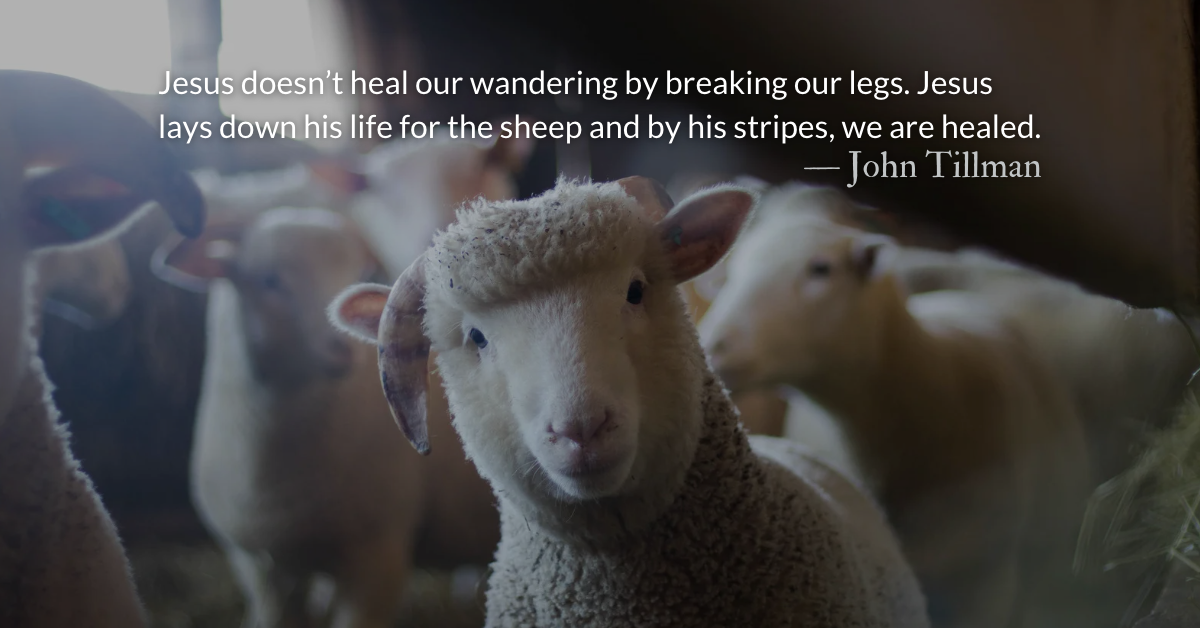
Jesus doesn’t heal our wandering by breaking our legs. Jesus lays down his life for the sheep and by his stripes, we are healed. Jesus’ body is broken for his sheep, and by him we are whole.

You may have been wounded by a foolish or wicked shepherd. But you can still be healed by Jesus, the good shepherd.

Music: “Jesus Is The Great Shepherd” from Live From Lawrence, Kansas (November 1974) by Phil Keaggy and Paul Clark

Divine Hours Prayer: The Greeting
O God, you have taught me since I was young, and to this day I tell of your wonderful works. — Psalm 71.17

– From The Divine Hours: Prayers for Summertime by Phyllis Tickle.

Today’s Readings
1 Samuel 20 (Listen 6:3)
Revelation 1 (Listen 1:51)

Read more about Tendencies of Unfaithful Shepherds
May we, and our shepherds be more like Jesus. May we seek and support earthly shepherds like him.

Read The Bible With Us
It’s never too late to join our Bible reading plan. Immerse in the Bible with us at a sustainable, two-year pace.

https://mailchi.mp/theparkforum/m-f-daily-email-devotional