Getting to the Heart

Scripture: Proverbs 27.19
As water reflects the face,
so one’s life reflects the heart.

Reflection: Getting to the Heart
The Park Forum

Our hearts, like fine instruments, need to be tuned. Proverbs warns, “Keep your heart with all vigilance, for from it flow the springs of life.” This may have been what Jesus was thinking of when he said, “…for out of the overflow of the heart, (the) mouth speaks.” Our heart sets the course for our life. If our heart is envious, entitled, impatient or pleasure-seeking, everything in our life will be marked by these traits.

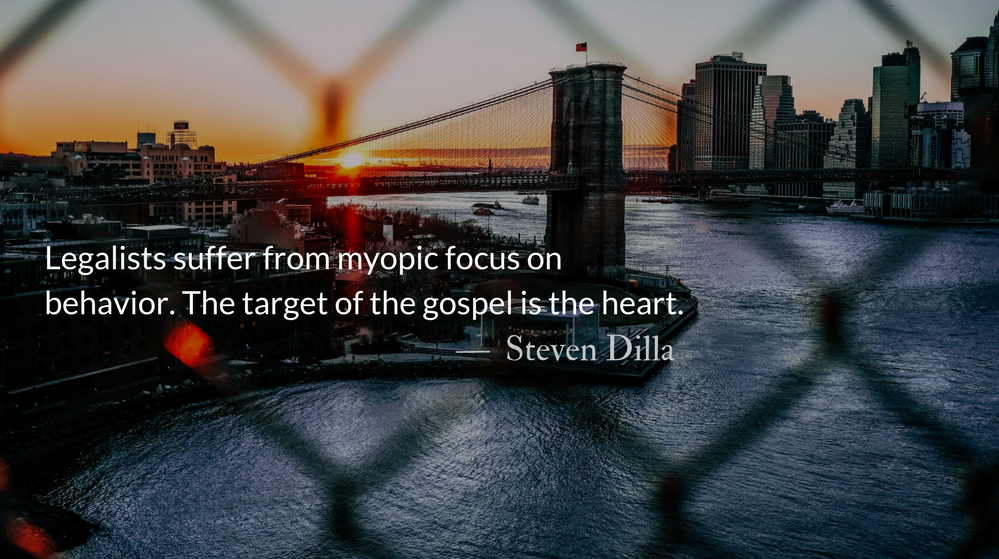
Legalists suffer from myopic focus on behavior. If a person is angry, legalists demand the person control the outputs of anger. Don’t lash out. Pause before you react. In contrast, the target of the gospel is the heart — it address a person’s actions by moving directly to the root.

For example, is a person angry: (1) because he feels superior and sees others as a nuisance, (2) because he lusts for success and lashes out when things get shaky, or (3) because something happened in the past and he now responds disproportionally under the same circumstances.

In the first case, the root of the anger is entitlement — and the root is likely fleshing itself out as he belittles people who work in service positions or spends large amounts of money on things that refine his image. Multiple sins often draw life from the same root.

In the second case, the root is the idol of success. The person might use peers to scrape his way to the top — taking credit for other people’s work and shifting blame for failures. He could also be ignoring relationships that don’t seem to benefit his bottom line.

In the later case, the root of his anger is likely either guilt or bitterness. If the person is full of guilt, he may not have forgiven himself or walked through the necessary steps to seek forgiveness from those he has hurt. If he is bitter it’s possible he is delaying the journey to forgive someone who has hurt him.

When we get to the root issues of the heart we begin discussing motivations rather than just actions. Focusing solely on actions is like a doctor handing throat lozenges to a coughing patient who is really suffering from pneumonia.

In some ways it’s more comfortable to deal exclusively with actions rather than addressing heart issues. After all, if it’s simply an action that’s our core problem, we can often provide the solution on our own — willing ourselves into change.

Seeing God’s grace as the primary means of change doesn’t mean we stop working on our will. True change happens when a person responds with all of their heart, all of their soul, all of their mind and all of their strength. In his book, The Great Omission: Reclaiming Jesus’ Essential Teachings on Discipleship, Dallas Willard clarifies, “Grace is not opposed to effort, it’s opposed to earning.”

In this, we seek to live dedicated lives of faith empowered by the Holy Spirit. After all, what person can change their own heart? Tell two people in love to stop their hearts from loving. Tell an envious person to have a content soul. It can’t happen. When the gospel drives at our heart it takes us beyond our own sufficiency to our need for a Savior—someone who can change our heart.

Prayer: The Call to Prayer
I will lift up my hands to your commandments, and I will meditate on your statutes.” — Psalm 119.48

– Prayer from The Divine Hours: Prayers for Springtime by Phyllis Tickle.

Full prayer available online and in print.

Today’s Readings
Proverbs 27 (Listen – 2:43)
2 Thessalonians 1 (Listen – 1:52)
Strength in Weakness

Scripture: 2 Corinthians 11.29-30
Who is weak, and I do not feel weak? Who is led into sin, and I do not inwardly burn? If I must boast, I will boast of the things that show my weakness.

Reflection: Strength in Weakness
The Park Forum

In this season of reflection we reorient our understanding of Christ’s life—his ongoing sacrifice, pouring himself out from the moment of birth. Dietrich Bonhoeffer writes:

Jesus could have been Lord of this world. As the Messiah the Jews had dreamed of, he could have freed Israel and led it to fame and honor. He is a remarkable man, who is offered dominion over the world even before the beginning of his ministry. And it is even more remarkable that he turns down this offer. He knows that for this dominion he would have to pay a price that is too high for him. It would come at the cost of obedience to God’s will.

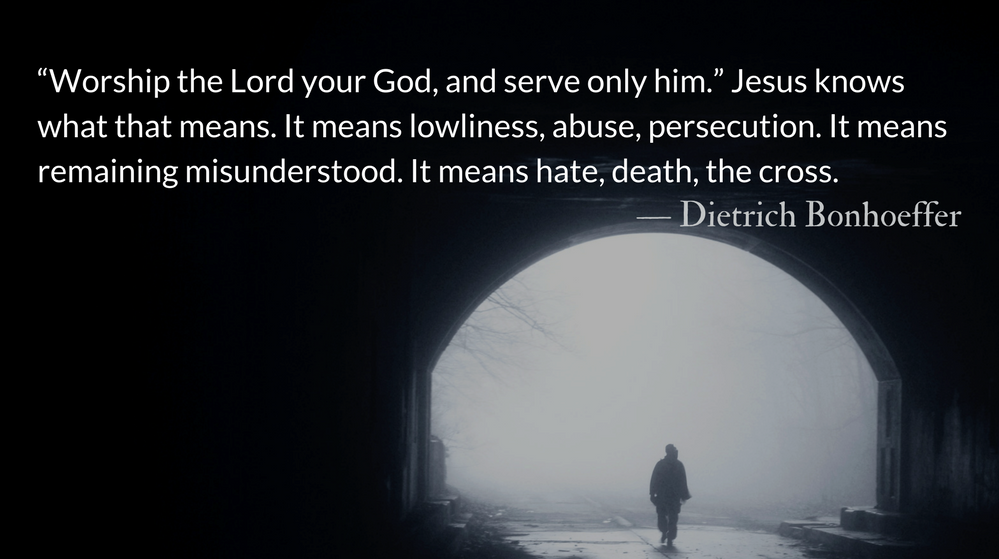
“Worship the Lord your God, and serve only him” (Luke 4:8). Jesus knows what that means. It means lowliness, abuse, persecution. It means remaining misunderstood. It means hate, death, the cross. And he chooses this way from the beginning. It is the way of obedience and the way of freedom, for it is the way of God. And therefore it is also the way of love for human beings.

It is only through the power of God’s Spirit that we are able to embrace the radically sacrificial lifestyle of Christ. Remarkably, no Christian is better than another at doing this—we all fail. We all must cry out for God’s strength. Bonhoeffer is a giant of faith, but he was not exempt from this cry; something we see in his Lenten Prayer:

I Cannot Do This Alone
O God, early in the morning I cry to you.
Help me to pray
And to concentrate my thoughts on you;
I cannot do this alone.
In me there is darkness,
But with you there is light;
I am lonely, but you do not leave me;
I am feeble in heart, but with you there is help;
I am restless, but with you there is peace.
In me there is bitterness, but with you there is patience;
I do not understand your ways,
But you know the way for me….
Restore me to liberty,
And enable me to live now
That I may answer before you and before men.
Lord whatever this day may bring,
Your name be praised.
Amen

Prayer: The Request for Presence
Be my strong rock, a castle to keep me safe; you are my crag and my stronghold. — Psalm 71.3

– Prayer from The Divine Hours: Prayers for Springtime by Phyllis Tickle.

Full prayer available online and in print.

Today’s Readings
Job 41 (Listen – 3:03)
2 Corinthians 11 (Listen – 4:46)

Be Ye Perfect

Scripture: 1 Corinthians 15.10
But by the grace of God I am what I am, and his grace to me was not without effect. No, I worked harder than all of them—yet not I, but the grace of God that was with me.

We referenced this devotional in Monday’s discussion of the compelling Gospel of Billy Graham. It bears repeating. — John

Reflection: Be Ye Perfect
The Park Forum

“Be ye perfect is not idealistic gas,” warns C.S. Lewis. “Nor is it a command to do the impossible. He is going to make us into creatures that can obey that command.” Lewis, after examining how we cling to earthly pursuits, goes on to show how letting them go radically reorients the life of a Christian:

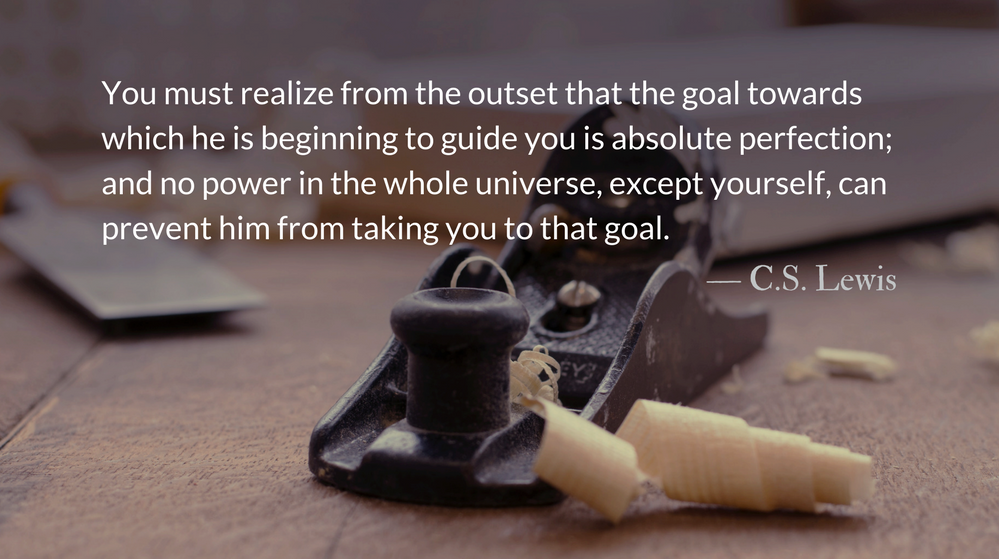
You must realize from the outset that the goal towards which he is beginning to guide you is absolute perfection; and no power in the whole universe, except yourself, can prevent him from taking you to that goal.

Many of us, when Christ has enabled us to overcome one or two sins that were an obvious nuisance, are inclined to feel (though we do not put it into words) that we are now good enough. He has done all we wanted him to do, and we should be obliged if he would now leave us alone. As we say, “I never expected to be a saint, I only wanted to be a decent ordinary chap.” And we imagine when we say this that we are being humble.

The discipleship process, then, is not defined by the Christian, but by the Scriptures, Church, and Paraclete. “The question,” Lewis says, “is not what we intend ourselves to be, but what he intended us to be when he made us.”

Likewise, if the Lenten season is reduced to what we want to gain or lose through fasting we miss the point entirely. Fasting is the process of winnowing the clutches of our flesh so that the glory of God might be fully realized in our appetites, attitudes, and actions. Lewis, imagining the words of Christ, writes:

That is why he warned people to ‘count the cost’ before becoming Christians. “Make no mistake,” he says, “If you let me, I will make you perfect. You have free will and, if you chose, you can push me away. But if you do not push me away, understand that I am going to see this job through. Whatever suffering it may cost you in your earthly life, whatever inconceivable purification it may cost you after death, whatever it costs me, I will never rest, nor let you rest, until you are literally perfect—until my father can say without reservation that he is well pleased with you, as he said he was well pleased with me.”

Prayer: The Morning Psalm
Lord, who may dwell in your tabernacle: Who may abide upon your holy hill? Whoever leads a blameless life and does what is right, who speaks the truth from his heart… — Psalm 15.1-2

– Prayer from The Divine Hours: Prayers for Springtime by Phyllis Tickle.

Full prayer available online and in print.

Today’s Readings
Job 29 (Listen – 2:26)
1 Corinthians 15 (Listen – 8:06)

Learning to Pray

Scripture: Job 21.4
Is my complaint directed to a human being?
Why should I not be impatient?

Reflection: Learning to Pray
The Park Forum

“This is a dangerous error,” warns Dietrich Bonhoeffer, “to imagine that it is natural for the heart to pray.” The great theologian, who lost his life in a Nazi concentration camp in 1945, was no stranger to unanswered prayer. He wrote:

It can become a great torment to want to speak with God and not to be able to do it—having to be speechless before God, sensing that every cry remains enclosed within one’s own self, that heart and mouth speak a perverse language which God does not want to hear.

This may have contributed to the reason Bonhoeffer did not believe it was possible to pray without the power of God:

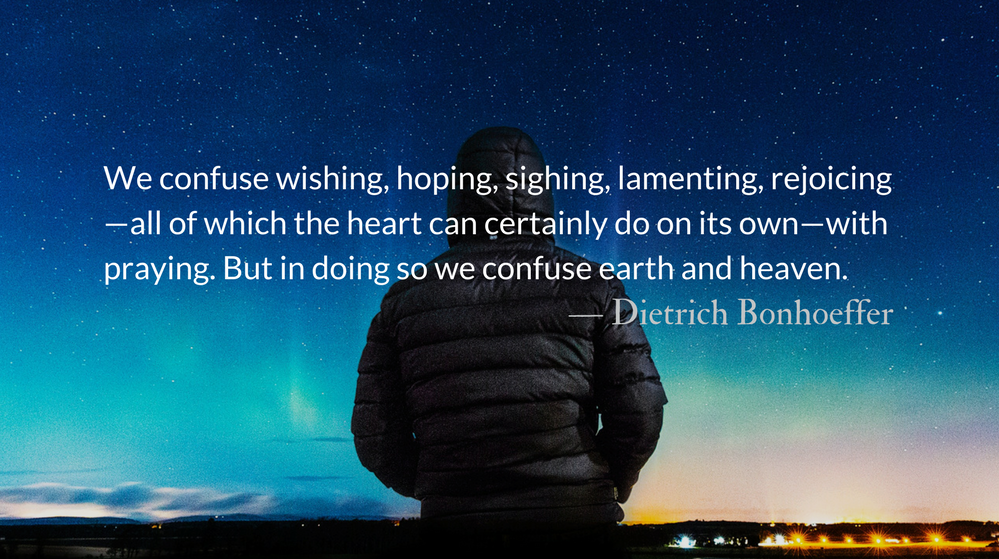
We confuse wishing, hoping, sighing, lamenting, rejoicing—all of which the heart can certainly do on its own—with praying. But in doing so we confuse earth and heaven, human beings and God. Praying certainly does not mean simply pouring out one’s heart. It means, rather, finding the way to and speaking with God, whether the heart is full or empty. No one can do that on one’s own. For that one needs Jesus Christ.

Not wanting “needs Jesus Christ” to devolve into mere platitude, Bonhoeffer explains how to pray the words of God—Scripture—through the power of God—Spirit:

Jesus Christ has brought before God every need, every joy, every thanksgiving, and every hope of humankind. In Jesus’ mouth the human word becomes God’s Word. When we pray along with the prayer of Christ, God’s Word becomes again a human word.

If we want to read and to pray the prayers of the Bible, and especially the Psalms, we must not, therefore, first ask what they have to do with us, but what they have to do with Jesus Christ. We must ask how we can understand the Psalms as God’s Word, and only then can we pray them with Jesus Christ. Thus it does not matter whether the Psalms express exactly what we feel in our heart at the moment we pray.

Perhaps it is precisely the case that we must pray against our own heart in order to pray rightly. It is not just that for which we ourselves want to pray that is important, but that for which God wants us to pray. If we were dependent on ourselves alone, we would probably often pray only the fourth petition of the Lord’s Prayer. But God wants it otherwise. Not the poverty of our heart, but the richness of God’s word, ought to determine our prayer.

Prayer: The Request for Presence
O God of hosts, show the light of your countenance, and we shall be saved. — Psalm 80.7

– Prayer from The Divine Hours: Prayers for Springtime by Phyllis Tickle.

Full prayer available online and in print.

Today’s Readings
Job 21 (Listen – 3:05)
1 Corinthians 8 (Listen – 1:54)

O Holy Night :: Advent’s Peace

On Christmas Eve of 1906 Reginald Fessenden, who had been one of Thomas Edison’s chief chemists, was testing a new generator for radio transmissions. In what became the first broadcast of voice and music over radio, Fessenden read the Christmas story from the gospel of Luke and played the carol “O Holy Night” on his violin. This remarkable entrance into history was not the first, nor the only for this song.

The lyrics to “O Holy Night” came from a French socialist, who penned them for a Catholic service in 1847. The music was written by a Jewish composer. Legend holds that the song brought a 24-hour respite to fighting between French and German troops after being sung from the battlefield on Christmas Eve of 1871. The carol hopped the pond, thanks to the Unitarian minister and abolitionist John Sullivan Dwight, and caught on in the North far more quickly than in the South:

Truly He taught us to love one another;
His law is love and His gospel is peace.
Chains shall He break for the slave is our brother;
And in His name all oppression shall cease.

The only thing more astonishing than the journey of one the most beloved Christmas songs is the event which it celebrates:

Long lay the world in sin and error pining,
‘Til He appear’d and the soul felt its worth.
A thrill of hope the weary world rejoices,
For yonder breaks a new and glorious morn.

How remarkable that in the light of God our soul feels its worth? “God is in the manger, wealth in poverty, light in darkness, succor in abandonment.” remarks Dietrich Bonhoeffer in his book, God is in the Manger. He continues:

And that is the wonder of all wonders, that God loves the lowly. God marches right in. He chooses people as his instruments and performs his wonders where one would least expect them. God is near to lowliness; he loves the lost, the neglected, the unseemly, the excluded, the weak and broken.

The hope, love, joy, and peace of Advent broke into our world on the holiest of nights. Songs about Christ have endured, and changed, history—more importantly the good news of Christ changes our present and future.

ListenO Holy Night by Chris Tomlin (1:29).

The Refrain for the Morning Lessons
Everyone will stand in awe and declare God’s deeds; they will recognize his works. — Psalm 64.9

– From 
Christmastide: Prayers for Advent Through Epiphany from The Divine Hours by Phyllis Tickle.

Full prayer available online and in print.

Today’s Reading
2 Chronicles 26-27 (Listen – 5:28)
Revelation 13 (Listen – 3:20)

This Weekend’s Readings
2 Chronicles 28 (Listen – 4:59) Revelation 14 (Listen – 3:51)
2 Chronicles 29 (Listen – 6:49) Revelation 15 (Listen – 1:29)

Show Buttons
Hide Buttons
Spur a spiritual rhythm of refreshment right in your inbox
By joining this email list you are giving us permission to send you devotional emails each weekday and to communicate occasionally regarding other aspects of the ministry.
100% Privacy. We don't spam.