The Mountain of the Lord

Scripture Focus: Isaiah 2.1-2
1 This is what Isaiah son of Amoz saw concerning Judah and Jerusalem: 
2 In the last days 
the mountain of the Lord’s temple will be established 
as the highest of the mountains; 
it will be exalted above the hills, 
and all nations will stream to it. 
3 Many peoples will come and say, 
“Come, let us go up to the mountain of the Lord, 
to the temple of the God of Jacob. 
He will teach us his ways, 
so that we may walk in his paths.” 
The law will go out from Zion, 
the word of the Lord from Jerusalem.

Music: “Mountains” — Interstellar, by Hans Zimmer

Reflection: The Mountain of the Lord
By John Tillman

Mountains were believed to be places where heaven and earth overlapped or touched. Every religion in the ancient near east put temples on hills. Even if the “temple” was just a hasty shrine under a spreading tree. (2 Kings 17.10; Deuteronomy 12.2) Peter wanted to set one up for Jesus after the Transfiguration. 

If there weren’t grand enough mountains, people built them. Towers, pyramids, and ziggurats reached toward not just the stars but the heavens.

Today, we don’t believe mountains touch heaven. Not exactly. But we do call our towers “skyscrapers” and we come close to worshiping those who dwell or work there. We are not so different from the ancients as we think.

Isaiah foresaw the mountain of God’s temple exalted and “established as the highest of the mountains.” 

Jerusalem is already situated on a high point. Mount Zion’s elevation is 2500 feet. Geographically, however, it is not the highest mountain in the region. It’s neighbor, The Mount of Olives, from which Jesus wept over the city, tops it by 200 feet. 

Is Isaiah speaking of a cataclysmic geological event, raising Zion higher than Everest?

Isaiah is speaking theologically, not geologically, but that does not mean there has not been a cataclysmic event. The cataclysm that overthrew the powers of this world was the cross. (Colossians 2.15) On the cross, Jesus descended to the lowest place and was raised to the highest. Jesus is the mountain, the Temple, that is exalted over all other gods, rulers, and authorities. (Ephesians 1.20–22)We have only a foretaste of Isaiah’s promises. Jesus is exalted, yet we still languish. Humans glorify and enrich themselves through oppression. Powers rule over us. However, Isaiah’s promises will come to fullness. Every human leader holding themselves up for worship will have their legs cut from beneath them. Every oppressor will be thrown down. Every spiritual power will be crushed by the heel of our God.

In many images of the City of God, a river is depicted flowing from the city. In Isaiah we see a stream flowing uphill instead of down. It is a stream of people, from all nations, who are being drawn, against the gravity of this world, to Jesus.

Let our gravity be changed. Let every other “mountain” in our lives, by faith, be cast into the sea as we are drawn up.

“Come. Let us go up to the mountain of the Lord.”


Divine Hours Prayer: The Greeting
I am bound by the vow I made to you, O God; I will present to you thank-offerings;
For you have rescued my soul from death and my feet from stumbling, that I may walk before God in the light of the living. — Psalm 56.11-12


– From The Divine Hours: Prayers for Summertime by Phyllis Tickle.

​Today’s Readings
Isaiah 2 (Listen 3:00)
Psalm 95-96 (Listen 2:37)

​This Weekend’s Readings
Isaiah 3-4 (Listen 4:34), Psalm 97-98 (Listen 2:19)
Isaiah 5 (Listen 4:48), Psalm 99-101 (Listen 2:48)

Read more about The Sin Which Fells Nations
From Isaiah we can learn that what looks like a great and powerful nation may actually be a spiritual wasteland of pride and greed.

Read more about Way of the Cross
How uncomfortable does the suffering servant make you?
Everyone rejected the suffering Christ—even the closest of his disciples.

What About Ahaz?

Scripture Focus: Isaiah 1.4
4 Woe to the sinful nation, 
a people whose guilt is great, 
a brood of evildoers, 
children given to corruption! 
They have forsaken the Lord; 
they have spurned the Holy One of Israel 
and turned their backs on him. 

Reflection: What About Ahaz?
By John Tillman

Verse one of Isaiah tells us he served during the reigns of Uzziah, Jotham, Ahaz, and Hezekiah. Jotham was a good king. Under Uzziah and Hezekiah, Judah thrived militarily and spiritually. Ahaz was the only bad seed. Of him, it was said, “he did not do what was right in the eyes of the Lord his God…” (2 Kings 16.2-4) 

Why does Isaiah open with condemnation of the rebellious nation? Why is Isaiah dragging everyone? What about Ahaz? If we just got rid of Ahaz, wouldn’t everything be okay? Apparently not.

Perhaps when you read about a bad king in the Bible, like Ahaz, you think of a current leader. “If we just got rid of fill-in-the-blank…” I confess that I think of more than one name for that blank, from more than one political party. If I were Isaiah, I’d be tempted to name check people. But Isaiah namechecks the whole nation. “What about you?” he says.

Of course, the removal of wicked leaders is a worthy cause. Prophets, including Isaiah, regularly confronted wicked and errant leaders. (Rabbinic tradition tells us Hezekiah’s son, Manasseh, murdered Isaiah.) But there’s a difference in confronting wicked leaders and pushing off the blame on them. The buck may stop at the president’s desk but sin spends plenty of time on every desk and kitchen table in the country.

The king on the throne of a nation does not determine its righteousness. No matter what king is elevated or deposed, we need to depose sin from the throne of our hearts.

Let us check our own hearts, using Isaiah 1.15-17.

“Your hands are full of blood!”
Are you “clean?”
This blood represents suffering. What suffering have you caused or could have eased?

“…stop doing wrong. Learn to do right…”
Will you repent?
You cannot repent of what you claim is not sin.

“…seek justice.”
Will you seek righteousness?
Righteousness is not forcing others to live in obedience. It is killing your own sinful nature.

“Take up the cause of the fatherless; plead the case of the widow.”
Who will you defend?
Will you take up the cause of the oppressed, even ones who make you uncomfortable?

“Defend the oppressed.”
Who will you correct? 
“Defend the oppressed” can be translated as “correct the oppressor.” Correct those in your circles. Leave others to God.

Before we confront “Ahaz,” be sure we confront ourselves honestly.


Divine Hours Prayer: The Request for Presence
Send out your light and truth, that they may lead me, and bring me to your holy hill and to your dwelling; 
That I may go to the altar of God, to the God of my joy and gladness; and on the harp I will give thanks to you, O God my God. — Psalm 43.3-4


– From The Divine Hours: Prayers for Summertime by Phyllis Tickle.


​Today’s Readings
Isaiah 1 (Listen 4:36)
Psalm 94 (Listen 2:08)

Read more about Wearisome Worship
It is frightening to think that we might trample God’s courts with worship that is annoying to him rather than pleasing.

Read more about Supporting Our Work
Please consider becoming a donor. Support ad-free content that brings biblical devotionals to inboxes across the world.

God’s Feathers

Scripture Focus: Psalm 91
1 Whoever dwells in the shelter of the Most High 
will rest in the shadow of the Almighty. 
2 I will say of the Lord, “He is my refuge and my fortress, 
my God, in whom I trust.” 
3 Surely he will save you 
from the fowler’s snare 
and from the deadly pestilence. 
4 He will cover you with his feathers, 
and under his wings you will find refuge; 
his faithfulness will be your shield and rampart. 
5 You will not fear the terror of night, 
nor the arrow that flies by day, 
6 nor the pestilence that stalks in the darkness, 
nor the plague that destroys at midday. 
7 A thousand may fall at your side, 
ten thousand at your right hand, 
but it will not come near you. 
8 You will only observe with your eyes 
and see the punishment of the wicked. 
9 If you say, “The Lord is my refuge,” 
and you make the Most High your dwelling, 
10 no harm will overtake you, 
no disaster will come near your tent. 
11 For he will command his angels concerning you 
to guard you in all your ways; 
12 they will lift you up in their hands, 
so that you will not strike your foot against a stone. 
13 You will tread on the lion and the cobra; 
you will trample the great lion and the serpent. 
14 “Because he loves me,” says the Lord, “I will rescue him; 
I will protect him, for he acknowledges my name. 
15 He will call on me, and I will answer him; 
I will be with him in trouble, 
I will deliver him and honor him. 
16 With long life I will satisfy him 
and show him my salvation.” 

Reflection: God’s Feathers
By John Tillman

Even in our relatively comfortable lives today, we have parallels to the dangers the psalmist fears.

We fear snares, traps, scams, and conspiracies. We fear terrors of darkness and unknown enemies and dangers. We fear pestilences, plagues, and illnesses that can strike early or late in life. We know of weapons that fly overhead and are more deadly than arrows. We know of enemies and armies that can swarm around us to harass and attack us both online and in real life.

The psalmist portrays humans as fragile, vulnerable, and defenseless birds. We are easily ensnared by grift, infected by filth, or broken by force. 

Birds are dual symbols in scripture. Many times, they symbolize helplessness, struggle, and chaos. Fluttering flocks are metaphors of panic, terror, and fright in the face of danger. When sheltered in trees or craggy rocks, birds represent the poor and oppressed. Jesus described birds as relying on God and as being cared for despite their low monetary value.

Other times, birds symbolize power, freedom, and protection. God and the living creatures that surround his throne are associated with birds, feathers, and flight. God carries his people on eagle’s wings and empowers them to soar on wings of their own. (Exodus 19.4; Isaiah 40.31) In this psalm, God is a protective bird. We are covered in God’s feathers. God’s wings are our refuge.

In his commentary, Federico Villanueva says, “In Asia and Africa, Psalm 91 has been used as a kind of magic charm…on amulets and inscribed on buildings.” It’s not hard to see why. The psalm makes some of the most explicit claims of protection in the Bible. Who would not want to lay claim to such bold promises?

Scripture is not magic, and it is a snare to think that it is. Satan spoke of Psalm 91 as magical protection to tempt Jesus. But the psalm also promises that Satan, who is the snake, the fowler, and the roaring lion, will be trampled. 

Carving scripture onto an amulet or a building is educational but not protective. However, carving it into our hearts brings change. Through scripture, make God your shelter and dwelling. 

When we dwell in his shelter, fragile as we are, we are shielded in God’s feathers. Powerless as we are, we fly towards God’s purposes. Foolish as we are, God’s wisdom keeps us from the snares of the fowler.


Divine Hours Prayer: The Refrain for the Morning Lessons
Wake up, my spirit; awake, lute and harp: I myself will waken the dawn. — Psalm 108.2


– From The Divine Hours: Prayers for Summertime by Phyllis Tickle.


​Today’s Readings
Malachi 3 (Listen 3:13)
Psalm 91 (Listen 1:39)

Read more about Quotations from the Desert
Satan quotes Ps 91…stops before the verse about him: “You will…trample the…serpent.” He is speaking to the one destined to do the trampling.

Read more about Bearing Reproach
Mary was slandered as a prostitute. We must not be surprised at our mistreatment as the Lord’s messengers

A Broken Rebel’s Prayer

Scripture Focus: Psalm 90
A prayer of Moses the man of God. 
1 Lord, you have been our dwelling place 
throughout all generations. 
2 Before the mountains were born 
or you brought forth the whole world, 
from everlasting to everlasting you are God. 
3 You turn people back to dust, 
saying, “Return to dust, you mortals.” 
4 A thousand years in your sight 
are like a day that has just gone by, 
or like a watch in the night. 
5 Yet you sweep people away in the sleep of death— 
they are like the new grass of the morning: 
6 In the morning it springs up new, 
but by evening it is dry and withered. 
7 We are consumed by your anger 
and terrified by your indignation. 
8 You have set our iniquities before you, 
our secret sins in the light of your presence. 
9 All our days pass away under your wrath; 
we finish our years with a moan. 
10 Our days may come to seventy years, 
or eighty, if our strength endures; 
yet the best of them are but trouble and sorrow, 
for they quickly pass, and we fly away. 
11 If only we knew the power of your anger! 
Your wrath is as great as the fear that is your due. 
12 Teach us to number our days, 
that we may gain a heart of wisdom. 
13 Relent, Lord! How long will it be? 
Have compassion on your servants. 
14 Satisfy us in the morning with your unfailing love, 
that we may sing for joy and be glad all our days. 
15 Make us glad for as many days as you have afflicted us, 
for as many years as we have seen trouble. 
16 May your deeds be shown to your servants, 
your splendor to their children. 
17 May the favor of the Lord our God rest on us; 
establish the work of our hands for us— 
yes, establish the work of our hands.

Reflection: A Broken Rebel’s Prayer
By John Tillman

Psalm 90, the prayer of Moses, is the prayer of a broken rebel, humbled and wise, relying on God.

Moses was a rebel from the beginning. Born illegally, the state condemned him to death from birth. Secreted into the wicked king’s palace as a child, he grew up like a sleeper agent. His family did this for his safety but also must have hoped that their little rebel, like a well-slung stone, might take down the oppressive giant.

Instead, he fails miserably. Commits murder. Gets caught. Flees for his life. Marries foreigners. Has uncircumcised children. He stutters. He hesitates. He hides. Yet, God speaks directly to him and does wonders before his eyes. But, despite the burning bush and the voice of God and all those miracles, Moses still says, “Please send someone else.”

Who better to emulate in prayer than a man this broken, purposeless, ashamed, and fearful? Through prayer, Moses became a different kind of man. He became a man used for God’s purposes, breaking the might of a national superpower. He became a man of humility instead of shame. He became a man who stood his ground in faith rather than fleeing in fear.

A Broken Rebel’s Prayer
Lord, whether in a precariously floating basket, a gleaming palace, or a desert lit by burning bushes, you are the source of our life.

All our strivings are pointless before you.
You are the better dwelling place we long for.
Everything we hope for is in you.
We dwell enslaved to our brokenness, our shame, and our fear.
We return to the dust with you as our only hope.

Lord, you see thousands of years like a day and our lives like a blink of an eye.
Help us live our brief lives wisely, with your righteous wrath and merciful love before our eyes.

Have compassion on us, Lord, weak as we are.
Help us praise you with our faltering voices,
Raise our unworthy hands to see you win what our rebellions never could.

Let us pursue your power for your purposes.
Let us release our shame and stand before you in humility.
Let us stand our ground defending the weak with faith that seas will part and armies will fall without striking a blow against us.

Establish your work through our hands and speak your words through our voices.


Divine Hours Prayer: The Request for Presence
Lord, God of hosts, hear my prayer; hearken, O God of Jacob. — Psalm 84.7


– From The Divine Hours: Prayers for Summertime by Phyllis Tickle.


​Today’s Readings
Malachi 2 (Listen 3:12)
Psalm 90 (Listen 2:03)

Read more about Outward-Focused Rhythms
Instead of focusing mostly on activities that are forms of self-investment, practicing daily rhythms that are rooted in Christ can take us beyond ourselves.

Read more about Offal Leaders
God smeared their faces with offal, but some keep trying to wipe it off and pretend nothing is wrong.

Our Immovable Rock

Scripture Focus: Zechariah 12.3
3 On that day, when all the nations of the earth are gathered against her, I will make Jerusalem an immovable rock for all the nations. All who try to move it will injure themselves.

Luke 21.5-11
5 Some of his disciples were remarking about how the temple was adorned with beautiful stones and with gifts dedicated to God. But Jesus said, 6 “As for what you see here, the time will come when not one stone will be left on another; every one of them will be thrown down.” 
7 “Teacher,” they asked, “when will these things happen? And what will be the sign that they are about to take place?” 
8 He replied: “Watch out that you are not deceived. For many will come in my name, claiming, ‘I am he,’ and, ‘The time is near.’ Do not follow them. 9 When you hear of wars and uprisings, do not be frightened. These things must happen first, but the end will not come right away.” 
10 Then he said to them: “Nation will rise against nation, and kingdom against kingdom. 11 There will be great earthquakes, famines and pestilences in various places, and fearful events and great signs from heaven. 

Reflection: Our Immovable Rock
By John Tillman

Zechariah spoke to those who had gone through exile and captivity. They knew what it meant for armies to gather, the city to fall, and the walls to be destroyed and burned. They heard their parents’ tales and tasted the fear and uncertainty. God’s words reassured these people that, in the future, no gathering of armies will be able to overcome Jerusalem, the shelter of his people.

Jesus spoke to his disciples, suffering under Roman occupation and puppet kings like Herod. Herod was “king”, but all were forced to say “Caesar is Lord.” They longed for liberation.

The Temple Zechariah knew was renovated and expanded by Herod. The disciples were impressed with the stonework in Herod’s expansion. If they had read Zechariah’s words at that moment, they would probably have thought that they were living in the time of their fulfillment. We know they expected Jesus to become king. We can easily imagine that they hoped to see Jerusalem become the immovable rock that Rome and every other enemy would break themselves against.

But instead of speaking of armies breaking against Jerusalem, Jesus spoke of Jerusalem being broken. Even the Temple’s impressive stones would be cast down, not one of them left on another.

Eschatological anxiety has waxed and waned in my lifetime. It’s easy for us to go to extremes on this issue. Some panic that the end is near and then, when it seems delayed, lose faith. Some throw their hands up in cynical doubt that the day will ever come. Some seek to bring the day to pass by taking the reins of power into their own hands. They long to build whatever kingdom they can using hastily baptized political power.

Christ told his followers to not be easily taken in by messianic movements. He warned them against fear and reactionary haste and encouraged patience.

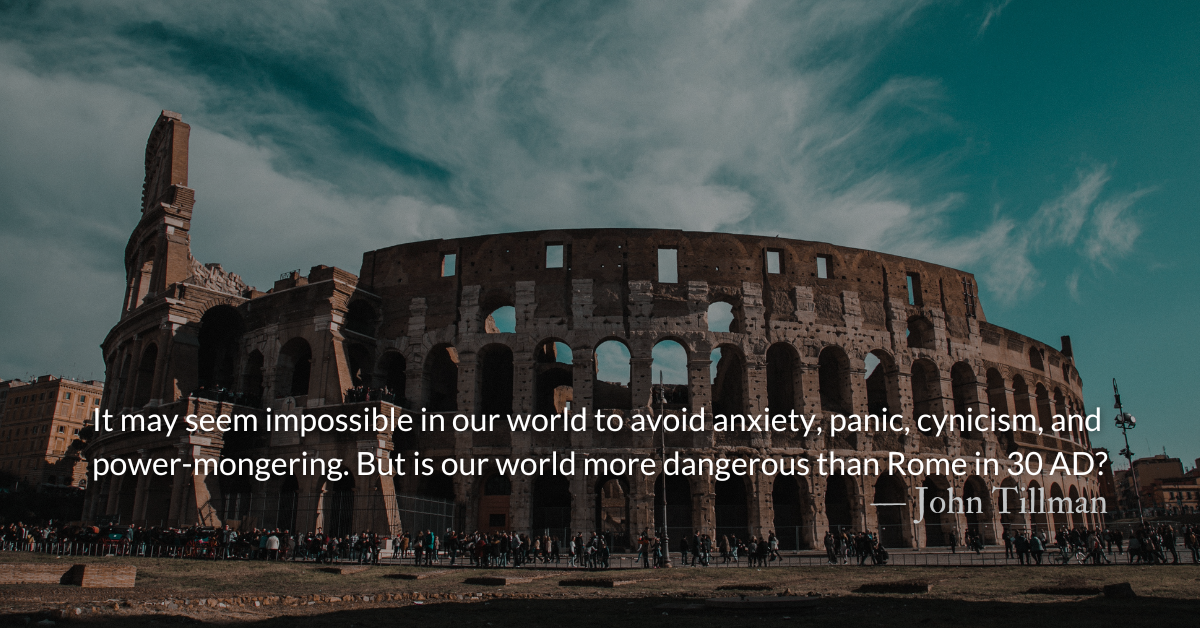
It may seem impossible in our world to avoid anxiety, panic, cynicism, and power-mongering. But is our world more dangerous than Rome in 30 AD?

“Do” is easier than “Don’t.” Instead of thinking, “Don’t be anxious,” concentrate on resting in Jesus. Resist panic by resting in hope. Wrestle in prayer rather than for power. What Christ will establish will not depend on our power or wisdom but on his.

Remember that our immovable rock is not an institution, movement, country, or leader. Jesus is our immovable rock.

Divine Hours Prayer: The Greeting
The Lord lives! Blessed is my Rock! Exalted is the God of my salvation! — Psalm 18.46


– From The Divine Hours: Prayers for Summertime by Phyllis Tickle.

​Today’s Readings
Zechariah 12-13.1 (Listen 2:30)
Luke 21 (Listen 4:18)

Read more about Fasting Uncovers Our Hearts
If all we get from fasting is a measurable, earthly ROI, we will be unlikely to reap a spiritual benefit.

Read The Bible With Us
Our two-year Bible reading plan encourages moments of reflection at a sustainable pace. It’s never too late to join.

https://mailchi.mp/theparkforum/m-f-daily-email-devotional

Show Buttons
Hide Buttons
Spur a spiritual rhythm of refreshment right in your inbox
By joining this email list you are giving us permission to send you devotional emails each weekday and to communicate occasionally regarding other aspects of the ministry.
100% Privacy. We don't spam.