Water of Cleansing

Scripture Focus: Numbers 19.1-8
1 Tell the Israelites to bring you a red heifer without defect or blemish and that has never been under a yoke. 3 Give it to Eleazar the priest; it is to be taken outside the camp and slaughtered in his presence. 4 Then Eleazar the priest is to take some of its blood on his finger and sprinkle it seven times toward the front of the tent of meeting. 5 While he watches, the heifer is to be burned—its hide, flesh, blood and intestines. 6 The priest is to take some cedar wood, hyssop and scarlet wool and throw them onto the burning heifer. 7 After that, the priest must wash his clothes and bathe himself with water. He may then come into the camp, but he will be ceremonially unclean till evening. 8 The man who burns it must also wash his clothes and bathe with water, and he too will be unclean till evening. 

Reflection: Water of Cleansing
By John Tillman

The water of cleansing required extraordinarily detailed criteria for the sacrifice which specified both gender and color. The ashes from this sacrifice were used to make “water of cleansing”. Whenever someone became unclean for any reason, a ritual using the water of cleansing could restore them to a state of ritual cleanliness.

One of the unique aspects of the making of the water of cleansing was that in the process of making it, the priest himself became unclean. Only by allowing himself to become unclean, could the priest carry out the rituals needed to cleanse others.

We sometimes equate being unclean with committing sin. There were sins that made one unclean, but there were also many normal parts of life which could make one unclean. 

Uncleanness was not necessarily a penalty for sinning, but a reminder that sin existed amidst the harsh realities of the world. People became unclean by simply living life in a world in which death happened, for example. Mourning a relative who died would involve becoming unclean by touching and tending to the dead body. Joseph and Nicodemus and the women who attended to the body of Jesus all became ritually unclean. 

Laws around ritual purity also reminded the Israelites that they were a unique and special people called to live in a unique degree of holiness.

Similarly, we are called to a unique degree of holiness, yet, there are harsh realities of life that make us unclean. We live in a world in which death happens and injustice, greed, and lust lay waste. We cannot go about our lives without being touched and made unclean by their destruction.

We, however, do not make our own water of cleansing. Our high priest, Jesus, supplies it for us through his sacrifice. He fulfilled all the requirements. He met all the criteria. He allowed himself to become defiled so that we could be made clean. Through confession and prayer, we can be cleansed daily from the uncleanness of our world.

Through our witness, our actions to aid our community, and through speaking the truth in love, we can offer those living in our unclean world the cleansing water of the gospel. From our eternal High Priest, Jesus, we have an eternal supply of the water of cleansing. Let us put it to use for our own cleansing and that of those around us.

Divine Hours Prayer: The Call to Prayer
Let my mouth be full of your praise and your glory all the day long. — Psalm 71.8

– Divine Hours prayers from The Divine Hours: Prayers for Springtime by Phyllis Tickle

Today’s Readings
Numbers 19 (Listen – 3:39)
Psalm 56-57 (Listen – 3:11)

Read more about Artful Prayers
One of the reasons that the psalms are so engaging to any reader of God’s Word is that they are works of art.

Read more about A High Priest Like No Other
Our great high priest Jesus has provided each of us with access to God’s throne of grace in any time of need.

Prayer Is Our Tent of Meeting

Scripture Focus: Psalm 42.2
2 My soul thirsts for God, for the living God. 
When can I go and meet with God? 

Numbers 7.89
89 When Moses entered the tent of meeting to speak with the Lord, he heard the voice speaking to him from between the two cherubim above the atonement cover on the ark of the covenant law. In this way the Lord spoke to him.

From John: Our church has a common saying, a mantra, “Prayer precedes power.” This power implies that there is action to be carried out. As discussed in this post from 2019, in prayer, we are preparing to act.

Reflection: Prayer Is Our Tent of Meeting
By John Tillman

In today’s reading from Numbers, we get a description of Moses talking with God in the Tent of Meeting. The Tent of meeting described here is not the first tent of meeting, but the one that replaced it, in the newly finished tabernacle. There in the Holy of Holies, Moses hears the voice of God from between the cherubim above the place of atonement.

Scripture tells us that the conversations of Moses with God were intimate. God spoke to Moses as a man speaks to his friend. But this communication was not only personal—it was communal.

Moses entering the Tent of Meeting was a communitywide event. When Moses entered, the entire community would come and stand at the entrances to their own tents as Moses spoke with God on their behalf.

The design of the Tabernacle and the Tent of Meeting was a tool for community prayer and connection. Prayer—even individual prayer—is an act of community, because God is a God of community.

At the center of this community are the symbols of the atonement that God has set in motion. It is through the atonement that Moses heard God’s voice. The voice from between the cherubim came from the spot where the blood of the atonement sacrifices were placed by the high priest.

For us, prayer is our tent of meeting, where the deepest thirsts of our souls may be satisfied. When we pray as Jesus taught, we enter into God’s presence through the torn curtain of the Tent of Meeting, and hear his voice because of his atoning sacrifice.

Next week, on Thursday, The United States will observe a National Day of Prayer. As you pray this weekend and next week, be reminded that you are entering the tent of meeting in priestly capacity and carry the ability to bring before God the sins and concerns of your nation.

May we all be empowered to pray beyond a personal conversation and approach God on behalf of our communities and our world.

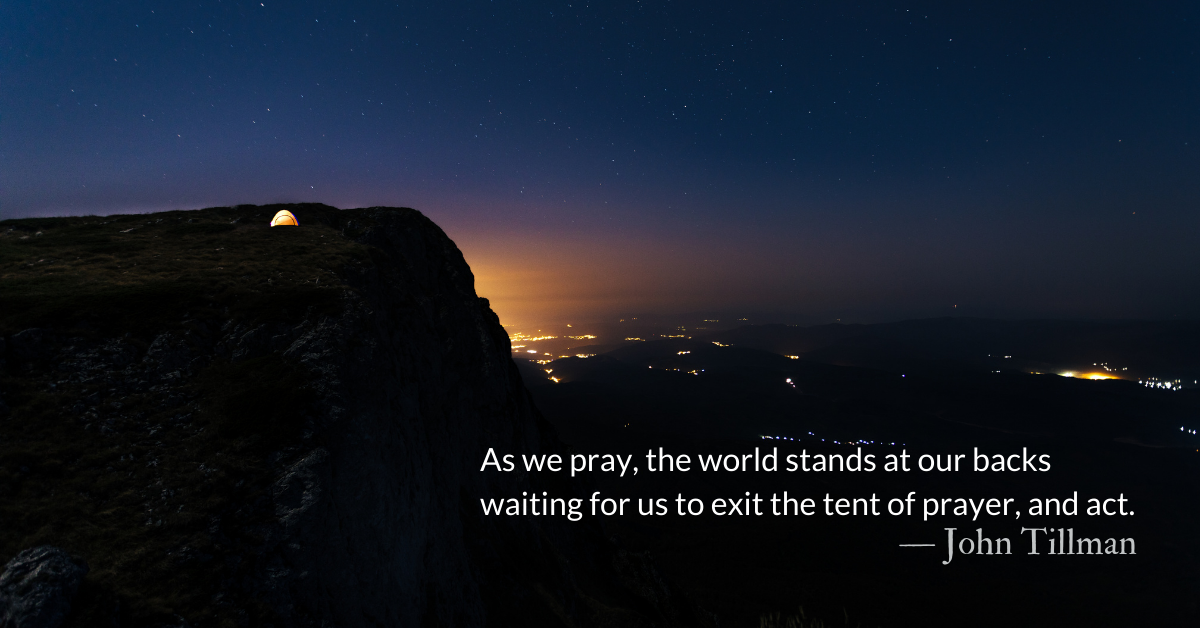
Like Moses, we approach prayer as an individual, speaking to God through the atoning sacrifice of Christ. But we bring with us all the concerns and cares of our communities and our world. As we pray, the world stands at our backs waiting for us to exit the tent of prayer, and act.

Divine Hours Prayer: The Request for Presence
I call with my whole heart; answer me, O Lord, that I may keep your statues. — Psalm 119.145

– Divine Hours prayers from The Divine Hours: Prayers for Springtime by Phyllis Tickle

Today’s Readings
Numbers 7 (Listen – 12:50)
Psalms 42-43 (Listen – 2:32)

This Weekend’s Readings
Numbers 8 (Listen – 3:27), Psalms 44 (Listen – 2:44)
Numbers 9 (Listen – 3:20), Psalms 45 (Listen – 2:17)

Read more about Maintaining Sacred Space
Prayer, Bible reading, meditation, intercession, are our tabernacle walls, frames, and sacred tools.

Read more about Unveiled
Seek regular and deep intimacy with God through prayer and the scriptures…then, let us walk through our world alight with his love.

Praying Priestly Blessings

Scripture Focus: Numbers 6.22-27
22 The Lord said to Moses, 23 “Tell Aaron and his sons, ‘This is how you are to bless the Israelites. Say to them: 
24 “ ‘ “The Lord bless you 
and keep you; 
25 the Lord make his face shine on you 
and be gracious to you; 
26 the Lord turn his face toward you 
and give you peace.” ’ 
27 “So they will put my name on the Israelites, and I will bless them.”

From John: How deeply our world needs us to step into our role as priests and speak, act, and walk in ways that bless our world. We look back, today, at this rewrite of the Aaronic blessing from 2019.

Reflection: Praying Priestly Blessings
By John Tillman

Through the Aaronic blessing, God puts his name—his identity—on the Israelites. As followers of God today, a part of our identity is as carriers of the blessings of God that are intended for the world.

One of the primary purposes of humanity, upheld throughout the entirety of scripture, is being a blessing to others.

Adam and Eve’s charge was to cultivate and spread God’s blessings.
Abraham was called to bless all people through his offspring.
Through Moses, God began building a nation intended to share with the world the blessings of God’s wisdom and justice.
Sounding over and over within the societal laws of Israel is a drumbeat of blessing and caring for others, even foreigners, as members of one’s family.
The prophets, time and time again, spoke of spreading God’s blessings and the light of truth to the gentile nations.
Gabriel’s annunciation of Christ’s birth and Mary’s song about it later both put at center stage blessings for all of humanity.

Blessing others is a baked-in quality of the Imago Dei in all people. When we refuse to bless others, we are shoveling dirt over the image of God in us, burying our treasure in the ground and refusing to invest it out of selfishness and fear.

Only in Christ, however, can that Imago Dei be brought fully to life and empowered by the presence of the Holy Spirit. Then, blessing others may go beyond simple kindness as we take on our role as a royal priesthood.

Just as the family of Aaron were priests under Aaron, we are priests under Jesus, our high priest. We are charged, as the Aaronic priests were charged, to pronounce God’s blessing.

If we were to rewrite the Aaronic blessing for Christ’s order of priests, using images and teachings from Jesus, to put his identity on us, it might look something like this:

Like a mother tending to her children,
A shepherd tending sheep,
Or a gardener cultivating a garden,
May our Father bless and protect you.
May our Father’s eyes shine on you
Delighting in you as his child, showing you grace and love.
May our Father’s face be raised to you,
Welcoming you in his presence, bringing you peace.

Through this blessing, God puts his name, his identity, on those who will accept it. May we pronounce this priestly blessing not with words alone, but in how we live and walk through our world.

Music:The UK Blessing” — Churches from all across the UK sing “The Blessing” over their country.

Divine Hours Prayer: Refrain for the Morning Lessons
Blessed is he who comes in the name of the Lord; we bless you from the house of the Lord. — Psalm 118.26

– Divine Hours prayers from The Divine Hours: Prayers for Springtime by Phyllis Tickle

Today’s Readings
Numbers 6 (Listen – 4:04)
Psalms 40-41 (Listen – 3:54)

Read more about Becoming a Blessing
From Abram, you made a great nation
Through Abram, you promised to bless the nations
Make us, O Lord, a blessing in our nations

Read more about Identity Lost, Identity Gained
God, our father, is greater and more loving than Isaac…No one who comes to him will need cry, “Do you have only one blessing, my father?”

https://theparkforum.org/843-acres/identity-lost-identity-gained/

Are There Ashtrays in Your Elevators?

Scripture Focus: Numbers 5.5-8
5 The Lord said to Moses, 6 “Say to the Israelites: ‘Any man or woman who wrongs another in any way and so is unfaithful to the Lord is guilty 7 and must confess the sin they have committed. They must make full restitution for the wrong they have done, add a fifth of the value to it and give it all to the person they have wronged. 8 But if that person has no close relative to whom restitution can be made for the wrong, the restitution belongs to the Lord and must be given to the priest, along with the ram with which atonement is made for the wrongdoer.

Reflection: Are There Ashtrays in Your Elevators?
By John Tillman

God’s law is clear. Harming others is sin against God. There is no way in which a person can be harmed that is not connected to sin. Thinking about systemic sin and harm to others always reminds me of ashtrays in elevators. 

If you happen to see an ashtray in an elevator, I’d recommend taking the stairs. That elevator is old.

When smoking was viewed as innocuous, even healthful, it was incorporated into every aspect of life. From the 60s to the 80s, ashtrays were a ubiquitous normality of architecture and design. They appeared on every surface like not-so-secret compartments with nifty little sliding, rotating, or opening panels. Like light switches, they were built into the walls of hallways, offices, and hospital rooms. They were in desks and bathroom stalls and above every urinal. Some cars had more ashtrays than seatbelts. Airlines installed them in armrests both in terminals and in planes. But most memorable to me, for some reason, were the ones in elevators. Not even for the brief time of riding in an elevator, could people do without an ashtray.

Even as society realized that smoking was literally killing people, this didn’t change. We clung to personal freedom in defiance of scientific revelations. It was only when we recognized that cigarette smoke was not only harmful to the smoker but to everyone else in the elevators and other public spaces, that smoking “rights” began to be curtailed.

Is smoking a sin? Perhaps. But sin is absolutely like smoking. 

In the individualistic West, we think of sin mostly as personal choices that only affect the individual. However, there are no sins that only harm ourselves. Sin is not just what happens inside our minds, souls, or bodies. Sin creates a transcendent cloud of tangible and intangible damage. This damage may be physical, economic, or cultural. Sin poisons everyone in our atmosphere.

Like ashtrays in elevators, there are always systemic, tangible, widespread, societal enablements of sins, especially if we think of them as innocuous. Let’s examine ourselves with sober judgment.

Are there ashtrays in your elevators? What in your life indicates an enabling of sin?
What sins do you think of as innocuous? Are you using personal freedom as an excuse for actions which harm others?
What harm to others do you need to repent of? What support structures of sins need to be ripped out of the walls of your life?

Divine Hours Prayer: The Refrain for the Morning Lessons
The Lord is near to those who call upon him, to all who call upon him faithfully. — Psalm 145.19

– Divine Hours prayers from The Divine Hours: Prayers for Springtime by Phyllis Tickle

Today’s Readings
Numbers 5 (Listen – 4:39)
Psalms 39 (Listen – 1:49)

Read more about Steeped In Sin
Sin is gravity. It is our atmosphere. It is our water. We are radioactive with sin.

Read more about Suffering and Sin
We feel less responsible when we believe only the lazy are poor, only the promiscuous are in danger of sexual assault, only hedonists become addicts, and only nihilists suffer depression.

Maintaining Sacred Space

Scripture Focus: Numbers 4.47-49
47 All the men from thirty to fifty years of age who came to do the work of serving and carrying the tent of meeting 48 numbered 8,580. 49 At the Lord’s command through Moses, each was assigned his work and told what to carry. 

Reflection: Maintaining Sacred Space
By John Tillman

All across the United States, and in places around the world, God’s people worship in rented or temporary spaces. They worship under the open sky. They worship in tents. They worship in rented theaters, schools, or hotel conference rooms. They worship in private residences.

Church workers and volunteers in these mobile churches can uniquely identify with the tasks described in preparing the Tabernacle to move to a new place. The tools and equipment related to each other are packed up together. You’ll never have to go looking for batteries for the lapel microphones, because they are packed in the storage tub with the microphones. You’ll never have to look for a mallet to stake down a welcome tent, because it is packed in with the stakes and the tent.

This labor may seem at first to be all a matter of having a strong back, stout limbs, and a careful checklist. However, like the work done by the tribes who packed and carried the Tabernacle, this work is holy work which makes holy space for people to encounter a holy God.

The Tabernacle is made after the pattern of the heavenly Temple which Moses sees on the mountain. It is filled with artwork representing it as an artificial Garden of Eden where God once again meets with humans. Making sacred space where humans and God can interact is a priestly duty. It is also one each believer bears today.

Our bodies are our “tents” into which we invite the Holy Spirit of God, promised to us by Jesus. They are temporary, holy vessels in which we are united in Christ and united to God. Peter calls the church a Temple of living stones. Paul calls us members of the body of Christ.

Through spiritual disciplines and practices, we maintain and carry with us sacred space. Prayer, Bible reading, meditation, intercession, are our tabernacle walls, frames, and sacred tools. We can access this sacred space wherever we go. In our priestly role, we can invite others into this sacred space as well, allowing them to encounter and experience God through us.

How are you preparing to make sacred space for yourself? In your schedule? In your home? In your work life?

How are you preparing to make sacred space for others, inviting them to encounter God through you?

Divine Hours Prayer: A Reading
Jesus said: “In all truth I tell you, whoever welcomes the one I send, welcomes me, and whoever welcomes me, welcomes the one who sent me.” — John 13.20

– Divine Hours prayers from The Divine Hours: Prayers for Springtime by Phyllis Tickle

Today’s Readings
Numbers 4 (Listen – 6:11)
Psalms 38 (Listen – 2:14)

Read more about Christ our Temple, River, and City
Christ himself is our temple. He is the gate, the doorway, through which we enter to worship.

Read more about Intimidating, Liberating Glory
We have the accounts of those who touched with their hands and saw with their eyes the tender, loving, human tabernacle of Jesus.

Show Buttons
Hide Buttons
Spur a spiritual rhythm of refreshment right in your inbox
By joining this email list you are giving us permission to send you devotional emails each weekday and to communicate occasionally regarding other aspects of the ministry.
100% Privacy. We don't spam.