Of Temples and Gardens

Scripture Focus: 1 Kings 7.51
51 When all the work King Solomon had done for the temple of the Lord was finished, he brought in the things his father David had dedicated—the silver and gold and the furnishings—and he placed them in the treasuries of the Lord’s temple.

Reflection: Of Temples and Gardens
By John Tillman

Gardens are places where nature is maximized and brought to greater, more ordered, and more beautiful potential.

Gardens and parks are places to meet with God. They are places of planting and of sacrifice. The Tabernacle, Solomon’s Temple, and other biblical Temples mimic and recreate the imagery of Eden’s garden. The Temple was a structure of worship, a physical liturgy that, when followed, allowed the worshiper to return to the relationship of the garden and walk with God.

The theme of gardens runs strongly throughout the scriptures.

Humanity first dwelt with God in a garden, maintaining and co-managing the garden with God. When that relationship was fractured by sin, we found ourselves excluded from the garden, unworthy to tend it or eat its fruits. The first sacrifice happened in the garden when God killed a creature to clothe humanity, covering our nakedness.

Noah began reestablishing the post-flood world by planting a vineyard, a specialized garden. In the psalms and prophets, God referred to Israel as his garden, his vineyard. Jesus amplified this imagery in his most direct (and offensive) parable against the religious leaders. He cast them as the unworthy tenants of God’s vineyard who would be cast out and killed by God the landowner.

The first drops of Christ’s propitiating blood fell in the Garden of Gethsemane. The Lamb of God began to bleed there amongst the wooded garden—the first pressing of the salvific work to come.

Jesus cared deeply about the Temple (risking death by cleansing it) yet he told the woman at Sychar that soon, it would not matter whether she worshiped on her own mountain or in Jerusalem.

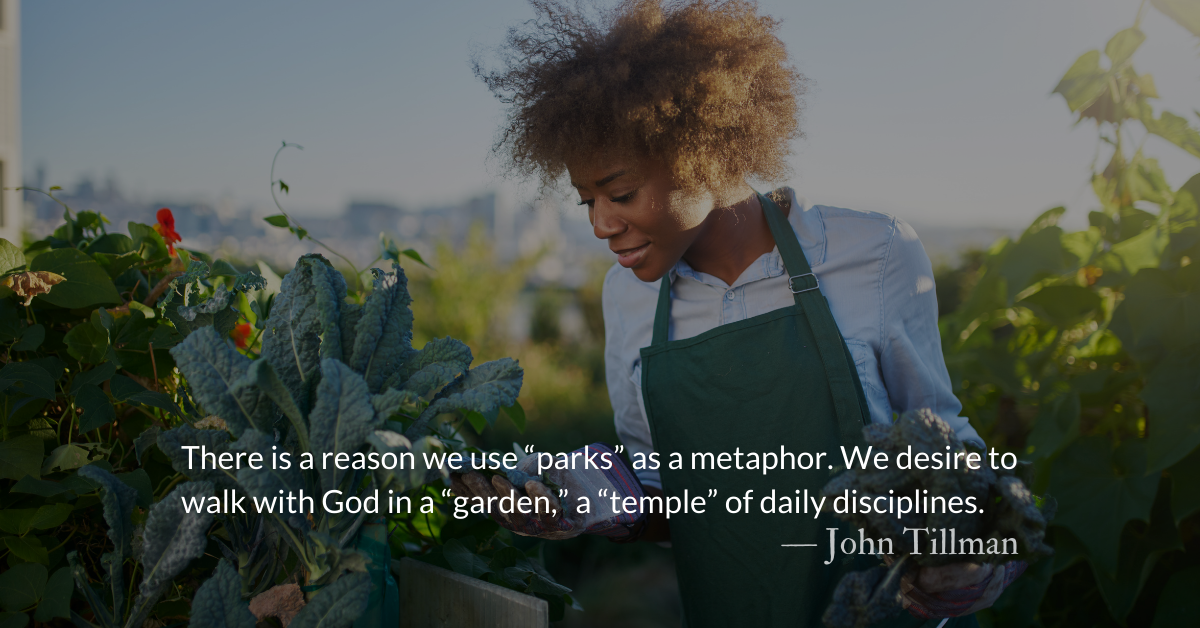
That time is now. We worship not in golden colonnades, with bronze basins of water, or the blood of animals. We worship, if we do so correctly, in spirit and in truth. There is a reason we use “parks” as a metaphor. We desire to walk with God in a “garden,” a “temple” of daily disciplines.

What does the garden of your worship look like? What are you planting in your garden, with faith that God will cause gospel seeds to grow?

What is your daily liturgy? What value have you placed in your temple that reminds you to value your relationship with God? How are you decorating your worship to make it attractive and remind you of God’s blessing?

Divine Hours Prayer: The Refrain for the Morning Lessons
The heaven of heavens is the Lord’s, but he entrusted the earth to its peoples. — Psalm 115.16

– From The Divine Hours: Prayers for Summertime by Phyllis Tickle.

Today’s Readings
1 Kings 7 (Listen – 5:10)
Ephesians 4 (Listen – 2:41)

Read more about Seeking After a Seeking God
He will meet with us in a corrupted Temple, as he met with Isaiah.

Read more about Cultivation Leads to Harvest
Cultivation leads to harvest. Harvests, when shared, lead to celebration.


Seeking After a Seeking God

Scripture Focus: 1 Kings 3.3-4
3 Solomon showed his love for the Lord by walking according to the instructions given him by his father David, except that he offered sacrifices and burned incense on the high places. 4 The king went to Gibeon to offer sacrifices, for that was the most important high place, and Solomon offered a thousand burnt offerings on that altar.

From John: Many have wondered over this long period of pandemic if our worship of God would suffer from fewer physical gatherings. As we look back at this post from 2019, we remember and reassure ourselves that God is a seeking God—seeking those who worship in spirit and in truth. Whether our buildings have been open physically is less important than whether our hearts have been open spiritually. Wherever we truly seek him, there we will be found by him. May he continue to give us wisdom.

Reflection: Seeking After a Seeking God
By John Tillman

People in scripture often worshiped God wherever they happened to be and God accepted them. But the “high places” in Israel were different. They were pagan sites of worship before the Israelites conquered the land. 

Israel drove out most idol worship but some still survived. Joshua warned the people of “traps and snares” saying that these practices would be “whips for your backs and thorns for your eyes.” Worship at “high places” was expressly forbidden by God, because God knew that the old, cultic practices would return to pollute and subvert true worship. 

However, people in Solomon’s day still worshiped at these places. The worship of God in Israel at this time was scattered. This was partly for convenience. People could worship near their homes rather than traveling to Jerusalem. But it also had to do with tradition and an emotional and cultural connection to these locations. 

David had taken the Ark of the Covenant to Jerusalem and set up a tent for it there in anticipation of the Temple being built. But the tent of meeting constructed by Moses was still at Gibeon. Possibly what made Gibeon the “most important” high place was the emotional, traditional, and historical connection to Moses. This empty tent, filled only with nostalgia, remained in use as a place of worship and is where God spoke to Solomon. 

James tells us that God grants wisdom to all, without finding fault, and that includes young king Solomon who asked for wisdom even while unwisely worshiping God at a questionable place. God will do the same for us. 

God, throughout the scriptures, is a God who seeks. God, of course, desires us to seek him “while he may be found” and to seek him in his Temple. We should care deeply about worshiping in ways that are proper and biblical. But because God is a seeking God, he is always ready to meet us where we are. 

He will meet us in hiding in the wilderness, as he met with David.
He will meet us wrapped in nostalgia, as he met with Solomon.
He will meet with us singing new songs, as he met with Asaph.
He will meet with us in a corrupted Temple, as he met with Isaiah.
He will meet with us in a corrupted land, as he met with the woman at the well in Sychar.
Wherever and however we draw near to God, he will draw near to us.

Divine Hours Prayer: A Reading
Philip said, “Lord, show us the Father and then we shall be satisfied.” Jesus said to him, “Have I been with you all this time, Philip, and you still do not know me? Anyone who has seen me has seen the Father, so how can you say, ‘Show us the Father’? Do you not believe that I am in the Father and the Father is in me? What I say to you I do not speak of my own accord: it is the Father, living in me, who is doing his works.” — John 14.8-11

– From The Divine Hours: Prayers for Summertime by Phyllis Tickle.

Today’s Readings
1 Kings 3 (Listen – 4:29)
Ephesians 1 (Listen – 3:10)

This Weekend’s Readings
1 Kings 4-5 (Listen – 7:21), Ephesians 2 (Listen – 3:04)
1 Kings 6 (Listen – 5:10), Ephesians 3 (Listen – 2:41)

Read more about Take Up Your Mat
Jesus sought us out when we were paralyzed and deformed by sin…He still seeks us out. To warn us, to call us to continued repentance, to transform our lives.

Read more about Hope on a Limb
We can be assured as we stand on Zacchaeus’s hope-filled Sycamore limb, that the King of Glory we hope for will not pass us by.

When Grace Surrenders to Self-Protection

Scripture Focus: 1 Kings 2.8-9
8 “‘When he came down to meet me at the Jordan, I swore to him by the Lord: ‘I will not put you to death by the sword.’ 9 But now, do not consider him innocent. You are a man of wisdom; you will know what to do to him. Bring his gray head down to the grave in blood.”

Reflection: When Grace Surrenders to Self-Protection
By John Tillman

Many parents leave their children valuable possessions and wisdom. Some leave only bad debts and inherited controversies. David left Solomon a mix of things, including a hit list of enemies to wipe out.

David’s final instructions to Solomon show us the limits of David’s human grace. In the past few chapters, David has seemed magnanimous, humble, forgiving, and gracious, however, his deathbed speech sounds hurt, petty, vindictive. Many people forgiven by David during his lifetime would soon find out that the grace extended to them died with the king. 

There were good and practical reasons for David’s hit list. David was being protective. Solomon was young and would be seen as weak. He was not the oldest son, and by legal tradition was ineligible to inherit. He was also a child of controversy. David took Solomon’s mother, Bathsheba, as his wife after the state-sanctioned murder of her husband.

Perhaps David was just being practical, reasonable, and protective of his son and God’s kingdom. However, in his attempts to protect Solomon from Joab and other dangerous men, David nudged Solomon towards becoming like Joab. Practical, reasonable, and protective Joab was meticulous about killing others before they killed him or potentially David. 

Solomon would become renowned for wisdom, but the first signs of his wisdom were his shrewd arrangements of the murders advised by his father. Where Joab made politically necessary murders without David’s explicit approval, Solomon gave Benaiah direct orders for all three of these killings. Adonijah, Joab, and Shimei all fell to Solomon’s sword. 

Practicality and self-preservation don’t automatically lead to good things. These kinds of things often earn a rebuke from Christ.
Peter striking and taking off the ear of Malchus was protective. 
The disciples’ concern about not having bread in the boat was reasonable.
The marketplace set up in the Temple was practical.

Are we more like David or like Christ? Do we have human, David-like grace? Or do we have divine, Jesus-like grace?

The grace of king David died with him. 
The grace of Christ lives on with him. It should also live on within us.

May we learn to extend Christ’s undying grace past the limits of our own.

Divine Hours Prayer: The Refrain for the Morning Lessons
Blessed are they which do hunger and thirst after righteousness; for they shall be filled. — Matthew 5:6

– From The Divine Hours: Prayers for Summertime by Phyllis Tickle.

Today’s Readings
1 Kings 2 (Listen – 7:45)
Galatians 6 (Listen – 2:18)

Read more about Grasping for Mercy
We reach out to grasp the edges of mercy. Through Jesus, forgiveness is at our fingertips..through Christ, we are healed by faith

https://theparkforum.org/843-acres/grasping-for-mercy

Read more about Grace Displaces Retribution

The kind of humility and gracious forgiveness often shown by David is as greatly out of place today as it was in his own time.

The Superior Bravery of Tenderness

Scripture Focus: 2 Samuel 23.13-17
13 During harvest time, three of the thirty chief warriors came down to David at the cave of Adullam, while a band of Philistines was encamped in the Valley of Rephaim. 14 At that time David was in the stronghold, and the Philistine garrison was at Bethlehem. 15 David longed for water and said, “Oh, that someone would get me a drink of water from the well near the gate of Bethlehem!” 16 So the three mighty warriors broke through the Philistine lines, drew water from the well near the gate of Bethlehem and carried it back to David. But he refused to drink it; instead, he poured it out before the Lord. 17 “Far be it from me, Lord, to do this!” he said. “Is it not the blood of men who went at the risk of their lives?” And David would not drink it.

Such were the exploits of the three mighty warriors.

Reflection: The Superior Bravery of Tenderness
By John Tillman

There are many bad spiritual takeaways from these “Mighty Men” passages. The especially damaging ones attempt to “baptize” men’s sinful, violent tendencies as being honorable and desirable spiritual qualities.

Many years ago, a friend from seminary and a member of a ministry team we served on, Bill, had cancer. Despite fervent prayer for a miracle of healing, the cancer worsened.

As the end neared, Bill’s father approached me with a request. Men were being asked to sign up to stay overnight in the hospital with Bill. I was warned that it would be unpleasant duty and many had turned it down. Metastasizing cancer and multiple organ failure does frightful things to the human body. Those who stayed overnight handled intimate needs for Bill. We helped him face grim tasks of maintenance that were better done by a friend or with a friend present. Some did not have the stomach to face what needed to be faced.

Later, at Bill’s funeral, his father approached me. He handed me a gift inscribed with a message referencing this passage and thanking me for being one of Bill’s “mighty men.” There were thirty of us. I will never forget the honor.

To be certain, it takes courage to face hundreds of enemies alone in a field of lentils (2 Samuel 23.11-14), or a lion in a pit on a snowy day (2 Samuel 23.20). I take nothing away from the valor of such deeds. But I challenge you that there is superior bravery that men need, especially men who wish to follow Christ. It takes bravery beyond what many men can muster to be tender, merciful, and kind. 

If you can swing a sword until your hand freezes to it, but you cannot wipe away another’s tears and unashamedly shed your own, you lack a vital component of godliness. If you would give your body to be burned, but have not love…you are nothing. (1 Corinthians 13.3)

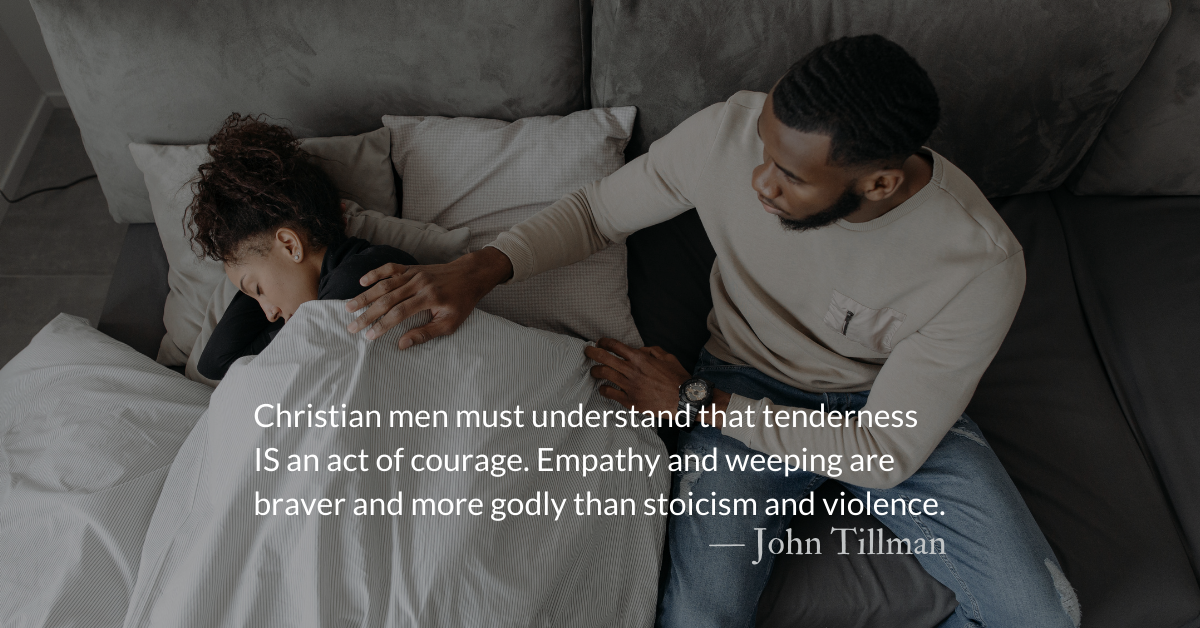
Men who follow Christ, the suffering servant, would be better men if they were mighty in tenderness and mighty in care. Christian men must understand that tenderness IS an act of courage. Empathy and weeping are braver and more godly than stoicism and violence.

Empires need men who swing a sword. God’s Kingdom needs men who gently care for the weak. Tenderness and care are Jesus-like masculinity, and show the image of God to a greater degree than any act of violence.

From John: Just a little additional insight from behind the scenes. Every day we post, I look for an image that will help carry the message and go well with the pull quote and storyline. Some days are more of a success and some are a struggle. This weekend, looking for an image with a man in a role of tenderness, I scrolled through hundreds of photos using the search terms “tenderness,” “kindness,” “caring,” etc. and could barely find any “tender” or “kind” images of men that were not “man with a romantic partner,” “man with a child,” or “man in a professional role of caring,” such as a doctor or nurse. It speaks volumes about what our society thinks of men that in photos intended for marketing/blogging, etc, we have so few images of men being tender if it isn’t their job, their kids, or their romantic partner. Men, even if the world doesn’t expect tenderness of you, being a representative of Christ demands it of you.

Divine Hours Prayer:
Bless the Lord all you angels of his, you mighty ones who do his bidding, and hearken to the voice of his word.
Bless the Lord, all you his hosts, you ministers of his who do his will.
Bless the Lord, all you works of his, in all places of his dominion… — Psalm 103.20-22

– From The Divine Hours: Prayers for Summertime by Phyllis Tickle.

Today’s Readings
2 Samuel 23 (Listen – 5:38)
Galatians 3 (Listen – 4:39)

Read more about The Law that leads to Grace
Whatever form of moralism we seek to add to grace is a failure of faith, doubting the value of Christ’s sacrifice on the cross.

Read more about Not So Random Acts of Kindness
Jesus is a greater king than David, never failing to minister to those in need.

Tribalism and Insurrection

Scripture Focus: 2 Samuel 20.8-10
8 While they were at the great rock in Gibeon, Amasa came to meet them. Joab was wearing his military tunic, and strapped over it at his waist was a belt with a dagger in its sheath. As he stepped forward, it dropped out of its sheath. 

9 Joab said to Amasa, “How are you, my brother?” Then Joab took Amasa by the beard with his right hand to kiss him. 10 Amasa was not on his guard against the dagger in Joab’s hand, and Joab plunged it into his belly, and his intestines spilled out on the ground. Without being stabbed again, Amasa died. Then Joab and his brother Abishai pursued Sheba son of Bikri. 

2 Corinthians 13.10-12
10 This is why I write these things when I am absent, that when I come I may not have to be harsh in my use of authority—the authority the Lord gave me for building you up, not for tearing you down. 
11 Finally, brothers and sisters, rejoice! Strive for full restoration, encourage one another, be of one mind, live in peace. And the God of love and peace will be with you. 
12 Greet one another with a holy kiss.

Reflection: Tribalism and Insurrection
By John Tillman

Sheba’s insurrection was an opportunistic power grab. Sheba was mad that someone from his tribe wasn’t still in charge. So he said loudly of David, “Not my king!” (Sounds eerily familiar…)

Sheba belittled David by calling him “Jesse’s son” and played into familial hatreds and inter-tribal bitterness that still was problematic between Saul’s tribe, the Benjamites, and David. Initially, eleven of the twelve tribes followed him.

David’s kingdom was politically and militarily precarious. David’s new general, Amasa, was the former general of Absalom’s rebellion. David’s choice of Amasa may have been a sly political move, but it failed. 

Amasa fails to gather troops and stop Sheba and the Bible is unclear on why. David feared that Sheba would escape to a fortified town and, because of Amasa’s delay, that is exactly what happened. It seems likely Amasa’s delay was purposeful. This is why David felt the need to put his trust back in the “Sons of Zeruiah.”

Joab certainly treats Amasa as if he was a threat, but Joab treats everyone that way. Was Joab dispensing justice to a traitor or simply murdering his rival? It’s probably both. 

Given time, Sheba’s rebellion could have grown, but the insurrection finally ended because of the words of a wise woman. The wise woman of Abel, with her diplomacy, bravery, and wisdom brought an end to Joab’s campaign and Sheba’s insurrection. 

We should all be wary of those, like Sheba, more loyal to their tribe than to God’s kingdom. Divisive leaders appeal to our tribal instincts and desire for power. They belittle opponents and call for conflict and conquest. This can happen in countries, in denominations, and in churches. 

It is difficult to make peace with insurrectionists. They aren’t interested. In a world fluent in violence, when we speak of peace, it is “an unknown tongue.” Being a peacemaker may sometimes mean silencing or excluding those who only want war. But with God’s grace, may we take our cue more from Paul, than from Joab. 

Joab uses a kiss as an opportunity to knife Amasa in the belly. From a worldly perspective, Joab’s way seems like the only way. With a holy kiss, Paul encourages us to strive for full restoration. This may be something that, humanly speaking, seems impossible. However, with God all things are possible. May we learn to follow Paul’s “more excellent way” and replace retribution with grace.

Divine Hours Prayer: The Refrain for the Morning Lessons
I sought the Lord, and he answered me and delivered me out of all my terror. — Psalm 34.4

– From The Divine Hours: Prayers for Summertime by Phyllis Tickle.

Today’s Readings
2 Samuel 20 (Listen – 4:51)
2 Corinthians 13 (Listen – 2:19)

This Weekend’s Readings
2 Samuel 21 (Listen – 4:34), Galatians 1 (Listen – 3:05)
2 Samuel 22 (Listen – 5:22), Galatians 2 (Listen – 3:44)

Read more about Grace Displaces Retribution
The kind of humility and gracious forgiveness often shown by David is as greatly out of place today as it was in his own time.

Read more about Dealing with Joab
When I was a younger man, I admired Joab. I thought Joab saved David. I was wrong.

Show Buttons
Hide Buttons
Spur a spiritual rhythm of refreshment right in your inbox
By joining this email list you are giving us permission to send you devotional emails each weekday and to communicate occasionally regarding other aspects of the ministry.
100% Privacy. We don't spam.