Prayer for Outcasts—Readers’ Choice

Readers’ Choice Month:
This September, The Park Forum is looking back on readers’ selections of our most meaningful and helpful devotionals from the past 12 months. Thank you for your readership. This month is all about hearing from you. Submit a Readers’ Choice post today.

Today’s post was originally published, on March 8, 2022, based on Proverbs 27.8 and Leviticus 19.34.
It was selected by reader, David: 
“Amen, Thank you for this reminder of what our call is.  We can all pray.”

Scripture Focus: Proverbs 27.8
8 Like a bird that flees its nest
is anyone who flees from home.

Leviticus 19.34
34 The foreigner residing among you must be treated as your native-born. Love them as yourself, for you were foreigners in Egypt. I am the Lord your God.

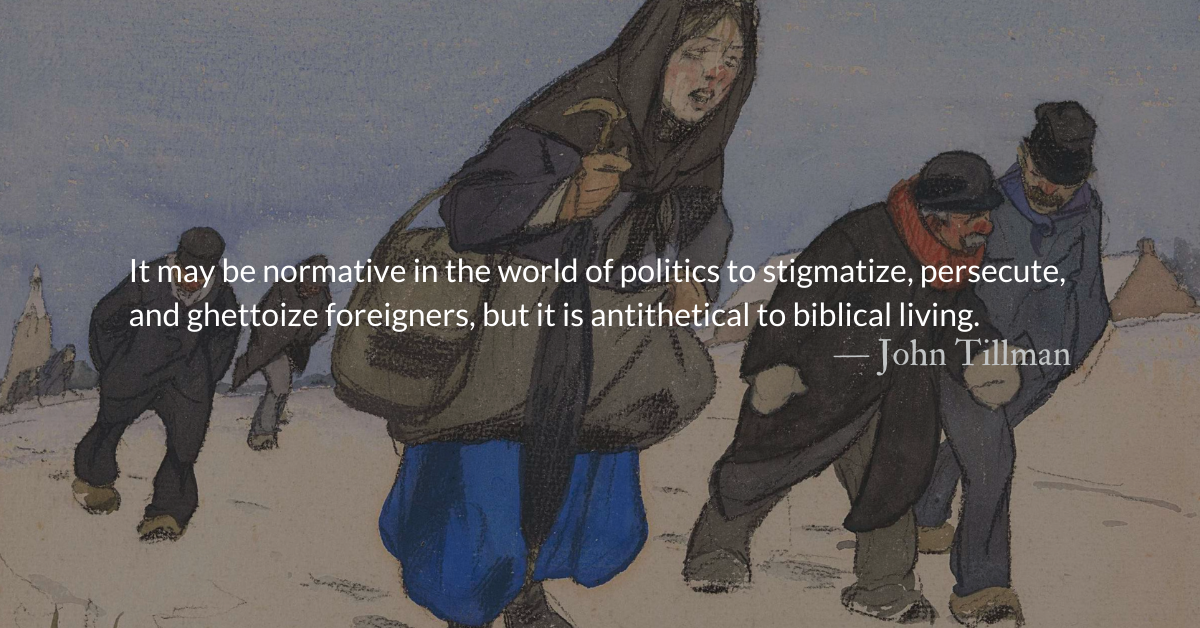
Image: Today’s image comes from the painting, War Refugees in the Snow by Alfred Ost, painted in 1914.

Reflection: Prayer for Outcasts—Readers’ Choice
By John Tillman

There have been many crises in history that have caused waves of migrants, refugees, and immigrants to flee their homes.

Some of the largest refugee movements in history happened during World War II when from 1939 to 1959 approximately 20 million people fled Europe. Our current decade, however, has nearly matched that 20-year stretch. Approximately 17.8 million refugees have fled Ukraine, Myanmar, Venezuela, Syria, South Sudan, and Libya, since 2011.

Refugee crises will continue to grow as nations and prideful leaders continue to choose violence.

Welcoming the stranger is a consistent command throughout the Bible. One must work hard not to pick up on it, but some do go out of their way to avoid it. It may be normative in the world of politics to stigmatize, persecute, and ghettoize foreigners, but it is antithetical to biblical living.

Welcoming the stranger is counter-cultural, not only today but in its original context. The evil treatment Israel received in Egypt is the experience God holds up as the source of his commands to welcome and treat well strangers and foreigners. “As Egypt was, you must not be. As you were treated, you must never allow others to be treated. Do unto others as you would wish they had done to your ancestors.” (Exodus 22.21; Leviticus 19.33-34; Deuteronomy 10.18-19)

In reflection on the continuation of the Ukrainian war, the widening flow of refugees, and a sobering awareness that this conflict has the potential to encompass other countries, we pause today to pray for migrants, immigrants, and refugees.

Prayer for Outcasts
Lord, we pray, today, for those who flee. Aid their flight.
May they avoid danger, escaping the fowler’s snare.
May they find fair winds, lifting their wings and spirits.
May they settle among the branches of the righteous who are like trees, providing healing for the nations.

We pray for those who are called by God to welcome them.
May our hearts overflow with the love of God for his children
May our eyes see the image of God in each face
May rivers of living water flow from our hearts that will satisfy, not just their physical needs, but their needs for emotional shelter, food, and healing.

When they flee violence, let us show gentleness.
When they flee hatred, let us show love.
When they flee scarcity, let us sate them.
When they flee abuse, let us console them.
When they flee oppression, let us free them.

Music: “God Help the Outcasts” — Hunchback of Notre Dame

Divine Hours Prayer: The Call to Prayer
God has gone up with a shout, the Lord with the sound of the ram’s horn.
Sing praises to God, sing praises; sing praises to our King, sing praises.
For God is King of all the earth; sing praises with all your skill.
God reigns over the nations; God sits upon his holy throne. — Psalm 47.5-8

– From The Divine Hours: Prayers for Summertime by Phyllis Tickle.

Today’s Readings
Lamentations 2 (Listen 4:55) 
2 Corinthians 13 (Listen 2:19)

Readers’ Choice is Here!
Your recommended posts from the last 12 months have blessed us! Which one helped you overcome fear?

Read more about Abandon Human Vengeance
The tactics of human vengeance are escalatory. We always hit back harder than we were struck.
The Sins Behind Sexual Sins—Readers’ Choice

Readers’ Choice Month:
This September, The Park Forum is looking back on readers’ selections of our most meaningful and helpful devotionals from the past 12 months. Thank you for your readership. This month is all about hearing from you. Submit a Readers’ Choice post today.

Today’s post was originally published, on October 30, 2020, based on Hosea 4.1-3
It was selected by reader, Casey.

Scripture Focus: Hosea 4.1-3
1 Hear the word of the Lord, you Israelites,
because the Lord has a charge to bring
against you who live in the land:
“There is no faithfulness, no love,
no acknowledgment of God in the land.
2 There is only cursing, lying and murder,
stealing and adultery;
they break all bounds,
and bloodshed follows bloodshed.
3 Because of this the land dries up,
and all who live in it waste away;
the beasts of the field, the birds in the sky
and the fish in the sea are swept away.

Reflection: The Sins Behind Sexual Sins—Readers’ Choice
By John Tillman

Gomer’s sexual sins of prostitution and adultery were not just an analogy for idolatry. The people of God were metaphorically and literally committing adultery and participating in prostitution as part of worshiping Ba’al. However, idolatry doesn’t have to involve sexual sin to cause similar damage.

When we read about sexual sins in the Bible, we need to take care not to automatically think of sexual sin as the only sin involved. Sometimes sexual sin is also a symptom or a tool of other sins.

The entire point of worshiping a fertility god or goddess in an agrarian economy is financial blessing. The sin behind the sexual sin was a desire to manipulate the economy. The blessing to be expected from Ba’al was a higher ROI.

Sex to gain power is a sin of lust, but it is a lust for power not for flesh. Sex in exchange for money or influence, likewise, is a sinful means to a sinful end. Sex to display power, such as rape or sexual harassment and abuse, is a sin of domination and control.

People commit today the exact same kind of sins as the Israelites who worshiped Ba’al in pursuit of better crops. When we are willing to kiss any ring, shake any hand, or endorse any person in order to gain power, get elected, make a deal, cut out a competitor, or monopolize an earning opportunity we are prostituting ourselves in lust whether or not there is sex involved. The Israelites attributed their profits and success to their efforts in worshiping Ba’al. We attribute our success to our “pulling ourselves up by our bootstraps.” It is the same sin of idolatry with a different object. 

Many times sexual sins are a symptom of other sins such as greed, selfishness, inequality, and oppression. Prostitution, adultery, and other sexual sins rise with poverty rates because the sins of greed and oppression create the circumstances under which women resort to prostitution and men seek dominance and control.

May we confess and weep over all our lusts, not just lusts of the flesh.
May we weep for our greed.
May we cry to be delivered from selfishness.
May we ache for healing for our addiction to power.
May we humble ourselves in repentance from our pride.
And, yes, may we turn in faithfulness toward a biblical sexual ethic that divorces sex from the abuses of sin.

Divine Hours Prayer: The Call to Prayer
Bless the Lord, you angels of his, you mighty ones who do his bidding, and hearken to the voice of his word.
Bless the Lord, all you his hosts, you ministers of his who do his will.
Bless the Lord, all you works of his, in all places of his dominion… — Psalm 103.20-22

– From The Divine Hours: Prayers for Summertime by Phyllis Tickle.

Today’s Readings
Lamentations 1 (Listen 4:44) 
2 Corinthians 12 (Listen 3:54)

Readers’ Choice is Here!
Thanks for sharing with us your recommended posts from the last 12 months. We always enjoy hearing from you!

Read more about Prayers God Hates
The sin at the top of God’s list isn’t adultery or any sexual sin…it is systemic oppression of the most vulnerable members of society.

Clear the Old Growth—Readers’ Choice

Readers’ Choice Month:
This September, The Park Forum is looking back on readers’ selections of our most meaningful and helpful devotionals from the past 12 months. Thank you for your readership. This month is all about hearing from you. Submit a Readers’ Choice post today.

Today’s post was originally published, on June 14, 2022, based on Isaiah 10.33-34 and Matthew 3.10b
It was selected by reader, Brad, from Texas: 
“I found this devotional poetically crafted and incredibly dense with meaning: turning our impossibly sized enemies over to God, trusting Him to deal with them as we remain steadfast in our trust and devotion to the many dimensions of God-honoring character.”

Scripture Focus: Isaiah 10.33-34
33 See, the Lord, the Lord Almighty,
will lop off the boughs with great power.
The lofty trees will be felled,
the tall ones will be brought low.
34 He will cut down the forest thickets with an ax;
Lebanon will fall before the Mighty One.

Matthew 3.10b
10b Every tree that does not produce good fruit will be cut down and thrown into the fire.

Reflection: Clear the Old Growth—Readers’ Choice
By John Tillman

I worked, for a few weeks, as a lumber surveyor’s assistant in the piney woods of East Texas.

I would drive a stake in the ground and then plow as straight a path as possible along a compass heading, dragging a long, smooth strip of hard plastic, called a “chain.” I wasn’t to turn to the left or the right. Unless it was impossible, I had to push straight through brush, bushes, or thorns.

The surveyor would step on the chain to stop me when the tape reached the stake. Then, I would drive another stake and wait. By tugging on the chain, he would signal me to continue straight or turn 90 degrees left or right. In this way, we marked off squares of wooded land, and calculated the value of its trees based on the ratio of “quality” trees to trees that were not useful or valuable.

In Macbeth, the wicked-hearted king is given a prophecy that he cannot be defeated until Birnam Wood comes to Dunsinane. Macbeth assumes he is invincible. For when does a wood travel?

Similarly, Assyria grew overconfident. Sennacherib knew God’s word well enough to twist its meaning in his threats to Jerusalem, yet he had no respect for God. He thought he was a god and all other gods were idols. He expected to overwhelm Jerusalem as easily as Samaria. Sennacherib’s army was an impossible, forest-like foe, covering the ground and overwhelming the land.

The foes we face don’t determine our fate. Like Hezekiah, we can turn them over to God. Isaiah promised that the Assyrian army would be cut down in a day. The “lofty” and “tall” trees would fall before God’s ax. 

In the ancient near east, trees were valuable and important—especially the highly valued cedars of Lebanon. Yet no earthly value or importance will stop God’s judgment. God’s ax “is already at the root of the trees.” (Matthew 3.10)

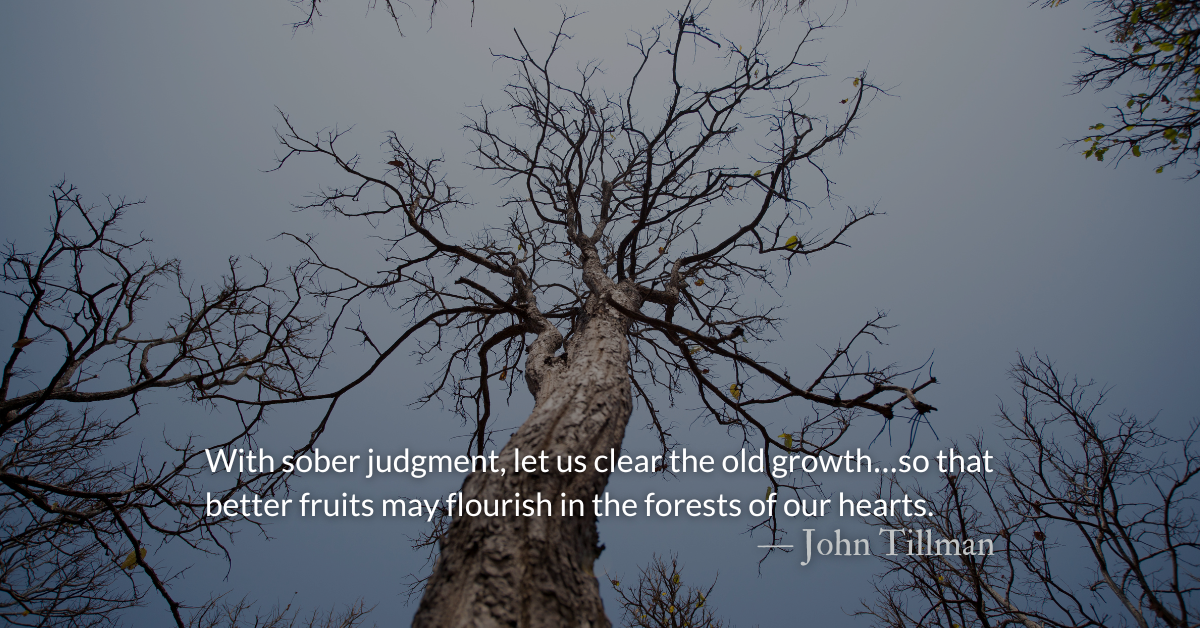
Instead of focusing on outward enemies we have little control over, let us survey our inner forest and the foes we find there. With sober judgment, let us clear the old growth, turning neither to the left nor the right, cutting down pride, selfishness, hatred, fear, greed, and lusts so that better fruits may flourish in the forests of our hearts.

“Every tree that does not produce good fruit will be cut down and thrown into the fire.”

Divine Hours Prayer: The Refrain for the Morning Lessons
I sought the Lord, and he answered me and delivered me out of all my terror. — Psalm 34.4

– From The Divine Hours: Prayers for Summertime by Phyllis Tickle.

Today’s Readings
Jeremiah 50 (Listen 8:42)
2 Corinthians 9 (Listen 2:26)

This Weekend’s Readings
Jeremiah 51 (Listen 10:15) 2 Corinthians 10 (Listen 2:45)
Jeremiah 52 (Listen 5:49) 2 Corinthians 11 (Listen 4:46)

Readers’ Choice is Here!
Thank you for your recommended posts from the last 12 months. Which one helped you understand scripture?

Read more about Uprooting and Replanting
People uproot thornbushes and burn them. Then they plant fruitful vines in their place.

Choices and Hard Hearts—Readers’ Choice

Readers’ Choice Month:
This September, The Park Forum is looking back on readers’ selections of our most meaningful and helpful devotionals from the past 12 months. Thank you for your readership. This month is all about hearing from you. Submit a Readers’ Choice post today.

Today’s post was originally published, on February 24, 2021, based on Exodus 7.1-5 and Luke 10.10-12, 16
It was selected by reader, Wade, from Texas. 

Scripture Focus: Exodus 7.1-5
1I have made you like God to Pharaoh, and your brother Aaron will be your prophet. 2 You are to say everything I command you, and your brother Aaron is to tell Pharaoh to let the Israelites go out of his country. 3 But I will harden Pharaoh’s heart, and though I multiply my signs and wonders in Egypt, 4 he will not listen to you. Then I will lay my hand on Egypt and with mighty acts of judgment I will bring out my divisions, my people the Israelites. 5 And the Egyptians will know that I am the Lord when I stretch out my hand against Egypt and bring the Israelites out of it.”

Luke 10.10-12, 16
10 But when you enter a town and are not welcomed, go into its streets and say, 11 ‘Even the dust of your town we wipe from our feet as a warning to you. Yet be sure of this: The kingdom of God has come near.’ 12 I tell you, it will be more bearable on that day for Sodom than for that town.
16 “Whoever listens to you listens to me; whoever rejects you rejects me; but whoever rejects me rejects him who sent me.”

Reflection: Choices and Hard Hearts—Readers’ Choice
By John Tillman

Pharaoh’s heart is the prototypical story about hardened hearts in the Bible. His story affects how we see the topic and the process of how a heart is hardened. Nearly half of the occurrences of the word “harden” in the NIV text are in reference to Pharaoh or the Egyptians.

We also see hardened hearts and the response of Christ’s messengers to them in our reading from Luke. God used Moses as a stand-in and had Moses use Aaron as a prophet. Jesus sends his 72 followers out as prophets of his message as well. 

“Whoever rejects you rejects me and the one who sent me,” Jesus said. Whoever rejected the apostles or other disciples, rejected Jesus, and rejected God the Father. When Pharoah rejected Aarron, he rejected Moses, and he rejected Yahweh.

In both stories, God’s messengers carried his peace. They performed miracles, healings, and signs. Yet there were those who missed (or denied) the miracles. Jesus knew some would reject his messengers. God knew Pharaoh would reject his messengers. In doing so, these hearers were rejecting God himself and bringing judgment on themselves.

Before we think of ourselves as messengers of God, we first need to consider ourselves with sober judgment.

Are we people of peace (Luke 10.5-6) or Pharaohs relying on violence? (Exodus 5.14-15, 20-21) Are we rejecting God by rejecting his messengers because they don’t look the way or sound the way we think they should? (“In Amaziah’s Shoes: Amos 7.10-17)

The scriptures contrast moments of Pharaoh hardening his own heart and God hardening it. (Exodus 4.21; 7.3; 8.15, 32; 9.12-34; 10.20, 27; 11.10) Even Pharaoh gets multiple chances to do the right thing. When he fails to see the miracles for what they are and refuses to heed God’s messengers, God gives him over to the path of rebellion he chose. 

Hardened hearts happen in stages. Our choices matter. Our hearts are hardened or softened day after day. Do we hear and obey? Our hearts will grow softer, more sensitive, and better able to obey in the future. Do we hear and turn away? Our hearts will grow harder, colder, less able to respond to the loving call of God.

Softening your heart is something that occurs not in one single moment, but rather through a lifelong process. Untended, our hearts harden and lean away from God. Only by continual cultivation will the soil of our hearts remain soft, fertile soil for fruitful expressions of the gospel.

Divine Hours Prayer: The Call to Prayer
Love the Lord, all you who worship him; the Lord protects the faithful, but repays to the full those who act haughtily. — Psalm 31.23

– From The Divine Hours: Prayers for Summertime by Phyllis Tickle.

Today’s Readings
Jeremiah 48 (Listen 7:31)
2 Corinthians 7 (Listen 2:58)

Readers’ Choice is Here!
There’s still room for your recommended posts from the last 12 months. Which one helped you heal?

Read more about For Those Yet Unseeing — Worldwide Prayer
We assume that faith comes easily when we witness miracles. We are wrong.

Daughters of Saul and Sons of Moses—Readers’ Choice

Readers’ Choice Month:
This September, The Park Forum is looking back on readers’ selections of our most meaningful and helpful devotionals from the past 12 months. Thank you for your readership. This month is all about hearing from you. Submit a Readers’ Choice post today.

Today’s post was originally published, on April 11, 2022, based on Psalm 145.1-4, 1 Chronicles 15.29, and Luke 19.39-40
It was selected by reader, MT.


Scripture Focus: Psalm 145.1-4
1 I will exalt you, my God the King; 
I will praise your name for ever and ever. 
2 Every day I will praise you 
and extol your name for ever and ever. 
3 Great is the Lord and most worthy of praise; 
his greatness no one can fathom. 
4 One generation commends your works to another; 
they tell of your mighty acts.

1 Chronicles 15.29
29 As the ark of the covenant of the Lord was entering the City of David, Michal daughter of Saul watched from a window. And when she saw King David dancing and celebrating, she despised him in her heart.

Luke 19.39-40
39 Some of the Pharisees in the crowd said to Jesus, “Teacher, rebuke your disciples!”
40 “I tell you,” he replied, “if they keep quiet, the stones will cry out.”

Reflection: Daughters of Saul and Sons of Moses—Readers’ Choice
By John Tillman

Yesterday, Palm Sunday, we celebrated Jesus’ arrival into Jerusalem and the week leading to the crucifixion and resurrection. (Matthew 21.1–11; Mark 11.1–11; Luke 19.28–44; John 12.12–19)

Like David’s procession of the Ark of the Covenant entering Jerusalem, Jesus’ processional was met by a joyous crowd. In both cases, there were those who wanted to steal the joy of the moment.

Michal, daughter of Saul and wife of David, critiqued the celebration. (1 Chronicles 15.29) She claimed to be concerned about propriety and modesty, but David’s response implied that her moralizing concealed a concern about power. (2 Samuel 6.20-23) The daughter of Saul despised this lowly king.

Likewise, religious leaders objected to crowds singing about Jesus “Hosanna to the Son of David! Blessed is he who comes in the name of the Lord!” (Psalm 118:25,26) They publicly voiced concerns about blasphemy but privately they were concerned about power. They didn’t want to upset Rome. (John 11.48) The sons of Moses despised this lowly teacher.

Psalm 105
is the Psalm listed in Chronicles as one David (or Asaph at David’s direction) sang on the occasion of the Ark’s entry. (1 Chronicles 16.7-11) However, despite Psalm 145 not having a date or event attached, one could certainly imagine its celebratory tone going well with the procession David led or the procession of Jesus the Son of David.

Those traveling up to Jerusalem would sing psalms on their ascent, preparing for and celebrating being in the presence of God. We can pray and sing these psalms with the same sense of anticipation. Jesus comes to us as he came to Jerusalem, humble and lowly. We can welcome him with shouts, cries, and joyous abandon that some will not understand.

Welcome him this week and every week as the only rightful king of our hearts. We must depose our affection for other Saul-like kings. We must abandon vestiges of religion which grasp at power rather than righteousness.

Do not let daughters of Saul or sons of Moses steal your joy in the lowly king, the humble teacher. Let us exalt him with pure praise and abandon. Let us ensure the next generation joins in with us.

“I will exalt you, my God the King; 
I will praise your name for ever and ever. 
Every day I will praise you 
and extol your name for ever and ever. 
Great is the Lord and most worthy of praise; 
his greatness no one can fathom. 
One generation commends your works to another; 
they tell of your mighty acts.”


Divine Hours Prayer: The Call to Prayer
Search for the Lord and his strength; continually seek his face. — Psalm 105.4

– From The Divine Hours: Prayers for Summertime by Phyllis Tickle.

Today’s Readings
Jeremiah 42(Listen 3:44)
2 Corinthians 2 (Listen 2:13)

Today’s Readings
Jeremiah 43(Listen 2:34)2 Corinthians 3 (Listen 1- 2:25)
Jeremiah 44(Listen 6:10)2 Corinthians 4 (Listen 1- 3:02)

Read more

Read more about A Way Back for Strivers
If we wrestle with you God, you will bless…If we will return to you, God, you will heal

Readers’ Choice is Here!
We want to know about your favorite post from the last 12 months! Tell us about it and we will repost it in September.

Show Buttons
Hide Buttons
Spur a spiritual rhythm of refreshment right in your inbox
By joining this email list you are giving us permission to send you devotional emails each weekday and to communicate occasionally regarding other aspects of the ministry.
100% Privacy. We don't spam.