Are There Ashtrays in Your Elevators?

Scripture Focus: Numbers 5.5-8
5 The Lord said to Moses, 6 “Say to the Israelites: ‘Any man or woman who wrongs another in any way and so is unfaithful to the Lord is guilty 7 and must confess the sin they have committed. They must make full restitution for the wrong they have done, add a fifth of the value to it and give it all to the person they have wronged. 8 But if that person has no close relative to whom restitution can be made for the wrong, the restitution belongs to the Lord and must be given to the priest, along with the ram with which atonement is made for the wrongdoer.

Reflection: Are There Ashtrays in Your Elevators?
By John Tillman

God’s law is clear. Harming others is sin against God. There is no way in which a person can be harmed that is not connected to sin. Thinking about systemic sin and harm to others always reminds me of ashtrays in elevators. 

If you happen to see an ashtray in an elevator, I’d recommend taking the stairs. That elevator is old.

When smoking was viewed as innocuous, even healthful, it was incorporated into every aspect of life. From the 60s to the 80s, ashtrays were a ubiquitous normality of architecture and design. They appeared on every surface like not-so-secret compartments with nifty little sliding, rotating, or opening panels. Like light switches, they were built into the walls of hallways, offices, and hospital rooms. They were in desks and bathroom stalls and above every urinal. Some cars had more ashtrays than seatbelts. Airlines installed them in armrests both in terminals and in planes. But most memorable to me, for some reason, were the ones in elevators. Not even for the brief time of riding in an elevator, could people do without an ashtray.

Even as society realized that smoking was literally killing people, this didn’t change. We clung to personal freedom in defiance of scientific revelations. It was only when we recognized that cigarette smoke was not only harmful to the smoker but to everyone else in the elevators and other public spaces, that smoking “rights” began to be curtailed.

Is smoking a sin? Perhaps. But sin is absolutely like smoking. 

In the individualistic West, we think of sin mostly as personal choices that only affect the individual. However, there are no sins that only harm ourselves. Sin is not just what happens inside our minds, souls, or bodies. Sin creates a transcendent cloud of tangible and intangible damage that may be physical, economic, or cultural. Sin poisons everyone in our atmosphere.

Like ashtrays in elevators, there are always systemic, tangible, widespread, societal enablements of sins, especially if we think of them as innocuous. Let’s examine ourselves with sober judgment.

Are there ashtrays in your elevators? What in your life indicates an enabling of sin?
What sins do you think of as innocuous? Are you using personal freedom as an excuse for actions which harm others?

What harm to others do you need to repent of? What support structures of sins need to be ripped out of the walls of your life?


Divine Hours Prayer: The Refrain for the Morning Lessons
Righteousness shall go before him, and peace shall be a pathway for his feet. — Psalm 85.13

– From The Divine Hours: Prayers for Springtime by Phyllis Tickle.

Today’s Readings
Numbers 5 (Listen 4:39)
Acts 28 (Listen 4:56)

This Weekend’s Readings
Numbers 6 (Listen 4:04), James 1 (Listen 3:26)
Numbers 7 (Listen 12:51), James 2 (Listen 3:32)

Read more about The Sins Behind Sexual Sins
Many times sexual sins are a symptom of other sins such as greed, selfishness, inequality, and oppression.

Read more about Seeing And Believing
What personal experience have we had with Jesus that points to a transformative experience in our lives today?

Maintaining Sacred Space

Scripture Focus: Numbers 4.47-49
47 All the men from thirty to fifty years of age who came to do the work of serving and carrying the tent of meeting 48 numbered 8,580. 49 At the Lord’s command through Moses, each was assigned his work and told what to carry.

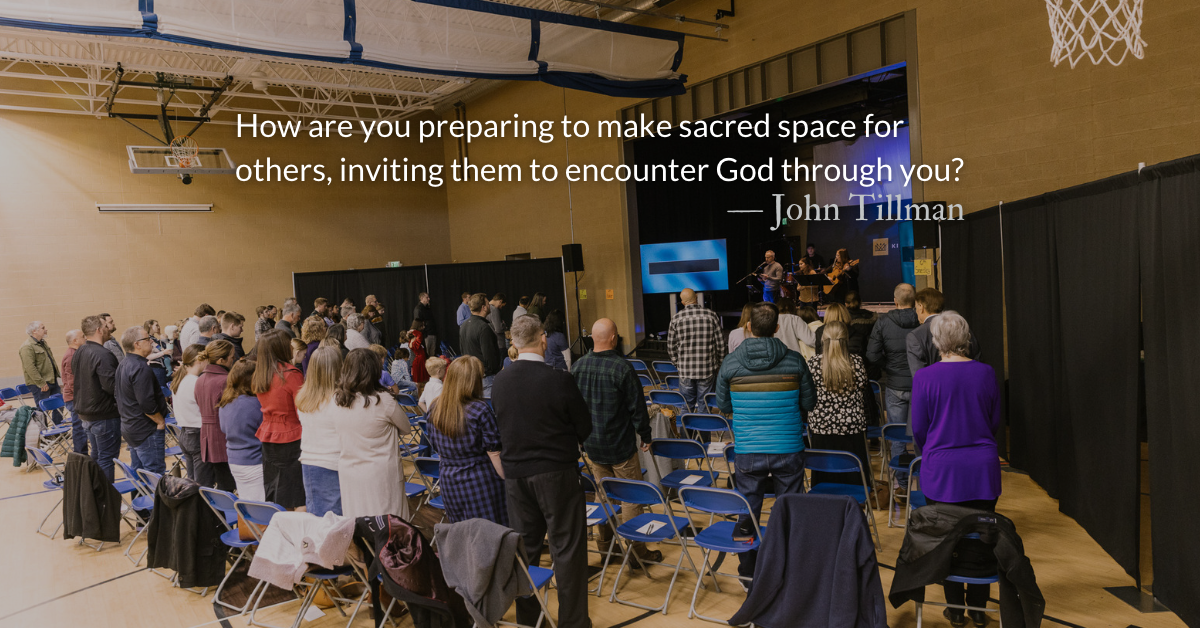
From John: The church I attend places an emphasis on sending out members to plant new churches more than growing bigger and bigger in one location. (Today’s image is from one of our church plants.) During this time of year, we collect special offerings that go to church planting. New churches, often meeting in temporary spaces, tearing down and setting up each week, are one of the nearest analogues we have of how the Jews traveled with the Tabernacle. As we look back at this post from 2021, pray for church planters and mobile churches around the world and consider donating toward church planting efforts.

Reflection: Maintaining Sacred Space
By John Tillman

All across the United States, and in places around the world, God’s people worship in rented or temporary spaces. They worship under the open sky. They worship in tents. They worship in rented theaters, schools, or hotel conference rooms. They worship in private residences.

Church workers and volunteers in these mobile churches can uniquely identify with the tasks described in preparing the Tabernacle to move to a new place. The tools and equipment related to each other are packed up together. You’ll never have to go looking for batteries for the lapel microphones, because they are packed in the storage tub with the microphones. You’ll never have to look for a mallet to stake down a welcome tent, because it is packed in with the stakes and the tent.

This labor may seem at first to be all a matter of having a strong back, stout limbs, and a careful checklist. However, like the work done by the tribes who packed and carried the Tabernacle, this work is holy work which makes holy space for people to encounter a holy God.

The Tabernacle is made after the pattern of the heavenly Temple which Moses sees on the mountain. It is filled with artwork representing it as an artificial Garden of Eden where God once again meets with humans. Making sacred space where humans and God can interact is a priestly duty. It is also one each believer bears today.

Our bodies are our “tents” into which we invite the Holy Spirit of God, promised to us by Jesus. They are temporary, holy vessels in which we are united in Christ and united to God. Peter calls the church a Temple of living stones. Paul calls us members of the body of Christ.

Through spiritual disciplines and practices, we maintain and carry with us sacred space. Prayer, Bible reading, meditation, and intercession, are our tabernacle walls, frames, and sacred tools. We can access this sacred space wherever we go. In our priestly role, we can invite others into this sacred space as well, allowing them to encounter and experience God through us.

How are you preparing to make sacred space for yourself? In your schedule? In your home? In your work life?

How are you preparing to make sacred space for others, inviting them to encounter God through you?

Divine Hours Prayer: The Greeting
Your testimonies are very sure, and holiness adorns your house, O Lord, forever and forevermore. — Psalm 93.6

– From The Divine Hours: Prayers for Springtime by Phyllis Tickle.

Today’s Reading
Numbers 4 (Listen 6:11)
Acts 27 (Listen 6:09)

Read more about The Hand of Providence
Let this hope be our anchor in the midst of the tempestuous seas…we weather the storms not by our wisdom but by his providential hand.

Read more about Supporting Our Work
Please consider becoming a donor to support ad-free content that brings biblical devotionals to inboxes across the world.

https://theparkforum.org/support/

True and Reasonable Faith

Scripture Focus: Acts 25.18-19
18 When his accusers got up to speak, they did not charge him with any of the crimes I had expected. 19 Instead, they had some points of dispute with him about their own religion and about a dead man named Jesus who Paul claimed was alive.

Acts 26.24-27
24 At this point Festus interrupted Paul’s defense. “You are out of your mind, Paul!” he shouted. “Your great learning is driving you insane.” 
25 “I am not insane, most excellent Festus,” Paul replied. “What I am saying is true and reasonable. 26 The king is familiar with these things, and I can speak freely to him. I am convinced that none of this has escaped his notice, because it was not done in a corner. 27 King Agrippa, do you believe the prophets? I know you do.” 

Reflection: True and Reasonable Faith
By John Tillman

Festus is confused by the false charges against Paul. He didn’t even know how to describe the case when sending it to Caesar. Paul’s claims seemed like madness to him.

Many within Greek-influenced Roman culture thought the spirit was a superior form of reality and the body was an inferior shell. The resurrection of the dead was nonsense—more like a curse than a miracle. Later, as Paul spoke of resurrection during his defense, Festus would interrupt, saying, “You are out of your mind!” (Acts 26.24-27)

Paul’s defense included telling the facts of his own life, his previous persecution of “The Way,” and his meeting with the risen Jesus. Paul presented his claims as verifiable facts that “did not happen in a corner” (Acts 26.26) and invited scrutiny of everything, including the resurrection. Even in Paul’s day, all the authority and power of Rome couldn’t disprove Paul’s testimony about Jesus.

Paul’s defense also claimed that his testimony about resurrection was “reasonable” from the Jewish perspective and in light of what was written in the prophets. To Agrippa, a man well-studied in Jewish anthropology and the scriptures, the resurrection of the dead was not madness and Paul’s story apparently seemed quite compelling. (Acts 26.28)

Paul demonstrated that he was innocent of the charges against him. But what is more important is that he demonstrated that Christian claims sprang logically from promises in the Jewish scriptures and that the facts of his life merited serious consideration of his religious claims.

The TV series, The Chosen, imagines a conversation between Nicodemus and Mary Magdalene. In that scene, she says, “I was one way… and now I am completely different. And the thing that happened in between… was Him.” Even as far removed from the events of the Gospels as we are, we still can bear witness, like Paul and others did, using our own stories.

You may think, “I don’t have a dramatic story. I wasn’t arresting Christians like Paul or possessed by demons like Mary.” But surely Jesus has made a dramatic change in you? Hasn’t he changed the way you think about yourself? Hasn’t he changed the way you think about others? Hasn’t he rooted out of your heart stones and weeds and planted new growth?

Keep testifying to the truth of the resurrection and living out its implications. It is our lives, paired with our words, that make our faith “true and reasonable” to the watching world.


Divine Hours Prayer: A Reading

Jesus said: “In all truth I tell you, whoever welcomes the one I send, welcomes me, and whoever welcomes me, welcomes the one who sent me.” — John 13.20

– From The Divine Hours: Prayers for Springtime by Phyllis Tickle.


Today’s Reading
Numbers 2 (Listen 3:47)
Acts 25 (Listen 4:40)

Read more about Implore Them to Stay
Christians are engaged in evangelism by living ordinary lives and glorifying God.

Read more about A Bad Day Fishing
Peter’s first recorded words to Jesus in response the miracle are “go away.”

Winning People > Winning Arguments

Scripture Focus: Acts 24.14-16
14 However, I admit that I worship the God of our ancestors as a follower of the Way, which they call a sect. I believe everything that is in accordance with the Law and that is written in the Prophets, 15 and I have the same hope in God as these men themselves have, that there will be a resurrection of both the righteous and the wicked. 16 So I strive always to keep my conscience clear before God and man.

Reflection: Winning People > Winning Arguments
By John Tillman

Acts gives many examples of followers of “The Way” on trial. When we are on trial, in courts or in conversations, do we follow their examples?

In every case, those who were handed over to the local councils, flogged in the synagogues, or brought before governors and kings served as witnesses about Jesus both to their accusers and to the authorities they stood before. This is as Jesus said it would be. (Matthew 10.16-20) They were sheep among wolves. They were as wise as the snakes that accused them and yet as innocent as doves. Jesus said that when they were put on trial the Holy Spirit would speak through them. 

Paul is on trial for his life and, in a sense, his faith. His accusers charged him with blasphemy, yet Paul was the one confessing the true God. Their denial of Christ was blasphemy against the Holy Spirit. Paul was accused of rebellion, yet it was they who crucified the rightful King. Their execution of Jesus was a rebellion against the only kingdom that matters.

Inspired by the Spirit, how does Paul respond? Does he spit fire, pronounce curses, and call them blasphemers and heretics? No. 

Paul defends himself against lies but he doesn’t need insults to do it. He simply tells the truth. Not only does he not insult them, Paul emphasizes his common ground with his accusers. “I have the same hope in God as these men,” Paul says.

We have little control over what courts or kings may judge us or demand an account from us. On social media or in conversation, there are many judgments or arguments we might face.

Unlike Paul, we may face accusations that are true. “The church abused me.” “The Bible was used to harm me.” Even if, individually, we are innocent, rather than being defensive, we should address these with compassion and humility. We should heal, not deny, people’s wounds.

Paul’s trial was a platform for him to find common ground with all people and to explain the gospel publicly. (Acts 26.28-29) Whatever trials we face, formal or informal, keep Jesus’ words and Paul’s example front of mind. Even when accusations are unfair or false, those putting us on trial are not our enemies. We aren’t there to win the trial or win the argument but to win people for the gospel and bring honor to Jesus.

Divine Hours Prayer: A Reading
Jesus said to us: “…Everything now covered up will be uncovered, and everything now hidden will be made clear. What I say in the dark, tell in the daylight; what you hear in whispers, proclaim from the housetops.” — Matthew 10.26-27

– From The Divine Hours: Prayers for Springtime by Phyllis Tickle.

Today’s Reading
Numbers 1 (Listen 6:21)
Acts 24 (Listen 4:11)

Read more about Portrait Shaped by Scripture
If we can show the beauty of living in a way that shows the Father’s love, people will be willing to consider trusting our Father’s words.

Read more about None Excluded or Excused
Are you one of those sharing the gospel? Who are you bringing along? Who are you collaborating with? Who is learning from you and from whom are you learning?

Beyond Jubilee

Scripture Focus: Leviticus 25.9-10
9 Then have the trumpet sounded everywhere on the tenth day of the seventh month; on the Day of Atonement sound the trumpet throughout your land. 10 Consecrate the fiftieth year and proclaim liberty throughout the land to all its inhabitants. It shall be a jubilee for you; each of you is to return to your family property and to your own clan.

Reflection: Beyond Jubilee
By John Tillman

Weekly sabbaths bring us freedom and joy in this world. This freedom and joy grows more expansive as we ponder the sabbath of years and Jubilee.

Sabbath years built, in an exponential crescendo, to Jubilee. After seven septennial sabbath years, trumpets were to announce liberty throughout the land. Liberty from debt. Liberty from enslavement. Jubilee brought a national reset of property and land ownership. The “monopoly game” was to be folded up, properties redistributed, and the game started over with all participants on equal footing once more. This was to remind Israel that the land did not belong to them. It belonged to the Lord. 

It is difficult for us to imagine such an economic system. In the dominant economic systems of their world and ours, the game never stops and each generation starts the game with an inherited benefit or handicap. Generational wealth and poverty are features, not bugs, of every world economic system in history. 

Biblical laws are intended to be a check on our tendencies toward greed, violence, and inequity. Jubilee was a systemic reboot, restoring the moral code God desired—equity, justice, righteousness, unity.

Talking about Jubilee upsets some people. Some dogmatically demand implementation of Jubilee in today’s economic terms, even though they would not submit to any other laws from the Old Testament. Others work just as stubbornly to deemphasize or even ignore Jubilee because it conflicts with their economic beliefs. (It is beyond the scope of this devotional to discuss how some of us have greater religious devotion to and faith in sociological, economic, and political ideas than we do in scripture or theological ideas…)

We must remember that many systems and laws in the Bible, like Jubilee, are bandaids on gaping wounds. For example, Jesus challenged laws regarding marriage and the sabbath, saying they did not complete God’s intention or will. (Matthew 19.3-12; Mark 2.23-28; Luke 6.1-10; Luke 13.10-16) We have little evidence of how Israel enacted Jubilee, but to whatever degree they did, it was insufficient. Great inequities persisted. (Deuteronomy 15.7, 11; 1 Samuel 2.8; Isaiah 41.17; Matthew 19.21, 26.11)

Implementing Jubilee would be insufficient. The gospel compels us to go beyond it. As the sacrifice of Christ surpasses the sacrifice of lambs, and our righteousness must surpass that of the scribes and Pharisees, our sacrificial generosity should surpass that of Jubilee. (Matthew 5.20)

In Jesus, Jubilee is now and forever. Jubilee is the gospel. (Isaiah 55.1-2; John 7.37; Revelation 22.17) 

May our voices and actions be jubilant trumpets declaring liberty, freedom, and joy.


Divine Hours Prayer: The Morning Psalm
Our iniquities you have set before you, and our secret sins in the light of your countenance. — Psalm 90.8

– From The Divine Hours: Prayers for Springtime by Phyllis Tickle.


Today’s Reading

Leviticus 25 (Listen 7:41)
Acts 21 (Listen 5:55)

This Weekend’s Reading
Leviticus 26 (Listen 6:22), Acts 22 (Listen 4:26)
Leviticus 27 (Listen 4:45), Acts 23 (Listen 5:15)

Read more about Supporting Our Work
Please consider becoming a donor. Support ad-free content that brings biblical devotionals to inboxes across the world.

Read The Bible With Us
It’s never too late to join our Bible reading plan. Immerse in the Bible with us at a sustainable, two-year pace.

https://mailchi.mp/theparkforum/m-f-daily-email-devotional

Show Buttons
Hide Buttons
Spur a spiritual rhythm of refreshment right in your inbox
By joining this email list you are giving us permission to send you devotional emails each weekday and to communicate occasionally regarding other aspects of the ministry.
100% Privacy. We don't spam.