
Transformed by Koinonia  — Readers’ Choice

Scripture Focus: Philippians 1.4-6
4 In all my prayers for all of you, I always pray with joy 5 because of your partnership in the gospel from the first day until now, 6 being confident of this, that he who began a good work in you will carry it on to completion until the day of Christ Jesus.

Originally published on July 13, 2023, based on readings from Philippians 1.

Readers’ Choice posts are selected by our readers:
Gloria, Texas — I work with missionaries who serve all over the world and this makes me think of their work, their fellowship with other believers (even if far from them), and their connection to the Lord that gives them strength to keep serving…they are working to see more people transformed by koinonia.

Reflection: Transformed by Koinonia  — Readers’ Choice
By John Tillman

The word Paul uses to describe the partnership that he feels with the Philippian church is koinonia. Like many Greek words, it has multiple shades of meaning. The word in English primarily refers to the “fellowship” of the church as a community. This meaning is not incorrect, but another interpretation is of being a business partner or having a “share” or investment together in a business. 

Paul knows what it is to have partners in business, having supported himself at times through the skilled trade of tentmaking which he had in common with Priscilla and Aquila. However, the business to which Paul is referring, that we all have a share in, is the gospel.

The business of the gospel is the “putting right” of everything in the cosmos. And the means by which we do so is by “fellowship” or “partnership” with Christ Jesus, whose work continues until “the day of Christ Jesus.” There is no koinonia with Christ without change.

In this phrase, Paul is redefining the ancient Jewish concept of the “Day of the Lord.” This is the “last day” to which Martha refers when discussing her brother Lazarus’s future resurrection and is sometimes called the “eighth day” to symbolize that God is both ending and renewing creation.

This is a day when all will be put right. The day of Lord will be a day of leveling. It will mean tearing down those who have built themselves up and lifting up those who have been crushed.  Earth will be transformed into another place—a place in keeping with all that God desires for us, but we are too foolish to ask for or seek.

Christ’s correction of the cosmos is not limited to all that is without us but includes all that is within us. It is not just Earth that will be transformed but Earthlings. We, each of us, have an inner cosmos that must succumb to a “Day of the Lord” transformation. Within us are exalted idols and habits that must be torn down. Within us are fruits of the spirit that we have trampled under selfish feet.

As we submit to him, Jesus will, with axe and fire, tear down in us what must burn, and with tender nourishing care will tend and cultivate the fruit that he always designed to grow in us. Christ is our partner and our koinonia with him means every trial, suffering, isolation, loss, and sadness, shall work together for our betterment, strengthening, and righteousness.


Divine Hours Prayer: The Refrain for the Morning Lessons
One thing have I asked of the Lord; one thing I seek; that I may dwell in the house of the Lord all the days of my life… — Psalm 27.5


– From The Divine Hours: Prayers for Summertime by Phyllis Tickle.

Today’s Readings
1 Samuel 1 (Listen 4:13)
Hebrews 12 (Listen 4:36)

This Weekend’s Readings
1 Samuel 2 (Listen 6:09), Hebrews 13 (Listen 3:31)
1 Samuel 3 (Listen 3:03), 2 Timothy 1 (Listen 2:37)

Read more about A Rebellion of Repentance
The repentance John describes is a rebellion more radical than violent insurrection.

Read The Bible With Us
You can join our Bible reading plan at any time and reflect on the whole Bible with us at a sustainable, two-year pace.


https://mailchi.mp/theparkforum/m-f-daily-email-devotional

Anger Industrial Complex  — Readers’ Choice

Scripture Focus: Ephesians 4.25-32
25 Therefore each of you must put off falsehood and speak truthfully to your neighbor, for we are all members of one body. 26 “In your anger do not sin”: Do not let the sun go down while you are still angry, 27 and do not give the devil a foothold. 28 Anyone who has been stealing must steal no longer, but must work, doing something useful with their own hands, that they may have something to share with those in need.

29 Do not let any unwholesome talk come out of your mouths, but only what is helpful for building others up according to their needs, that it may benefit those who listen. 30 And do not grieve the Holy Spirit of God, with whom you were sealed for the day of redemption. 31 Get rid of all bitterness, rage and anger, brawling and slander, along with every form of malice. 32 Be kind and compassionate to one another, forgiving each other, just as in Christ God forgave you. 

Originally published on October 4, 2022, based on readings from Ephesians 4.

Readers’ Choice posts are selected by our readers:
Jason, Austin, TX — A great perspective on anger and how our culture weaponizes it for material gain.

Reflection: Anger Industrial Complex  — Readers’ Choice
By John Tillman

The Christian relationship to anger is complex. God gets angry. Jesus gets angry. Christians can be angry too. Anger can be an appropriate reaction to injustice and suffering. Anger can be a fruit of love. Anger can be a requirement for social change. However, anger is also a “Deadly Sin.” Deadly sins are ones that produce and lead to other sins.

We need to escape sinful anger while acting on godly, righteous anger. How?

Our culture is addicted to anger. We play anger for laughs in our entertainment. We signal our virtue with anger. We get applause when we are angry at the “right” things. Yet, we judge others for their anger. We mock those triggered or angered by things we deem insignificant.

Anger affects us in many ways. It warps our humanity. Anger can form grooves, patterns, in our lives that affect our identity, transforming us into people of anger, rather than people of God.

Anger hinders our relationship with God. Paul considered anger a severe problem. Elders in the church could be disqualified if “given over to anger.”

Anger makes us vulnerable to human and spiritual manipulation. Paul says anger gives the devil a foothold in our lives but it also gives a foothold to manipulative politicians and media voices. This “anger industrial complex” sows tares of outrage in our hearts and harvests profits from the crop of our anger. 

Anger crouches at our doors, and on our devices, ready to take us down a path leading eventually to violence. Anger will rule us or we will rule it. 

We must ask, “Why am I angry?” and “How can I turn anger toward loving action?”

Anger is often sinful when rooted in self-love, fear, insecurity, and pride. We think, “I deserve better.” “I’ll never allow that to happen again.” We must turn these thoughts over to God and starve our lives of the voices that prompt these demands.

Even “selfless” anger can spur us to sinful actions. Actions springing from righteous anger will always be inherently righteous. If what anger motivates us to do is sinful, then either the anger itself or our reaction to it is sinful.

Rather than comforting ourselves with anger, let us comfort ourselves with God’s peace. His peace will lead to flourishing. Our anger will only lead to failure and violence.

*Based on my notes from a sermon by JR Vassar, at Church at the Cross. See the full sermon here.

Divine Hours Prayer: The Refrain for the Morning Lessons
I am like a green olive tree in the house of God; I trust in the mercy of God forever and ever. — Psalm 52.8

– From The Divine Hours: Prayers for Summertime by Phyllis Tickle.


Today’s Readings
Ruth 3-4 (Listen 6:24)
Hebrews 11 (Listen 6:22)

Read more about Two Lamechs, One Jesus
Noah’s world was cursed by anger, hatred, division, and sin. Sound familiar?

Read more about Supporting Our Work
Support our ad-free content that brings biblical devotionals to inboxes across the world. Join our donors today.

Idolatry as Parody — Readers’ Choice

Scripture Focus: Jeremiah 10.11-14
11 “Tell them this: ‘These gods, who did not make the heavens and the earth, will perish from the earth and from under the heavens.’ ” 
12 But God made the earth by his power; 
he founded the world by his wisdom 
and stretched out the heavens by his understanding. 
13 When he thunders, the waters in the heavens roar; 
he makes clouds rise from the ends of the earth. 
He sends lightning with the rain 
and brings out the wind from his storehouses. 
14 Everyone is senseless and without knowledge; 
every goldsmith is shamed by his idols. 
The images he makes are a fraud; 
they have no breath in them.

Originally published on August 16, 2022, based on readings from Jeremiah 10.

Readers’ Choice posts are selected by our readers:
Brian, Montana — How true. May the idols be removed from our lives. We are definitely livings in days similar to Jeremiah’s. God is the only cure.

Barbara, Tennessee — I needed to pray through some things – cultural fears as I age especially! Thanks for this challenge to replace the imitation with the Truth!

Reflection: Idolatry as Parody — Readers’ Choice
By John Tillman

Jeremiah encouraged idolaters to look again at God compared to their idols.

God made the world:
God’s spirit hovered over chaotic nothingness and, by his words, the earth came to be. By his power the mountains were lifted. By his wisdom heavenly bodies took their places. By his understanding the hidden realities of DNA strands, quantum particles, and things science has yet to discover were created. God calls us to serve him, but it is actually he who serves us.

Humans make idols:
Our spirits, disconnected from God, sink in chaos and we are desperate to ground ourselves in something tangible. In our weakness we cast about for symbols of strength (that will yield to our whims). In foolishness we mold realities that center on our needs. In ignorance we claim perfect knowledge and understanding, cutting out of our lives anything that contradicts us. We make our idols to serve us, but we end up serving them. 

We become like our idols: fraudulent, shameful, unable to think, and unable to respond. Our hearts harden and our ears tune out and our eyes glaze over.

We think of idol-making as primitive and foolish. The Bible dumps scorn on the practice. It describes how foolish it is to make idols from worldly things when the world and everything in it was made by God. Idolaters worship the derivative rather than the original—the parody rather than the artist.

But are we that different from Jeremiah’s idolatrous audience?

Don’t we make idols of the things culture tells us are important? Careers? Sexual expression? Perfect spouses? Perfect bodies? Perfect families? Power? Influence? Politics? Don’t we pay and sacrifice, expecting these things to protect us, guide us, lead us, teach us?

Our idols make us senseless. God will give sight and hearing to the blind and the deaf.
Our idols make us ignorant. God will give wisdom to those who seek it.
Our idols shame us. God will lift up the humble.
Our idols defraud us. God will have mercy on us.

We need to, with regularity, search through the temples of our hearts for idols that slip in with our culture. No one is immune. No one has arrived. Bring out your idols and compare them to God. Then let him replace them with himself.


Divine Hours Prayer: The Request for Presence
Bow down your ear, O Lord, and answer me… Keep watch over my life, for I am faithful. — Psalm 86.1-2


– From The Divine Hours: Prayers for Summertime by Phyllis Tickle.


Today’s Readings
Ruth 1  (Listen 3:33)
Hebrews 9  (Listen 4:40)

Read more about Normalizing Idols
Love is a greater ethic than knowledge or freedom. When knowledge leads us toward pride, let love lead us toward humility.

Read The Bible With Us

It’s never too late to join our Bible reading plan. Invite friends to join you in reading the Bible with us at a sustainable, two-year pace.
https://mailchi.mp/theparkforum/m-f-daily-email-devotional

Woe, Whoa, Wow — Readers’ Choice

Scripture Focus: Matthew 11:20–24
Then Jesus began to denounce the towns in which most of his miracles had been performed, because they did not repent. 21 “Woe to you, Chorazin! Woe to you, Bethsaida! For if the miracles that were performed in you had been performed in Tyre and Sidon, they would have repented long ago in sackcloth and ashes. 22 But I tell you, it will be more bearable for Tyre and Sidon on the day of judgment than for you. 23 And you, Capernaum, will you be lifted to the heavens? No, you will go down to Hades.  For if the miracles that were performed in you had been performed in Sodom, it would have remained to this day. 24 But I tell you that it will be more bearable for Sodom on the day of judgment than for you.”

Originally published on February 17th, 2023, based on readings from Matthew 11.

Readers’ Choice posts are selected by our readers:
Jason, Austin, Texas — “Clinging to my unbelief” really spoke to me. It hadn’t thought about it like that.
Brad, Texas — From woe to wow. That’s a zinger.


Reflection: Woe, Whoa, Wow — Readers’ Choice
By John Tillman

Keanu Reeves made “whoa” famous. Owen Wilson did the same for “wow.” These words express a sense of amazement and wonder. (Or sometimes a sarcastic lack of wonder.)

Jesus repeatedly says something that sounds similar: woe. These woes are statements of judgment, not amazement. However, as Jesus reluctantly pronounced judgment on these cities he was amazed. Despite all he showed them, including miracles and healings, people didn’t believe. Jesus said to them, as God said to ancient Israel and Judah through the prophets, “What more could I have done? Why will you stubbornly refuse to believe?” (Ezekiel 33.11)

Often, our culture thinks faith is something one must cling to without a shred of surety. We want “evidence,” “proof,” or “a sign” to believe God. Even believers want signs. We want “proof” that good things will happen when we step out in faith to witness, change jobs, or give sacrificially.

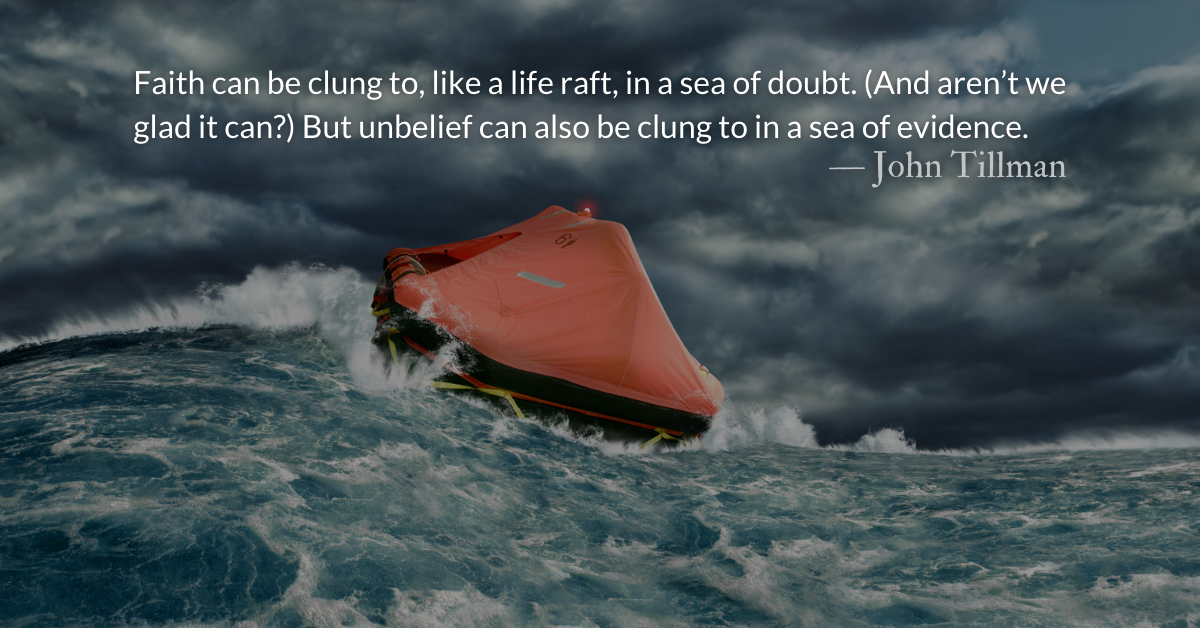
Faith can be clung to, like a life raft, in a sea of doubt. (And aren’t we glad it can?) But unbelief can also be clung to in a sea of evidence. We should ask ourselves if we are clinging to doubt. Are we using a demand for certainty to fend off faith? 

The condemned towns had a special opportunity and they wasted it. They still rejected Jesus. To whom much is given, much is expected. (Luke 12.47-48) We might wish that we had the same opportunity they had: to see Jesus in the flesh, to see healings, etc. But Jesus also said, “To those who are faithful with a little, more will be given.”

If we are faithful with what we are given, we will see more. There are many things given to us so that we may believe. But the best two to focus on are the Bible, a miracle you can hold in your hands, and prayer, our miraculous heart-to-heart connection with God. How we steward these gifts may affect what other signs we see. Maybe the reason we don’t see evidence of the next step of faith, is because we haven’t taken the step that we have been shown?

Also, perhaps your stepping out in faith to act is the evidence someone else needs. Just prior to this chapter, Jesus sent his disciples out to the towns with miracles, messages, and peace. To whom might Jesus be sending you?

Perhaps your faithful obedience can take them from “woe” to “wow.”


Divine Hours Prayer: The Call to Prayer

Worship the Lord in the beauty of holiness; let the whole earth tremble before him. — Psalm 96.9

Today’s Readings
Judges 21  (Listen 3:47)
Hebrews 8  (Listen 2:22)

Read more about Jesus with Axe and Fire
John the Baptist describes a Christ who stands ready with both axe and fire.

Read more about Supporting Our Work
People around the world receive our devotionals because of the generosity of donors just like you. Please consider becoming a donor.

When God Leaves the Building — Readers’ Choice

Readers’ Choice posts are selected by our readers:
Alisha, Texas — This needs to be on repeat. So when you again ask “which devotionals should we repeat again?” Please do this one. Because I was surprised. I was shocked. My eyes had been blinded and I couldn’t see until we were out of the specific church organization that God was not there. Sigh. This was so encouraging too, because though he left the building and we had gone into exile “his presence went with us”. Thank you for this perspective!

Barbara, Tennessee — Thank you. Praising God that he is always with us regardless of what’s happening or how we feel!

Brian, Washington D.C. — I have been watching Romans 1.24 being played out here. I believe this has been happening for a long time in this country. I am so grateful my job puts me in contact with people who are salt and light. The saints I met in NYC, LA, and Chicago this year give me such hope. The Church is booming in Africa, Asia, the Middle East and Latin America. If this revival and outpouring of the holy Spirit continues in oppressive nations around the world it might be that the once powerful Church here in the US will be in the condition of the people in Acts 11:28 who were starving and needed to be rescued. And were helped by a small church in Antioch. The daughter church went back to the mother church with money for the saints to buy food. Imagine the power of hundreds of house churches in Cuba sending money to the US Church to save us. It happened before….

Kolade, Nigeria — Amen, brother…Might print this out and share out to friends or church members.

Scripture Focus: Ezekiel 10.18-22
18 Then the glory of the Lord departed from over the threshold of the temple and stopped above the cherubim. 19 While I watched, the cherubim spread their wings and rose from the ground, and as they went, the wheels went with them. They stopped at the entrance of the east gate of the Lord’s house, and the glory of the God of Israel was above them. 
20 These were the living creatures I had seen beneath the God of Israel by the Kebar River, and I realized that they were cherubim. 21 Each had four faces and four wings, and under their wings was what looked like human hands. 22 Their faces had the same appearance as those I had seen by the Kebar River. Each one went straight ahead. 

Originally published on October 10, 2022, based on readings from Ezekiel 10.

Reflection: When God Leaves the Building — Readers’ Choice
By John Tillman

Ezekiel’s visions of cherubim and “whirling wheels” are as confusing as they are captivating—as befuddling as they are beautiful.

Many study the details of Ezekiel’s vision. Many paintings, many theories, and many words have come from this imagery. Some think Ezekiel was hallucinating or on drugs. Some think his vision describes an alien spaceship. (Easier to believe in than God, I suppose?) But Ezekiel isn’t some poor, inept, ignorant, ancient fool. His literary skill is beyond ours. It’s better to admit we don’t understand what we are reading than to accuse him of not understanding what he saw.

What Ezekiel saw is less important than what he is telling us. In seeking to define the objects he described, many have missed the object of his argument.

The point of Ezekiel’s vision is not to describe the kind of vehicle God drives. The point is to tell us God is leaving. God is moving out—leaving the house David and generations of followers had worshiped in. The glory is departing from the temple. 

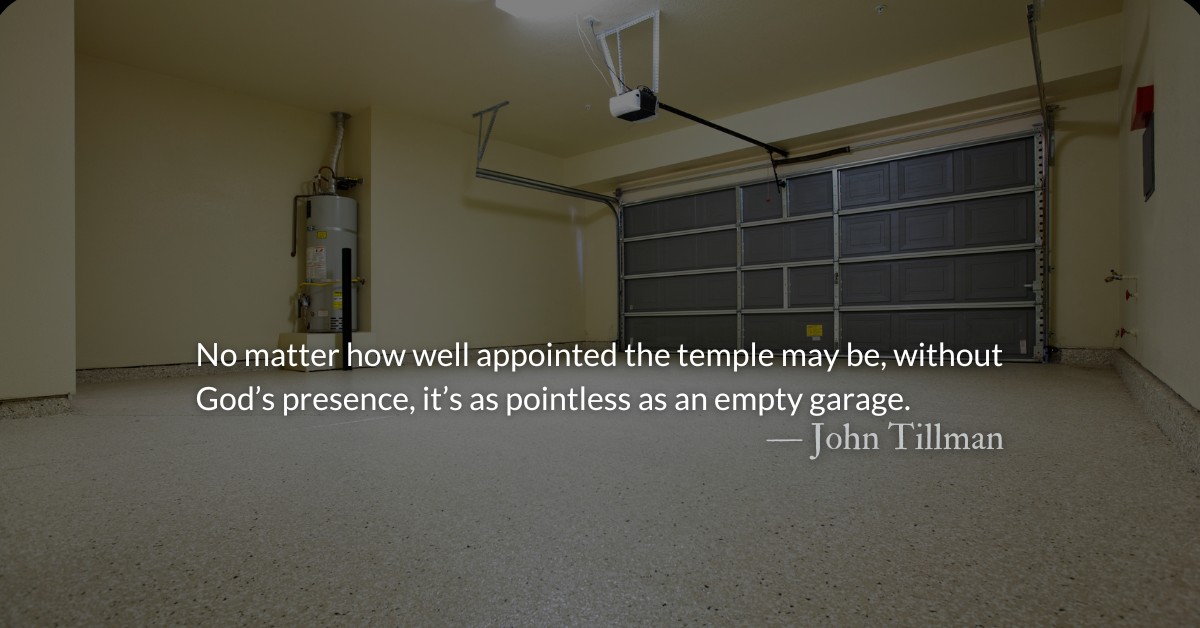
The “car”, if God drove one, is pulling out of the garage. No matter how well appointed the temple may be, without God’s presence, it’s as pointless as an empty garage. Its tools have no meaning. It smells vaguely of gasoline and rubber but there’s no horsepower, no purpose. It’s just an empty room.

God did not leave without reason or without many, many warnings and pleadings with his people. Yet people were surprised at God’s leaving. They missed the warnings. They ignored the pleadings.

If God can leave the Temple Solomon built, he can surely leave our churches, our organizations, and our nations. That’s the scary part. The beautiful part is that God didn’t leave his people. He just left their corrupted places. His people, including Ezekiel, were either already in exile or on their way. God went with them just as he was with them in Egypt. Then he heard their cries and brought them out, repentant and joyful.

Let us never be so prideful, so unheeding, that we are surprised to turn around and find that God has left the building. Let us never be so despairing over God abandoning a building, a country, or an organization that we forget that God remains close to his faithful remnant. Even if everything falls and burns, God can restore, if we will simply be faithful.


Divine Hours Prayer: The Greeting
Restore us, O God of hosts; show the light of your countenance, and we shall be saved. — Psalm 80.3


Today’s Readings
Judges 18  (Listen 4:39)
Hebrews 5  (Listen 1:57)

This Weekend’s Readings
Judges 19  (Listen 4:52), Hebrews 6  (Listen 2:58)
Judges 20  (Listen 7:13), Hebrews 7  (Listen 4:01)

Read more about Hearts God Moves

In Ezra we will see God’s work to, stone by stone, reconstruct the Temple of Jerusalem to bear his name.

#Exiles #Rebuilding #Redemption #LivingTemple #BodyOfChrist

20200102

Read The Bible With Us
It’s never too late to join our Bible reading plan. Immerse in the Bible with us at a sustainable, two-year pace.
https://mailchi.mp/theparkforum/m-f-daily-email-devotional

Show Buttons
Hide Buttons
Spur a spiritual rhythm of refreshment right in your inbox
By joining this email list you are giving us permission to send you devotional emails each weekday and to communicate occasionally regarding other aspects of the ministry.
100% Privacy. We don't spam.