In Medias Res

Scripture Focus: Mark 1.1-8
1 The beginning of the good news about Jesus the Messiah, the Son of God, 2 as it is written in Isaiah the prophet: 
“I will send my messenger ahead of you, 
who will prepare your way” — 
3 “a voice of one calling in the wilderness, 
‘Prepare the way for the Lord, 
make straight paths for him.’ ” 

4 And so John the Baptist appeared in the wilderness, preaching a baptism of repentance for the forgiveness of sins. 5 The whole Judean countryside and all the people of Jerusalem went out to him. Confessing their sins, they were baptized by him in the Jordan River. 6 John wore clothing made of camel’s hair, with a leather belt around his waist, and he ate locusts and wild honey. 7 And this was his message: “After me comes the one more powerful than I, the straps of whose sandals I am not worthy to stoop down and untie. 8 I baptize you with water, but he will baptize you with the Holy Spirit.”

Reflection: In Medias Res
By John Tillman

The Latin literary term, in medias res, means “in the middle of things.” It refers to narratives beginning in the middle of the action. No exposition. No introduction. The action just starts.

Stephen King’s epic series The Dark Tower begins with, “The man in black fled across the desert and the gunslinger followed…” These nameless men, one running before, one following behind, lead us into the desert and the rest of the story. 

Vince Gilligan’s addictive show, Breaking Bad, opens with a man in his underwear crashing an RV as sirens sound in the desert. Then he steps out into the road holding a pistol to face the consequences of something we don’t fully understand yet.

Mark begins his story in the desert with a mysterious, strangely dressed man. Mark says John the Baptist “appeared” in the wilderness.

John’s backstory is fascinating. He is a miracle child, announced by an angel, born to a barren couple in their twilight years. John first met and responded to Jesus while still in the womb. Mark cuts those scenes. The only hint of backstory is the mention of a prophecy about a mysterious messenger who comes to announce a mighty king. This reference is just one more way Mark tells us we are beginning in the middle.

John appears in the desert, then Jesus appears in the water. In the middle of a line of sinners, he comes to John, submitting to a baptism of repentance.

When John baptized others, they repented from sin, exited the desert of temptation, and followed a righteous God. When John baptized Jesus, heaven was torn open. The Holy Spirit descended on Jesus along with the loving approval of God the Father. Then Jesus, the sinless one, entered the desert of temptation to prove he was the righteous king John announced.

We all meet Jesus in medias res, in the middle of our lives, our troubles, our tragedies, our deserts. We might be fleeing something or chasing something. We might have made a wreck of our lives. There may be sirens sounding in the distance.

Jesus goes into the desert and to the cross to face our consequences and win our victory. He faces what we flee. He obtains what we pursue. He repairs what we wreck.

Because of Jesus, we have the chance to be one who goes before him, announcing the coming of the kingdom.

Divine Hours Prayer: The Greeting
With my whole heart I seek you; let me not stray from your commandments. — Psalm 119.10


– From The Divine Hours: Prayers for Summertime by Phyllis Tickle.

​Today’s Readings
Proverbs 11 (Listen 3:41) 
Mark 1  (Listen 5:05)

Read more about King on the Mountain, King on the Cross
Israel fell into sin in the desert. Jesus would resist sin in the desert. Everything that Israel had lost or failed to do, Jesus would accomplish.

Read more about Visionaries Not Vigilantes
God calls Moses, not with a sword in his hand, but a staff. He doesn’t need vigilantes. He needs visionaries.
The Promise of Proverbs is Change

Scripture Focus: Proverbs 10.6-9
6 Blessings crown the head of the righteous, 
but violence overwhelms the mouth of the wicked. 
7 The name of the righteous is used in blessings, 
but the name of the wicked will rot. 
8 The wise in heart accept commands, 
but a chattering fool comes to ruin. 
9 Whoever walks in integrity walks securely, 
but whoever takes crooked paths will be found out.

Reflection: The Promise of Proverbs is Change
By John Tillman

Proverbs transitions to the “Proverbs of Solomon” and the format shifts.

Narrative elements and stories disappear, but two characters still walk the stage. Two-lined quips compare and contrast them. “The wicked experience this…the righteous experience that.”

The wicked plot foolishness. The righteous pursue wisdom. The wicked strut with pride. The righteous walk in humility. The wicked are lazy and demanding. The righteous are industrious and merciful. The wicked squeeze the poor for profit. The righteous leverage profits to aid the poor. The wicked enjoy and celebrate violence. The righteous endure violence and use it only in defense of the weak.

These statements reflect the truth, including the brutal and natural reality that the wicked often prosper and the righteous suffer. However, they reveal an underlying supernatural pattern operating in the world—wrongs will be righted.

Satan and sin operate in the world, often with human help, creating suffering and harm. God is merciful and gracious, offering repeated opportunities time after time, for the wicked to repent, yet he does not leave the guilty unpunished. The day of reckoning will come when evil will be wiped out completely.

Until that day, Proverbs shows us smaller days of reckoning. Even if wickedness seems to be racking up successes, it is only running up a tab. And all bills will come due. The mouth that incites waves of violence will drown in them. (Proverbs 10.6) The schemes of the wicked will ensnare them. They will fall into pits they dug themselves. (Proverbs 26.27; 28.18)Reading these proverbs may remind us of news headlines and scandals involving fallen pastors, leaders, and politicians. This is good. We can and should thank God when the wicked fall. It is also good to ask, “Are we supporting leaders of wickedness or righteousness?” because we can become what we support.

We often apply these sayings to others but resist applying them to ourselves. It is crucial to ask, “Are we becoming people of wickedness or righteousness?” What we become can change our world. We must take the logs out of our own eyes. Seeing clearly, we can help others remove specks from their eyes.

Proverbs does not promise that the righteous will never suffer or that we will see every wicked person fall. It promises the possibility of change. It offers us the tools to abandon foolishness and wickedness, become wise and righteous, and take action, affecting our world for good.


Divine Hours Prayer: The Request for Presence
O Lord, watch over us and save us from this generation forever. — Psalm 12.7


– From The Divine Hours: Prayers for Summertime by Phyllis Tickle.

​Today’s Readings
Proverbs 10 (Listen 3:34) 
Psalm 40-41 (Listen 3:57)

Read more about Hate Conflict? Love Truth
We must learn to love the truth more than we love living in a false peace built by deceptive, manipulative leaders.

Read The Bible With Us
Your reading plan should be a joy, not a slog. Read the Bible with us at a sustainable, two-year pace.

https://mailchi.mp/theparkforum/m-f-daily-email-devotional

Justice Starts Within

Scripture Focus: Psalm 37.1-6
1 Do not fret because of those who are evil
or be envious of those who do wrong;
2 for like the grass they will soon wither,
like green plants they will soon die away.
3 Trust in the Lord and do good;
dwell in the land and enjoy safe pasture.
4 Take delight in the Lord,
and he will give you the desires of your heart.
5 Commit your way to the Lord;
trust in him and he will do this:
6 He will make your righteous reward shine like the dawn,
your vindication like the noonday sun.

Reflection: Justice Starts Within
By John Tillman 

We often experience evil that is external to ourselves and acts upon us. This evil, whether the direct actions of humans or not, is a reflection and repercussion of individual and collective sin.

Christianity simultaneously holds an extraordinarily high view of human nature and an extraordinarily low view. Humans are “gods,” Jesus quotes (John 10.34-36; Psalm 82.6) and just lower than the angels. (Hebrews 2.5-8; Psalm 8.5) Yet, we are also rebellious and broken. Evil infects and corrupts our best intentions. (Romans 3.10-12; Psalms 14.1-3; 53.1-3; Ecclesiastes 7.20) Creation itself is cursed because of our sin. (Genesis 3.17; Romans 8.20-23) At the peak of human righteousness, we stand dressed in filth rather than finery. (Romans 3.10; Isaiah 64.6; Psalm 143.2)

If evil were just a few regrettable actions by a few misguided people, we’d be “god” enough to handle it. We could just “do better,” as many voices on social media tell us to do, and lock up the “bad apples” who fail this charge.

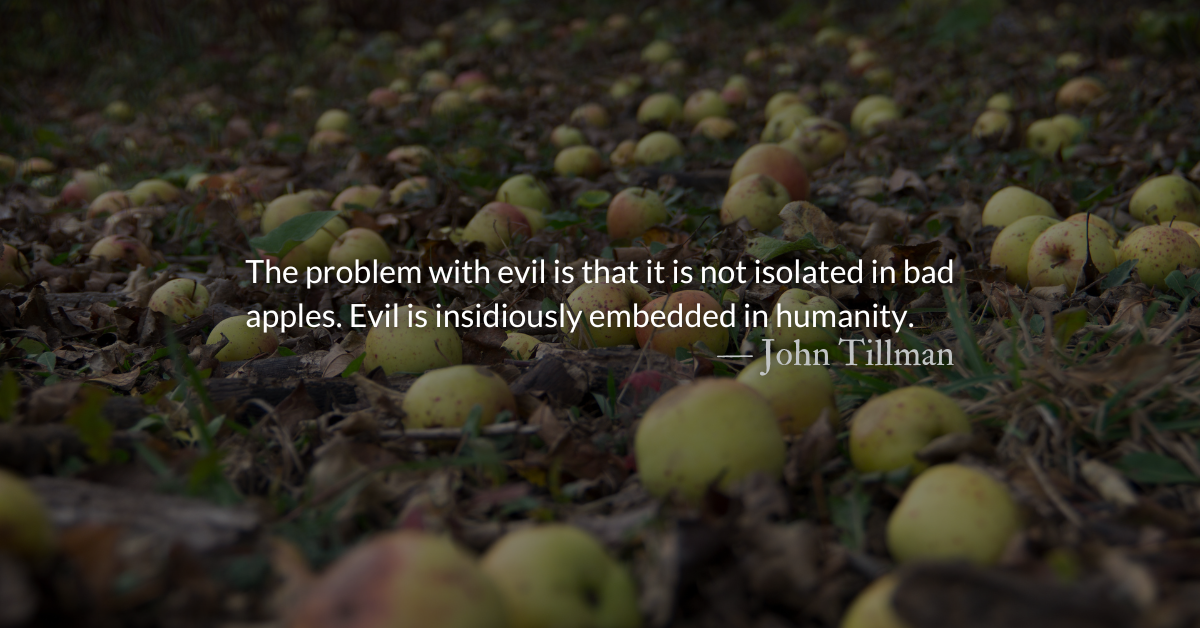
The problem with evil is that it is not isolated in bad apples. Evil is insidiously embedded in humanity. Solzhenitsyn said, “The line dividing good and evil cuts through the heart of every human being. And who is willing to destroy a piece of his own heart?” Paul said, “I want to do good, evil is right there with me…who will deliver me from this body of death?” (Romans 7.21-25)

Justice must start within. Jesus confronts our tainted hearts, comforting us when suffering under wickedness while simultaneously discomforting us by attacking our wickedness. Christ delivers us from an inner evil nature through sanctification. (Luke 11.20-22) If we allow him to, he will go beyond destroying the evil piece of our heart. He will give us a brand new heart that will grieve injustice and work for justice, both inwardly and outwardly. 

We join our voices and bend our backs to the suffering and working of all God’s people for justice. (Revelation 6.9-11) There is evil without and evil within, but greater is Jesus than any evil. (1 John 4.4) God is with us through any suffering and his grace to us is sufficient to work in and through us. 

As the Holy Spirit within us contests our inner evils, he also spurs us to act in Christ’s name on behalf of justice against evils that go beyond personal or individual. Justice starts within. It doesn’t stop there.

May we answer the call, becoming agents of Christ, seeking out darkness and shining a light of justice and truth.

Divine Hours Prayer: The Call to Prayer
I will call upon God, and the Lord will deliver me.
God, who is enthroned of old, will hear me. — Psalm 55.17, 20

– From The Divine Hours: Prayers for Summertime by Phyllis Tickle.

​Today’s Readings
Proverbs 7 (Listen 2:21)
Psalm 37 (Listen 4:21)

​Today’s Readings
Proverbs 8 (Listen 3:26) Psalm 38 (Listen 2:14)
Proverbs 9 (Listen 1:50) Psalm 39 (Listen 1:49)

Read more about Hope for Marred Pots
God, understanding Jeremiah’s grief, sends him to a place he can see that there is hope for marred and broken things—the potter’s house.

Read more about Pause To Read
Today’s episode is the final episode in our series on Lady Folly, Lady Wisdom, and RSVP to Wisdom or Folly. Share this series with a friend who needs wisdom.

Hate Conflict? Love Truth

Scripture Focus: Proverbs 6.12-19
12 A troublemaker and a villain, 
who goes about with a corrupt mouth, 
13 who winks maliciously with his eye, 
signals with his feet 
and motions with his fingers, 
14 who plots evil with deceit in his heart— 
he always stirs up conflict. 
15 Therefore disaster will overtake him in an instant; 
he will suddenly be destroyed—without remedy. 
16 There are six things the Lord hates, 
seven that are detestable to him: 
17 haughty eyes, 
a lying tongue, 
hands that shed innocent blood, 
18 a heart that devises wicked schemes, 
feet that are quick to rush into evil, 
19 a false witness who pours out lies 
and a person who stirs up conflict in the community. 

Reflection: Hate Conflict? Love Truth
By John Tillman

Many people today are conflict-averse or conflict-avoidant. We cringe when things get tense or walk away, surrender, or stay silent to prevent a conflict. Conflict in a community is horrible, especially within a church community. Division within the church is a division in the body of Christ. It divides what God has united together.

The Lord “hates” a person who stirs up conflict in the community. We are right to mourn division and to hate conflict. When we do, we join our feelings and actions to God’s feelings and actions.

While we mourn division and conflict, we must honestly assess what has happened. What causes division? Who is responsible for stirring up conflict? In Proverbs 6.12-19, it is clear that the deceitful man stirs up the conflict. The deceitful man (or woman) normalizes conflict, conceals conflict, and stigmatizes dissent.

Ahab called Elijah the “troubler” of Israel for stirring up conflict. But Ahab started the trouble and initiated the conflict when he abandoned the Lord and replaced true worship with false worship. (1 Kings 18.16-18) Elijah was labeled a troublemaker when he refused to follow the new normal and exposed Ahab’s false god.

Conflict that is concealed, like sexual abuse or abusive leadership, weaves an illusive false peace. When revelations of truth shatter this false peace, deceitful people often call truth-tellers “troublemakers” and blame them for “stirring up conflict.” It is not unusual for community members to be pulled into this argument, defending the deceivers and abusers and attacking the truth-tellers and victims.

When conflict arises (or is revealed) in our communities, we should hate the conflict, but we must love the truth. Quelling conflict must never come at the cost of the truth. The person the Lord hates is the villain, not the victim.

Beware of corrupt mouths (v12), deceitful hearts (v14), haughty eyes (v17), lying tongues (v17), hands that harm the innocent (v17), and hearts that devise wicked schemes (v18). They will try to convince us to defend them instead of listening to those who speak the truth about them

Not all conflicts are worth having, but we cannot remain conflict-averse or avoidant when victims need our help. We must learn to love the truth more than we love living in a false peace built by deceptive, manipulative leaders.

Revealing the truth is not stirring up conflict. It is the first step toward healing conflict.


Divine Hours Prayer: The Refrain for the Morning Lessons
Let not those who hope in you be put to shame through me, Lord God of hosts; let not those who seek you be disgraced because of me. — Psalm 69.7

– From The Divine Hours: Prayers for Summertime by Phyllis Tickle.


​Today’s Readings
Proverbs 6 (Listen 3:22)
Psalm 36 (Listen 1:29)

Read more about Ahab and David
Rather than the friendly relationship David had with God and his prophets, Ahab considers Elijah his “enemy.”

Read more about Prophets in Our Path
When an inconvenient prophecy stops us in our tracks…When an ugly truth comes to light…Let us repent.

Wisdom—A Spouse, A Path, A Healer

Scripture Focus: Proverbs 4.5-7
5 Get wisdom, get understanding; 
do not forget my words or turn away from them. 
6 Do not forsake wisdom, and she will protect you; 
love her, and she will watch over you. 
7 The beginning of wisdom is this: Get wisdom. 
Though it cost all you have, get understanding.

Reflection: Wisdom—A Spouse, A Path, A Healer
By John Tillman

The father, instructing his child, compares wisdom to many things. 

Wisdom is like a spouse. (Proverbs 4.6-9) The one who embraces wisdom and is faithful, loving, and devoted will be protected, watched over, exalted, and honored. The greater attention, deference, submission, love, and priority we give to wisdom, the greater protection and blessing she grants to us.

Abandoning wisdom means turning to the arms of other partners who make lofty promises of love but have no desire or ability to follow through. In their arms we will find abuse instead of protection, neglect instead of attention, subjugation instead of exaltation, and shame instead of honor.

Wisdom is like a path. (Proverbs 4.11-19) The path of wisdom is bright and grows brighter as it is traveled. What we learn of God’s wisdom today, leads us to learn greater wisdom tomorrow. Ever brighter, the path leads on and on. It is a straight path, not turning to the right or the left. It is a smooth path, safe to walk and safe to run, with no obstacles or dangers.

The only hazards on the path of wisdom are the many opportunities to wander onto paths leading away from wisdom’s light. These paths stay within wisdom’s sight briefly. Long enough to seem like shortcuts or detours. But soon, downward into darkness they turn, lined with false steps, dark corners, and opportunities for ambush and injury. These paths have twists and switchbacks, always promising better things around the corner, but only delivering more of the same.

Wisdom is like a healer. (Proverbs 4.20-27) Wisdom gives our bodies nourishment for what needs to grow and medicine for what is sick. Through our ears and eyes wisdom brings health to our hearts, our inner being. This inner mental and spiritual health flows to the rest of our life. Our words and our actions are healed and purified. Our sight is sharpened.

Forsaking wisdom is slowly poisoning ourselves. It brings diseased actions, feelings, and thoughts. We sicken from the inside out, unable to scratch what itches or staunch what is bleeding.

Be wisdom’s dutiful patient and experience healing and nourishment of spirit, mind, and body.

Place one foot after another on the penitent pilgrimage of wisdom’s path and find destinations beyond your imagining.

Vow to love wisdom for life as a faithful partner and be filled and satisfied.

Wisdom is calling. Will you answer? Will you be her patient? Her pilgrim? Her spouse?


Divine Hours Prayer: The Greeting
Out of Zion, perfect in its beauty, God reveals himself in glory.
Let the heavens declare the rightness of his cause; for God himself is judge. — Psalm 50.2, 6

– From The Divine Hours: Prayers for Summertime by Phyllis Tickle.


​Today’s Readings
Proverbs 4 (Listen 2:37)
Psalm 34 (Listen 2:14)

Read more about Wisdom Versus Obedience
Wisdom is mined from a deep relationship with God. It is refined in the crucible of life.

Read more about Supporting Our Work
Support ad-free content that brings biblical devotionals to inboxes across the world. Join our4 donors.

Show Buttons
Hide Buttons
Spur a spiritual rhythm of refreshment right in your inbox
By joining this email list you are giving us permission to send you devotional emails each weekday and to communicate occasionally regarding other aspects of the ministry.
100% Privacy. We don't spam.