

Links for today’s readings:
Feb 9 Read: Job 42 Listen: (2:41) Read: Psalm 30 Listen: (1:32)
Scripture Focus: Psalm 22.1-2, 23-24, 30-31
1 My God, my God, why have you forsaken me?
Why are you so far from saving me,
so far from my cries of anguish?
2 My God, I cry out by day, but you do not answer,
by night, but I find no rest.
23 You who fear the Lord, praise him!
All you descendants of Jacob, honor him!
Revere him, all you descendants of Israel!
24 For he has not despised or scorned
the suffering of the afflicted one;
he has not hidden his face from him
but has listened to his cry for help.
30 Posterity will serve him;
future generations will be told about the Lord.
31 They will proclaim his righteousness,
declaring to a people yet unborn:
He has done it!
Reflection: A Poem Before Dying
By John Tillman
What poem would you quote before dying?
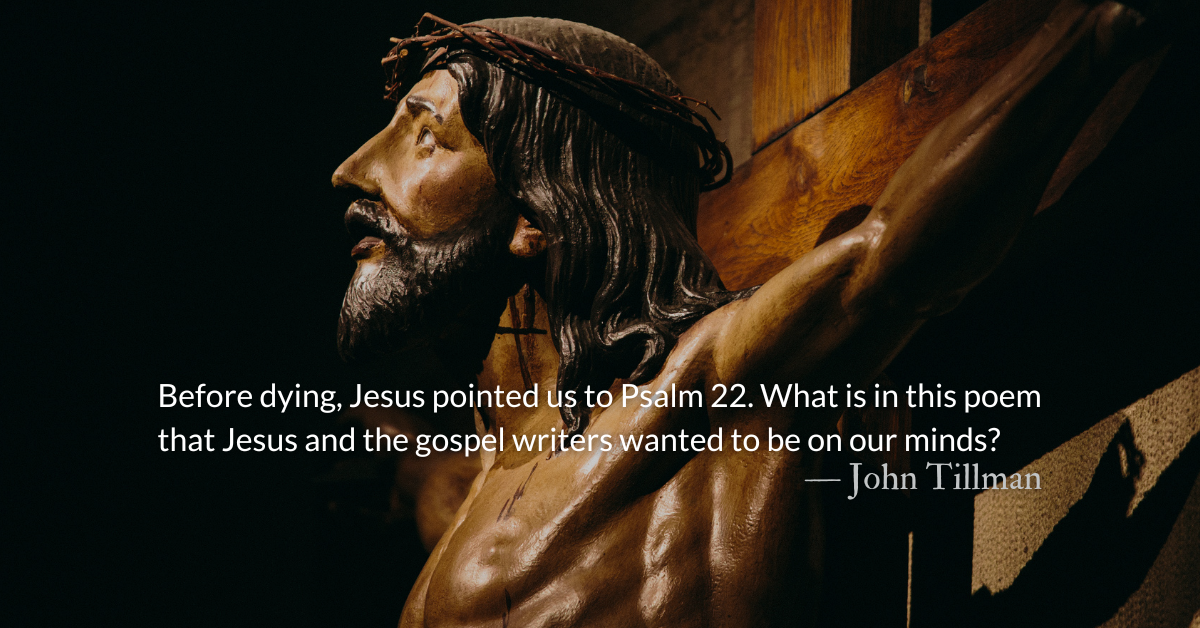
Before dying, Jesus pointed us to Psalm 22. What is in this poem that Jesus and the gospel writers wanted to be on our minds?
“To be or not to be” is a popular quote. It is referenced thousands of times in many shows, plays, and films, including the Arnold Schwarzenegger film, The Last Action Hero. Even those who slept through English classes would at least remember it was from Shakespeare.
Others would recognize it from the play, Hamlet, even if they didn’t “remember Hamlet accurately.” Many would know Hamlet said it. Many more would know it begins an important speech. Many others might remember the speech as one of the most profound meditations in the English language on whether to resist the oppressions, struggles, and injustices of life or surrender to hopelessness, inaction, and death. Many might have memorized it.
Whenever someone alludes to “to be or not to be,” everything you know about it is activated. Your level of understanding an allusion, depends on your level of familiarity.
Jesus alluded to Psalm 22 from the cross by quoting its first line. (Matthew 27.46-49; Mark 15.34-37) Some of those around the cross would not even recognize the quote. Some would recognize it was scripture, but not where it was from. Some would recognize it but misunderstand its meaning. But some, including the gospel authors, had a deep understanding of the entire psalm and why Jesus would reference it.
From the last line to the first, there are many similarities in Jesus’ crucifixion and Psalm 22. The psalmist begins by asking why God has abandoned him but overall, the psalm affirms that God hears his cry and did not turn his face away (Psalm 22.24). It describes many physical details of crucifixion and proclaims in its final line that “He (God) has done it,” (Psalm 22.31) or, in other words, “It is finished.” (John 19.30)
Biblical authors are masters of allusion, referring constantly to other texts. The power of an allusion depends on how deeply you know the source material. Refamiliarize yourself with Psalm 22 keeping your mind open to what Jesus speaking from the cross would direct your attention to. Imagine standing there hearing him quote it and having its lines run through your mind as you watched.
Deeper familiarity with scripture will lead to deeper understanding.
Resource:“Seeing What’s Really There: A Guide to Biblical Allusions” — The Biblical Mind Podcast
Divine Hours Prayer: The Request for Presence
I long for your salvation, O Lord, and your law is my delight. — Psalm 119.174
– From The Divine Hours: Prayers for Springtime by Phyllis Tickle.
Read more: The Prayer From the Cross
My God, my God, why have you forsaken me? Why are you so far from saving me, so far from my cries of anguish?
Read more: Job’s Christlikeness
Job is Christlike in his eucatastrophic return…everything in Job’s life died or was lost. Then, unexpectedly, everything was restored.

