Links for today’s readings:
Mar 3 Read: Proverbs 22 Listen: (2:59) Read: Mark 12 Listen: (6:10)
Scripture Focus: Proverbs 22.1-2, 4, 7-9, 16
1 A good name is more desirable than great riches;
to be esteemed is better than silver or gold.
2 Rich and poor have this in common:
The LORD is the Maker of them all.
4 Humility is the fear of the LORD;
its wages are riches and honor and life.
7 The rich rule over the poor,
and the borrower is slave to the lender.
8 Whoever sows injustice reaps calamity,
and the rod they wield in fury will be broken.
9 The generous will themselves be blessed,
for they share their food with the poor.
16 One who oppresses the poor to increase his wealth
and one who gives gifts to the rich—both come to poverty.
Rich man’s war, poor man’s fight. — unknown (Civil War era, 1861-1865)
From John: Today, as always, our devotional writings are steered by the scriptures for the day, not the headlines of the day. We originally posted this devotional on March 3, 2022, one week after Russia’s invasion of Ukraine on February 24, 2022. I decided last week that we would repost this devotional today, and reflect that four years later, the Center for Strategic and International Studies (CSIS) estimates that up to 325,000 Russian soldiers and up to 140,000 Ukrainian soldiers have died in Russia’s invasion.
Then, over the weekend, the US and Israel opened a new conflict with attacks on Iran and the President cautioned Americans that US military personnel may die in this action or as a result. By the time this posts on Tuesday, perhaps the attacks will be over. Perhaps a “Mission Accomplished” banner will be raised as George W. Bush did long before the Iraq war accomplished anything lasting. However, Russia’s experiences in Ukraine and America’s own experiences in regime change should caution us that we cannot know the future consequences of this action. We can know, however, that poor Iranians, Americans, and Israelis will bear the brunt of the suffering, dying, and fighting as the wealthy and powerful pontificate and moralize. As President Jimmy Carter wisely reminded us, “War may sometimes be a necessary evil. But no matter how necessary, it is always an evil, never a good.”
May we redouble our prayers against the evils of war. Pray the innocent will be protected. Pray that the plans of the powerful will be frustrated. Pray the wicked will be destroyed by their own wicked ways.
Reflection: Prayer for the Poor at War
By John Tillman
Today’s section of Proverbs has many reflections on the relationship of the rich to the poor.
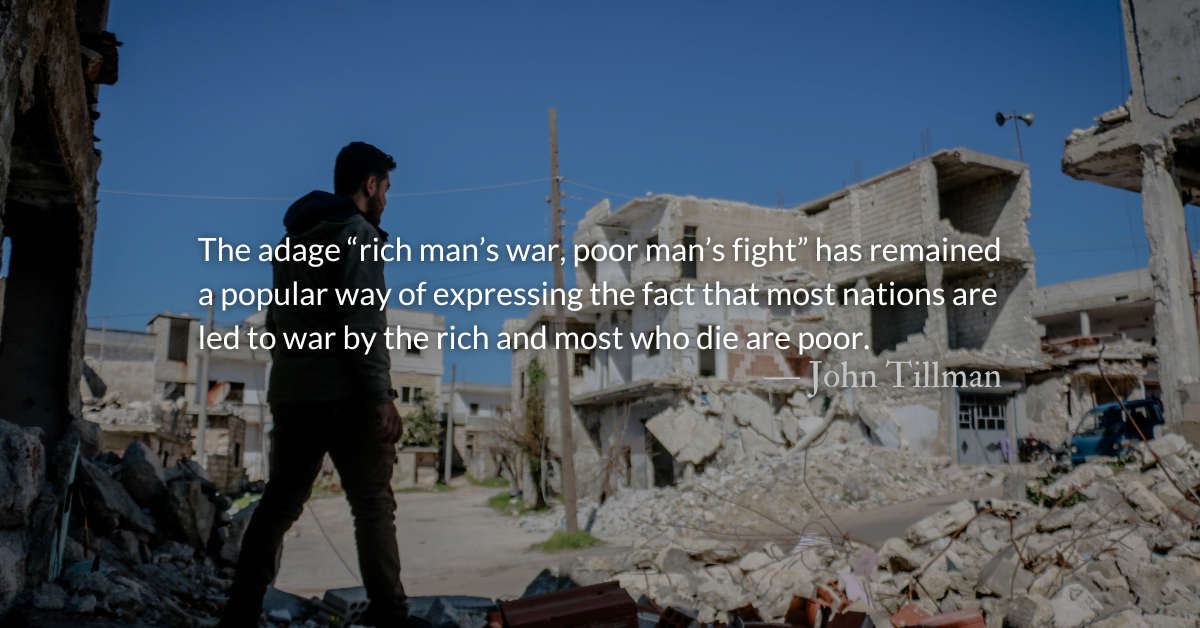
During the American Civil War, men could avoid conscription into the military for a fee of $300. That would be approximately $9,500 in today’s currency. The adage “rich man’s war, poor man’s fight” originated at this time. This “proverb” has remained a popular way of expressing the fact that most nations are led to war by the rich and most who die are poor.
United States military forces have been volunteer-only since 1973 but conscription (called the draft) could be reactivated if national security demanded it. Despite being a volunteer force, the US Armed Forces are still mostly filled by those from lower economic backgrounds, so the adage is still true.
In other nations, practices vary, but it has become clear in the early days of the Russian invasion of Ukraine that many captured Russian soldiers are conscripts and some of them were unaware of where they were being sent and who they were being told to attack.
Poor men dying on behalf of the powerful is the way of the world. The way of Christ is the opposite.
Christ was the wealthiest but became the poorest. He was the most powerful but became the weakest. Rather than allow us to be casualties of sin and death, God, in Christ, leapt in front of the bullets and died in our place. Yet, through God’s power he won the war with sin and death, conquering them through the cross and shaming them through his bodily resurrection. Thank God that in the war against sin and death, it is God who fights for us.
Prayer for the Poor at War
Lord, you give humans power to do good, yet we turn to evil.
We have power to plant, yet we uproot.
We have power to bless, yet we curse.
We have power to raise, yet we raze.
We have power to birth, yet we murder instead.
Lord, we pray for the poor at war and for the powerful who send them to it.
Whether the military conscript or the mother huddled in a bomb shelter, we pray for you to touch the poor and weak to save them.
Lord, fight for the weak and the powerless.
Frustrate the plans of the powerful.
Use the weak to overcome the strong.
And to those commanded to do wickedness, give bravery to rebel.
Divine Hours Prayer: The Morning Psalm
Our days are like the grass; we flourish like a flower of the field;
When the wind goes over it, it is gone, and its place shall know it no more.
But the merciful goodness of the Lord endures forever on
those who fear him, and his righteousness on children’s children;
On those who keep his covenant and remember his commandments and do them. — Psalm 103.15-18
– From The Divine Hours: Prayers for Springtime by Phyllis Tickle.
Read more: False Dilemmas
This doesn’t mean that some mushy, non-committal-middle is the right answer. But it does mean that we don’t win by humiliating our opponents.
Read more: Gift of Noticing
The wise teacher is not listening to attack or to destroy. Through opposition and questioning, we see him find in Jesus a kinship and common ground of faith.