A Lifetime of Joy — Joy of Advent

Links for today’s readings:

Dec 16   Read: 2 Chronicles 18 Listen: (5:51) Read: Psalms 119.145-176 Listen: (15:14)

Scripture Focus: Psalm 119.1, 176

1 Blessed are those whose ways are blameless,
    who walk according to the law of the Lord.

176 I have strayed like a lost sheep.
    Seek your servant,
    for I have not forgotten your commands.

Reflection: A Lifetime of Joy — Joy of Advent

By John Tillman

Charles Spurgeon believed David composed Psalm 119 over his lifetime. Spurgeon pointed to the growth in the subject matter and argued that early stanzas showed a young man’s idealism and aspirations and later stanzas showed a world-weary elder’s humility and laments.

Comparing the first and last lines seems to support this. The first line praises those whose ways are blameless. The last line confesses straying so far as to become hopelessly lost. The psalmist needs God to seek him.

He has not forgotten the Lord’s commands but he also has failed to follow them blamelessly. Yet, he appeals to the Lord to seek him, save him, restore him, and sustain his life.

Even though the psalmist has strayed, even though he is lost, even though he has listed many ways in which he has been oppressed, attacked, slandered, and harmed, he maintains his joy through God and God’s word.

For the psalmist, God’s character is intimately bound up in God’s commands through scripture. It is in God’s written words, commands, prophecies, narratives, judgments, and songs that the psalmist sees God’s nature, will, and guidance.

It is the same for us. Jesus is the perfect image of the invisible God. When we see Jesus, we see the Father and we see Jesus most clearly through the scriptures. The Holy Spirit shaped scripture to show us God in the person of Jesus Christ.

The pattern of Psalm 119 shows the development of identity, wisdom, humility, and joy that cannot be dimmed by the circumstances of life. This development, this joy, comes from long and repeated devotion to the scriptures and their Holy Spirit-enabled transformative power.

Where are you in Psalm 119? Where are you in Advent? Are you the idealistic young person? Are you the world-wearied elder? Are you joyously seeking God? Are you crying for God to seek and find you?

There is room in Advent for every stage of our waiting, every ounce of our suffering, every emotion of our hearts, and every idealistic or cynical thought. Hope, peace, joy, and love abound despite circumstances when we focus our vision on Jesus through the scriptures.

Devote yourself not to the emotionalism of a sentimental season, but to the indefatigable joys scripture reveals in the character of Jesus and our future with him. Jesus is the source of Advent’s joy that cannot be dimmed by the dark.

Divine Hours Prayer: A Reading

Because you have kept my commandment to persevere, I will keep you safe in the time of trial which is coming for the whole world, to put the people of the world to the test. I am coming soon: hold firmly to what you already have, and let no one take your victor’s crown away from you. Anyone who proves victorious I will make into a pillar in the sanctuary of my God, and it will stay there forever; I will inscribe on it the name of my God and the name of the city of my God, the new Jerusalem which is coming down from my God in heaven, and my own new name as well. Let anyone who can hear, listen to what the Spirit is saying to the churches. — Revelation 3.10-13

– From The Divine Hours: Prayers for Autumn and Wintertime by Phyllis Tickle.

Read more: The Garden of Psalm 119

It is our hope that each cycle of our two-year-long tread through the garden of scripture produces not pride, but humility.

Consider Supporting Our Work

For the cost of a streaming service, you can help keep our ad-free, biblical content freely flowing to inboxes across the world.
The Door to Joy — Joy of Advent

Links for today’s readings:

Dec 15   Read: 2 Chronicles 17 Listen: (2:48)  Read: Psalms 119.121-144 Listen: (15:14)

Scripture Focus: Psalm 119.121-128

121 I have done what is righteous and just;
    do not leave me to my oppressors.
122 Ensure your servant’s well-being;
    do not let the arrogant oppress me.
123 My eyes fail, looking for your salvation,
    looking for your righteous promise.
124 Deal with your servant according to your love
    and teach me your decrees.
125 I am your servant; give me discernment
    that I may understand your statutes.
126 It is time for you to act, Lord;
    your law is being broken.
127 Because I love your commands
    more than gold, more than pure gold,
128 and because I consider all your precepts right,
    I hate every wrong path.

Reflection: The Door to Joy — Joy of Advent

By John Tillman

How can we be joyful in the dark?

The psalmist makes a bold statement! God, you’re late.

It is time for God to show up, but the psalmist’s eyes fail waiting for God. It is time for God to destroy oppressors, but oppressors still stand, whip in hand. It is time for justice to fall on law-breakers, but the judge of all the earth seems to be holding his court in recess.

Moments of darkness can become moments of doubt. It is easy to become discouraged and disillusioned. How long, O Lord?

Like the psalmist, we see oppressors and law-breakers and systems of justice that seem inadequate or absent. Oppressors and law-breakers are, in some ways, unchanging. Every time and culture has criminals who break laws and the most literal form of oppression, slavery, still exists today. But the form and means of lawlessness and oppression change and adapt.

Oppressors today might use an algorithm instead of a whip or banking policies instead of chains. Law-breakers may use the legal systems intended to uphold the law to upend justice by enacting unjust laws or enforcing just laws through unjust means.

But oppression is not only outward; it is inward. We are oppressed individually by sinful temptations, addictions, tendencies, and desires. Sin pressures, prods, and pushes us towards lawless paths by small steps. As God warned the downcast Cain, Sin crouches at the door to pounce. (Genesis 4.7) If we do not master it, it will be our master. (Romans 6.16)

The psalmist resisted by leaning into love for God’s word. This makes him “hate every wrong path” and is how he held onto joy in the dark. Jesus is our door to enter Advent’s joy. 

Joy may not be the first thing people think of when they think of Advent.

Many perceive Advent as somber and sober. We sit in the dark and light candles very slowly. (One a week!) Christmas is the party, the good gifts, the joyous celebrations. Avent is just the waiting. However, Advent is not a static and staid ceremony of somberness. Advent prepares us to party, but has joys all its own. Advent arms us with joy and light.


Joy thrives even in sunless realms. Christian joy is not based on temporal circumstances but on eternal realities of God’s character revealed in Jesus. Enter Avent’s joy from any dark place you find yourself by the door of Jesus, Emmanuel. (John 10.9)

Divine Hours Prayer: A Reading

Mary set out at that time and went as quickly as she could into the hill country to a town in Judah. She went into Zechariah’s house and greeted Elizabeth. Now it happened that as soon as Elizabeth heard Mary’s greeting, the child leapt in her womb and Elizabeth was filled with the Holy Spirit. She gave a loud cry and said, “Of all women you are the most blessed, and blessed is the fruit of your womb. Why should I be honored with a visit from the mother of my Lord? Look, the moment your greeting reached my ears, the child in my womb leapt for joy. Yes, blessed is she who believed that the promise made her by the Lord would be fulfilled.” — Luke 1.39-45

– From The Divine Hours: Prayers for Autumn and Wintertime by Phyllis Tickle.

Consider Supporting Our Work

Donor support is vital to our work and we are in need of more donors just like you. Please consider supporting our ad-free biblical devotionals.

Read The Bible With Us

When we read the Bible repetitively and reflectively, it gets deeply imbedded in our heart. Join our Bible reading plan and reflect on scripture at a sustainable, two-year pace.

https://mailchi.mp/theparkforum/m-f-daily-email-devotional

Peace for Our Path – Peace of Advent

Links for today’s readings:

Dec 12  Read: 2 Chronicles 13  Listen: (3:56) Read: Psalms 119.49-72 Listen: (15:14)

Links for this weekend’s readings:

Dec 13  Read: 2 Chronicles 14-15  Listen: (5:49) Read: Psalms 119.73-96 Listen: (15:14)
Dec 14  Read: 2 Chronicles 16  Listen: (2:51) Read: Psalms 119.97-120 Listen: (15:14)

Scripture Focus: Psalm 119:106

105 Your word is a lamp for my feet,
    a light on my path.

Reflection: Peace for Our Path – Peace of Advent

By Erin Newton

Robert Frost penned “The Road Not Taken” in 1915.

     I shall be telling this with a sigh

     Somewhere ages and ages hence:

     Two roads diverged in a wood, and I—

     I took the one less traveled by,

     And that has made all the difference.

Some tend to read a hopeful tone, seeing the untraveled road as a counter-cultural move. Frost admitted that the speaker echoes the laments of a friend who consistently regretted whichever path he had not taken. But therein lies the irony of life. Some paths are brave; others are disappointing. Some are good; some are dreadful.

The diversity of our options is one of God’s greatest gifts to us. We are granted a measure of creativity in how our lives go. Some paths, however, are laid under our feet. Hardships and difficulty come upon us, perhaps having no measurable connection to any decision we’ve made. It just happens. On those paths, it feels rather dark and trepidatious.

I imagine Mary and Joseph seeing their calling as a daunting road to travel. She responded with joy, but we know she must have questioned how the path laid before her was really going to work out. Raise a divine child? I don’t envy that calling! Joseph struggled with his part in the story, even the “right choice” to dismiss Mary was one he likely struggled with. Accepting his role as the guardian of the divine infant is literally the most untraveled road in history.

But we know that they were guided and encouraged (and helped!) by messengers from God and friends and family. Their path was not a darkened, obscure journey. It was lit by the Light of the World—the very same Prince of Peace who called them would be the one to guide them.

I have found myself walking down the unexpected path of raising a special needs child or burying my mother or struggling against my own intrusive thoughts. I have often thought, “I don’t know how I’ll do this,” as I take one step after another.

I have tried to think of peace as a source of light in my life. When there is no peace, it does feel awfully dark.

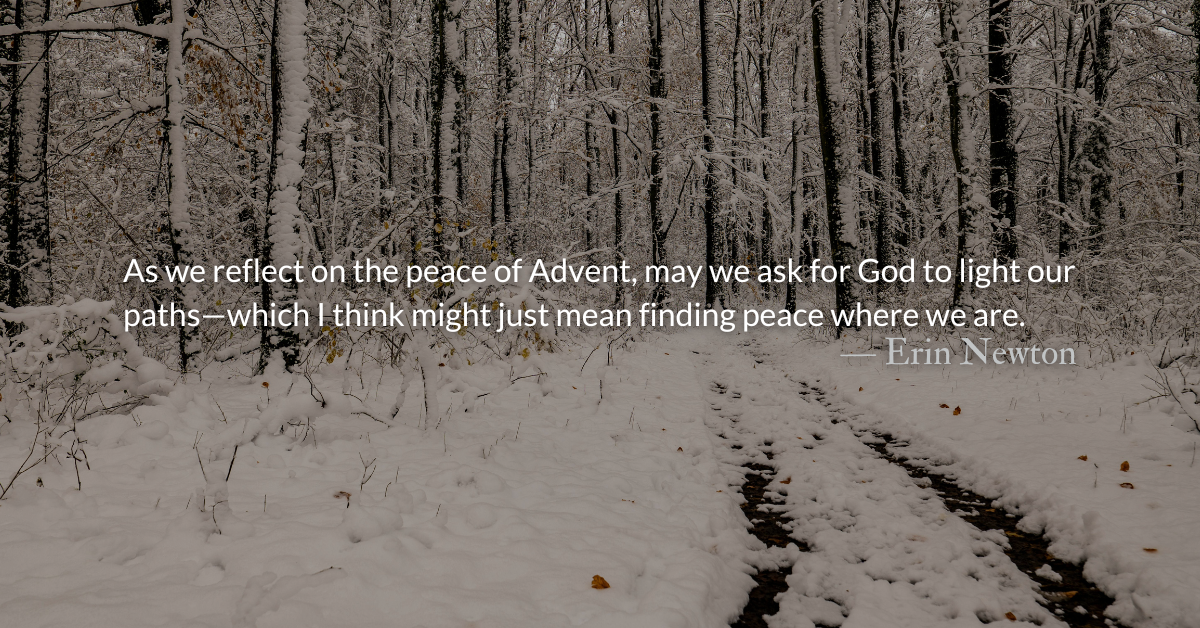
As we reflect on the peace of Advent, may we ask for God to light our paths—which I think might just mean finding peace where we are.

Divine Hours Prayer: The Request for Presence

Lead me, O Lord, in your righteousness,…make your way straight before me. — Psalm 5.8

– From The Divine Hours: Prayers for Autumn and Wintertime by Phyllis Tickle.

Read more: Peace from Uncertainty — Peace of Advent

This is no Canaanite tale of a weak god against the sea-serpent. This is Emmanuel. The God who puts the dragon on the leash…

Read The Bible With Us

Advent is a great time to join our Bible reading plan. Invite friends to read the Bible with us at a sustainable, two-year pace.

https://mailchi.mp/theparkforum/m-f-daily-email-devotional

The Absurdity of Peace – Peace of Advent

Links for today’s readings:

Dec 11  Read: 2 Chronicles 11-12 Listen: (6:00) Read: Psalms 119.25-48 Listen: (15:14)

Scripture Focus: Psalm 119: 41-42

41 May your unfailing love come to me, Lord,
    your salvation, according to your promise;
42 then I can answer anyone who taunts me,
    for I trust in your word.

Reflection: The Absurdity of Peace – Peace of Advent

By Erin Newton

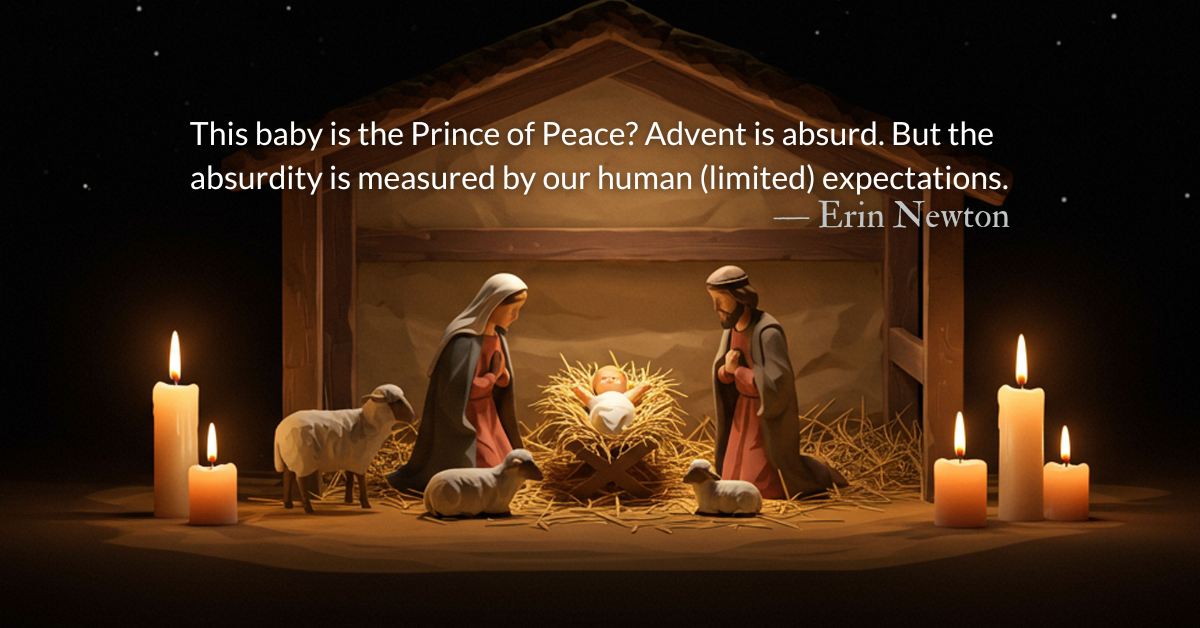
Every nativity scene portrays Jesus in his most vulnerable state. This baby is the Prince of Peace? The Almighty God? It sounds absurd.

But Advent is absurd. It is unthinkable that a God of infinite power would limit himself by taking on flesh or that a baby would rule nations. But the absurdity is measured by our human (limited) expectations.

It is the unimaginable aspect of Advent that draws us in each year. It is the unexpected works of God that we celebrate and we hope for. Advent reminds us that our hope does not align with what the world offers.

Though we know little from the text about Mary’s experience during pregnancy, we know that Joseph feared the community would shame her. Taunting was a real threat. Their journey could not have been without sideways glances or hushed whispers when she walked by. Joseph likely feared the taunts when people learned the truth. But she resolutely followed through with what God had called her to do—because she trusted in his word.

Most of us will not receive a level of taunting that causes anything more than hurt feelings, bruised egos, strained relationships, and perhaps a little embarrassment. But when we live fully trusting in God’s word, we might be questioned about our decisions or our demeanor. It is far more likely for a friend to ask a piercing “Why?” when we are following Christ.

Can we call these questions “taunts”? Probably not. We are not like Elijah on Mount Carmel battling the false prophets of Baal. But the motive behind the question hinges on the perspective that God being incarnated into a tiny baby is an absurd idea. Who is this God? Is he really all that powerful? Prove it.

The Prince of Peace’s first advent was in frailty and meekness and in a body completely dependent on two trusting parents. Mary and Joseph trusted in the words spoken to them. They faced potential ridicule because they trusted in God more than the world’s expectation.

As we look at the peace that came with Advent, we see the absurdity of it all. The Virgin pregnant. The Infinite in flesh. The Almighty swaddled.

The absurdity of the peace of Advent gives us confidence that we can face the world’s questions or criticisms. Our peace defies reality. Peace from God sometimes looks ridiculous. The peace born from Advent is unlike any other. Praise God.

Divine Hours Prayer: The Greeting

Seven times a day do I praise you, because of your righteous judgments. — Psalm 119.164

– From The Divine Hours: Prayers for Autumn and Wintertime by Phyllis Tickle.

Consider Supporting Our Work

Please consider becoming a donor. Support ad-free content that brings biblical devotionals to inboxes across the world.

Read more: Peace from Strife — Peace of Advent

There is the expectation…The Redeemer will come with swords and fire and plagues! But you turn the page and find a baby…

Peace in a World Not Our Home – Peace of Advent

Links for today’s readings:

Dec 10  Read: 2 Chronicles 10  Listen: (3:01) Read: Psalms 119.1-24 Listen: (15:14)

Scripture Focus: Psalm 119: 18-19

18 Open my eyes that I may see
    wonderful things in your law.
19 I am a stranger on earth;
    do not hide your commands from me.

Reflection: Peace in a World Not Our Home – Peace of Advent

By Erin Newton

“This world is not our own”—a phrase we have heard many times. It is an idea that ought to bring us peace. It should identify us as strangers on this earth. But we fall prey to the attempts of conforming to our world and its wishes, its desires, its motivations, its means.

But this world is not always kind, and motivations are often self-serving or abusive. The goals of one sometimes mean the subjugation of another. We cannot be at home here, not now, not as it is.

The prophets cried out in the wilderness against the same social injustices we have not found freedom from yet. We join the call: “Prepare the way for the Lord; make straight in the desert  a highway for our God” (Isa 40:3).

And so one day, Christ left his home in the heavens to abide with us. Now, he bids us all to leave our home here and join him. We are, in fact, strangers on earth.

We are estranged from the impulses of society, the human-centered goals of a self-centered populace. For such reasons, we must see the beauty and wonder of God’s law. We must find peace in going a different direction than what the world says is “the way.” The Way tells us to find our peace in him.

Wendell Berry expresses the need for “the peace of simple things” in his poem “The Want of Peace”:

     All goes back to the earth,
     and so I do not desire
     pride of excess power,
     but men who have had little:
     the fisherman’s silence
     receiving the river’s grace
     the gardener’s musing on rows.

     I lack the peace of simple things.
     I am never wholly in place.
     I find no peace or grace.
     We sell the world to buy fire,
     our way lighted by burning men,
     and that has bent my mind
     and made me think of darkness
     and wish for the dumb life of roots.

As we reflect on the peace of knowing we are truly strangers here—never exactly conforming, never assimilating to those around us—we find peace. The peace of Advent is rooting ourselves in who God calls us to be.

Let us find the peace of simple things. Let go of the ways of the world and embrace the beauty of God’s direction in your life. The peace of Advent calls us to our true home.

Divine Hours Prayer: A Reading

In due course John the Baptist appeared; he proclaimed this message in the desert of Judaea, ‘Repent, for the kingdom of Heaven is close at hand.’ This was the man spoken of by the prophet Isaiah when he said: A voice of one that cries in the desert, ‘Prepare a way for the Lord, make his paths straight.’ This man John wore a garment made of camel-hair with a leather loin-cloth round his waist, and his food was locusts and wild honey. Then Jerusalem and all Judaea and the whole Jordan district made their way to him, and as they were baptized by him in the river Jordan they confessed their sins. — Matthew 3.1-6

– From The Divine Hours: Prayers for Autumn and Wintertime by Phyllis Tickle.

Consider Supporting Our Work

If you appreciate our ad-free biblical content, please consider becoming a one-time or monthly donor.

Read more: People of Two Cities

The righteous, eternal city…is a city of people who trust God for their peace. It is a shelter for refugees escaping the wicked city.