
The Sound of Glory — Love of Advent

Links for today’s readings:

Dec 23  Read: 2 Chronicles 27-28 Listen: (6:27) Read:  Psalms 137-138 Listen: (2:13)

Scripture Focus: Psalm 138:1-5

1 I will praise you, Lord, with all my heart;

    before the “gods” I will sing your praise.

2 I will bow down toward your holy temple

    and will praise your name

    for your unfailing love and your faithfulness,

for you have so exalted your solemn decree

    that it surpasses your fame.

3 When I called, you answered me;

    you greatly emboldened me.

4 May all the kings of the earth praise you, Lord,

    when they hear what you have decreed.

5 May they sing of the ways of the Lord,

    for the glory of the Lord is great.

Luke 2:13-14

13 Suddenly a great company of the heavenly host appeared with the angel, praising God and saying,

14 “Glory to God in the highest heaven,

    and on earth peace to those on whom his favor rests.”

Reflection: The Sound of Glory — Love of Advent

By Jon Polk

The first piece to feature the chorus in George Frideric Handel’s Messiah is the bold and declarative “And the Glory of the Lord.” Here, as he does nearly twenty times in his masterwork, Handel sets to music words from the prophecy of Isaiah, specifically from chapter 40 verse 5.

And the glory, the glory of the Lord

Shall be revealed

And all flesh shall see it together

What exactly is God’s glory? It is a difficult concept to grasp. C.S. Lewis wrestled with the idea in his book, The Weight of Glory. Lewis attempted to define glory in one of two ways, “Either glory means to me fame, or it means luminosity.”

Regarding glory as fame, Lewis initially felt that fame was a shallow, selfish pursuit that seems unbecoming and out of character with the nature of God. However, upon further consideration and reflecting on the work of other theologians, Lewis reframed his understanding of fame as “good report” or “approval,” in the same manner as a parent approves of a child or an artist takes pleasure in her or his work. He writes,

For glory meant good report with God, acceptance by God, response, acknowledgment, and welcome into the heart of things. The door on which we have been knocking all our lives will open at last.

By this definition, glory is to be of “good report” with God, to be accepted and welcomed by God, to be known by God. As Lewis concludes, this is the deepest desire of all our hearts.

Consider the angels appearing in the fields outside Bethlehem proclaiming God’s glory and peace to a handful of ordinary shepherds. Never in their wildest dreams did those herdsmen imagine that the God of their forefathers would look down on their lowly lives and embrace them, delivering to them first the greatest news in human history.

The Christ Child entering into our world is a heavenly proclamation from God, “You are loved. You are welcome. You are accepted by me.”

Isaiah’s prophecy and the rousing choral setting from Handel are truly an anthem, a declaration that God’s glory has been revealed to us and in us. God welcomes us into the family. God smiles on us as an artist admires his creation. 

May our response be that of the psalmist: to praise God with our whole heart (138:1), to sing and proclaim the goodness of God (138:5), and to find strength in God’s embrace (138:3).

And about glory as luminosity, imagine having been out in the fields with the shepherds that night…

Divine Hours Prayer: The Request for Presence

May God be merciful to us and bless us, show us the light of his countenance and come to us.
Let your ways be known upon earth, your saving health among all nations. — Psalm 67.1-2

– From The Divine Hours: Prayers for Autumn and Wintertime by Phyllis Tickle.

Read more: From Silence, Peace :: Peace of Advent

We need the silence of Advent…time to turn off the noise of our self-reliance and to sit listening for God’s words of life. 

Consider Supporting Our Work

Our donors help us provide ad-free content that brings biblical devotionals to inboxes across the world. We’d like to do more. Become a donor to help us.

Call Him by Name — Love of Advent

Links for today’s readings:

Dec 22  Read: 2 Chronicles 26 Listen: (4:00) Read: Psalms 135-136 Listen: (5:03)

Scripture Focus: Psalm 135:13

13 Your name, Lord, endures forever,

    your renown, Lord, through all generations.

14 For the Lord will vindicate his people

    and have compassion on his servants.

Psalm 136:23-26

23 He remembered us in our low estate

    His love endures forever.

24 and freed us from our enemies.

    His love endures forever.

25 He gives food to every creature.

    His love endures forever.

26 Give thanks to the God of heaven.

    His love endures forever.

Matthew 1:20-21

20 But after he had considered this, an angel of the Lord appeared to him in a dream and said, “Joseph son of David, do not be afraid to take Mary home as your wife, because what is conceived in her is from the Holy Spirit. 21 She will give birth to a son, and you are to give him the name Jesus, because he will save his people from their sins.”

Reflection: Call Him by Name — Love of Advent

By Jon Polk

Many of Isaiah’s Messianic prophecies have been enshrined in popular consciousness thanks to the magnificent work of George Frideric Handel. Take, for example, the names of Jesus from Isaiah 9:6 sung by the chorus in “For Unto Us a Child Is Born” from Handel’s Messiah:

…and His name shall be called

Wonderful Counselor, the Mighty God

the Everlasting Father, the Prince of Peace…

Names are significant. The psalmist proclaims that God’s name and great renown will last forever, surpassing all earthly generations (135:13). In ancient Jewish thought, a name was tightly woven with the character of a person, capturing their essence, reputation and authority.

In Matthew’s Nativity account, the angel instructs Joseph to give Mary’s child the name Jesus, “because he will save his people from their sins” (1:21). Jesus is the Greek form of the Hebrew name Joshua, which means “the Lord saves.”

Jesus, literally “the Savior,” is…

Wonderful Counselor. Jesus is a compassionate counselor to his people, healing their afflictions and listening to their broken hearts. Jesus meets our needs, gently guides our steps, and imparts divine wisdom. As the psalmist notes of God, “he remembers us in our low estate” (136:23), walking alongside us in our times of need.

Mighty God. Jesus, while completely human, is also fully God, and being fully God, he is all-powerful. Jesus comes to our rescue, protects us from harm, and in an ultimate act of power and might, lays down his own life for ours. As the psalmist states, “he frees us from our enemies” (136:24), chief of which is our enslavement to sin.

Everlasting Father. Jesus, as God, exists eternally, without restraints due to time. Jesus, as a good father, provides for us, his children, and weeps with us in our anguish and pain. Jesus’ heart beats with a fatherly love for us. As the psalmist declares, “he gives food to every creature” (136:25), demonstrating paternal care.

Prince of Peace. Jesus is heavenly royalty, but not like the brutal warlords of ancient times. Jesus’ rule over the universe brings true, lasting peace, a peace that restores the broken relationship between humanity and God. It is a peace won through the sacrifice of his own life. For this, we echo the psalmist who encourages us to “Give thanks to the God of heaven” (136:26).

Consider which name and characteristic of Jesus you need most this Advent season. Call out to him with that name in confidence. Let your spirit sing along with the jubilant choir, “For unto us a child is born, unto us a Son is given!”

Divine Hours Prayer: The Request for Presence

Be my strong rock, a castle to keep me safe, for you are my crag and my stronghold; for the sake of your Name, lead me and guide me. — Psalm 31.3

– From The Divine Hours: Prayers for Autumn and Wintertime by Phyllis Tickle.

Read more: Silent Night — Carols of Advent Joy

Silent Night was born out of a period of insecurity

Consider Supporting Our Work

We need more donors just like you. Every donation, small or large, supports ad-free content that brings biblical devotionals to inboxes across the world.

Undoing Treason — Joy of Advent

Links for today’s readings:

Dec 19  Read: 2 Chronicles 22-23 Listen: (6:51) Read: Psalms 126-128 Listen: (1:58)

Links for this weekend’s readings:

Dec 20  Read: 2 Chronicles 24 Listen: (5:07) Read: Psalms 129-131 Listen: (2:03)
Dec 21  Read: 2 Chronicles 25 Listen: (5:12) Read: Psalms 132-134 Listen: (2:42)

Scripture Focus: 2 Chronicles 22.10-12

10 When Athaliah the mother of Ahaziah saw that her son was dead, she proceeded to destroy the whole royal family of the house of Judah. 11 But Jehosheba, the daughter of King Jehoram, took Joash son of Ahaziah and stole him away from among the royal princes who were about to be murdered and put him and his nurse in a bedroom. Because Jehosheba, the daughter of King Jehoram and wife of the priest Jehoiada, was Ahaziah’s sister, she hid the child from Athaliah so she could not kill him. 12 He remained hidden with them at the temple of God for six years while Athaliah ruled the land. 

2 Chronicles 23.1-3

1 In the seventh year Jehoiada showed his strength. He made a covenant with the commanders of units of a hundred: Azariah son of Jeroham, Ishmael son of Jehohanan, Azariah son of Obed, Maaseiah son of Adaiah, and Elishaphat son of Zikri. 2 They went throughout Judah and gathered the Levites and the heads of Israelite families from all the towns. When they came to Jerusalem, 3 the whole assembly made a covenant with the king at the temple of God. Jehoiada said to them, “The king’s son shall reign, as the Lord promised concerning the descendants of David.

11 Jehoiada and his sons brought out the king’s son and put the crown on him; they presented him with a copy of the covenant and proclaimed him king. They anointed him and shouted, “Long live the king!” 12 When Athaliah heard the noise of the people running and cheering the king, she went to them at the temple of the Lord. 13 She looked, and there was the king, standing by his pillar at the entrance. The officers and the trumpeters were beside the king, and all the people of the land were rejoicing and blowing trumpets, and musicians with their instruments were leading the praises. Then Athaliah tore her robes and shouted, “Treason! Treason!”

Reflection: Undoing Treason — Joy of Advent

By John Tillman

A wicked usurper takes the throne, slaughtering the royal family. A princess hides the youngest heir with an old priest who raises him in secrecy. Then, at the right time, the priest reveals the young prince, restoring the nation’s rightful ruler.

When the wicked queen sees the legal heir surrounded by supporters and proclaimed as the rightful king, she cries, “Treason!” But the only treason was hers. The priest’s conspirators are not committing treason. They are undoing it. And the nation rejoices.

We’ve read (and written) about Athaliah and Joash in Kings. Joash fits the common literary trope of the “hidden heir.” Each variation changes some details, but Caspian, Trillian, and Cor/Shasta from The Chronicles of Narnia, Luke and Leia from Star Wars, and Rapunzel from Tangled use the elements.

As usual, the chronicler has a different focus. Kings concerns itself with political and military matters. Chronicles highlights the liturgical and spiritual background. Both accounts tell of Jehoiada’s instructions to his coalition. Only Chronicles tells us Jehoiada’s theological reasoning. “The king’s son shall reign,” he says, because this is what “the Lord promised.” For Jehoiada, this plot is not his or carried out by his cleverness or strength. It is the will of God.

Advent is, in a way, like Jehoiada’s plot to undo Athaliah’s treason.

Jesus, the King of Kings, is hidden now in heaven, we are hidden in him, and he is hidden in us. On earth, Satan’s treasonous rebellion has dominion over thrones, powers, rulers, and authorities. We are the resistance movement, working under Satan’s nose to reveal the true kingdom to as many as possible. At the right time, the joyous day will come when treason is undone and the true Son, the King of Kings, will be fully revealed. 

Our resistance movement is both similar to and different from Jehoiada’s.

Jehoiada had a political mission and used tools of politics and warfare. Our mission differs because our kingdom is not of this world. So our methods are testimony, service, and sacrifice, not the sword.

For years, Joash lived in the temple, immersed in worship and the scriptures. We must devote ourselves to worship and scripture. They prepare us for the coming kingdom.

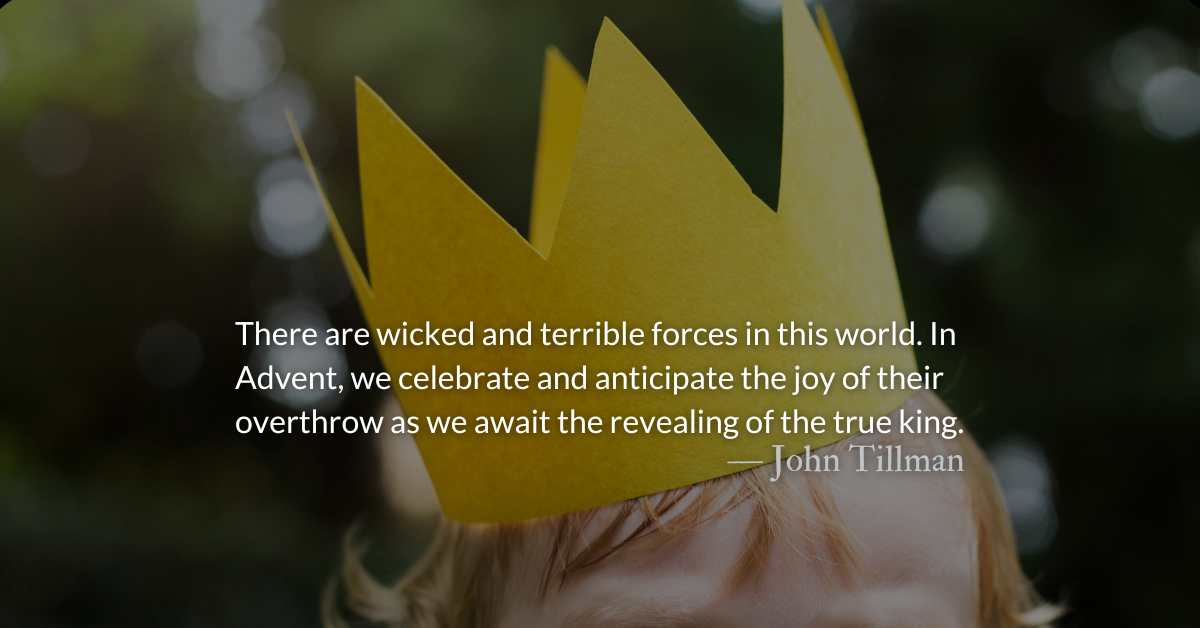
There are wicked and terrible forces in this world. In Advent, we celebrate and anticipate the joy of their overthrow as we await the revealing of the true king.

Divine Hours Prayer: The Greeting

Happy are they whom you choose and draw to your courts to dwell there! They will be satisfied by the beauty of your house, by the holiness of your temple. — Psalm 65.4

– From The Divine Hours: Prayers for Autumn and Wintertime by Phyllis Tickle.

Read more: Hidden Co-heirs

Wickedness and evil will be thrown down and all who follow Jesus will be co-heirs with him when he is marvelously revealed.

Read more: Eating the Book :: Joy of Advent

One of the simplest practices that can make Advent a time of transformative joy is regular Bible reading.

To No One’s Regret — Joy of Advent

Links for today’s readings:

Dec 18  Read: 2 Chronicles 21 Listen: (3:25) Read: Psalms 123-125 Listen: (1:32)

Scripture Focus: 2 Chronicles 21.20

20 Jehoram was thirty-two years old when he became king, and he reigned in Jerusalem eight years. He passed away, to no one’s regret, and was buried in the City of David, but not in the tombs of the kings.

Reflection: To No One’s Regret — Joy of Advent

By John Tillman

The chronicler’s harsh words about Jehoram’s death have been repeated about many distasteful people in history. “He passed away, to no one’s regret.”

They also remind us of the visions the Ghost of Christmas Yet to Come shows Ebenezer Scrooge. Scrooge sees reactions to the death of an unmourned man. His business associates scoff at the cheap funeral. His house staff steal valuables. The man is, of course, Scrooge. Prior to his repentance, Scrooge created wealth but no goodness. Worse than that, he caused pain, suffering, and hardship without mercy, compassion, or empathy. He touched no one’s life. He only collected their fees. For these reasons he dies to no one’s regret.

By contrast, in It’s a Wonderful Life, Clarence comments on the awful alternate version of Bedford Falls that exists without George Bailey in it. “Each man’s life touches so many other lives. When he isn’t around he leaves an awful hole.”

These fictional tales of alternate realities show two ways to “leave an awful hole.” Bailey left a hole by the absence of his self-sacrifice, compassion, and bravery. Scrooge left a hole by the presence of his greed, cruelty, and mercilessness.

Jehoram was more merciless and wicked than any Christmas movie villain. He murdered his brothers and undid the spiritual progress his father made. The only joy associated with Jehoram was at his death.

Mary prophesied that the unborn Jesus would bring down “rulers from their thrones.” Part of the joy of Advent is awaiting the justice Jesus will bring. There are many “rulers” we have suffered or will suffer under. Some rulers, like Jehoram and Herod, may perhaps die in embarrassing and public demonstrations of God’s judgment (2 Chronicles 21.18-19; Acts 12.21-22) “to no one’s regret.”

But Jesus primarily throws down other tyrants. Our inner sinful nature is a tyrant we carry in our minds and hearts. Death, sin, and Satan are the tyrants of all tyrants. These are the powers, rulers, and authorities that Christ publicly humiliates and throws down. (Colossians 2.15)

Mary celebrated joyously before Jesus was even born. We also celebrate joy before its full completeness. We both participate in and demonstrate the results of Christ’s work by creating goodness, easing hardship, and working for justice. Let us be repentant Scrooges, ever filling holes in others’ lives rather than leaving them.

When our lives are over, may “good and faithful servant” be said rather than “to no one’s regret.”

Divine Hours Prayer: The Morning Psalm

Come now and see the works of God, how wonderful he is in his doing toward all people.
In his might he rules forever; his eyes keep watch over the nations; let no rebel rise up against him.
Bless our God, you peoples; make the voice of his praise to be heard;
Who holds our soul in life, and will not allow our feet to slip. — Psalm 66.4, 6-8

– From The Divine Hours: Prayers for Autumn and Wintertime by Phyllis Tickle.

Read more: Justice Brings Joy — Joy of Advent

Let him find us faithfully at work sowing the gospel, establishing righteousness, and distributing a harvest of justice.

Consider Supporting Our Work

To do more, we need more support. Please consider becoming a donor to support new ways and types of biblical content.

The Calculating Weapon of Joy — Joy of Advent

Links for today’s readings:

Dec 17   Read: 2 Chronicles 19-20 Listen: (8:09) Read:  Psalms 120-122 Listen: (2:12)

Scripture Focus: 2 Chronicles 20.20-28

20 Early in the morning they left for the Desert of Tekoa. As they set out, Jehoshaphat stood and said, “Listen to me, Judah and people of Jerusalem! Have faith in the Lord your God and you will be upheld; have faith in his prophets and you will be successful.” 21 After consulting the people, Jehoshaphat appointed men to sing to the Lord and to praise him for the splendor of his holiness as they went out at the head of the army, saying: 

     “Give thanks to the Lord, 
         for his love endures forever.” 

22 As they began to sing and praise, the Lord set ambushes against the men of Ammon and Moab and Mount Seir who were invading Judah, and they were defeated. 23 The Ammonites and Moabites rose up against the men from Mount Seir to destroy and annihilate them. After they finished slaughtering the men from Seir, they helped to destroy one another. 24 When the men of Judah came to the place that overlooks the desert and looked toward the vast army, they saw only dead bodies lying on the ground; no one had escaped. 25 So Jehoshaphat and his men went to carry off their plunder, and they found among them a great amount of equipment and clothing and also articles of value—more than they could take away. There was so much plunder that it took three days to collect it. 26 On the fourth day they assembled in the Valley of Berakah, where they praised the Lord. This is why it is called the Valley of Berakah to this day. 27 Then, led by Jehoshaphat, all the men of Judah and Jerusalem returned joyfully to Jerusalem, for the Lord had given them cause to rejoice over their enemies. 28 They entered Jerusalem and went to the temple of the Lord with harps and lyres and trumpets.

Reflection: The Calculating Weapon of Joy — Joy of Advent

By John Tillman

Happiness works fine in good times. As long as the lights stay on and nothing goes wrong, you might mistake happiness for joy. But they aren’t the same.

King Jehoshaphat had many reasons for happiness. A bright spot among the kings of Judah, Jehoshaphat beat back the darkness of idolatry, systemized spiritual education in God’s law, and revitalized temple worship. His military strength reminds us of David’s and his wealth reminds us of Solomon’s.

But he might have been too happy. Jehoshaphat was happily at peace with Israel but the prophet Jehu warned that his military cooperation with them helped “the wicked” and brought God’s wrath.

Then, darkness grew on the horizon. Enemy nations combined armies to attack. In response, Jehoshaphat went to the temple, not the battlements. He cried out toward God’s altar instead of shouting orders from a chariot. Perhaps Jehoshaphat assumed this was God’s wrath and the solution was mercy, not might.

God answered through Jahaziel, who prophesied that God would fight for Judah. Jahaziel descended from the prolific psalmist, Asaph. Perhaps this is why Jehoshaphat put singing men rather than swordsmen at the front of the army. All they had to do was sing and pick up the spoils. This was joyful, but not rational. By God’s mercy, Jehoshaphat found joy even before the victory.

I’ve acted in musicals where a song solved problems. I’ve watched action films in which musical training montages helped win battles. That’s not reality most of the time and not our intended lesson.

Most battles aren’t won by singing psalms. Certainly some in Jerusalem sang psalms when Babylon conquered Jerusalem. Jesus quoted Psalm 22 on the cross. Many martyrs met death with psalms or scripture on their lips. Worship isn’t magic. However, joy is a weapon against darkness—the weapon of vision.

Joy is not naiveté or denial. Happiness is naive—not joy. Happiness can be spoiled, broken, or stolen. Not joy. Joy acknowledges, even accepts, pains and darkness because it sees what happiness can’t. Joy recognizes that our solution is mercy, not might and the battle is already won. Joy sees the ultimate truth of Jesus’ victory even when it looks like a cross.

Even before victory arrives, joy calculates its inevitable reality. Joy plots a line from manger, to cross, to empty tomb. This line points unbendingly to our joyful destiny and nothing can separate us from it.

Divine Hours Prayer: The Greeting

Your love, O Lord, reaches to the heavens, and your faithfulness to the clouds. — Psalm 145.1

– From The Divine Hours: Prayers for Autumn and Wintertime by Phyllis Tickle.

Read more: Unexpected Victory — Joy of Advent

Advent is the unassuming mustard seed from which sprouts the unexpected joy of gospel victory.

Consider Supporting Our Work

The only way our work continues is with continued support from readers like you. Please consider becoming a donor.