Last Priest Standing

Scripture: Hebrews 7.27
Unlike the other high priests, he does not need to offer sacrifices day after day, first for his own sins, and then for the sins of the people. He sacrificed for their sins once for all when he offered himself.

Reflection: Last Priest Standing
By Jon Polk

Melchiz-a-who?

Quoting Psalm 110:4, the book of Hebrews favorably compares Jesus several times to the mysterious Melchizedek. The only other biblical reference to this king-priest is a brief interaction with Abraham in Genesis. The name Melchizedek means “king of righteousness” and he was the king of Salem, which is “king of peace.” Certainly, Jesus fits both of these titles.

However, foremost in the comparison is the acknowledgment that Jesus has become our priest forever, as Melchizedek’s life was said to have no beginning and no end.

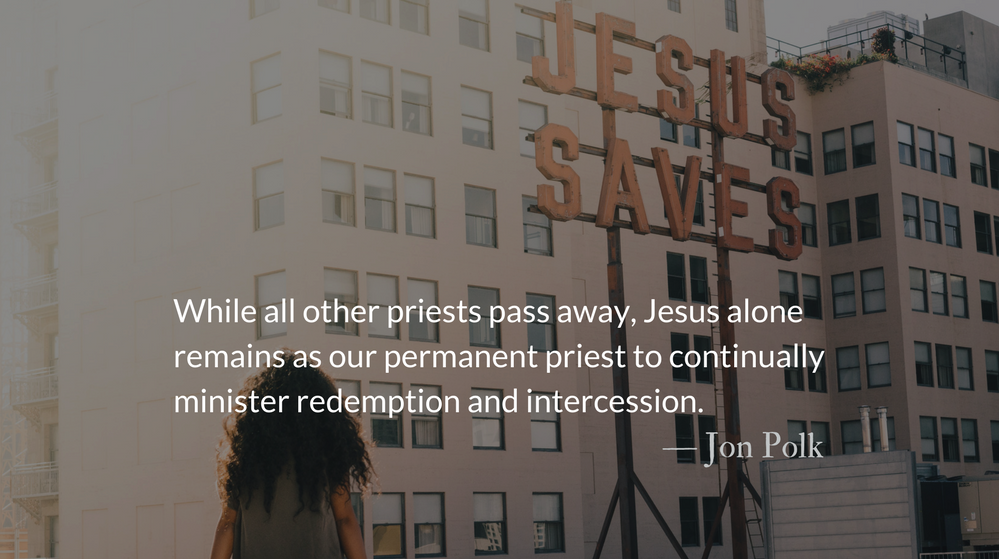
Under the old Levitical priestly system, a plurality of priests came and went; they were temporal, finite human ministers. Jesus (like Melchizedek) was not a Levite. He was from the tribe of Judah. While all other priests pass away, Jesus alone remains as our permanent priest to continually minister redemption and intercession.

Jesus’ personal sacrifice was so perfect and complete that it put an end to sacrifice itself. It put an end to the rote and routine rituals practiced by the Levitical priests. He did not need to make sacrifices for his own sins – he had none – nor does he need to make sacrifices repeatedly for our sins. The sacrifice of his own life was the last and only sacrifice necessary for our salvation.

Jesus’ high priestly ministry on our behalf is perpetual, never-ending. If we could grasp the full ramifications of this reality, it would radically impact our daily lives.

We can rest in the security of knowing that our eternal priest, Jesus the Christ, is forever working for the salvation of those who seek him and he is alive to intercede before God on our behalf.

Considering this continual priestly work of Jesus Robert Murray M’Cheyne, a Scottish minister in the early 1800s, wrote:

I ought to study Christ as an Intercessor. He prayed most for Peter who was to be most tempted. I am on his breastplate. If I could hear Christ praying for me in the next room, I would not fear a million of enemies. Yet the distance makes no difference; he is praying for me!

We would be wise to consider what practices of our faith have become routine and need to be revitalized by the living presence of Christ.

May we remind ourselves regularly of the powerful intercessor and high priest we have working for our good.

Prayer: A Reading
Let all who seek you rejoice and be glad in your; let those who love your salvation say forever, “Great is the Lord!” — Psalm 70.4

– Prayer from The Divine Hours: Prayers for Springtime by Phyllis Tickle.

Full prayer available online and in print.

Today’s Readings
Song of Songs 7 (Listen – 1:55)
Hebrews 7 (Listen – 4:01)

The Long Journey to Maturity

Scripture: Hebrews 6.11-12
We want each of you to show this same diligence to the very end, so that what you hope for may be fully realized. We do not want you to become lazy, but to imitate those who through faith and patience inherit what has been promised.

Reflection: The Long Journey to Maturity
By Jon Polk

“Now I know my ABCs. Next time won’t you sing with me?”

Letters of the alphabet are the elementary building blocks of language. The learner must comprehend the sounds of letters before combining letters to make works, before combining words to make sentences, and so on.

Once the student has mastered a language, it would be foolish and useless to continue to rehearse the very basic ABCs.

Like language learning, there are no shortcuts to spiritual maturity, but how will we know when we have arrived? We must move past merely knowing the basic teachings about Christ’s life, death and resurrection and beyond simply acknowledging our need for faith and repentance.

To be sure, no one but our sinless high priest Jesus will ever be fully spiritually mature in this lifetime, but there are some indicators to help us know we are headed in the right direction.

As rain-soaked land is expected to produce a bountiful crop, the mature Christian should produce what Paul describes to the Galatians as the fruits of the spirit, i.e. God-honoring, selfless character traits. As land that produces thorns instead of crops is worthless, James declares that faith that does not produce actions is dead, useless.

Marks of spiritual maturity include character growing in likeness to God and actions that demonstrate our love for God and care for his people. In reality, we can never truly arrive; this is a never-ending process.

In his book, A Long Obedience in the Same Direction, Eugene Peterson describes discipleship—the process by which we mature spiritually—as a lifelong journey:

For recognizing and resisting the stream of the world’s ways there are two biblical designations for people of faith that seem useful: disciple and pilgrim. Disciple says we are people who spend our lives apprenticed to our master, Jesus Christ. Pilgrim tells us that we are people who spend our lives going someplace, going to God, and whose path for getting there is the way, Jesus Christ.

Indeed, the journey of spiritual maturity is a one-way trip. We are warned of the dangers of falling away after tasting the goodness of God. Our calling is to diligently work until the end of our lives, moving forward ever onwards towards maturity.

As the writer of the anonymous hymn succinctly stated, “I have decided to follow Jesus, no turning back, no turning back.”

Prayer: A Reading
Let all who seek you rejoice and be glad in your; let those who love your salvation say forever, “Great is the Lord!” — Psalm 70.4

– Prayer from The Divine Hours: Prayers for Springtime by Phyllis Tickle.

Full prayer available online and in print.

Today’s Readings
Song of Songs 6 (Listen – 1:48)
Hebrews 6 (Listen – 2:58)