Hope in Times of Terror :: Readers’ Choice

I remember reading this devotional as I was preparing for the funeral services for my mother-in-law who died of cancer at a young age. The words were a reminder of God’s truth at just the right moment: He was with me as I wept, but was also reminding me of the hope we have in Him. — Rob

Readers’ Choice (Originally published July 18, 2016)

But the angel said to the women, “Do not be afraid, for I know that you seek Jesus who was crucified. He is not here, for he has risen, as he said.” — Matthew 28.5-6

If, as Jill Lepore has said, “watching people shoot one another has become an obligation of American citizenship,” then watching people around the world weep in the wake of terror has become an obligation of global citizenship.

We want to look away. Every few weeks I spend a day writing from a coffee shop nestled 8,200’ up in the Rocky Mountains. Inside The New York Times gets stacked upside down whenever images of terror take over above the fold. After watching, I realized it’s not the employees, but the customers who reposition the paper.

Jesus did not look away. When faced with the brutality of death, Jesus walked toward it—and wept. We must reflect on this—God, broken with us at the brutality and injustice of our world.

Then—when everyone thought it was too late and that God had, yet again, missed his opportunity to make everything all right—he called out Lazarus from the grave. What was lost was restored. Injustice of death’s sting replaced by the celebration of resurrection.

And so we cling to this hope. English poet George Herbert said the promise of resurrection is that death is no longer an executioner, but a gardener. “When he tries to bury you, he’s really planting you, and you’re going to come up better than before.”

And so, for today—for a world shattered by terror—a meditation from from Psalm 46:

God is our refuge and strength, a very present help in trouble.

Therefore we will not fear though the earth gives way, though the mountains be moved into the heart of the sea, though its waters roar and foam, though the mountains tremble at its swelling.

Pause and reflect.

There is a river whose streams make glad the city of God, the holy habitation of the Most High. God is in the midst of her; she shall not be moved; God will help her when morning dawns. The nations rage, the kingdoms totter; he utters his voice, the earth melts. The Lord of hosts is with us; the God of Jacob is our fortress.

Pause and reflect.

“Be still, and know that I am God. I will be exalted among the nations, I will be exalted in the earth!”

The Lord of hosts is with us; the God of Jacob is our fortress.

Pause and reflect.

Today’s Reading
Jeremiah 38 (Listen – 5:18)
Psalms 11-12 (Listen – 1:59)

Submit a devotional for Readers’ Choice

Contribute your favorite Park Forum devotionals to Readers’ Choice.

Email me the title or link. If you don’t mind adding a sentence or two as to why each post was significant to you, I would love to include your voice as well.

Thanks for being part of The Park Forum community. We are so thankful to be part of your devotional rhythm.
The Garden of Anguish :: Readers’ Choice

This one was such a kick in the gut, knowing that at the Cross, hell came down and could not break the grip of Christ’s love for me. I needed to hear all over again how great that cost was. — Scott

Readers’ Choice (Originally published March 23, 2016)

Then Jesus said to them, “My soul is very sorrowful, even to death; remain here, and watch with me.” — Matthew 26.38

The Son of God, who rhythmically withdrew from all human contact to pray, now asks his disciples to journey with him into the garden. He did not want to be left alone.“Father, take this cup.” The prayer of Christ would go unanswered.

For the first time in all of eternity, “Jesus Christ turned toward the Father and there was nothing there but the abyss,” remarks Timothy Keller. “There was nothing there but the darkness that opens out into an infinite nothing. He turned, expecting heaven and the Father, and there was hell.” Blood vessels ruptured under stress—his body being forced toward death long before the cross—as the weight of sin fell upon our savior. Keller explains:

As he began to walk, he began to experience the wrath of God. He began to actually experience God turning away from him. How does God punish sin? The Bible tells us (it’s almost poetic justice) the sinful human heart wants to get away. It wants to be away from God. It wants to be able to be its own master. So the way God punishes sin is to give the heart what it wants.

Jesus received what we deserved—what we have earned. From his birth to his resurrection, Christ did for us what we are unable to do. He loved God fully and loved man perfectly. He gave his life that we may live. Though we see this, we have trouble reorienting our lives in response.

We do not want to accept such a sacrifice. We do not want to cost of our sin to be so high. We do not want to live indebted to grace so deep. Christ’s love shines through the night, even while our love flickers in the wind. Keller concludes:

We don’t trust him. We’re afraid he might not have our best interest in mind, that he might ask us to do something that won’t be really good for us. So on the one hand, we don’t really trust him, but on the other hand, we don’t really trust ourselves. One of the reasons why we don’t give ourselves wholly and utterly and completely is because we’re afraid of failure.

Here is a love that hell came down on. His love for you—hell came down on it—and it didn’t eat through it. His love for you, hell came down on it, and it didn’t break it.

Today’s Reading
Jeremiah 37 (Listen – 3:25)
Psalm 10 (Listen – 2:13)

Submit a devotional for Readers’ Choice

Contribute your favorite Park Forum devotionals to Readers’ Choice.

Email me the title or link. If you don’t mind adding a sentence or two as to why each post was significant to you, I would love to include your voice as well.

Thanks for being part of The Park Forum community. We are so thankful to be part of your devotional rhythm.
When Church Leaders Let Us Down :: Readers’ Choice

The Tolkien quote hit me for I too have suffered in my life from church leadership. For years I have wanted to take up pitchforks and torches and storm the doors of various churches from my past. And in recent years I have quoted Matt 23:3 often. As I read the essay the weight of God’s grace hit me. So I am working through my past as an act of will, inspired by love. — Brian

Readers’ Choice (Originally published July 13, 2016)

[Jesus instructed,] “Do and observe whatever they tell you, but not the works they do.” — Matthew 23.3

Jesus was fantastically under-impressed with the religious leaders of his day. And yet this didn’t diminish his love for God, faithfulness to live according to the Scriptures, or passion for the Church in the slightest.

Eugene Peterson, in his paraphrase of the Bible, highlights the reasons behind Christ’s frustration and the way he resets the conversation on failed leadership:

Instead of giving you God’s Law as food and drink by which you can banquet on God, they package it in bundles of rules… They seem to take pleasure in watching you stagger under these loads, and wouldn’t think of lifting a finger to help.

Their lives are perpetual fashion shows, embroidered prayer shawls one day and flowery prayers the next. They love to sit at the head table at church dinners, basking in the most prominent positions, preening in the radiance of public flattery, receiving honorary degrees, and getting called ‘Doctor’ and ‘Reverend.’

Don’t let people do that to you, put you on a pedestal like that. You all have a single Teacher, and you are all classmates. Don’t set people up as experts over your life, letting them tell you what to do. Save that authority for God; let him tell you what to do.

Do you want to stand out? Then step down. Be a servant. If you puff yourself up, you’ll get the wind knocked out of you. But if you’re content to simply be yourself, your life will count for plenty.

J.R.R. Tolkien, in a letter to his son who was thinking of leaving the church, confessed, “I have suffered grievously in my life from stupid, tired, dimmed, and even bad priests.” Even still, the elder Tolkien revealed, he would not leave the church over failed clergy.

His reasoning is profoundly similar to the argument Christ makes: “For myself, I find I become less cynical rather than more—remembering my own sins and follies.”

Leaders of the church fail because they are not the leader of the church. They are, like you and I, fellow sinners and sufferers who sit under the authority of Christ. So how should we respond when church leaders let us down? By grace. This is, of course, the heart of Christianity—and a choice—as Tolkien reminds, “faith is an act of will, inspired by love.”

Today’s Reading
Jeremiah 36 (Listen – 5:54)
Psalm 9 (Listen – 2:21)

Submit a devotional for Readers’ Choice

Contribute your favorite Park Forum devotionals to Readers’ Choice.

Email me the title or link. If you don’t mind adding a sentence or two as to why each post was significant to you, I would love to include your voice as well.

Thanks for being part of The Park Forum community. We are so thankful to be part of your devotional rhythm.
When the World Needs Us to Look :: Readers’ Choice

This is a hard article to read. Our Enemy loves to steal, kill and destroy. How else can we explain these barrel bombs—lobbed into family dwellings? Pray for these folks—the victimizers and the victims. — Steve

Readers’ Choice (Originally published June 24, 2016)

I spent the first five years of my professional life as a paramedic in the critical care, neonatal transport, and 911 systems of Dallas and Fort Worth, TX. I’ve been around gunfire three times; once my partner and I were shot at, the other two times we were simply far too close when shots were fired on others. Although both warrant immediate action, if I’m honest I’ll admit I generally prefer shot-near to shot-at.

I’ll never forget the first time my tactical boot stepped in a deep enough puddle of blood that it rippled as I walked toward my patient. I’ll never forget carrying the lifeless bodies of children toward the ambulance while their parents chased after us, praying and hoping we could help.

Our culture is designed to insulate us from the realities medical professionals face each day—even more from the stories of those who give their lives to serve the marginalized through organizations like Doctors Without Borders.

The barrier was broken this past week by Ben Taub’s haunting New Yorker article, The Shadow Doctors. As I read Taub’s account of the small group of doctors serving and suffering in Syria, I found myself wanting to look away. Then I realized this impulse—to return to my comfortable life—is among the greatest tragedies of the modern world: instead of facing reality, we have the option to turn away. Taub writes:

For almost a year, Syrian government helicopters had been lobbing barrels filled with shrapnel and TNT onto markets, apartment blocks, schools, and hospitals.

In the aftermath of a barrel-bomb attack, [Dr. David Nott] said, “as you walked down the stairs to the emergency department, you just heard screams.” Barrel bombs blow up entire buildings, filling the air with concrete dust; many people who survive the initial explosion die of suffocation minutes later. Every day, patients arrived at the hospital so mangled and coated in debris that “you wouldn’t know whether you were looking at the front or the back, whether they were alive or dead,”

When barrel bombs fall on homes, they often send entire families to the ward. One day, five siblings arrived. Unable to treat any of them, Nott started filming the scene, so that he would have proof, he said, of “how terrible it was.” A baby with no feet let out a stifled cry, then died. An older brother lay silently nearby, his guts coming out. In the next room, a toddler with blood on his face shouted the name of his dying brother.

Two medical workers carried in the fourth brother, who was about three years old. His pelvis was missing, and his face and chest were gray with concrete dust. He opened his eyes and looked around the room, blinking, without making a noise.

The boy was dying. There was no treatment; he had lost too much blood, and his lungs had filled with concrete particles. Nott held his hand for four agonizing minutes. “All you can do is just comfort them,” he told me. I asked him what that entailed, since [the hospital] had exhausted its supply of morphine. He began to cry, and said, “All you can hope is that they die quickly.”

Dr. Nott has trained a team of medical professionals to serve in a network of underground hospitals. They are so effective the Syrian government has started to target them for assassination.

Shots have been fired at our global brothers and sisters, and their lives are near enough to ours that it should move us to action. The global refugee crisis is a massive problem—yet it is not beyond the sufficiency of Christ’s work of restoration in and through his Church.

Refugees and immigrants need our prayers and action on their behalf. Organizations serving in this crisis need our support. Government officials working toward justice need to hear our voices speaking out for the fatherless and the marginalized. The blood of innocent children will ripple as we move toward those that need our help the most—but we cannot look away.

Weekend Reading List

Today’s Reading
Jeremiah 33 (Listen – 4:46)
Psalms 3-4 (Listen – 1:56)

This Weekend’s Readings
Jeremiah 34 (Listen – 4:15) Psalms 5-6 (Listen – 2:45)
Jeremiah 35 (Listen – 3:43) Psalms 7-8 (Listen – 2:58)

Submit a devotional for Readers’ Choice

Contribute your favorite Park Forum devotionals to Readers’ Choice.

Email me the title or link. If you don’t mind adding a sentence or two as to why each post was significant to you, I would love to include your voice as well.

Thanks for being part of The Park Forum community. We are so thankful to be part of your devotional rhythm.

The Soul of Shame :: Readers’ Choice

Too often I am consumed by the shame of my sin and continue to dwell in it and not focus my eyes on the one who has already won the victory. The grace that we continue to receive day in and day out propels us not to sin more but to run to the one who loves us even harder. — Dalton

Readers’ Choice (Originally published June 7, 2016)
By Curt Thompson, MD

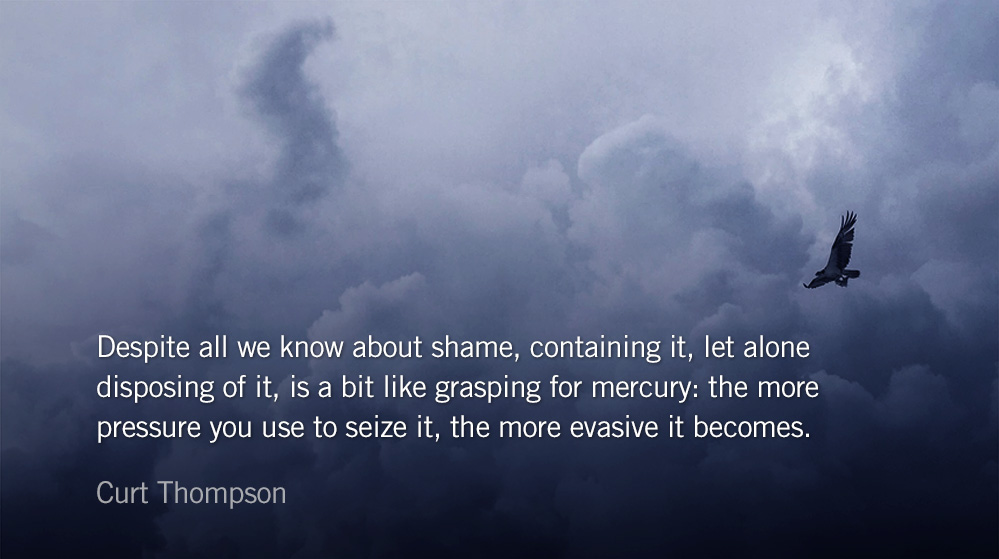
Despite all we know about shame, containing it, let alone disposing of it, is a bit like grasping for mercury: the more pressure you use to seize it, the more evasive it becomes.

Typically, whenever researchers study and discuss shame, we do so as though it is some abstract emotional or cognitive phenomena. We describe shame as something we would do well to better regulate, but not as an entity that has a conscious will of its own.

But I believe we live in a world in which good and evil are not just events that happen to us but rather expressions of something or someone whose intention is for good or for evil. And I will suggest that shame is used with this intention to dismantle us as individuals and communities, and destroy all of God’s creation.

Putting shame to death is not simply about addressing it as a deeply destructive emotional and relational nuisance. For we cannot speak of shame without speaking of creation and God’s intention for it. From the beginning it has been God’s purpose for this world to be one of emerging goodness, beauty and joy. Evil has wielded shame as a primary weapon to see to it that that world never happens.

Consequently, to combat shame is not merely to wrestle against something we detest. Shame is not just a consequence of something our first parents did in the Garden of Eden. It is the emotional weapon that evil uses to corrupt our relationships with God and each other and disintegrate any and all gifts of vocational vision and creativity.

Shame, therefore, is not simply an unfortunate, random, emotional event that came with us out of the primordial evolutionary soup. It is both a source and result of evil’s active assault on God’s creation, and a way for evil to try to hold out until the new heaven and earth appear at the consummation of history.

Combating shame requires more work than you might imagine. Shame’s power lies not so much in facts that we can clarify but rather in its emotional state, which is so much harder to shake.

Throughout this book you will read the stories of people like you and me who are wrestling with shame and doing their best to fix their eyes on Jesus, do what he did, and despise it on the way to being liberated to create as they were so intended from the beginning.

*Excerpt from Curt Thompson, The Soul of Shame: Retelling the Stories We Believe About Ourselves. IVP Books, 2015. Book review at Hearts and Minds Books.

Today’s Reading
Jeremiah 32 (Listen – 7:34)
Psalms 1-2 (Listen – 2:05)

Submit a devotional for Readers’ Choice

Contribute your favorite Park Forum devotionals to Readers’ Choice.

Email me the title or link. If you don’t mind adding a sentence or two as to why each post was significant to you, I would love to include your voice as well.

Thanks for being part of The Park Forum community. We are so thankful to be part of your devotional rhythm.