O Come, All Ye Faithful :: Advent’s Joy

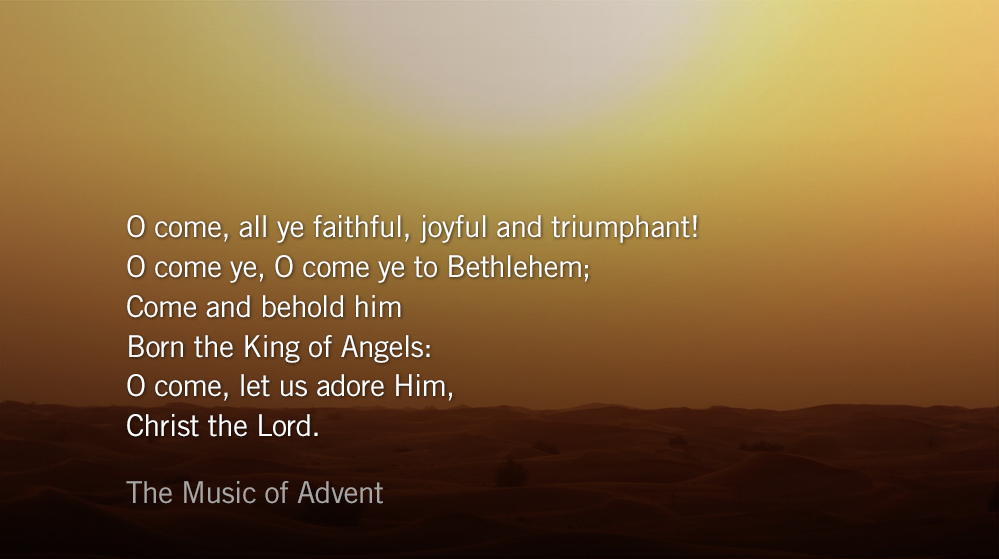
John Francis Wade was a published hymnist and a rebel who died in exile—though little else is known about his life. The song he is now best known for, “O Come, All Ye Faithful,” was originally believed to be an anonymous Latin hymn. Recently discovered fragments of Wade’s journal revealed the four original stanzas, penned in 1744, and the centrality that faith played in his life.

Not long after he completed the hymn, Wade filled the margins of the page with calls for the Jacobites to rally against England’s King. It’s unclear how entwined the lyrics of “O Come, All Ye Faithful” were with the Jacobites larger mission—the then century-old commitment to restore the lineage of James II—although it is clear that the hymn is a rallying cry at its heart.

History did not favor the rebels. The Jacobite Rising of 1745 was decisively defeated by the British in less than a year. The uprising’s leader had a price placed on his head and fled to France with what was left of his men.

“Oh Come, All Ye Faithful” was originally written in French and published in England in 1751, between the Jacobite exile and Wade’s death in Douai, France. The hymn fell into relative obscurity until it was translated into English by Frederick Oakeley in 1841.

Nearly a century after Wade first marveled at the Christ, the song would be adopted by the Church, with new verses added and translations made into over 100 languages.

John Francis Wade also left a reminder that Christ’s birth is a rally cry. All earthly kings must be displaced. Wade wanted to replace them with kings of his own choosing; Christ’s call is for purity in lordship—he is a good King and he will not share the throne.

Through Wade’s words, we are also reminded of the power of awe. It is rare, even more in our world than his, to stop and marvel. But what we find in meditations strengthens our souls, readies our hearts for action, and roots our lives in the true faithful one.

ListenO Come, All Ye Faithful by The Baylor University A Cappella Choir (2:59 – lyrics below)

Today’s Reading
Zechariah 1 (Listen – 3:37)
John 4 (Listen – 6:37)
Hark the Herald Angels Sing :: Advent’s Joy

Christmas is a musical outlier—no other modern holiday is set to its own soundtrack. The downside to seasonal music is that nearly everyone has a Christmas song that they can’t stand. Little Drummer Boy, Feliz Navidad, and Santa Baby occur frequently on modern lists of annoying Christmas songs.

For Charles Wesley, the 18th century theologian, the song that bothered him so much that he refused to sing it was Hark the Herald Angels Sing. Now a popular carol, it was originally published by Wesley’s student George Whitefield. Most of the lyrics, however did not belong to Whitefield, they came from the pen of Charles Wesley himself.

When Wesley originally wrote it as a Christmas Day hymn for his church. “Hark! How all the welkin rings, glory to the King of Kings,” he wrote, echoing the angel’s praise in Luke,  “Glory to God in the highest heaven.” Welkin means sky, and while the skies were filled with praise, there is no Biblical record of the angels singing.

Whitefield went further than narrative adaptation, however. And the verses he chose to drop from the hymn demonstrate Wesley’s ability to capture robust theology in verse:

Come, desire of nations, come,
Fix in us thy humble home;
Rise, the woman’s conquering seed,
Bruise in us the serpent’s head.

Now display thy saving power,
Ruin’d nature now restore;
Now in mystic union join
Thine to ours, and ours to thine.

Adam’s likeness, Lord, efface,
Stamp thy image in its place.
Second Adam from above,
Reinstate us in thy love.

Let us thee, though lost, regain,
Thee, the life, the inner man:
O, to all thyself impart,
Form’d in each believing heart.

Ultimately the song has stood the test of time, in part because of both men’s work. Whitefield shaped what we now celebrate as heaven and earth rejoicing at the coming of Christ, but Wesley’s theology still resonates with our longings in Advent as we sing:

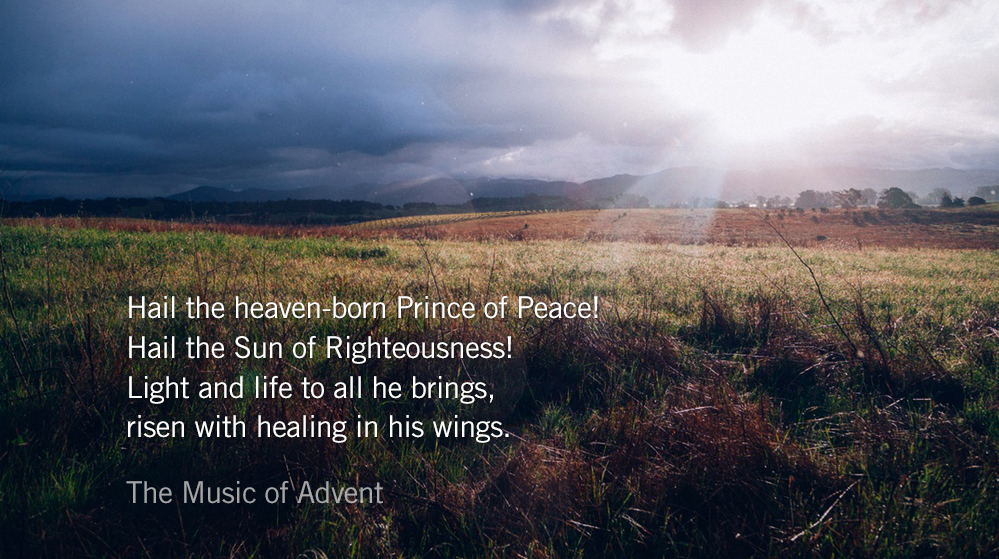
Hail the heaven-born Prince of Peace!
Hail the Sun of Righteousness!
Light and life to all he brings,
risen with healing in his wings.

ListenHark the Herald Angels Sing by Paisley Abby Choir (2:59)

Today’s Reading
Haggai 2 (Listen – 3:49)
John 3 (Listen – 4:41)

Come, Thou Long Expected Jesus :: Advent’s Joy

“It thrilled him with a vague uncertain horror,” Charles Dickens wrote of Scrooge’s meeting with the Ghost of Christmas Yet to Come.

The Phantom slowly, gravely, silently approached. When it came near him, Scrooge bent down upon his knee; for in the very air through which this Spirit moved it seemed to scatter gloom and mystery. It was shrouded in a deep black garment, which concealed its head, its face, its form, and left nothing of it visible save one outstretched hand.

The future of Christmas came as a warning to Scrooge—change your ways, or this is what will become of you. The miser pleads, “Assure me that I yet may change these shadows you have shown me, by an altered life!” As a tool in Dickens’ narrative, this transition serves Scrooge well. As a motto to live by, it would lead readers to misery.

Our hearts and flesh fail us too regularly for this to work—go try harder is a recipe for disaster. Perhaps it’s best to contrast Dickens vision with the words of another literary giant, John Wesley. The pastor and theologian composed dozens of books, wrote thousands sermons, and published over 6,500 hymns during his lifetime. In one of his most famous hymns he wrote:

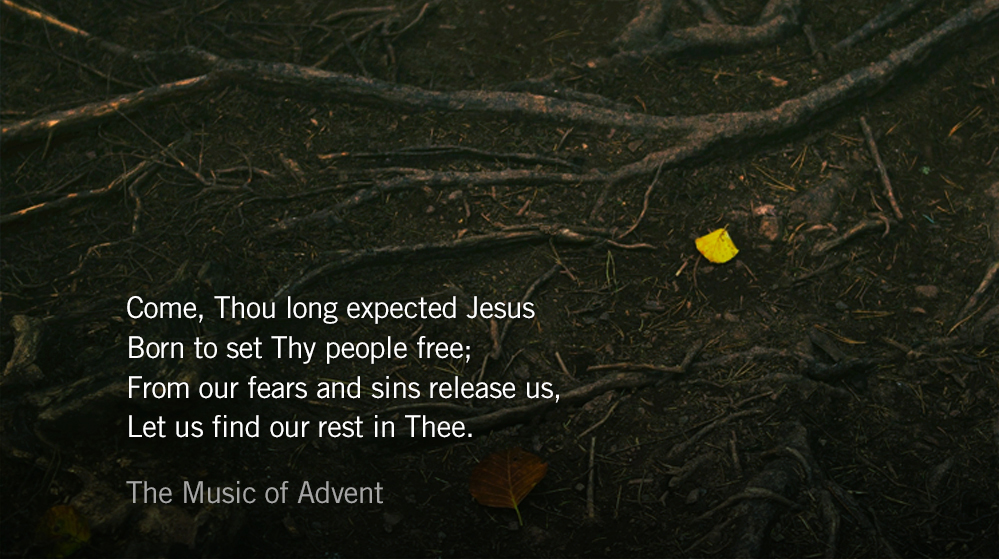
Come, Thou long expected Jesus
Born to set Thy people free;
From our fears and sins release us,Let us find our rest in Thee.

In this, Wesley captures the fulfillment of the first Advent while directing our attention on the brilliance of the second advent. What a miracle that the long expected Messiah was born into our world! How we long to be released from this brokenness. How we long for rest.

The message to Scrooge never led him beyond himself (which was his problem in the first place). The message of Wesley is for those who have met the end of self. For those who haven’t found true joy in success, those who can’t live past their failures, those who cannot find satisfaction in the messiness of this world; Christ is the “Joy of every longing heart.”

ListenCome, Thou Long Expected Jesus by Christy Nockels (2:59)

Today’s Reading
Haggai 1 (Listen – 2:39)
John 2 (Listen – 3:02)

The Divine Mystery Of That Cross

Today: The Divine Mystery Of That Cross: a Holy Week reflection and prayer guide to prepare our hearts and minds for Easter. Curated by The Park Forum.

Leviticus 2.6-8
[God said,] “If you offer an animal from the flock as a fellowship offering to the LORD, you are to offer a male or female without defect. If you offer a lamb, you are to present it before the LORD, lay your hand on its head and slaughter it in front of the tent of meeting. Then Aaron’s sons shall splash its blood against the sides of the altar.”

Christ Alone Suffered Death (an excerpt) | by Ambrose of Milan

O the divine mystery of that cross, on which weakness hangs, might is free, vices are nailed, and triumphal trophies raised. For Christ died for us, that we might live in His revived Body. Therefore not our life but our guilt died in Him, “Who,” it is said, “bare our sins in His own Body on the tree; that being set free from our sins we might live in righteousness, by the wound of Whose stripes we are healed.”

That wood of the cross is, then, as it were a kind of ship of our salvation, our passage, not a punishment, for there is no other salvation but the passage of eternal salvation. While expecting death I do not feel it; while thinking little of punishment I do not suffer; while careless of fear I know it not.

Who, then, is He by the wound of Whose “stripes we are healed,” but Christ the Lord? Of Whom Isaiah also prophesied His stripes were our healing, of Whom Paul the Apostle wrote in his epistle: “Who knew no sin, but was made sin for us.” 

That we may know that this mystery of the common redemption was most clearly revealed by the prophets, you have also in this place: “Behold, it has taken away your sins;” not that Christ put aside His sins Who did no sin, but that in the flesh of Christ the whole human race should be loosed from their sins.

Lenten Evening Prayer: The Daily Examen
1. Opening prayer of invitation: become aware of God’s presence (2 minutes).
2. Review the day with gratitude (3 minutes).
3. Pay attention to your emotions (3 minutes).
4. Choose one feature of the day and pray from it (5 minutes).
5. Closing prayer: look toward tomorrow (2 minutes).

Today’s Readings
Leviticus 2-3 (Listen – 4:43)
John 21 (Listen – 3:58)

Holy Week Reflections
Part 2 of 5, read more on TheParkForum.org

___________________

FAQs

How can I make a tax-deductible donation? Click here.
How can I get these devotionals in my inbox? Click here.
What is the reading plan this blog is based on? Click here.

 ___________________________________

The Remedy for a Disquieted Soul

Today: The Remedy for a Disquieted Soul: a Holy Week reflection and prayer guide to prepare our hearts and minds for Easter. Curated by The Park Forum.

John 20.19
On the evening of that first day of the week, when the disciples were together, with the doors locked for fear of the Jewish leaders, Jesus came and stood among them and said, “Peace be with you!”

The Farewell Discourse and Final Prayer of Jesus (an excerpt) | by Don Carson

It is vital to recognize that the peace Jesus gives is not a kind of placid tranquility which avoids all conflict. Jesus himself is heading for the cross; yet he speaks of his peace. 

Similarly, the peace Jesus promises does not avoid trouble; it triumphs over it. Nor is this peace to be confused with aloofness that is indifferent to injustice, corruption, idolatry, or some other sin. It is not simply “feeling good” in some narcissistic way, nor is it some mystical sense of well-being detached from physical and spiritual realities.

The world wishes peace on people. Yet for all its wishing, the world cannot grant the gift of personal peace, but only wish it on someone. At most, it can achieve reconciliation between brothers or between nations; and even then the achievement often proves temporary. 

Christ, by contrast, bequeaths the gift of peace on all his followers, bestowing it as an essential part of the salvation he achieves for them. The cross wins peace with God. The forgiveness, restoration, and healing which flow from this primary peace constitute the only adequate basis for peace with others, and for personal peace within ourselves.

So much of our restlessness and bitterness springs from our possessiveness, our desire for preeminence, our lust for recognition. Our love for self is so strong that it turns to hatred for others who do not give us what we think is our due. 

There is no peace where such sins flourish. Jesus betrayed no possessiveness. He desired his Father’s glory and will, not personal preeminence and popular recognition. Far from loving his life, he gave it up for others—indeed, for others who did not begin to offer him what was his due. And so Jesus could speak of his peace.

Lenten Evening Prayer: The Daily Examen
1. Opening prayer of invitation: become aware of God’s presence (2 minutes).
2. Review the day with gratitude (3 minutes).
3. Pay attention to your emotions (3 minutes).
4. Choose one feature of the day and pray from it (5 minutes).
5. Closing prayer: look toward tomorrow (2 minutes).

Today’s Readings
Leviticus 1 (0 – 2:37)
John 20 (Listen – 4:17)

Holy Week Reflections
Part 1 of 5, read more on TheParkForum.org

___________________

FAQs

How can I make a tax-deductible donation? Click here.
How can I get these devotionals in my inbox? Click here.
What is the reading plan this blog is based on? Click here.

 ___________________________________