Break Their Fangs

Links for today’s readings:

Jan 27  Read: Job 29 Listen: (2:26) Read: Psalm 10 Listen: (2:13)

Scripture Focus: Job 29.17

17 I broke the fangs of the wicked

    and snatched the victims from their teeth.

Reflection: Break Their Fangs

By John Tillman

Need to stop a lion, a bear, a wolf, or a viper? Break their fangs.

Broken teeth are bad for any animal but predators are especially reliant on the large teeth that help them capture, hold, and kill prey. No matter how powerful, how large, how fast, or how fierce a predator is, a broken fang means death. Job considered breaking the fangs of the wicked righteousness.

Job often focused on being innocent of wrongdoing. He challenged anyone to point out sin he committed. They couldn’t. He asked God what he had done wrong. God stayed silent. In his final speech, Job focused more on good things he did.

Job’s righteous resume lists actions benefiting the vulnerable. Job was a friend to the poor, the orphan, the widow, and the foreigner. He was eyes for the blind, feet to the lame, a father to those in need, and a legal defender for the immigrant stranger.

As they did then, powerful and wealthy people today take advantage of these and other vulnerable groups. They prey on the weak. Job defined righteousness as not just helping the weak, but incapacitating those preying on them—breaking the predators’ fangs.

Fangs grasp victims, preventing escape, damaging victims, weakening resistance, and sometimes injecting deadly or paralyzing venom. As Christians, breaking the wicked’s fangs does not mean violence but breaking the means used to poison, paralyze, damage, and hold captive the vulnerable.

What might this look like?

Legislation might “break the fangs” of debt, pornography, prejudices, labor abuses, or pollution but political solutions aren’t enough. Churches “break fangs” in their communities in many ways, such as paying off medical debt, supporting pregnant women and mothers, ministering to incarcerated and recently released prisoners, or providing cars, jobs, and safe housing to victims escaping abuse. Individuals “break fangs” by supporting charities that help the fatherless, the immigrant, and other outcasts.

Breaking the fangs of earthly wickedness is about more than saving victims from earthly sufferings. It points to Jesus’ ultimate snake-crushing salvation. John the Baptizer’s doubts about Jesus’ identity were eased by evidence of his earthly actions. Our limited imitations of Christ’s earthly actions ease people’s doubts and reveal Jesus’ true nature as the ultimate savior of all things that will be saved.

Are you on the side of the snake-crusher, the fang-breaker? How are you and your faith community participating in breaking the fangs of the wicked?

Divine Hours Prayer: The Request for Presence

Show us the light of your countenance, O God, and come to us. — Psalm 67.1

– From The Divine Hours: Prayers for Autumn and Wintertime by Phyllis Tickle.

Read more: Righteousness Sets Things Right

Job defines his righteousness by his use of power, wealth, and influence to benefit the weak, the marginalized, and the victimized.

Read more: The Righteous Judge — A Guided Prayer

“Break the arm of the wicked man;

   call the evildoer to account for his wickedness

   that would not otherwise be found out.”
Righteousness Sets Things Right

Scripture Focus: Job 29.2-3, 12-17
“How I long for the months gone by,
    for the days when God watched over me,
when his lamp shone on my head
    and by his light I walked through darkness!…
…Whoever heard me spoke well of me,
    and those who saw me commended me,
because I rescued the poor who cried for help,
    and the fatherless who had none to assist them.
The one who was dying blessed me;
    I made the widow’s heart sing.
I put on righteousness as my clothing;
    justice was my robe and my turban.
I was eyes to the blind
    and feet to the lame.
I was a father to the needy;
    I took up the case of the stranger.
I broke the fangs of the wicked
    and snatched the victims from their teeth.

John: This rewritten post from 2020 looks again at the relationship of righteousness and justice. For Job, they are of the same substance. We can’t have one without the other.

Reflection: Righteousness Sets Things Right
By John Tillman

When we think of righteousness, we tend to think first about righteousness via elimination. We think of avoiding sin, abstaining from certain food and drink, abjuring the company of certain people, or censoring our experience of the world. These may be wise measures for avoiding temptation but they are not marks of righteousness. 

Limiting exposure to certain things to remain righteous is a confession of our unrighteous state. Light does not avoid darkness to remain light—it pierces the darkness and the darkness cannot overwhelm it. Job acknowledges that the light of righteousness that used to be his was not his own, but came from the presence of God shining through him. Rather than focus on righteousness by omission, Job describes the righteousness of commission. 

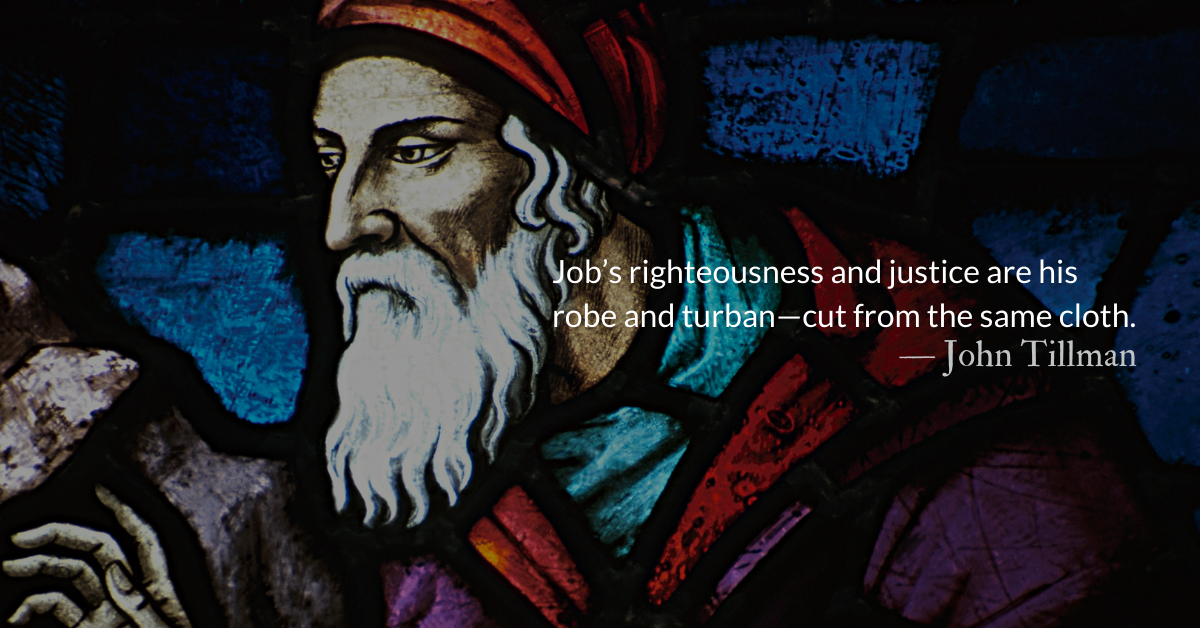
In Job’s example, righteousness is connected to and related to justice. The word sedeq, translated “righteous,” also means “just” or “fair.” It also is often paired with mispat, which is translated as “justice,” in this passage but can mean “law,” or “judgment.” Job’s righteousness and justice are his robe and turban—cut from the same cloth.

Righteousness, as Job describes it, is marked by formidable, positive actions on behalf of justice. Righteousness sets things right. Job defines his righteousness by his use of power, wealth, and influence to benefit the weak, the marginalized, and the victimized. 

When Job walked in, the powerful trembled. They recognized an enemy who would break their “fangs” which were their means of holding onto prey and exerting their poisonous control.

When Job walked in, those taking advantage of the poor would lose their control and investment. When Job walked in, abusers knew their time was up. 

When Job walked in, the needy rejoiced and the outcast celebrated. When Job walked in, the fatherless felt the power of a father on their side. When Job walked in widows knew that they would no longer suffer indignity or disregard.

When the church and Christians walk in righteousness, the powerful will tremble at our approach. Oppressors will pray that we do not show up. Swindling money-lenders will dread us setting their debtors free.

Do you walk in righteousness? Ask yourself this question. Who gets nervous when you approach? Do the powerful pat you on the back? Or do the oppressed consider you a friend?

Righteousness may not be righteous if it makes the wrong people nervous.

Divine Hours Prayer: The Refrain for the Morning Lessons
Blessed is he who comes in the name of the Lord; we bless you from the house of the Lord. — Psalm 118.26

– From The Divine Hours: Prayers for Autumn and Wintertime by Phyllis Tickle.

Today’s Readings
Job 29 (Listen – 2:26)
Psalm 38 (Listen – 2:14)

Join us! Walk through the Bible with us…
Share this subscription link with friends, family, or your community of faith. Find joy reflecting on God’s Word!

https://mailchi.mp/theparkforum/m-f-daily-email-devotional

Read more about Justice Brings Joy
Would we bury the tasks of righteousness and justice in the ground and dig them up, undeveloped and unimproved, to hand back to Christ?

Righteousness Sets Things Right

Scripture Focus: Job 29.2-3, 12-17
“How I long for the months gone by,
    for the days when God watched over me,
when his lamp shone on my head
    and by his light I walked through darkness!…
…Whoever heard me spoke well of me,
    and those who saw me commended me,
because I rescued the poor who cried for help,
    and the fatherless who had none to assist them.
The one who was dying blessed me;
    I made the widow’s heart sing.
I put on righteousness as my clothing;
    justice was my robe and my turban.
I was eyes to the blind
    and feet to the lame.
I was a father to the needy;
    I took up the case of the stranger.
I broke the fangs of the wicked
    and snatched the victims from their teeth.

Reflection: Righteousness Sets Things Right
By John Tillman

When we think of righteousness today, we tend to think first about achieving righteousness via elimination. We seek to avoid sin, to abstain from certain food and drink, to abjure the company of certain people, or to censor our experience of the world. These things may be wise measures for avoiding temptation but they are not marks of righteousness. 

Limiting our exposure to certain things in order to remain righteous is a confession of our unrighteous state. Light does not avoid darkness to remain light—it pierces the darkness and the darkness cannot overwhelm it. Job acknowledges that the light of righteousness that used to be his was not his own, but came from the presence of God shining through him. Rather than focus on righteousness by omission, Job describes the righteousness of commission. 

In Job’s example, righteousness is connected to and related to justice. The word sedeq, translated “righteous,” is often translated “just,” “justice,” “fairly,” and “rights,” it also is often paired with mispat, which is in this passage translated “justice,” but can mean “law,” or “judge.” 

Righteousness, as Job describes it is marked by formidable, positive actions on behalf of justice. Righteousness sets things right. Job defines his righteousness by his use of power, wealth, and influence to benefit the weak, the marginalized, and the victimized. 

When Job walked in, the powerful trembled. They recognized an enemy who would break their “fangs” which were their means of holding onto prey and exerting their poisonous control.

When Job walked in, those taking advantage of the poor would lose their control and investment. When Job walked in, abusers knew their time was up. 

When Job walked in, the needy rejoiced. When Job walked in, the outcast celebrated. When Job walked in, the fatherless felt the power of a father on their side. When Job walked in widows knew that they would no longer suffer indignity or disregard.

When the church and Christians walk in righteousness, it will be the powerful who tremble at our approach. It will be oppressors who pray that we do not show up. It will be swindling money-lenders who dread us setting their debtors free.

Do you walk in righteousness? Ask yourself this question. Who gets nervous when you approach? Do the powerful pat you on the back? Or do the oppressed consider you a friend?

Righteousness isn’t righteous if it makes the wrong people nervous.

Divine Hours Prayer: The Refrain for the Morning Lessons
Keep watch over my life, for I am faithful; save your servant whose trust is in you. — Psalm 86.2

– Divine Hours prayers from The Divine Hours: Prayers for Springtime by Phyllis Tickle.

Today’s Readings
Job 29 (Listen -2:26)
1 Corinthians 15 (Listen -8:06)

This Weekend’s Readings
Job 30 (Listen -3:14)
1 Corinthians 16 (Listen -2:54)

Read more about Praise God for the Justice of the Gospel
We can and should be agents of justice to the best of our ability. But we also know that ultimate justice cannot be completed by this world’s systems.

Read more about Joy and Justice :: Joy of Advent
The justice we long for will come yet, as we wait, we represent the justice and righteousness of Christ on Earth.