

Links for today’s readings:
Aug 28 Read: Jeremiah 22 Listen: (5:07) Read: 2 Thessalonians 2 Listen: (2:32)
Links for this weekend’s readings:
Aug 29 Read: Jeremiah 23 Listen: (7:13) Read: 2 Thessalonians 3 Listen: (2:16)
Aug 30 Read: Jeremiah 24 Listen: (1:54) Read: 1 Corinthians 1 Listen: (4:03)
Scripture Focus: Jeremiah 22.1-5
1 This is what the Lord says: “Go down to the palace of the king of Judah and proclaim this message there: 2 ‘Hear the word of the Lord to you, king of Judah, you who sit on David’s throne—you, your officials and your people who come through these gates. 3 This is what the Lord says: Do what is just and right. Rescue from the hand of the oppressor the one who has been robbed. Do no wrong or violence to the foreigner, the fatherless or the widow, and do not shed innocent blood in this place. 4 For if you are careful to carry out these commands, then kings who sit on David’s throne will come through the gates of this palace, riding in chariots and on horses, accompanied by their officials and their people. 5 But if you do not obey these commands, declares the Lord, I swear by myself that this palace will become a ruin.’”
Reflection: Solo Sins and Systemic Sins
By John Tillman
God, through Jeremiah, confronted wicked kings for their individual sins and for their sins as heads of state. But the first words of God’s message were about governmental responsibility.
Jeremiah challenged kings to rescue people from crime, protect foreigners from violence, and stop innocent bloodshed. These were political/governmental sins.
Prophets address moral problems that are both spiritual and political. This was especially true in Jeremiah’s day, when state power and religious power were synonymous. Every religious problem was a political problem and every state problem was a religious one.
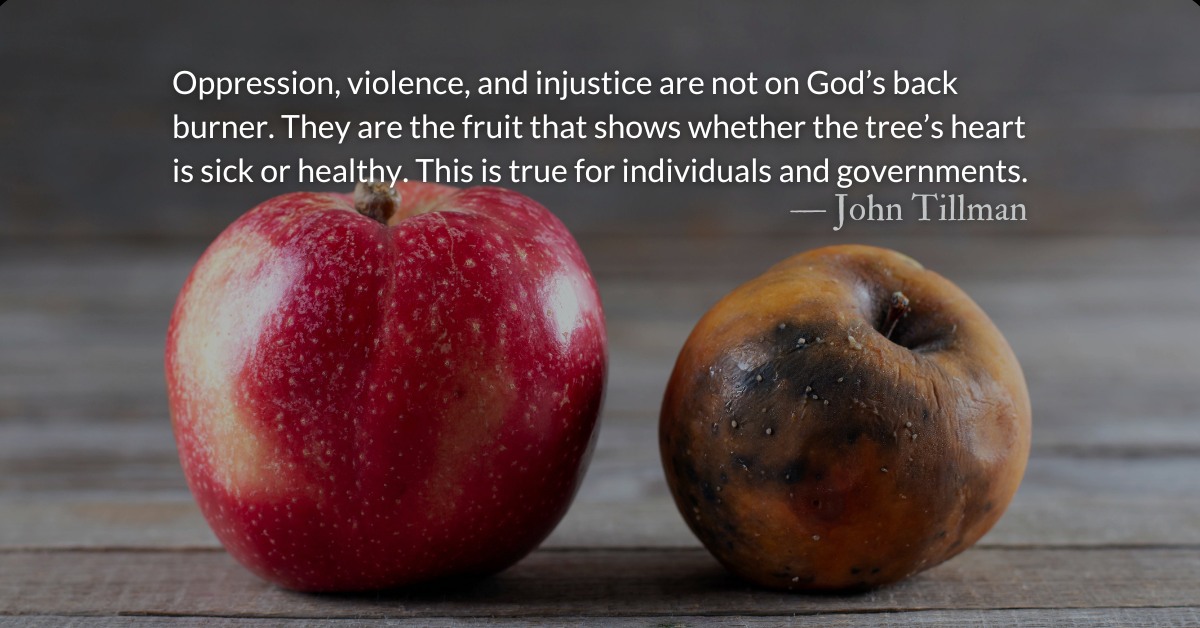
Oppression, violence, and injustice are not on God’s back burner. They are the fruit that shows whether the tree’s heart is sick or healthy. This is true for individuals and governments.
Some Christians individualize moral commands in scripture to the point that they deny any corporate or community culpability for the moral failings of systems that we individuals manage and create together. “We just need to change hearts,” is their half-truth.
Some Christians make the opposite error. They only acknowledge collective sins of political, economic, or judicial systems and deny that personal choices, lifestyles, or identities can be caused by, or connected to, individual sins that need correction. “Better systems, better people, better choices,” is their half-truth.
If prophets like Jeremiah heard us separating individual and systemic sins, they’d pull out their beards in frustration. What foolishness! We need the whole truth. There’s no such thing as “solo sins.” Every sin is systemic.
What are oppressive systems made from other than the compounded selfish choices of individuals? What individual sins are not influenced by the systems of culture, economics, and power that surround, control, and influence us? It is foolish to deny they are connected.
Think of Cain and Abel and the Good Samaritan…
The hyper-individualist Christian denies being his brother’s keeper and denies being the neighbor of the wounded traveller. The hyper-collectivist Christian blames God’s evaluation of sacrifices for Abel’s death, and rather than help the wounded traveler, lectures us that the robbers are merely symptoms of an unfair economy.
Hear and heed Jeremiah’s challenge to the kings as it was intended. It challenges both individuals and the systems those individuals influence. The gospel is the answer to every human problem, but its effects were never intended to stop with individuals.
If the gospel changes only you, and nothing around you, it isn’t the gospel.
Divine Hours Prayer: The Request for Presence
Lead me, O Lord, in your righteousness,… make your way straight before me. — Psalm 5.8
– From The Divine Hours: Prayers for Summertime by Phyllis Tickle.
Read more: What Makes a King?
True kings are those who know God. Their lives, efforts, causes, where they put their money…reveal who is truly a king after God’s heart.
Read more: The Crux of Repentance
The unmerited favor of Christ is an acquired taste. Most of us are gauche enough to like our grace flavored with a little bit of earning it.


