Links for today’s readings:
May 11 Read: Habakkuk 1 Listen: (2:39) Read: Luke 2 Listen: (6:11)
Scripture Focus: Habakkuk 1.2-4
2 How long, Lord, must I call for help,
but you do not listen?
Or cry out to you, “Violence!”
but you do not save?
3 Why do you make me look at injustice?
Why do you tolerate wrongdoing?
Destruction and violence are before me;
there is strife, and conflict abounds.
4 Therefore the law is paralyzed,
and justice never prevails.
The wicked hem in the righteous,
so that justice is perverted.
Reflection: Getting the Foxes Out
By John Tillman
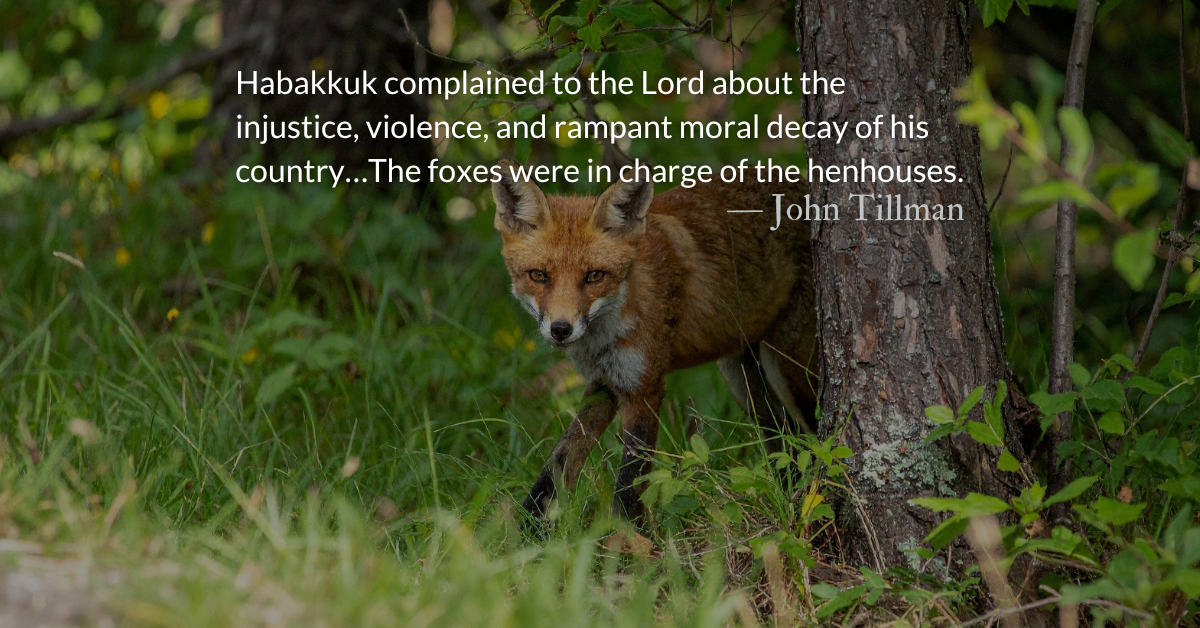
Habakkuk complained to the Lord about the injustice, violence, and rampant moral decay of his country.
Habakkuk watched in shock as the legal system failed to deliver justice. He witnessed the righteous hemmed in by the wicked. He watched justice perverted in the hands of greedy, corrupt wrongdoers. The foxes were in charge of the henhouses.
Habakkuk wanted God to do something about the foxes in the henhouse, but he didn’t expect God would send ravenous wolves to do it. The Babylonians were God’s instrument that punished Judah’s rulers with the exact sins they were committing.
Judah chose to worship harsh and unholy false gods. So God sent people who followed such gods to conquer them and enslave them to the types of gods they chose over him. The calloused leaders would be ravaged by ruthless rulers. The corrupt officials would be terrorized by impetuous invaders. (Hab 1.6) The unjust judges would face judgments by those with no respect for the law. (Hab 1.7)
God turned them over to their sins. The Babylonians physically devastated the land that was already devastated spiritually and socially.
Like Habakkuk, we have probably seen “foxes” in many different “henhouses,” including industries, faith communities, and political and legal systems. We have probably all watched in shock as legal systems failed, injustices mounted, and abuses of power proliferated.
Take these complaints to God. Ask God to get the foxes out. But be prepared for unexpected answers. (Especially if we are responsible for letting in the foxes in the first place. Song of Songs 2.15) In God’s economy, waking us up to repent of our sins is worth temporary pain.
On white-water rafting expeditions, everyone from staff to tourists wears extra-buoyant life vests. When a passenger falls out of the raft, the first thing staff do is not pull them up—they push them under the water hard. Then, when the life vest pops them back up, they use that momentum to pull the passenger back into the raft.
Sometimes things must get much worse before they can get better. Sometimes reaching rock bottom is the only way to get momentum to rise back up.
In Judah’s case, their entire society, government, and religious practice had to be destroyed to completely start over. Pray that in our individual lives and our other areas of influence, we will wake up sooner and repent faster.
Divine Hours Prayer: The Refrain for the Morning Lessons
This is the Lord’s doing, and it is marvelous in our eyes. — Psalm 118.23
– From The Divine Hours: Prayers for Springtime by Phyllis Tickle
Read more: God, Can You Hear Me?
We confuse the patience of God as the endorsement of evil…In the end…praise God and trust that God is still good…may our faith sustain us as we trust in his timing.
Consider Supporting Our Work
If you find our ministry valuable, help provide this ministry for others by becoming a donor. Support ad-free content that brings biblical devotionals to inboxes across the world.