Anxious Nights Between Destruction and Chaos

Scripture Focus: Exodus 14.19-20
19 Then the angel of God, who had been traveling in front of Israel’s army, withdrew and went behind them. The pillar of cloud also moved from in front and stood behind them, 20 coming between the armies of Egypt and Israel. Throughout the night the cloud brought darkness to the one side and light to the other side; so neither went near the other all night long. 

Reflection: Anxious Nights Between Destruction and Chaos
By John Tillman

The crossing of the Red Sea is dramatic, but it was not an instant miracle. The waters did not rush backward in seconds or in dramatic slow motion. We do not know exactly what it looked like but we do know that it took all night long for the waters to be blown back and the path to dry out. 

During the night the people were protected by the pillar of cloud and fire, which brought them light and their enemies darkness. Despite this, the night must still have been one of sustained tension and anxiety as the wind blew and the waters slowly parted and dried up.

The imagery of the Red Sea crossing reflects parts of the Genesis creation account and establishes God as the ruler over creation. Many in the ancient world viewed large bodies of water as symbols of chaos. It is this kind of watery chaos and darkness that is depicted in Genesis when God’s Spirit is hovering over the waters before causing dry land to appear. (Genesis 1.2)

To part the waters for Israel, God’s Spirit sends an “East wind” that blows on the waters through the night, exposing dry land. An “East wind” did not necessarily blow from the East, as we would think of it. 

In Hebrew climatology, different types of winds came from the four corners of the Earth. Wind from “the East” was associated with dryness. It was a wilderness wind that destroyed vegetation. On this night, the wilderness wind brought order to the chaos of the sea, driving it back and drying the land beneath. From the chaos of the sea and the wilderness wind, God brings order and a highway to salvation.

In our lives, we may spend many anxious nights facing chaos. We may wait in tension and darkness, needing a miracle. Chaos may block our way, with destruction only steps behind us.

God is with us in these times. 

We have no pillar of cloud, but we have the guidance and protection of his Word. 
We have no wind to blow across the chaos, but we are filled with the wind of the Holy Spirit that brings order to our chaotic hearts and minds. 
When we face turbulent, chaotic waves, we have the foundation of Jesus Christ upon which to make our stand and the footsteps of the Savior in which to place our feet.

Divine Hours Prayer: The Call to Prayer
Come now and see the works of God, how wonderful he is in his doing toward all people. — Psalm 66.4

– From The Divine Hours: Prayers for Springtime by Phyllis Tickle.

Today’s Readings
Exodus 14 (Listen 4:46) 
Matthew 25 (Listen 6:04)

This Weekend’s Readings
Exodus 15 (Listen 4:11),  Matthew 26 (Listen 10:01)
Exodus 16 (Listen 5:02),  Matthew 27 (Listen 8:45)

Read more about Circumstances Matter
Pharaoh claimed they were lazy, but what he really feared was any thoughts of freedom.

Read more about Supporting Our Work
Our ministry of providing ad-free devotional content to inboxes across the world would not be possible without our donors. Consider joining them with a gift of your own.
Cherishing Chaff

Scripture Focus: Matthew 24.1-2
1 Jesus left the temple and was walking away when his disciples came up to him to call his attention to its buildings. 2 “Do you see all these things?” he asked. “Truly I tell you, not one stone here will be left on another; every one will be thrown down.”

Reflection: Cherishing Chaff
By John Tillman

Some buildings are great by age and grandeur and some by the gleam and glisten of modern glass and steel. However, no matter how impressive a building is when you walk, ride, or drive by it regularly, it becomes just a part of the scenery. 

How impressive does a building have to be for you to still comment on it as you pass by, years later? Why would the disciples call Jesus’ attention to the impressive buildings of the Temple that both he and they had been worshiping in their entire lives?

The Temple had been standing for 500 years and had been extensively renovated and repaired by Herod during the disciple’s lifetimes. Perhaps the disciples were happy to see some scaffolding come down on an area that had been newly restored. 

But the Temple’s shiny new sheen couldn’t distract Jesus’ eyes from the self-righteous deceit within and the suffering he saw over the horizon. The disciples saw the Temple as grand, renewed, and a symbol of strength and status. Jesus saw its present and future, sinful, destroyed, and humiliated.

Herod was a ruler of nominal faith at best. (Even that is being extraordinarily generous.) Herod was corrupt, a womanizer, boastful, and lived in a sinful relationship. He “liked to listen” to John the Baptist, but that didn’t stop him from cutting off the prophet’s head. 

Herod’s work on the Temple wasn’t faith-driven. It was a political tactic to boost his status and generate support among the people—and it worked. Even the disciples of Jesus were impressed.

The Temple, and Herod, are just two examples of things unworthy of the esteem and attention the disciples gave them. Many things the disciples prized, Jesus recognized as poison. Many things they cherished Jesus called chaff in the wind. 

What catches our eyes? What chaff do we cherish or poison do we prize? A building? A politician? A charismatic leader? An institution? Point out to Jesus what catches your eye. Seek his opinion on whether you should hold it up for honor or whether it is destined to be thrown down.

Physical idols, whether statues, buildings, institutions, or living humans, are the product of inward sin. We worship them instead of God because inwardly we refuse to trust God or we have denounced God. Allow the revelation of outward idols to lead you to discover inward attitudes that must be torn down.


Divine Hours Prayer: The Small Verse
My soul thirsts for the strong, living God and all that is within me cries out to him.

– From The Divine Hours: Prayers for Springtime by Phyllis Tickle.

Today’s Readings
Exodus 13 (Listen 3:30) Matthew 24 (Listen 5:59)

Read more about Defilement, Deconstruction, and Reconstruction
Defiled structures must be completely deconstructed and rebuilt. Destruction is not God’s goal. Reconstruction is.

Read more about Supporting Our Work
Please consider becoming a monthly donor. Support ad-free content that brings biblical devotionals to inboxes across the world.

When They Ask

Scripture Focus: Exodus 12:26-27
26 And when your children ask you, ‘What does this ceremony mean to you?’ 27 then tell them, ‘It is the Passover sacrifice to the Lord, who passed over the houses of the Israelites in Egypt and spared our homes when he struck down the Egyptians.’” Then the people bowed down and worshiped. 

Reflection: When They Ask
By Erin Newton

“Preach the Gospel. If necessary, use words.” This anonymous quote suggests the gospel can be told through actions. It’s true—faith needs to have actions. But it fails to answer Paul’s rhetorical question, “how can they hear without someone preaching to them?”

As the Hebrews prepared for the final plague, God instructed them to perform the Passover ceremony. This was an unprecedented ceremony and one that would be repeated annually. With each new year, the people would explain to the community why they celebrated. No new generation could say, “I didn’t know.”

You can always tell what is important to people by what they talk about the most. We know which friends are sports fanatics, bookworms, or cinema aficionados. If we love it, we ramble on about it. When God calls the Hebrews to teach the next generation, he’s asking for the Passover to fill a place of importance in their hearts.

It is not a laborious call to cover the curriculum. With devoted hearts, the people would celebrate, and the kids would be watching. “What does this mean to you, mom? Why are you doing that, dad? Where is the lamb we had last week, uncle?”

Passing on knowledge is commanded by God. We are called to teach to our children, younger believers, and those new in the faith. Sometimes it is handled like a theological checklist. Or something we pass off to the church staff. The burden seems daunting. 

Let’s look at the passage again. The parents would be practicing their faith. The kids would be noticing. Passover would not be a mere checklist of annual traditions; the people would celebrate out of faith and love.

We are fortunate to have myriads of resources at our fingertips. There are videos and books and programs designed to teach biblical truths to people with minimal religious backgrounds. Some are created to hold the attention of small children and others are created to spur deep thinking in new believers. For our core beliefs, we usually don’t need additional resources. The truths are too important to us.

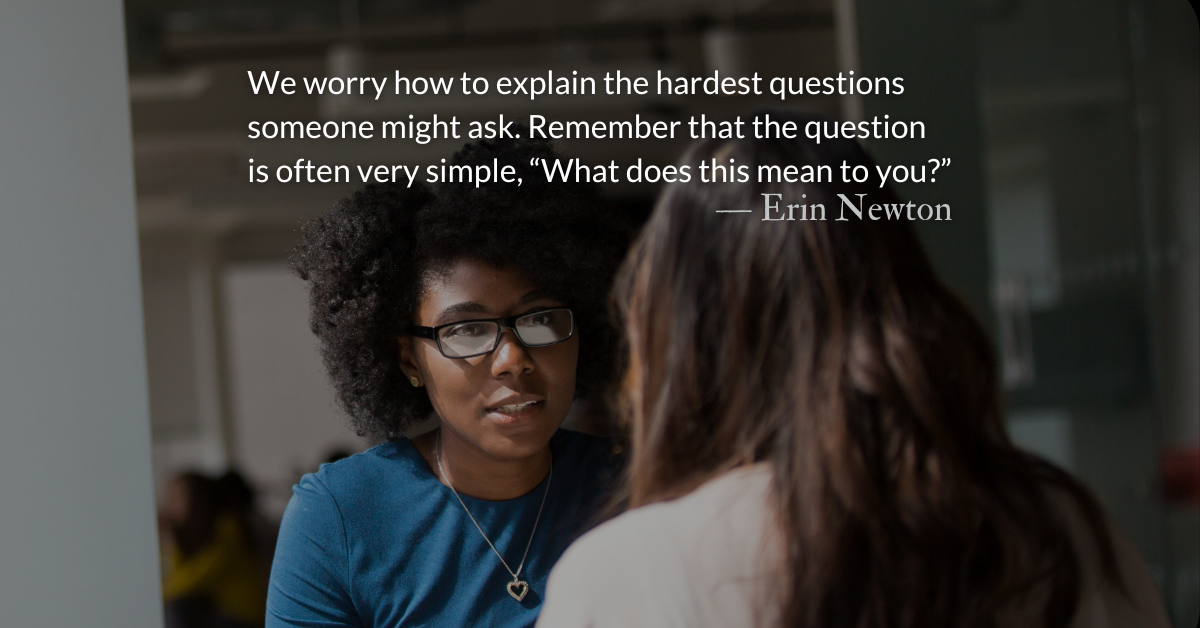
We worry how to explain the hardest questions someone might ask. Remember that the question is often very simple, “What does this mean to you?” No need to be eloquent. Speak from the heart. Let the truth be filled with your experience and emotions.

I imagine their answers, “We were terrified that night, but God saved us…”

Divine Hours Prayer: The Refrain for the Morning Lessons
Protect my life and deliver me; let me not be put to shame, for I have trusted in you. — Psalm 25.19

– From The Divine Hours: Prayers for Springtime by Phyllis Tickle.

Today’s Readings
Exodus 12.22-51 (Listen 7:31) 
Matthew 23 (Listen 4:53)

Read more about Complaint to Commission
The disciples to lead the next generation of the church may be those we have yet to reach.

Read The Bible With Us
Join our Bible reading plan. Build Bible literacy, a vibrant faith, and cultural insight at a sustainable, two-year pace.
https://mailchi.mp/theparkforum/m-f-daily-email-devotional

Pondering the Plague

Scripture Focus: Exodus 12.28-32
28 The Israelites did just what the Lord commanded Moses and Aaron. 
29 At midnight the Lord struck down all the firstborn in Egypt, from the firstborn of Pharaoh, who sat on the throne, to the firstborn of the prisoner, who was in the dungeon, and the firstborn of all the livestock as well. 30 Pharaoh and all his officials and all the Egyptians got up during the night, and there was loud wailing in Egypt, for there was not a house without someone dead. 

31 During the night Pharaoh summoned Moses and Aaron and said, “Up! Leave my people, you and the Israelites! Go, worship the Lord as you have requested. 32 Take your flocks and herds, as you have said, and go. And also bless me.” 

Reflection: Pondering the Plague
By John Tillman

Pharaoh released the Israelites and asked Moses for a blessing. Previously, Pharaoh threatened his life if Moses ever saw his face again. What happened in between is the tenth plague… 

No one has all the answers to difficult passages like this one. Even if we did, 400 words wouldn’t cover them. Today, we aren’t giving answers. We are asking questions. Some questions refer to the scripture and some to our hearts. Ponder these questions and additional questions of your own in prayer.

It’s not enough to simply say, “Well, the Egyptians deserved it. They are oppressors.” Moses is a genocide survivor. Moses’s Pharaoh is likely the son of the ruler who killed many young men of Moses’s age. A generation of his peers was wiped out. Now the nation that killed that generation would lose a generation of its own. Yet, instead of being satisfied or happy about this, Moses leaves “hot with anger” after announcing the plague. (Exodus 11.8) Why? Who is Moses angry with? Why isn’t retributive justice enough? Why doesn’t “an eye for an eye” satisfy?

What makes you “hot with anger”? Do you celebrate your enemy’s pain and suffering?

Moses survived Egypt’s slaughter of innocents. Jesus escaped Herod’s slaughter of innocents by fleeing to Egypt. The same nation that wiped out a generation of Israelites sheltered Jesus when his life was threatened. They played their part in bringing the gospel to the world and later became a bastion of Christianity in Africa.

Is there anyone/anything you have written off as irredeemable that may still have a part to play to benefit the gospel?

Over and over, Pharaoh was tested and warned of escalating disasters that proved true every time. Surely Pharaoh thought of his son when Moses announced the plague. Why did Pharaoh not believe? Why did he not give in?

Is there anything about which you are refusing to submit to God?

After all this conflict, and especially after losing his son, why would Pharaoh ask for a blessing from Moses? Next to Pharaoh’s request, the Logos Bible I use has a link to Genesis 27.34 in which Esau cries out for a blessing from his father. These two moments are connected. Pharaoh asked for a blessing. Scripture doesn’t say if Moses gave one. What do you think happened?

Is there anyone from whom you are withholding a blessing?

Divine Hours Prayer: The Request for Presence
Show your goodness, O Lord, to those who are good and to those who are true of heart. — Psalm 125.4

Today’s Readings
Exodus 11-12.21 (Listen 9:08) 
Matthew 22 (Listen 4:56)

Read more about Idol-Destroying Plagues
The plagues systematically and categorically destroyed everything that Egypt trusted in and worshiped.

Read more about Testing Before Judgment
The slowly escalating nature of the plagues provides Pharaoh with off-ramps to escape further judgment.

Blessed are the Troublemakers

Scripture Focus: Exodus 10.28-29
28 Pharaoh said to Moses, “Get out of my sight! Make sure you do not appear before me again! The day you see my face you will die.” 
29 “Just as you say,” Moses replied. “I will never appear before you again.”

Reflection: Blessed are the Troublemakers
By John Tillman

The Pharaoh of Joseph’s day had been personally blessed and prayed for by Israel himself. While Israel’s children lived there, Egypt enjoyed the blessings of God and was a channel of God’s blessing to the world.

Any nation that simply allows God’s people to flourish can be so blessed. Even the evil nations of Assyria and Babylon, when they acknowledged the God of the Hebrews among them, were blessed. But any nation, even the nation of Israel or a nation calling itself a “Christian Nation,” can become a nation of cursings instead of blessings. 

Moses’s Pharaoh treated him like an irritant. From a certain perspective, it’s understandable. Moses was demanding. He inconvenienced the privileged life to which Egypt was accustomed. He destroyed the peace. He disrupted the economy. He upended the established order. Pharaoh considered him a troublemaker. 

But Moses was not a troublemaker in Egypt any more than Elijah was a troublemaker in Ahab’s Israel. (1 Kings 18.16-18) In both countries, prophets brought correction through words, demands, and demonstrations of power. It was the leaders who were the troublemakers and made decisions that led toward certain disasters.  

Reading the progression of the plagues and the responses of Pharaoh is like watching a classic tragedy, like Macbeth. He makes horrible choice after choice after choice. We don’t understand how, in the face of so much evidence of God’s power, Pharaoh could still stiffen his neck, harden his heart, and refuse to give in.

Every time we have “trouble” it doesn’t mean God is displeased with us. Sometimes, as Moses did, we will experience “good trouble” when we are doing the right thing. But it is always good to pause and consider if we are “going Pharaoh.”

Moses was a visitation of grace, an opportunity for change. Pharaoh rejected it. Even his leaders realized that Egypt was falling to ruin but he wouldn’t give in to them either. (Exodus 10.7)

We don’t have to look far in the news headlines to see autocratic leaders, bringing their countries to ruin by stubbornly refusing to abandon foolish directions. We don’t have to look far in our own hearts to find moments we resist or resent calls for change that God puts in our path.

Blessed are the troublemakers who demand justice. We should have the humility not to treat them as irritants, but consider whether the source of trouble might instead be our own hearts.

Divine Hours Prayer: The Small Verse
Open, Lord, my eyes that I may see.
Open, Lord, my ears that I may hear.
Open, Lord, my heart and my mind that I may understand.
So shall I turn to you and be healed.

Today’s Readings
Exodus 10 (Listen 4:44) 
Matthew 21 (Listen 7:10)

Read more about The Ram and the Cornerstone
He rammed his teaching into the foundations of the religious leaders’ security and pride, knowing what their violent response would be.

Read more about Ahab and David
Rather than the friendly relationship David had with God and his prophets, Ahab considers Elijah his “enemy.”

Show Buttons
Hide Buttons
Spur a spiritual rhythm of refreshment right in your inbox
By joining this email list you are giving us permission to send you devotional emails each weekday and to communicate occasionally regarding other aspects of the ministry.
100% Privacy. We don't spam.