Wisdom in Houses of Mourning

Scripture Focus: Ecclesiastes 7.2-4
It is better to go to a house of mourning
    than to go to a house of feasting,
for death is the destiny of everyone;
    the living should take this to heart.
Frustration is better than laughter,
    because a sad face is good for the heart.
The heart of the wise is in the house of mourning,
    but the heart of fools is in the house of pleasure.

Proverbs 4.7
Get wisdom. Though it cost all you have, get understanding.

Hebrews 12.1-2
…let us throw off everything that hinders and the sin that so easily entangles. And let us run with perseverance the race marked out for us, fixing our eyes on Jesus…

Reflection: Wisdom in Houses of Mourning
By John Tillman

What happens when a society addicted to activity, distraction, and consumption has every activity canceled, normal distractions displaced, and consumption disrupted? We mourn.

Solomon tells us that there is more wisdom to be gained in a house of mourning than one of celebrating. In some ways, the homes in which we are sheltering have become houses of mourning. We are certainly mourning the frenetic fantasy of fruitfulness that our former schedules gave us. Our economies, both global and personal, were accelerated and everything else was trimmed out so that we could push harder for greater gain. But were we really gaining in the ways that are important? Did we trim out the wrong things? What can we learn from this unexpected experience of mourning? 

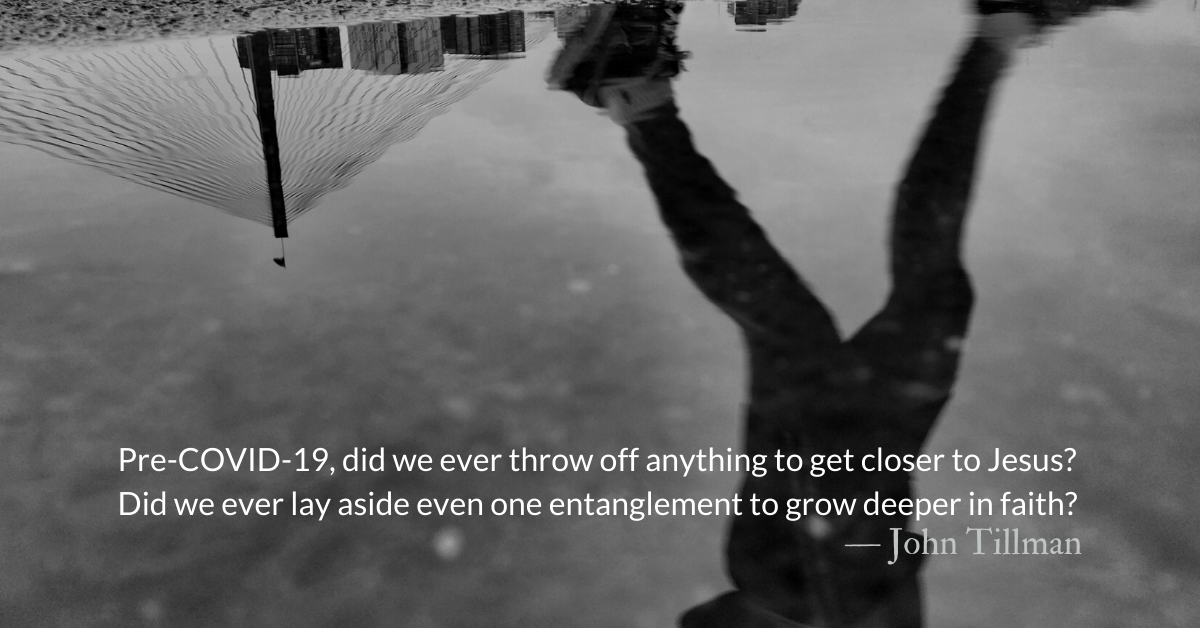
Paul writes that we should throw off everything that hinders us and the sin that so easily entangles us to run after Jesus, fixing our eyes on him. But in our previous life, pre-COVID-19, did we ever throw off anything to get closer to Jesus? Did we ever lay aside even one entanglement to grow deeper in faith? Did we fix our eyes more intently on Jesus than on our devices, work tasks, and investment portfolios? Did we strip even one thing out of our lives because it interfered with reading the Bible? Did we cancel even one activity in order to make more time to pray?

For the majority of us, the answers to these questions are probably “no.” Many of us may need to confess that what we tossed aside was Jesus, and the entanglement we escaped was the cords of loving-kindness that God sought to guide us by. We limited Jesus, the Bible, and prayer, to “when we have time” as if time was the issue and not our heart.

What if we learned from what we have lost how valuable what we still have is?
What if we, relieved of the burden of physically running from activity to activity, learned to run after Jesus spiritually?
What if we learned to make time with the most important things the most important time in our day?

I think personally we would be blown away by the tangible presence and power of God in our lives.
I think it would be a revelation.
And I think culturally the world would be blown away by the shockingly beautiful things God would call the church to do in the world.
I think it would be a revolution. 

Divine Hours Prayer: The Refrain for the Morning Lessons
Those who sowed with tears will reap with songs of joy. 
Those who go out weeping, carrying the seed, will come again with joy, shouldering their sheaves. — Psalm 126.6-7

– Divine Hours prayers from The Divine Hours: Prayers for Springtime by Phyllis Tickle.

Today’s Readings
Ecclesiastes 7 (Listen – 3:37) 
2 Timothy 3 (Listen -2:21)

Read more about Prayer Amidst Evil :: Guided Prayer 
The inevitable next tragedy will come. Whether it is the result of unthinking violence, tragic accident, or premeditated and targeted hatred, we turn to God in prayer…

Read more about Fasting from the Feast
Our culture has steadily, for decades, been encouraging us to abstain from spiritual disciplines in favor of activities that we are led to believe are more profitable.



The Last Shall be First—Resurrection Appearances

Scripture Focus: 1 Corinthians 15.3-10
For what I received I passed on to you as of first importance: that Christ died for our sins according to the Scriptures, that he was buried, that he was raised on the third day according to the Scriptures, and that he appeared to Cephas, and then to the Twelve. After that, he appeared to more than five hundred of the brothers and sisters at the same time, most of whom are still living, though some have fallen asleep. Then he appeared to James, then to all the apostles, and last of all he appeared to me also, as to one abnormally born. For I am the least of the apostles and do not even deserve to be called an apostle, because I persecuted the church of God. But by the grace of God I am what I am, and his grace to me was not without effect.

1 Timothy 6.17-19
Command those who are rich in this present world not to be arrogant nor to put their hope in wealth, which is so uncertain, but to put their hope in God, who richly provides us with everything for our enjoyment. Command them to do good, to be rich in good deeds, and to be generous and willing to share. In this way they will lay up treasure for themselves as a firm foundation for the coming age, so that they may take hold of the life that is truly life. 

Reflection: The Last Shall be First—Resurrection Appearances
By John Tillman

Paul’s analogy, translated “born unnaturally,” could be interpreted to mean an abortion or miscarriage. It is similar in meaning to the Hebrew word Job uses in Job 3.16 to wish he had never been born. Paul was not aborted but rather reborn—resurrected by Jesus as a new person. Paul’s intention seems to be to humble himself, making himself as unimportant as possible.

Paul describes himself as the “last” to see the risen Jesus and the least of the apostles but he became much more than that. By word count he is unquestionably the first, especially of epistles which contain explanations of the theological meaning of the gospel resurrection accounts.

Paul’s writing in 1 Corinthians 15 relates to us one of the earliest bits of writing about the resurrection. In verses 3-5, Paul is passing on what he learned from others about the resurrection appearances of Jesus. This text is a rhythmic format in Greek which scholars (including Gary Habermas, whose video discussing this we shared earlier in the week.) believe indicates it was written as early as one to two years after the cross and was intended as an easily memorizable early creed or lesson. 

This statement of faith in the resurrection could have been memorized and shared by some of the very families which Paul had been putting in chains prior to his conversion. 

If we believe the New Testament, then much of its message hinges on appearances and visions of Jesus. It is an important detail that these visions are not simply taken at face value in the text. The disciples and the authorities doubt them, test them, hear them over and over, and reconcile them with scripture. Paul, before experiencing an appearance of Jesus, tortured and murdered others for believing them.

In Paul’s day, women and children were not to be believed. So Jesus comes to the women first. Scholars and theologians were believed to see the scriptures clearly. So Jesus blinds Paul, one of the most brilliant theologians of his day.

We must flip many of our assumptions to enter the gospel story. To be mature we must believe as children. To be a part of the family we must admit we are outsiders. To gain riches of spiritual insight we must admit we are poor, blind, and naked.

Following Paul’s example, only by putting ourselves last, can we put Jesus first and take hold of “the life that is truly life.”

*For information on the historical evidence of the consistency and reliability of the gospel message, see this video from scholar, Gary Habermas — 1:20

Divine Hours Prayer: The Greeting
O God, you know my foolishness, and my faults are not hidden from you. — Psalm 69.6

– Divine Hours prayers from The Divine Hours: Prayers for Springtime by Phyllis Tickle.

Today’s Readings
Ecclesiastes 4 (Listen – 2:18)
1 Timothy 6 (Listen -3:16)

This Weekend’s Readings
Ecclesiastes 5 (Listen – 2:50), 2 Timothy 1 (Listen -2:37)
Ecclesiastes 6 (Listen – 1:44), 2 Timothy 2 (Listen -3:17)

Read more about Angelic Visions Require Childlike Faith
If we read the Bible, and if what we read has anything to do with what we believe, then we have no choice but to take angels seriously.

Read more about Gospel Faith or Garbage Faith
Once he met Christ, Paul realized everything prior was waste, rubbish, by comparison.

Normal is Dead—Resurrection Appearances

Scripture Focus: 1 Timothy 5.22
Do not be hasty in the laying on of hands, and do not share in the sins of others. Keep yourself pure.

John 21.17 
The third time he said to him, “Simon son of John, do you love me?”
Peter was hurt because Jesus asked him the third time, “Do you love me?” He said, “Lord, you know all things; you know that I love you.”
Jesus said, “Feed my sheep.

*This Easter week as we shelter in our homes due to COVID-19, we may feel more like the disciples than we ever have before. We continue to look this week at the appearances of Jesus, who comes to us as we seek normalcy to call us to something greater.

Reflection: Normal is Dead—Resurrection Appearances
By John Tillman

Scripture doesn’t tell us why Peter went fishing but it is not hard to imagine he needed a touch of normalcy. 

The disciples had been through a panoply of trauma and the familiar labor would be calming to them. Rope and oar and sail and sea (whatever those are to us) can provide an escape and a rhythm of distraction amidst a world of confusion.

This was an outspoken group of disciples—the loudmouths and extroverts. Besides Peter, there was Nathaneal, the sarcastic wisecracker, Thomas, the last to believe and first to call Jesus “my God,” James and John, who thought they should be closest to Jesus on his throne, and two unnamed disciples, one of whom is probably Andrew, Peter’s brother.

From Jerusalem to the Sea of Tiberius was about a 100-mile walk. Perhaps they had already left the city to go home. Perhaps they had access to faster transportation. John doesn’t elaborate. But it wasn’t a casual afternoon of fishing as a pastime. Some believe this trip implied Peter was resuming his prior occupation and giving up the ministry.

Then Jesus appears, sitting on the shore, pointing out the flaws in their plan. “Friends, haven’t you any fish?” This appearance is a callback—a reminder—of the initial callings of these fishermen and particularly of Peter. “You are fishing in the wrong place again, Peter. You aren’t even fishing for the right species. I called you to fish for people, remember?”

We all feel the cry for normalcy rising in us now. We just want to go back to work. Back to school. Back to self-reliance. Back to the illusion of safety and security in our own power and the world’s systems.

No matter how much we long for normalcy, the life Jesus called us to is not normal. Many foundations we’ve built on are being swept away and we can’t go back to pretending that our sand was a firm foundation after all. There are things about our normal that shouldn’t return.

Peter was unworthy when Jesus first called him and unworthy when he was reinstated. So are we. But Jesus forgave and reinstated Peter with a new normal and he can do the same for us. 

What is the new normal that Jesus is calling you to? What new rhythms might you discover during this time that are healthier spiritually than what you were doing before quarantine? What has quarantine taken from you that you can now let go of?

Divine Hours Prayer: The Call to Prayer
Know this: The Lord himself is God; he himself has made us, and we are his; we are his people and the sheep of his pasture. — Psalm 100.2

– Divine Hours prayers from The Divine Hours: Prayers for Springtime by Phyllis Tickle.

Today’s Readings
Ecclesiastes 3 (Listen -3:02)
1 Timothy 5 (Listen -3:22)

Read more about Remember Jesus Christ
Remembering the good news of the risen Christ provides perspective for our lives.

Read more about Recalling the Failures
It is not just Peter who is reinstated in the last chapter of John’s gospel and our last reading of this year. Other disciples who failed famously are there—Thomas who doubted, Nathanael the cynical elitist, the power-hungry sons of Zebedee. These confused and doubtful disciples are going back to the familiar when they are met by a familiar face on the shore.

Last to Believe—Resurrection Appearances

Scripture Focus: John 20.27
Then he said to Thomas, “Put your finger here; see my hands. Reach out your hand and put it into my side. Stop doubting and believe.”

Reflection: Last to Believe—Resurrection Appearances
By John Tillman

John, the first disciple to believe Jesus is alive without seeing him face-to-face has a purpose in recording the doubts of Thomas, the last disciple to believe Jesus is alive. 

Far from putting Thomas down, John treats Thomas’s journey from doubt to faith with respect and tenderness. It was not John’s intention to make Thomas the butt of pastors’ “doubt” jokes for millennia.

Every moment in John’s gospel is carefully crafted and chosen, appearing for a purpose. Where the synoptic gospel writers focus heavily on sequential timelines and explicitly tying events to historical markers, John does not. John’s gospel arrangement is thematic rather than chronological and pedagogical rather than historical. There are seven signs or miracles, seven “I am” statements by Jesus, seven “You are” statements of witnesses about Jesus, seven statements of aspects of Jesus’ equality with God, and seven word-pictures of faith.

John confesses that there are not enough books to contain an unabridged record of what Jesus did. Instead, John’s purpose is setting forth Christ’s deity that we may believe and have life. (John 20.31) Jesus also says to Thomas and the rest of the disciples, “blessed are those who have not seen and yet have believed.” (John 20.29)

John was writing later than the other evangelists (between 85-95 A.D, 20 years after the synoptics) and probably from Ephesus. Other than the synoptics, his audience had little access to direct eyewitness accounts other than his own. This may be why John may have emphasized the importance of belief in Jesus without physically seeing him and he uses Thomas as his example.

Instead of being the butt of bad jokes about doubt Thomas could be held up as a model of how to seek to overcome doubt. It is easy to take shots at Thomas for not taking the other disciples at their word, however, none of them (except John) believed without seeing, and even John had the benefit of seeing the empty tomb. Thomas stayed near, continued searching, continued in fellowship with his friends for a week that must have seemed like a year before Jesus finally appears personally to him.

Encourage those in doubt to follow the path of Thomas. Stay connected. Keep seeking. Keep asking. Keep knocking. Those who truly wish to conquer doubt will not fail to find Jesus showing them his hands, feet, and side.

Divine Hours Prayer: The Greeting
With my whole heart I seek you; let me not stray from your commandments. — Psalm 119.10

– Divine Hours prayers from The Divine Hours: Prayers for Springtime by Phyllis Tickle.

Today’s Readings
Ecclesiastes 2 (Listen -4:03)
1 Timothy 4 (Listen -2:05)

Read more about God of the Weak and Doubtful :: Readers’ Choice 
The ones who touched with their hands experienced doubt. The ones who saw with their eyes struggled to believe

Read more about The Miracle of Faith
Jesus’ greatest miracles were not ones of stopping storms or diseases or demons. His greatest miracles were helping the faithless to believe again. Helping the cynical to trust again. Helping the hardened to love again.

First to Believe Without Seeing—Resurrection Appearances

Scripture Focus: John 20.3-9
3 So Peter and the other disciple started for the tomb. 4 Both were running, but the other disciple outran Peter and reached the tomb first. 5 He bent over and looked in at the strips of linen lying there but did not go in. 6 Then Simon Peter came along behind him and went straight into the tomb. He saw the strips of linen lying there, 7 as well as the cloth that had been wrapped around Jesus’ head. The cloth was still lying in its place, separate from the linen. 8 Finally the other disciple, who had reached the tomb first, also went inside. He saw and believed. 9 (They still did not understand from Scripture that Jesus had to rise from the dead.)

1 Timothy 3.16
Beyond all question, the mystery from which true godliness springs is great:

He appeared in the flesh,
    was vindicated by the Spirit,
was seen by angels,
    was preached among the nations,
was believed on in the world,
    was taken up in glory.

Reflection: First to Believe Without Seeing—Resurrection Appearances
By John Tillman

Another “first” to note in the resurrection appearances of Jesus, is the first person to believe that Jesus was resurrected without seeing him.

After appearing first to the women and specifically to Mary Magdalene, Jesus appears to Peter, to Cleopas and an unnamed disciple (possibly Cleopas’s wife) on the Emmaus road, then he appears to some of the gathered disciples, and then again to the group of disciples when Thomas joins them. As far as we know, John did not see Jesus in the flesh until the first appearance of Jesus to the gathered disciples in the upper room.

John is the disciple who seemed closer to Jesus than any other. He is the one they sent to Jesus to ask questions they were afraid to ask. (John 13.22-24) He was the one who, along with his brother, James, expected to be closest to Jesus in his kingdom. (Mark 10.35-37) This was the disciple who wrote most passionately and poetically about the life and divinity of Jesus. (John 1.1-14) It was John who remembered and recorded the longest, most intimate and meaningful discourses of Jesus’ teaching, his struggles, and his demonstrations of love to the disciples. This disciple—the disciple whom Jesus loved—is one of the last to see him alive? 

Perhaps this was because he did not need to see to believe. John reports that he believed after seeing the empty tomb with its well-folded graveclothes, but before seeing Jesus alive. 

As Paul writes to Timothy, and to the Corinthian church (1 Corinthians 15.3-8), Jesus did indeed appear “in the flesh,” not just to a few, but to many. This was an important distinction to dispel ideas about a “ghostly” Jesus and to dispute gnostic accounts that never believed Jesus had a physical body to begin with.

But John leads the way for us, being the first to believe without seeing him. As Jesus tells Thomas, “blessed are those who have not seen and yet have believed..” (John 20.29)

There are real and tangible reasons and evidence to lead us toward belief—for John, the condition of the empty tomb or for us, the testimony of the early eyewitnesses—but the final line of belief can only be stepped over in faith.

*For information on the historical evidence of the consistency and reliability of the gospel message, see this video from scholar, Gary Habermas — 1:20

Divine Hours Prayer: The Call to Prayer
Come and listen, all you who fear God, and I will tell you what he has done for me. — Psalm 66.14

– Divine Hours prayers from The Divine Hours: Prayers for Springtime by Phyllis Tickle.

Today’s Readings
Ecclesiastes 1 (Listen -2:21)
1 Timothy 3 (Listen -2:10)

Read more about In the Face of Grief
The resurrected Christ seems to have a special preference for appearing to the grieving. Why then do we seem to assume that this stopped when he ascended?

Read more about Further up, Further in
The grave is open, that we may see He is risen.
The veil is open, that we may follow our High Priest.
Hell is open if we will but make for the exit.
Heaven is open, if we will but enter.

Show Buttons
Hide Buttons
Spur a spiritual rhythm of refreshment right in your inbox
By joining this email list you are giving us permission to send you devotional emails each weekday and to communicate occasionally regarding other aspects of the ministry.
100% Privacy. We don't spam.