The Arm of Flesh versus the Prince of Peace

Scripture Focus: 2 Chronicles 32.7-8
7 “Be strong and courageous. Do not be afraid or discouraged because of the king of Assyria and the vast army with him, for there is a greater power with us than with him. 8 With him is only the arm of flesh, but with us is the Lord our God to help us and to fight our battles.” And the people gained confidence from what Hezekiah the king of Judah said.

Isaiah 52.10
10 The Lord will lay bare his holy arm 
in the sight of all the nations, 
and all the ends of the earth will see 
the salvation of our God.

Reflection: The Arm of Flesh versus the Prince of Peace
By John Tillman

A popular Advent verse is Isaiah’s description of the Arm of the Lord being bared, showing the nations God’s salvation. It is a messianic prophecy fulfilled by Christ. The true “Arm of the Lord” is Jesus.

In his encouragement to the people, Hezekiah implies that the arm of the Lord is with them, but with Assyria is “only the arm of flesh.” (2 Chronicles 32.8)

Assyria’s “arm of flesh” went beyond military might. Assyria wielded the weapon of propaganda. Andrew Bowling writes that Sennacherib had “officers in charge of psychological warfare” who reinterpreted Hezekiah’s actions to claim God was on their side, not his. Hezekiah and the people had recently removed not only altars to false gods but altars to Yahweh that were against the regulations of the law. Assyria’s clever propagandists twisted this fact, claiming that Hezekiah had dishonored God and that God sent them to punish him. (Isaiah 36.7, 10) 

Did Sennacherib truthfully believe this, or was it just a deceptive tactic? His boasts about the supremacy of his own god and military seem to indicate he did not truly follow Yahweh or care about anything he said.

Many say, “God is on our side.” Both spiritual and political leaders claim to be “God’s man” or “God’s woman.” They say, “We are faithful; they are heretics. We follow Jesus; they follow demons.” Like Sennacherib’s propagandists, these leaders often wield scripture. (2 Kings 18.31-32; 1 Kings 4.25; Micah 4.4)

It shouldn’t shock us for scripture to be misused. Satan tempted both Eve and Jesus by misinterpreting God’s word. Peter admitted that Paul’s complex writings were abused and twisted contrary to what Paul intended. (Genesis 3.1; Matthew 4.6; 2 Peter 3.16)

We may often find ourselves opposed by those who use interpretations of scripture against us. Some may truthfully believe what they say. Some are just engaging in psychological manipulation. How can we tell the difference between Sennacherib’s propaganda and Hezekiah’s true faith? 

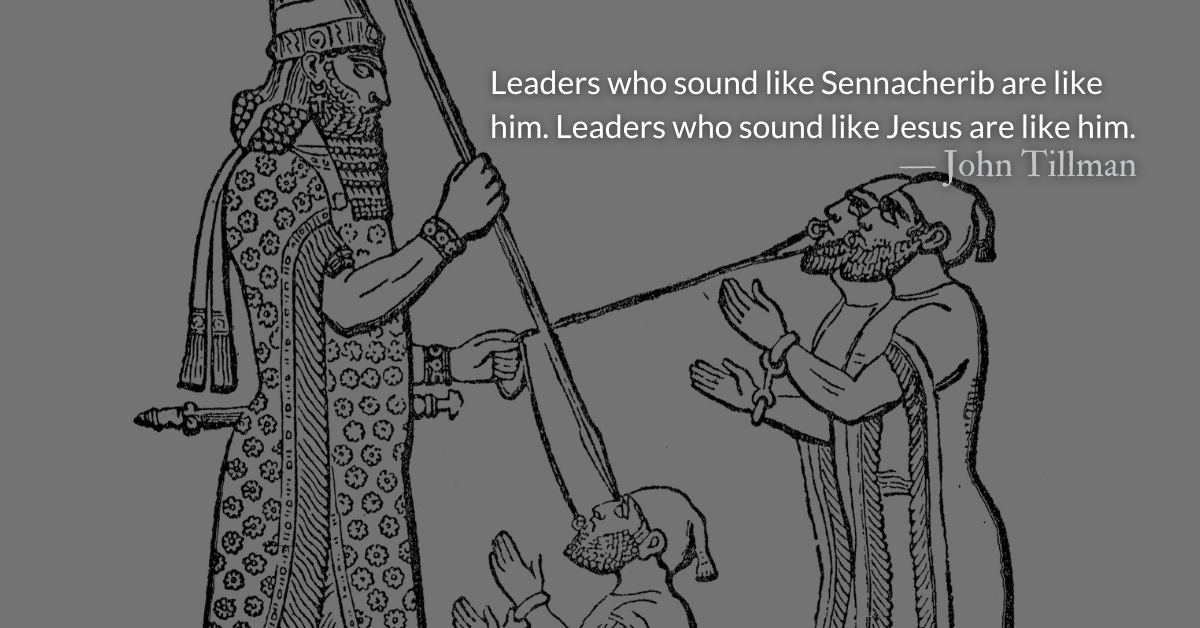
I don’t have a perfect answer. But I do have a guideline. Leaders who sound like Sennacherib are like him. Leaders who sound like Jesus are like him.

The arm of flesh uses the language of would-be emperors. It flexes, insults, boasts, and makes arm-twisting threats. The Arm of the Lord uses the language of the Prince of Peace. It works salvation and preaches repentance, truth, grace, mercy, and love.

May we be encouraged by the presence of the Arm of the Lord and serve the Prince of Peace.

Music: Isaiah 52.10, by Rich Mullins

Divine Hours Prayer: The Refrain for the Morning Lessons
The Lord is my strength and my song, and he has become my salvation. — Psalm 118.14

– From The Divine Hours: Prayers for Summertime by Phyllis Tickle.

Today’s Readings
2 Chronicles 32  (Listen 5:58)
Psalms 144 (Listen 1:56)

Read more about Pause To Read
Have you enjoyed our new podcast, Pause to Read? Subscribe so you don’t miss new episodes coming soon. Share and rate the episodes to help others find the show.

Read more about Supporting Our Work
There’s never a bad time to give. We’ll be as thankful for your donation in January as in December, but time is running out to give in 2023. Please consider giving today.
After Advent?

Scripture Focus: 2 Chronicles 30.18-19
18 Although most of the many people who came from Ephraim, Manasseh, Issachar and Zebulun had not purified themselves, yet they ate the Passover, contrary to what was written. But Hezekiah prayed for them, saying, “May the Lord, who is good, pardon everyone 19 who sets their heart on seeking God—the Lord, the God of their ancestors—even if they are not clean according to the rules of the sanctuary.” 20 And the Lord heard Hezekiah and healed the people.

2 Chronicles 31.1
1 When all this had ended, the Israelites who were there went out to the towns of Judah, smashed the sacred stones and cut down the Asherah poles. They destroyed the high places and the altars throughout Judah and Benjamin and in Ephraim and Manasseh. After they had destroyed all of them, the Israelites returned to their own towns and to their own property. 

Mark 1.14b-15
14b Jesus went into Galilee, proclaiming the good news of God. 15 “The time has come,” he said. “The kingdom of God has come near. Repent and believe the good news!”

Matthew 21.31b-32
31b Jesus said to them, “Truly I tell you, the tax collectors and the prostitutes are entering the kingdom of God ahead of you. 32 For John came to you to show you the way of righteousness, and you did not believe him, but the tax collectors and the prostitutes did. And even after you saw this, you did not repent and believe him.

Reflection: After Advent?
By John Tillman

2 Chronicles 30 describes a Passover celebration like none since the days of Solomon and David. But not everyone was ready for Hezekiah’s revival.

Whether by ignorance or haste, some failed to come to the feast consecrated, violating the commandments Hezekiah was reinstating. Yet, there was mercy.

Hezekiah prayed that God would not look at their outward adherence to ceremonial rules of cleanness but at the determination of their hearts to seek after God. When God had mercy, the celebration was so joyous that Hezekiah extended the Passover festival for a week.

Many popular songs wish for a continuation of the Christmas season and the “spirit” of Christmas. Can you imagine a Christmas so peaceful or joyous you’d want it to keep going?

Truthfully, Christmas does keep going. Christmastide continues on the church calendar, ending with Epiphany on January 6th. Additionally, Advent’s message of the gospel never expires. We can and should share it all year round. But what comes after Advent? What should follow in our lives after experiencing hope, love, joy, and peace in Christ?

2 Chronicles 30 is followed by 31. Mercy, worship, adoration, and joy bring change. After the festival, the people smashed sacred stones and cut down Asherah poles. They dismantled the infrastructure of false worship, tearing down altars and destroying high places. They acted in faith to turn away from idols they had been devoted to.

Thank God that we can seek him as we are. When we come to him, God will judge us not by our outward adherence to rules but by the determination of our hearts to seek after him. We do not need to perfect ourselves, cover our wounds, or shine ourselves up. Like the unwashed shepherds or the pagan Magi, we can rejoice, knowing we are accepted.

Seeking God’s mercy, however, doesn’t mean continuing in sins. Jesus ate with sinners and preached repentance. Prostitutes didn’t stay prostitutes. Crooked tax collectors became honest. The demonically influenced were set free. Violence-prone fishermen became disciples of love. 

Jesus’ advent will not leave us the same. Mercy does not maintain the status quo. Pardon is not perpetual permission. Healing is not the enablement of re-harming ourselves or others.

Continue Christmas by seeking what change Jesus initiates in you. May we act in faith, turning away from what we have been devoted to, smashing our sacred stones and tearing down our altars.


Divine Hours Prayer: The Request for Presence
Set a watch before my mouth, O Lord, and guard the door of my lips; let not my heart incline to any evil thing.
Let me not be occupied in wickedness with evildoers, nor eat of their choice foods.
Let the righteous smite me in friendly rebuke; let not the oil of the unrighteous anoint my head. — Psalm 141.3-5

– From The Divine Hours: Prayers for Summertime by Phyllis Tickle.


Today’s Readings
2 Chronicles 31  (Listen 4:20)
Psalms 142-143 (Listen 2:35)

Read more about Pause To Read
Have you enjoyed our new podcast, Pause to Read? New episodes will be coming out soon. Subscribe, share the episodes, and give a rating/review to help others find the show.

Read more about Supporting Our Work
Everything you see, hear, and read from The Park Forum is made possible by our donors. Help us thank them with a message or become a donor yourself.

Hymn of Hope — Hope of Advent

Scripture Focus: Psalm 116.1-2
1 I love the Lord, for he heard my voice;
he heard my cry for mercy.
2 Because he turned his ear to me,
I will call on him as long as I live.

Reflection: Hymn of Hope — Hope of Advent
By John Tillman

Advent isn’t shy about acknowledging pain and darkness. Advent happens as the world gets darker specifically to remind us that it is into the darkest dark that Jesus came and from the darkest dark that Jesus ignites the light of salvation. Psalm 116 is a lament that never loses sight of salvation’s light and cycles continually back to thankfulness and praise.

Hymn writer Isaac Watts wrote a hymn based on Psalm 116 in 1719. The hymn was later adopted and adapted by African-American churches and the gospel tradition. In 1990, gospel music artist Richard Smallwood wrote new music to the adapted text based on versions he experienced. The work was featured on the soundtrack of the Whitney Houston Christmas film The Preacher’s Wife. The opening phrase closely follows the psalm and Watts’s interpretation.

“I love the the Lord
He heard my cry
And pitied every groan
Long as I live
And troubles rise
I hasten to his throne”
 — I Love the Lord, sung by Whitney Houston on The Preacher’s Wife soundtrack

The psalmist agrees with Watts that troubles rise. The psalmist was “greatly afflicted” and alarmed, saying, “Everyone is a liar,” still, they trusted in the Lord. (Psalm 116.10-11). Death features repeatedly in Psalm 116. The psalmist has been delivered from death to the land of the living. In the end, despite darkness and trouble, the psalmist hastened to the temple courts to give an offering of thanks, praise, and obedience.

Thanksgiving and love are connected to lament. One often leads to another. When we love the Lord, rising troubles lead us to raise laments to God. When we lament, we reflect not only on the suffering of the moment but the salvation of the past. When we remember how good God has been to us and his promises for the future, we respond in hope with thanksgiving.

In this season and every season, no matter what your troubles are, the Lord pities every groan. His Holy Spirit groans with ours when we have no words. (Romans 8.26) Our hope is not only that we can hasten to his temple and throne of mercy but that Jesus hastens to us in response. His Advent brings his presence, compassion, and care.

Reminding ourselves of what Jesus has done and that he hastens to us, we can say, as the psalmist does, “Return to your rest, my soul, for the Lord has been good to you.” (Psalm 116.7)

Divine Hours Prayer: The Refrain for the Morning Lessons
For god, who commanded the light to shine out of darkness, hath shined in our hearts, to give the light of the knowledge of the glory of God in the face of Jesus Christ. — 2 Corinthians 4.6

– From The Divine Hours: Prayers for Summertime by Phyllis Tickle.

Today’s Readings
2 Chronicles 8 (Listen 3:02)
Psalms 116 (Listen 1:34)

Today’s Readings
2 Chronicles 9 (Listen 5:07) Psalms 117-118 (Listen 2:52)
2 Chronicles 10 (Listen 3:01) Psalms 119.1-24 (Listen 1:34)

Read more about What to Expect when Suffering
Don’t be surprised or ashamed of the emotions that come in times of struggle and pain.

Read more about Supporting Our Work
We are thankful for our donors who support ad-free content that brings biblical devotionals to inboxes across the world. Please consider joining them.

Zealous Correction and Healing — Hope of Advent

Scripture Focus: 2 Chronicles 7.11-16
11 When Solomon had finished the temple of the Lord and the royal palace, and had succeeded in carrying out all he had in mind to do in the temple of the Lord and in his own palace, 12 the Lord appeared to him at night and said: 
“I have heard your prayer and have chosen this place for myself as a temple for sacrifices. 
13 “When I shut up the heavens so that there is no rain, or command locusts to devour the land or send a plague among my people, 14 if my people, who are called by my name, will humble themselves and pray and seek my face and turn from their wicked ways, then I will hear from heaven, and I will forgive their sin and will heal their land. 15 Now my eyes will be open and my ears attentive to the prayers offered in this place. 16 I have chosen and consecrated this temple so that my Name may be there forever. My eyes and my heart will always be there. 

Luke 2.45-49
45 When they did not find him, they went back to Jerusalem to look for him. 46 After three days they found him in the temple courts, sitting among the teachers, listening to them and asking them questions. 47 Everyone who heard him was amazed at his understanding and his answers. 48 When his parents saw him, they were astonished. His mother said to him, “Son, why have you treated us like this? Your father and I have been anxiously searching for you.” 
49 “Why were you searching for me?” he asked. “Didn’t you know I had to be in my Father’s house?”

Reflection: Zealous Correction and Healing — Hope of Advent
By John Tillman

God promised Solomon that his eyes, ears, and heart would always be in the Temple and attentive to those who sought him there. But, God warned that if they turned away and abandoned him, he would reject Solomon’s Temple, destroy it, and exile his people away from the Temple and his presence. The slide into idolatry began quickly. Soon, Solomon built other temples for false gods and joined in worshiping there.

By the time Jesus visited Jerusalem, Solomon’s Temple had been destroyed and burnt with fire. Jesus entered a rebuilt version. However, Jesus’ eyes, ears, and heart still longed to be there, engaging in his father’s business.

One of the humorous mysteries of the incarnation is imagining adults teaching young Jesus about the world he created and the scriptures he inspired. Imagine him, who filled the hearts of psalmists until they burst with poetry, learning to sing words he shaped. Imagine him, who spoke through Isaiah and other prophets about the minute details of his life, ministry, and death, sitting in Nazareth’s Hebrew school listening to a teacher interpret Isaiah’s words without realizing they are about him. Imagine Jesus, who “knew what was in each person” (John 2.24-25), learning ethics from a pharisee who will “devour widows’ houses and for a show make lengthy prayers.” (Mark 12.40)

For Jesus, God’s house was the Temple, flawed as it was. Like today, corruption in religious circles was rampant, and religious leaders were more concerned about political power than truth or justice. Jesus showed us an example of maintaining zeal for God’s house in his life, but that zeal didn’t mean warm, fuzzy nostalgia or not rocking the boat. Every time Jesus came to the Temple, there was something to confront. In the Temple, Jesus deconstructed hypocrisy, repaired the foundations of faith, healed broken bodies, mended broken hearts, and corrected crooked teaching. Don’t we hope for that today?

For us, God’s house is the church, flawed as it is. Advent tells us Jesus is coming. To our churches. To our cities. To us. His eyes, ears, and heart are in his church today. What might Jesus see, hear, and feel in our churches? Will he long to stay? Will he find us doing his father’s business?

Thank God, Jesus is zealous for imperfect people and places! May his Advent bring zealous correction for our errors and healing for our weaknesses.


Divine Hours Prayer: The Refrain for the Morning Lessons
Blessed is he who comes in the name of the lord; we bless you from the house of the Lord. — Psalm 118.26 

– From The Divine Hours: Prayers for Summertime by Phyllis Tickle.


Today’s Readings
2 Chronicles 7  (Listen 4:07)
Psalms 114-115 (Listen 2:18)

Read more about Better Temples
Jesus’ life stands, like the Temple, as a miraculous work of God. He is the promised one who fulfills all of God’s promises.

Read more about Supporting Our Work
Please consider becoming a donor. Your support is needed for us to continue our work.

Exclusive Claims, Inclusive Hope — Hope of Advent

Scripture Focus: 2 Chronicles 6.18-21
​​18 “But will God really dwell on earth with humans? The heavens, even the highest heavens, cannot contain you. How much less this temple I have built! 19 Yet, Lord my God, give attention to your servant’s prayer and his plea for mercy. Hear the cry and the prayer that your servant is praying in your presence. 20 May your eyes be open toward this temple day and night, this place of which you said you would put your Name there. May you hear the prayer your servant prays toward this place. 21 Hear the supplications of your servant and of your people Israel when they pray toward this place. Hear from heaven, your dwelling place; and when you hear, forgive.

Luke 2.28-38
28 Simeon took him in his arms and praised God, saying: 
29 “Sovereign Lord, as you have promised, 
you may now dismiss your servant in peace. 
30 For my eyes have seen your salvation, 
31 which you have prepared in the sight of all nations: 
32 a light for revelation to the Gentiles, 
and the glory of your people Israel.” 

36 There was also a prophet, Anna, the daughter of Penuel, of the tribe of Asher. She was very old; she had lived with her husband seven years after her marriage, 37 and then was a widow until she was eighty-four. She never left the temple but worshiped night and day, fasting and praying. 38 Coming up to them at that very moment, she gave thanks to God and spoke about the child to all who were looking forward to the redemption of Jerusalem.

Reflection: Exclusive Claims, Inclusive Hope — Hope of Advent
By John Tillman

It was a common belief in the ancient world that gods were territorial.

When Assyria conquered the northern kingdom of Israel they exiled much of the population and imported captured peoples from other regions to take their place. When animal attacks became a problem, the Assyrians reasoned that the imported non-Israelites were not properly worshiping “the god of that country,” so they sent back an Israelite priest to train the foreigners in worshiping Yahweh. (2 Kings 17.26-28)

Jews did not worship Yahweh as a regional god. Yahweh was God in Israel, Judah, Egypt, Assyria, Babylon, and everywhere else. Yet, they still struggled to comprehend God’s presence. Solomon marveled that God’s presence would enter the Temple when even the highest heavens failed to contain him. Solomon pondered how this everywhere-god could “dwell on earth with humans.”

God’s enormity does not limit his intimacy, and Solomon’s Temple is not the smallest or humblest place God will enter.

Centuries later, standing in a reconstructed Temple, Simeon held in his arms the same presence that filled Solomon’s Temple. The prophetess Anna, who never left God’s presence in the Temple, recognized it in Jesus and proclaimed about him to Jerusalem.

How astounded Solomon would be at Simeon standing in the Temple holding Jesus in his arms! How astounded we should still be!

Yahweh is God, and Jesus is Lord everywhere, at all times, all at once. This exclusive claim was odd to some and offensive to others. “Who is the Lord that I should obey him?” (Exodus 5.2) “Bow down before this statue I have made!” (Daniel 3.15) “Great is Artemis of the Ephesians!” (Acts 19.34)

Exclusive claims are no less odd or insulting today. Christians face versions of these same objections now. “Why should I obey God?” “You must assent to and support my belief!” “My belief is greater than yours!”

God’s exclusivity is not a bragging point or an insult. Our hope is exclusively in God yet inclusively welcomes all people. Jesus is the light of the world, not the light of our region, race, or nation. His existence is exclusive—He is the only God. His invitation is inclusive—He will be anyone’s God.

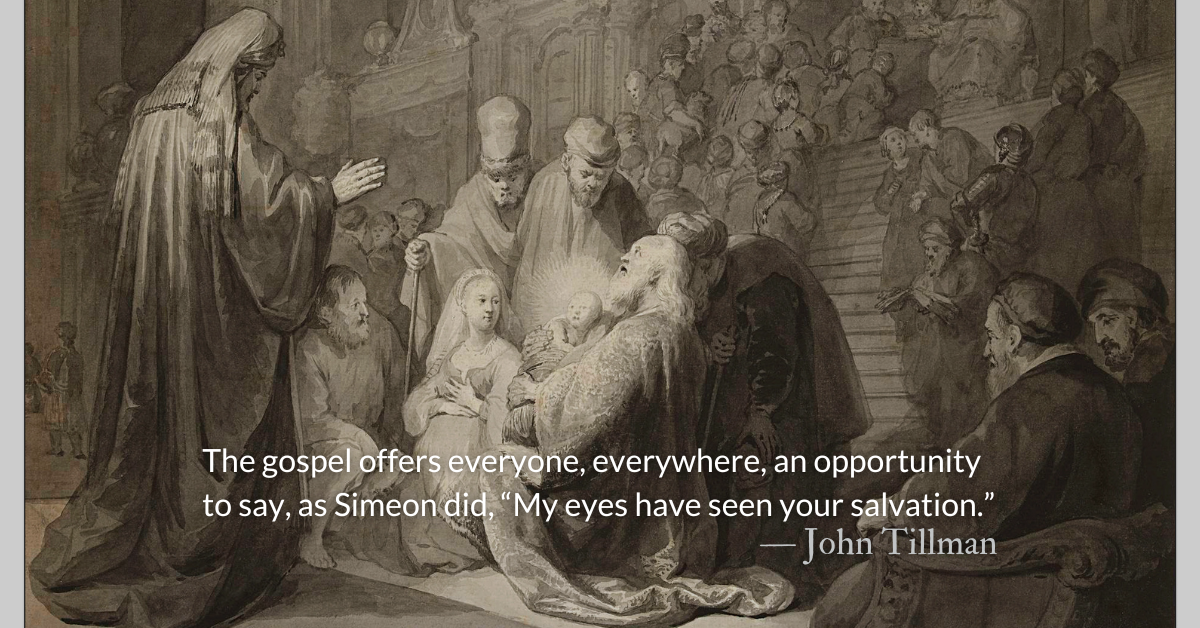
The gospel offers everyone, everywhere, an opportunity to say, as Simeon did, “My eyes have seen your salvation.” God is their God, too. Jesus loves them, too. He longs for them and desires to come closer to them than Solomon, Simeon, or Anna could imagine.


Divine Hours Prayer: The Refrain for the Morning Lessons
With my whole heart I seek you; let me not stray from your commandments. — Psalm 119.10

– From The Divine Hours: Prayers for Summertime by Phyllis Tickle.


Today’s Readings
2 Chronicles 6.11-42  (Listen 7:17)
Psalms 112-113 (Listen 1:49)

Read more about He Stoops to Raise
The equally interesting, intimate glory of God is how infinitely small he is willing to shrink in order to meet us, save us, and lift us up.

Read more about Supporting Our Work
Will you help support ad-free content that brings biblical devotionals to inboxes across the world? Join our donors with a one-time or recurring donation.

Show Buttons
Hide Buttons
Spur a spiritual rhythm of refreshment right in your inbox
By joining this email list you are giving us permission to send you devotional emails each weekday and to communicate occasionally regarding other aspects of the ministry.
100% Privacy. We don't spam.